.webp)
.webp)
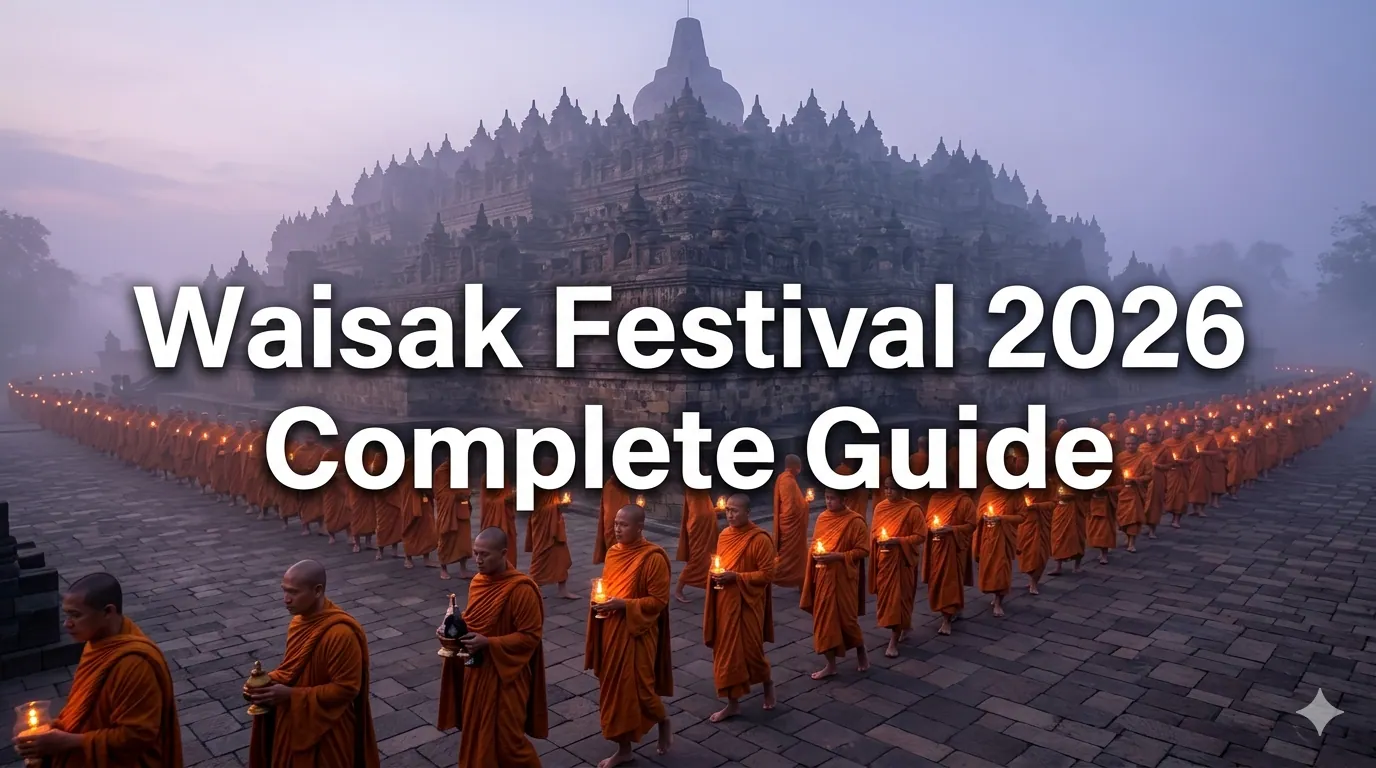
Overview of Waisak Festival in Central Java
Waisak Festival stands as Indonesia's most significant Buddhist celebration held annually at the magnificent Borobudur Temple in Central Java [[1]].
This sacred event commemorates three pivotal moments in Buddha's life including birth enlightenment and parinirvana or death [[2]].
The 2026 Waisak Festival is expected to occur in late May coinciding with the full moon of Vesakha [[3]].
Indonesian government officially recognizes Waisak as a national public holiday honoring the country's Buddhist community [[4]].
Thousands of Buddhist monks pilgrims and tourists gather at Borobudur creating one of Asia's most spectacular religious festivals [[5]].
Historical and Spiritual Significance
Waisak derives from the Sanskrit term Vaisakha marking the full moon day in May or June [[6]].
Borobudur Temple built in the 9th century serves as the world's largest Buddhist temple and UNESCO World Heritage Site [[7]].
The festival has been celebrated at Borobudur since the temple's restoration in the 1980s [[8]].
Indonesian Waisak celebrations blend ancient Buddhist traditions with local Javanese cultural elements [[9]].
The event attracts international Buddhist delegations from Thailand Myanmar Sri Lanka and other countries [[10]].
Why Attend Waisak Festival 2026
Witnessing Waisak at Borobudur offers once in a lifetime spiritual and cultural experience [[11]].
The festival showcases Indonesia's religious diversity and commitment to preserving Buddhist heritage [[12]].
Photographers capture stunning images of monks in saffron robes against ancient stone architecture [[13]].
Travelers gain deep insights into Buddhist philosophy meditation practices and Indonesian spirituality [[14]].
The celebration creates powerful sense of global Buddhist community and shared human values [[15]].
Waisak 2026 Dates and Ceremony Schedule

Waisak 2026 is anticipated to fall on May 31 2026 based on lunar calendar calculations [[16]].
Official confirmation comes from Indonesian Ministry of Religious Affairs typically announced 3 to 6 months prior [[17]].
Festival activities span 3 to 5 days with main ceremony occurring on the full moon day [[18]].
Ceremonies begin early morning around 5 AM and continue throughout the day into evening [[19]].
Three sacred temples participate in sequential rituals Borobudur Mendut and Pawon [[20]].
Main Ceremony Sequence
Taking of Holy Water from natural springs symbolizes purification and spiritual cleansing [[21]].
Transporting Holy Water from Mendut Temple to Borobudur in ceremonial procession [[22]].
Pradaksina ritual involves circumambulation walking clockwise around Borobudur Temple [[23]].
Three Sacred Fires ceremony represents birth enlightenment and death of Buddha [[24]].
Evening concludes with releasing thousands of lanterns into night sky creating magical spectacle [[25]].
Detailed Daily Schedule
Day 1 features opening ceremonies meditation sessions and cultural performances at temple grounds [[26]].
Day 2 includes Holy Water ceremony procession from Mendut to Borobudur with monk participation [[27]].
Main Waisak Day begins with sunrise prayers followed by Pradaksina circumambulation ritual [[28]].
Midday features sermons by senior monks and blessings for lay practitioners [[29]].
Evening culminates with lantern release ceremony and traditional Javanese gamelan music [[30]].
Understanding the Three Sacred Fires Ritual

The Three Sacred Fires represent most important ritual element of Waisak celebration at Borobudur [[31]].
First fire symbolizes Buddha's birth in Lumbini Nepal representing beginning of spiritual journey [[32]].
Second fire commemorates enlightenment under Bodhi tree in Bodh Gaya India [[33]].
Third fire marks parinirvana or Buddha's passing into final nirvana at Kushinagar [[34]].
Monks light these fires sequentially while chanting ancient Pali scriptures [[35]].
Ritual Symbolism and Meaning
Each fire represents different stage of Buddhist path from ignorance to enlightenment [[36]].
Flames symbolize wisdom dispelling darkness of suffering and delusion [[37]].
Ceremony reminds practitioners of impermanence central Buddhist teaching [[38]].
Participating in ritual creates merit positive karma for spiritual development [[39]].
International Buddhist leaders often preside over fire lighting emphasizing global unity [[40]].
Participation Guidelines for Visitors
Visitors may observe Three Sacred Fires ceremony from designated viewing areas [[41]].
Maintain respectful silence during chanting and sacred moments [[42]].
Photography permitted but avoid using flash during solemn rituals [[43]].
Dress modestly covering shoulders and knees as sign of respect [[44]].
Follow instructions from temple staff and security personnel at all times [[45]].
Getting to Borobudur for Waisak 2026

Borobudur Temple located in Magelang Regency Central Java approximately 40 kilometers northwest of Yogyakarta [[46]].
Nearest airports Adisutjipto International Airport Yogyakarta and Achmad Yani Airport Semarang [[47]].
Yogyakarta airport receives most international flights with connections from Singapore Kuala Lumpur and Bangkok [[48]].
Jakarta's Soekarno Hatta Airport offers domestic connections to Yogyakarta taking 1 hour flight [[49]].
From Yogyakarta airport taxi or private transfer to Borobudur takes 1.5 to 2 hours [[50]].
Transportation Options
Private car hire costs 500000 to 800000 Indonesian rupiah for Yogyakarta to Borobudur one way [[51]].
Shared shuttle buses operate from Yogyakarta city center at 100000 to 150000 rupiah per person [[52]].
Public buses available but require transfers and take 3 to 4 hours total journey time [[53]].
During Waisak special shuttle services run frequently from Yogyakarta and Semarang [[54]].
Book transportation in advance as demand surges during festival period [[55]].
Arrival and Temple Access
Temple grounds open from 5 AM to 7 PM during Waisak Festival with extended hours [[56]].
Security checkpoints screen all visitors with metal detectors and bag searches [[57]].
Separate entrances for pilgrims monks and general visitors streamline crowd flow [[58]].
Free shuttle buses transport visitors from parking areas to temple entrance [[59]].
Arrive at least 2 hours before main ceremonies to secure good viewing positions [[60]].
Accommodation Options During Waisak Festival

Waisak Festival represents peak tourist season requiring accommodation booking 3 to 6 months in advance [[61]].
Yogyakarta offers widest range of hotels from budget hostels to luxury resorts [[62]].
Borobudur area features boutique hotels and resorts with temple views at premium prices [[63]].
Magelang town provides mid range options 20 kilometers from temple at lower rates [[64]].
Expect prices to increase 50 to 100 percent during Waisak period compared to regular season [[65]].
Where to Stay Strategic Locations
Staying in Borobudur village allows early morning temple access and avoids traffic [[66]].
Yogyakarta city offers more dining nightlife and cultural attractions beyond festival [[67]].
Muntilan area provides compromise location between Yogyakarta and Borobudur [[68]].
Resorts near temple like Manohara Hotel offer exclusive sunrise viewing packages [[69]].
Homestays in local villages provide authentic Javanese hospitality at budget prices [[70]].
Booking Strategies and Costs
Budget hotels in Yogyakarta cost 300000 to 600000 rupiah nightly during Waisak [[71]].
Mid range properties range 600000 to 1500000 rupiah with better amenities [[72]].
Luxury resorts near Borobudur charge 2000000 to 5000000 rupiah per night [[73]].
Book directly with hotels for potential upgrades and flexible cancellation policies [[74]].
Consider booking refundable rates in case Waisak dates shift based on lunar calendar [[75]].
Festival Costs and Budget Planning

Attending Waisak Festival requires no entrance fee for main ceremonies as it is public religious event [[76]].
Borobudur Temple normally charges 450000 rupiah for international tourists but may be free during Waisak [[77]].
Transportation from Yogyakarta to Borobudur and back costs 200000 to 600000 rupiah [[78]].
Meals at local warungs cost 30000 to 75000 rupiah while restaurants charge 100000 to 250000 [[79]].
Accommodation represents largest expense varying dramatically by comfort level and location [[80]].
Daily Budget Breakdown
Budget travelers can manage on 500000 to 800000 rupiah daily excluding accommodation [[81]].
Mid range travelers should budget 1000000 to 2000000 rupiah daily for comfort [[82]].
Luxury travelers may spend 3000000 to 5000000 rupiah daily for premium experiences [[83]].
Bring cash as many vendors and small establishments do not accept cards [[84]].
ATMs available in Yogyakarta and Magelang but may run dry during festival crowds [[85]].
Additional Expenses to Consider
Travel insurance essential covering trip cancellation and medical emergencies [[86]].
Indonesian visa free for most nationalities for 30 day tourist visits [[87]].
Souvenirs and donations at temple typically 50000 to 200000 rupiah [[88]].
Guided tours explaining ceremony significance cost 300000 to 600000 rupiah [[89]].
Photography permits generally not required for personal use but check current regulations [[90]].
Cultural Etiquette and Dress Code

Waisak Festival is sacred religious event requiring respectful behavior and appropriate attire [[91]].
Visitors must cover shoulders and knees when entering temple grounds [[92]].
Remove shoes before stepping on sacred areas or entering temple structures [[93]].
Speak quietly and avoid loud conversations during prayers and meditation [[94]].
Never point feet toward Buddha statues or monks as this is considered disrespectful [[95]].
Photography Guidelines
Photography generally permitted during Waisak but be mindful of sacred moments [[96]].
Avoid using flash during evening ceremonies and meditation sessions [[97]].
Ask permission before photographing monks especially during private prayers [[98]].
Drone photography strictly prohibited without special government permission [[99]].
Respect barriers and restricted areas designated by temple authorities [[100]].
Behavioral Expectations
Public displays of affection inappropriate during religious festival [[101]].
Alcohol consumption discouraged on temple grounds and surrounding areas [[102]].
Follow instructions from security and volunteer staff without argument [[103]].
Participate in rituals only if invited by monks or ceremony leaders [[104]].
Maintain patience with crowds and delays as millions attend the festival [[105]].
Health and Safety Considerations

Waisak Festival attracts massive crowds requiring awareness of personal safety and health [[106]].
May weather in Central Java hot and humid with temperatures 25 to 32 degrees Celsius [[107]].
Stay hydrated carrying water bottles though check if allowed in specific ceremony areas [[108]].
Wear comfortable walking shoes as extensive standing and walking required [[109]].
Bring sun protection including hats sunscreen and sunglasses for daytime ceremonies [[110]].
Medical Preparedness
Carry basic medications for headaches stomach issues and allergies [[111]].
Prescription medications should be in original containers with doctor's note [[112]].
Medical clinics available in Yogyakarta and Magelang for minor issues [[113]].
Major hospitals in Yogyakarta equipped for emergencies with English speaking staff [[114]].
Travel insurance should cover medical evacuation for serious conditions [[115]].
Crowd Management Strategies
Arrive early to avoid worst crowd congestion especially for main ceremonies [[116]].
Establish meeting points with travel companions in case separated [[117]].
Keep valuables secure in money belts or hidden pouches [[118]].
Be aware of pickpockets in dense crowds though violent crime rare [[119]].
Follow designated pathways and avoid climbing on temple structures [[120]].
Best Viewing Locations at Borobudur

Borobudur Temple features multiple levels and platforms offering different ceremony perspectives [[121]].
Lower terraces provide close up views of monks and ritual activities [[122]].
Upper platforms offer panoramic views of entire temple and surrounding landscape [[123]].
Eastern side best for sunrise ceremonies and morning rituals [[124]].
Western area ideal for sunset and evening lantern release [[125]].
Photography Spot Recommendations
Arrive before dawn to secure prime photography positions on temple levels [[126]].
Northern terrace captures monks ascending stairs with morning light [[127]].
Southern platform offers dramatic backdrop of Mount Merapi volcano [[128]].
Ground level provides wide angle shots of entire temple structure [[129]].
Hillside viewpoints outside temple grounds show Borobudur in landscape context [[130]].
Accessibility Considerations
Temple has steep stairs and uneven surfaces challenging for mobility impaired visitors [[131]].
Ground level viewing areas accessible for wheelchairs and limited mobility [[132]].
Designated viewing zones for elderly and disabled visitors available with advance request [[133]].
Shaded rest areas positioned around temple complex for breaks [[134]].
Consider hiring local guide to navigate crowds and find accessible routes [[135]].
Combining Waisak with Central Java Exploration

Waisak Festival visit pairs perfectly with exploring Central Java's cultural treasures [[136]].
Yogyakarta offers royal palaces traditional arts and vibrant street food scene [[137]].
Prambanan Temple complex showcases stunning Hindu architecture 50 kilometers from Borobudur [[138]].
Mendut and Pawon temples visited during Waisak procession worth exploring in detail [[139]].
Traditional Javanese villages provide cultural immersion and craft workshops [[140]].
Recommended Extended Itinerary
Day 1 to 2 arrive Yogyakarta acclimate and explore city attractions [[141]].
Day 3 visit Prambanan Temple and traditional batik workshops [[142]].
Day 4 travel to Borobudur attend Waisak opening ceremonies [[143]].
Day 5 main Waisak celebration at Borobudur full day event [[144]].
Day 6 explore Mendut Pawon temples and local villages [[145]].
Day 7 return Yogyakarta depart or extend stay [[146]].
Nearby Attractions Worth Visiting
Kraton Yogyakarta Palace showcases Javanese royal culture and architecture [[147]].
Taman Sari Water Castle offers historic royal gardens and underground passages [[148]].
Mount Merapi volcano tours available for adventurous travelers [[149]].
Kaliurang hill station provides cool mountain retreat near volcano [[150]].
Parangtritis Beach features dramatic coastal scenery and sunset views [[151]].
Official Resources and Information Sources

Indonesian Ministry of Religious Affairs publishes official Waisak schedules and guidelines [[152]].
Borobudur Temple management website provides visitor information and updates [[153]].
Central Java Tourism Board offers comprehensive travel planning resources [[154]].
Indonesian Embassy websites provide visa requirements and entry regulations [[155]].
UNESCO World Heritage Centre features Borobudur conservation information [[156]].
Staying Updated on Festival Details
Follow official Borobudur social media accounts for real time announcements [[157]].
Subscribe to Indonesian Tourism Board newsletters for festival updates [[158]].
Check with Yogyakarta hotels for Waisak package deals and information [[159]].
Local tour operators provide detailed ceremony schedules and logistics [[160]].
Verify information from multiple official sources before making travel plans [[161]].
Useful Apps and Digital Tools
Google Translate with offline Indonesian language package aids communication [[162]].
Maps.me or Google Maps with downloaded offline maps for navigation [[163]].
Currency converter apps help manage rupiah transactions [[164]].
Weather apps monitor conditions for appropriate packing [[165]].
Travel booking apps for last minute accommodation or transportation changes [[166]].
Environmental Responsibility at Waisak

Waisak Festival emphasizes Buddhist principles of compassion extending to environmental stewardship [[167]].
Carry reusable water bottles to minimize plastic waste during festival [[168]].
Dispose of trash in designated bins or carry out if bins unavailable [[169]].
Respect temple grounds avoiding damage to ancient stone carvings and structures [[170]].
Use eco friendly sunscreen and personal care products [[171]].
Sustainable Tourism Practices
Choose locally owned accommodations and restaurants supporting community economy [[172]].
Hire local guides providing employment and authentic cultural insights [[173]].
Purchase handicrafts directly from artisans ensuring fair compensation [[174]].
Use public transportation or shared shuttles reducing carbon footprint [[175]].
Offset flight emissions through verified carbon offset programs [[176]].
Supporting Temple Conservation
Entrance fees and donations contribute to Borobudur preservation efforts [[177]].
Volunteer programs occasionally available for temple maintenance and education [[178]].
Respect barriers protecting fragile sections of ancient structure [[179]].
Educate yourself about conservation challenges facing UNESCO World Heritage Sites [[180]].
Share responsible tourism practices with fellow travelers [[181]].
Final Preparation Checklist

Confirm Waisak 2026 dates with Indonesian Ministry of Religious Affairs 3 months before travel [[182]].
Book flights and accommodation 4 to 6 months in advance for best availability [[183]].
Arrange Indonesian visa if required for your nationality [[184]].
Purchase comprehensive travel insurance covering medical and trip cancellation [[185]].
Exchange currency or ensure ATM access for Indonesian rupiah [[186]].
Packing Essentials
Modest clothing covering shoulders and knees for temple visits [[187]].
Comfortable walking shoes with good grip for temple stairs [[188]].
Light rain jacket as May may have afternoon showers [[189]].
Sun protection including hat sunscreen and sunglasses [[190]].
Camera with extra batteries and memory cards [[191]].
Personal medications and basic first aid supplies [[192]].
Scarf or sarong for additional coverage if needed [[193]].
Reusable water bottle and snacks for long ceremony days [[194]].
Small backpack for daily essentials during festival [[195]].
Last Minute Reminders
Download offline maps and translation apps before arrival [[196]].
Inform bank of travel dates preventing card blocks for international use [[197]].
Share itinerary with family or friends for safety [[198]].
Check weather forecast one week before adjusting packing accordingly [[199]].
Arrive in Yogyakarta at least 2 days before Waisak to acclimate [[200]].
0 Comments