.webp)
.webp)
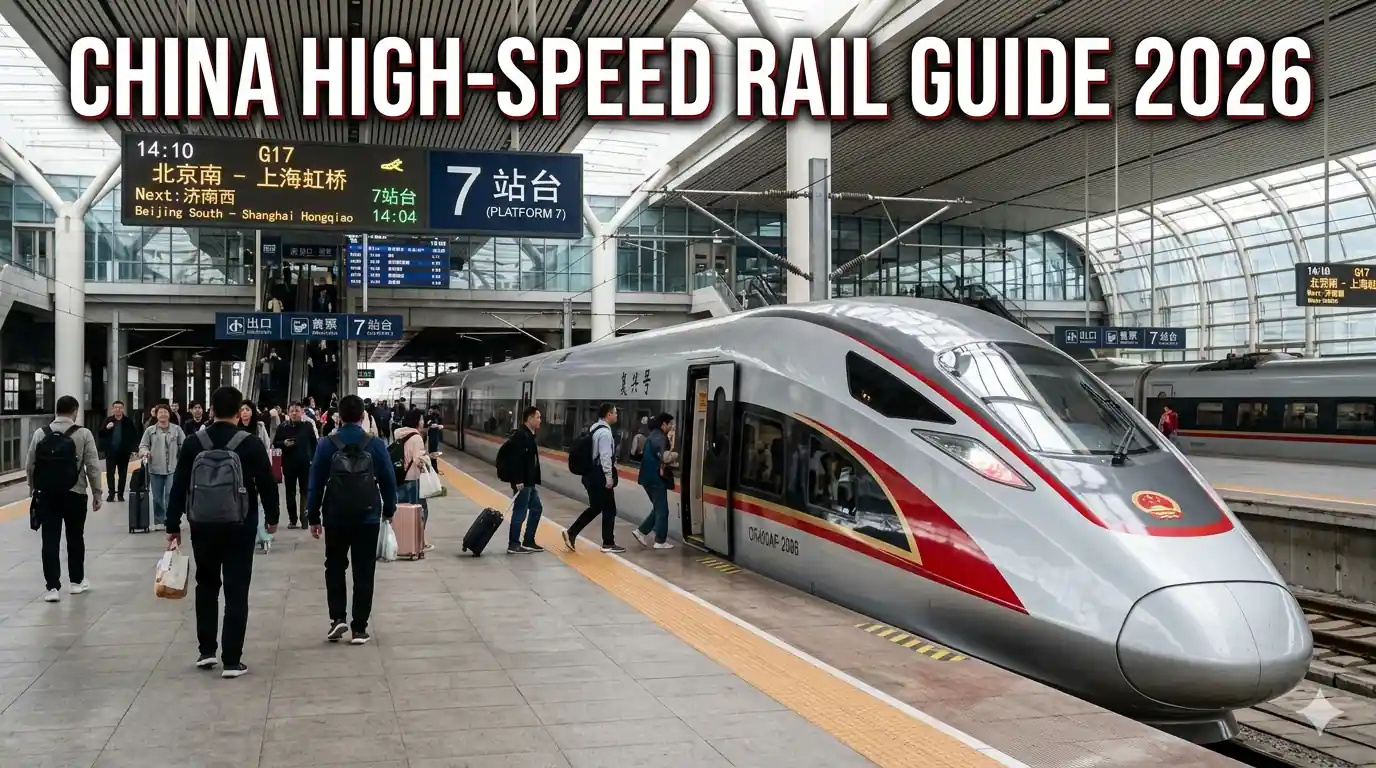
Important Clarification: Afrosiyob versus China High-Speed Rail
Important note: Afrosiyob trains operate in Uzbekistan, not China. They are manufactured by Spanish company Talgo and serve routes between Tashkent Samarkand and Bukhara.
China operates its own advanced high-speed rail network using domestically produced Fuxing and Hexie series trains.
This guide covers China's extensive high-speed railway system which is the world's largest and most advanced.
If you're interested in Uzbekistan's Afrosiyob trains, that is a separate rail system in Central Asia.
For China travel, you will encounter Fuxing CR400 series and Hexie CRH series high-speed trains.
Overview of China's High-Speed Rail Network

China operates the world's largest high-speed rail network with over 42000 kilometers of track as of 2026.
The network connects all major cities with trains reaching speeds up to 350 kilometers per hour.
High-speed rail is the preferred transportation method for domestic travel offering speed comfort and reliability.
Trains are categorized as G-trains fastest D-trains express and C-trains intercity services.
Foreign travelers can easily use the system with proper preparation and understanding of booking procedures.
Train Types and Classifications
G-trains or Gaotie are the fastest services operating at 300 to 350 km/h on dedicated high-speed lines.
D-trains or Dongche operate at 200 to 250 km/h serving routes without dedicated high-speed infrastructure.
C-trains are intercity services connecting nearby cities with frequent departures.
Fuxing series CR400 represents China's newest and most advanced trains with superior comfort and technology.
Hexie series CRH includes earlier generation trains still providing excellent service on many routes.
Fuxing versus Hexie Train Comparison
Fuxing trains feature wider carriages at 3.36 meters compared to Hexie's 3.1 meters providing more interior space.
Advanced air filtration systems in Fuxing trains offer better air quality and reduced noise levels.
USB charging ports available at every seat in Fuxing trains while older Hexie models may have limited charging.
Both train types maintain excellent safety records with punctuality rates exceeding 95 percent.
Fuxing trains primarily serve major routes like Beijing Shanghai Guangzhou while Hexie operates more广泛 network.
Booking Train Tickets in China

Foreign travelers have multiple options for booking China high-speed rail tickets in 2026.
Official 12306 website and app offer direct booking though English interface has limitations.
Third-party platforms like Trip.com Ctrip provide English language support and international payment options.
Tickets can be purchased 15 days in advance for most routes with popular routes selling out quickly.
Peak travel periods including Chinese New Year and Golden Week require booking immediately when sales open.
Using Trip.com for Foreign Travelers
Trip.com offers most user-friendly interface for English speakers booking China train tickets.
Platform accepts international credit cards eliminating need for Chinese payment methods.
Customer service available in English for assistance with booking issues or changes.
Small service fee charged typically 10 to 20 yuan per ticket for convenience.
E-tickets delivered via email or app eliminating need for physical ticket collection.
Official 12306 Platform
12306.cn is China Railway's official booking platform with no service fees.
English version available but functionality limited compared to Chinese interface.
Requires passport registration and verification process taking 1 to 3 days.
Payment options include Alipay WeChat Pay and limited international cards.
Best for travelers comfortable with Chinese digital ecosystem and planning multiple trips.
Station Ticket Counters
Physical ticket counters available at all major railway stations.
Bring passport for ticket purchase as required for all foreign travelers.
Expect longer wait times especially during peak travel periods.
Staff English proficiency varies with major stations having some English speakers.
Recommended only for same-day travel or when online booking unavailable.
Understanding Seat Classes and Pricing

China high-speed trains offer multiple seat classes with varying comfort levels and prices.
Second Class Seat provides comfortable seating at most affordable price point.
First Class Seat offers wider seats with more legroom and complimentary beverages.
Business Class features lie-flat or reclining seats with premium services and lounge access.
sleeper berths available on overnight D-trains for long-distance routes.
Second Class Seat Details
Second class seats arranged in 3-2 configuration providing reasonable personal space.
Seat pitch approximately 100 centimeters adequate for most travelers on journeys under 5 hours.
Recline function available though limited compared to higher classes.
Shared charging ports located between seats or under seats depending on train type.
Best value option for budget conscious travelers on routes under 4 hours.
First Class Seat Advantages
First class seats arranged in 2-2 configuration offering more space and privacy.
Seat pitch approximately 116 centimeters providing significantly more legroom.
Wider seats at 52 centimeters compared to 43 centimeters in second class.
Complimentary beverage service with choice of tea coffee or bottled water.
Recommended for journeys over 4 hours or travelers prioritizing comfort.
Business Class Premium Experience
Business class features 2-1 or 1-1 seating configuration with maximum privacy.
Seats recline to fully flat position on most Fuxing trains enabling proper sleep.
Premium meal service with multiple course options and beverage selection.
Access to business lounges at major stations with complimentary food and WiFi.
Priority boarding and dedicated service staff throughout journey.
Price typically 3 times first class and 5 to 6 times second class fares.
Major High-Speed Rail Routes

China's network includes thousands of routes connecting cities across the country.
Beijing to Shanghai represents busiest high-speed route with 1318 kilometers covered in 4.5 hours.
Guangzhou to Wuhan route covers 1069 kilometers in approximately 4 hours.
Beijing to Guangzhou one of world's longest high-speed routes at 2298 kilometers taking 8 to 10 hours.
Shanghai to Chengdu connects eastern and western China in 11 to 12 hours.
Beijing Shanghai Corridor
Beijing South to Shanghai Hongqiao is China's premier high-speed rail route.
Multiple daily departures from 6 AM to 7 PM with G-trains dominating schedule.
Fastest trains complete journey in 4 hours 18 minutes at 350 km/h.
Second class fares approximately 662 yuan with first class at 1062 yuan.
Business class tickets cost around 2300 yuan for this route.
Regional High-Speed Networks
Pearl River Delta network connects Guangzhou Shenzhen Hong Kong with frequent service.
Yangtze River Delta links Shanghai Hangzhou Nanjing with dense route coverage.
Beijing Tianjin Hebei region offers integrated high-speed connectivity.
Western China routes expanding rapidly connecting Chengdu Chongqing Xi'an and Kunming.
Cross-border service to Hong Kong requires special ticket and immigration procedures.
Navigating Railway Stations

China's major railway stations are massive facilities requiring strategic navigation.
Beijing South Shanghai Hongqiao and Guangzhou South among world's busiest stations.
Arrive minimum 45 minutes before departure for domestic travel allowing security and boarding time.
Stations feature extensive shopping dining and service facilities for passenger convenience.
Clear signage in Chinese and English guides travelers through stations.
Station Entry and Security
All passengers must pass through security screening similar to airport procedures.
Bring passport and ticket confirmation either printed or on mobile device.
Luggage screening mandatory with restrictions on hazardous materials and certain liquids.
Security lines can be long during peak hours requiring extra time buffer.
Keep ticket and passport accessible as required at multiple checkpoints.
Finding Your Platform and Train
Departure boards display train numbers destinations and platform assignments in Chinese and English.
Platform assignments typically announced 15 to 20 minutes before departure.
Follow signs to appropriate waiting area or directly to platform depending on station.
Large stations may require 10 to 15 minutes walking from entrance to platform.
Platform screens confirm train number and destination before boarding.
Boarding Procedures
Boarding typically begins 15 to 20 minutes before scheduled departure.
Scan passport at automatic gates or present to staff at manual checkpoints.
Follow colored lines on platform indicating where carriages will stop.
Large digital displays show carriage numbers helping locate your specific car.
Boarding ends 3 to 5 minutes before departure with doors closing promptly.
Onboard Experience and Amenities

China high-speed trains provide clean comfortable and efficient travel experience.
Air conditioning maintains comfortable temperature throughout journey.
Restrooms available in each carriage with both Western-style and squat toilets.
Dining car or food trolley service offers meals snacks and beverages.
Free WiFi available on most Fuxing trains though speed and reliability varies.
Food and Beverage Options
Dining cars serve hot meals including rice dishes noodles and Chinese cuisine.
Meal prices range 30 to 80 yuan depending on dish complexity.
Food trolleys pass through carriages offering snacks instant noodles and beverages.
Bring your own food permitted and common practice among Chinese travelers.
Major stations have extensive food courts for purchasing meals before boarding.
Restroom Facilities
Western-style sit toilets available though may have limited toilet paper.
Squat toilets more common and generally better maintained.
Restrooms equipped with sink soap and hand drying facilities.
Bring personal hygiene supplies including toilet paper and hand sanitizer.
Restrooms may be occupied during peak times requiring patience.
Charging and Connectivity
Fuxing trains provide USB charging ports and standard outlets at every seat.
Older Hexie trains may have limited charging stations between seats or at carriage ends.
Bring universal adapter as Chinese outlets use Type A C and I plugs.
Free WiFi available on most newer trains though speed sufficient only for basic browsing.
Mobile data coverage generally good along most routes with 4G and 5G availability.
Practical Tips for Foreign Travelers

Successful China rail travel requires preparation and understanding of local systems.
Always carry passport as required for ticket verification and security checks.
Download translation app for navigating stations and communicating with staff.
Have hotel addresses written in Chinese characters for taxi navigation after arrival.
Keep ticket confirmation accessible either printed or saved on mobile device.
Language Considerations
Station announcements made in Mandarin Chinese and sometimes English at major stations.
Staff English proficiency limited outside major cities and tourist areas.
Learn basic Chinese phrases for train numbers platforms and directions.
Translation apps like Pleco or Google Translate helpful for real-time communication.
Visual aids like pointing to ticket or showing destination on map effective.
Cultural Etiquette
Keep voice volume moderate as Chinese culture values quiet in public spaces.
Remove shoes if placing feet on seat though generally discouraged.
Dispose of trash properly using bins at carriage ends or platform.
Offer seat to elderly pregnant or disabled passengers as cultural expectation.
Avoid strong-smelling foods out of consideration for fellow passengers.
Money and Payment
Cash still accepted but mobile payments Alipay WeChat Pay dominate.
International credit cards accepted at major stations but not universally.
Carry some Chinese yuan for small purchases and emergencies.
ATMs available at major stations for cash withdrawal.
Set up Alipay or WeChat Pay before travel for seamless transactions.
Special Considerations and Accessibility

China railway system provides services for passengers with special needs.
Wheelchair accessible carriages available on most high-speed trains.
Priority seating designated for elderly disabled and pregnant passengers.
Assistance available at major stations for boarding and transfers.
Book special services in advance through ticket counter or customer service.
Traveling with Children
Children under 1.2 meters travel free without separate seat.
Children 1.2 to 1.5 meters qualify for discounted child tickets.
Children over 1.5 meters require full adult tickets.
Bring passport or birth certificate for age verification if requested.
Family-friendly facilities including restrooms with changing tables at major stations.
Luggage Regulations
Each passenger allowed 20 kilograms for adults 10 kilograms for children.
External dimensions should not exceed 160 centimeters for any single item.
Luggage storage racks available at carriage ends and overhead compartments.
Valuables should be kept with passenger not in checked luggage.
Prohibited items include weapons flammable materials and certain chemicals.
Advanced Booking Strategies

Strategic booking approaches can save money and ensure seat availability.
Book exactly 15 days in advance when tickets release for popular routes.
Morning departures typically less crowded than afternoon and evening trains.
Midweek travel Tuesday through Thursday offers better availability and sometimes lower prices.
Avoid peak travel periods including Chinese New Year National Day Golden Week and summer holidays.
Peak Travel Periods to Avoid
Chinese New Year late January or February creates world's largest annual migration.
Tickets sell out within minutes and stations experience extreme crowding.
National Day Golden Week October 1 to 7 sees massive domestic travel.
Summer vacation July and August brings increased family travel.
If travel during peak periods unavoidable book immediately when sales open.
Flexible Date Strategies
Use Trip.com flexible date search to identify cheapest travel days.
Prices can vary 20 to 40 percent between peak and off-peak days.
Consider traveling day before or after major holidays for better availability.
Red eye or very early morning trains often less crowded and cheaper.
Book return tickets simultaneously ensuring availability for entire itinerary.
Emergency Procedures and Customer Service

Understanding emergency protocols and available assistance enhances travel safety.
Emergency buttons located in restrooms and throughout carriages.
Train staff identifiable by uniforms and name badges for assistance.
Customer service hotline 12306 available for inquiries and complaints.
Lost and found services available at stations and through railway customer service.
Missed Train Procedures
If you miss your train tickets can be changed to later same-day service.
Changes must be made at ticket counter with passport and original ticket.
Fee may apply for ticket changes depending on timing and fare difference.
Refunds available for unused tickets with deductions based on timing.
Refunds requested over 8 days before departure incur 5 percent fee.
Refunds 48 hours to 8 days before incur 10 percent fee.
Refunds less than 48 hours before incur 20 percent fee.
Process refunds through original booking platform or station ticket counter.
0 Comments