.webp)
.webp)
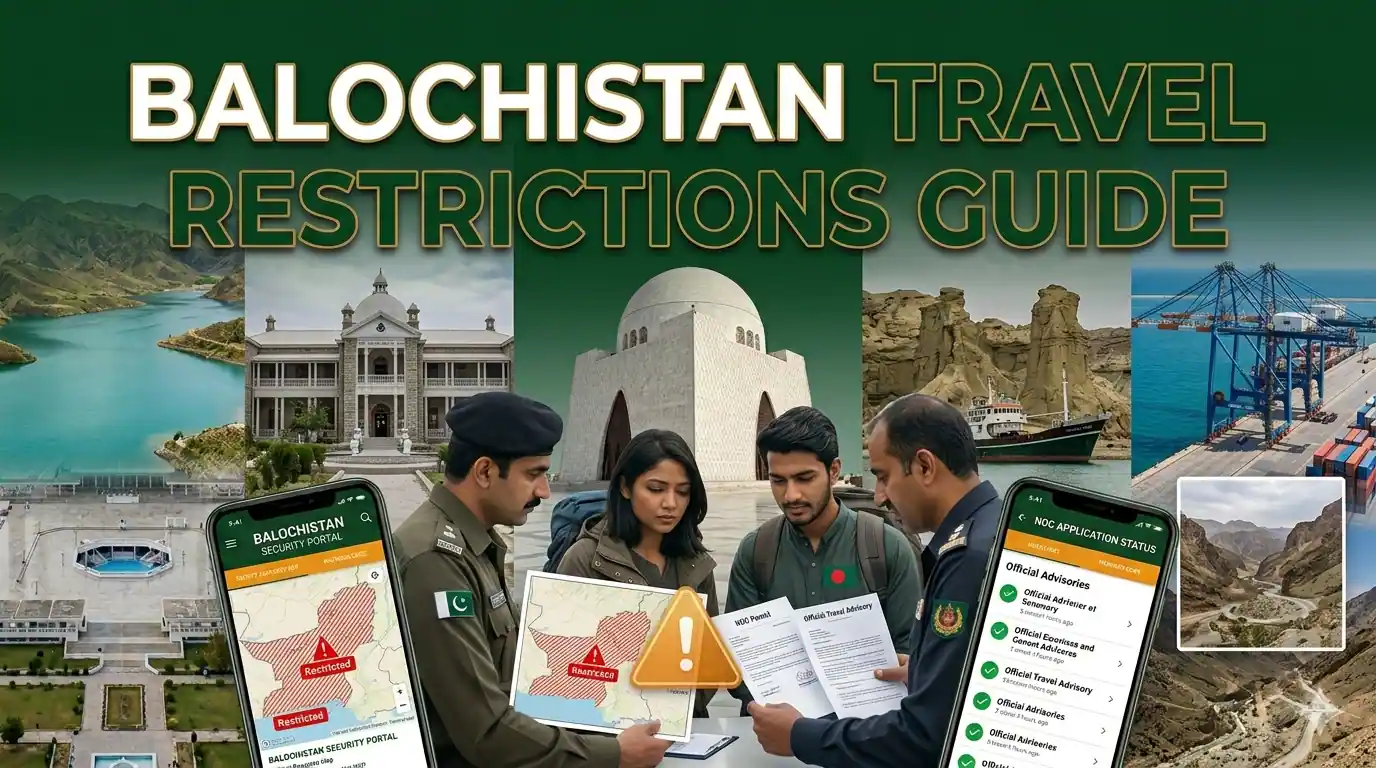
Understanding Travel Limitations in Pakistan's Balochistan Province
Balochistan travel restrictions represent one of the most significant security-related movement limitations within Pakistan's borders. As the country's largest province by land area, Balochistan encompasses diverse landscapes from the Arabian Sea coast at Gwadar to the mountainous regions bordering Afghanistan and Iran. However, ongoing security challenges—including insurgency, sectarian violence, and geopolitical tensions—have resulted in stringent travel controls for both Pakistani citizens and foreign nationals. This comprehensive guide explains the historical context, current security situation, permit requirements, and practical implications for travelers considering visits to this strategically important but complex region.
For Bangladeshi travelers and international visitors, understanding Balochistan's travel restrictions is essential for trip planning, legal compliance, and personal safety. While certain areas like Quetta city center and developed tourist sites such as Hanna Lake remain accessible with proper documentation, large portions of the province require No Objection Certificates (NOCs), military clearance, or are entirely off-limits to foreigners. This article provides evidence-based information drawn from government advisories, security analyses, and travel regulations to help readers make informed decisions about Balochistan travel.
What are the current travel restrictions in Balochistan?
As of 2026, Balochistan maintains a tiered restriction system: (1) Quetta city and immediate surroundings are accessible to foreigners with standard visa and hotel registration; (2) Major tourist sites like Hanna Lake, Ziarat, and Hingol National Park require No Objection Certificates (NOCs) from the Balochistan Home Department; (3) Border areas within 50km of Afghanistan and Iran, most of Gwadar district outside the port city, and regions designated as "sensitive" require additional military clearance; (4) Certain districts including Kech, Panjgur, Washuk, and parts of Kalat are effectively closed to foreign tourists. Pakistani citizens face fewer restrictions but still require NOCs for many areas. All travelers must register with local police upon arrival in Quetta.
Historical Context: Why Balochistan Faces Security Challenges

Understanding Balochistan's current travel restrictions requires examining the province's complex history of insurgency, resource disputes, and geopolitical significance. Balochistan has experienced multiple waves of separatist insurgency since Pakistan's independence in 1947, with major uprisings occurring in the 1950s, 1960s, 1970s, and the current ongoing insurgency that intensified in the early 2000s.
Root Causes of Unrest
Several factors contribute to Balochistan's security challenges:
- Resource Disputes: Balochistan possesses significant natural resources including natural gas, coal, copper, and gold, yet remains Pakistan's poorest province. Many Baloch nationalists argue that resources are extracted without adequate local benefit or compensation.
- Political Marginalization: Perceptions of limited political autonomy and federal overreach fuel separatist sentiments among some Baloch ethnic groups.
- Demographic Changes: Migration from other Pakistani provinces, particularly related to development projects, has altered demographic balances in some areas, creating tensions.
- External Influences: Balochistan's 1,100km border with Afghanistan and 900km border with Iran creates opportunities for cross-border militant movement and external interference.
- Cultural Preservation: Concerns about preserving Baloch language, culture, and identity in the face of modernization and integration.
- 👉 The Church of the Holy Sepulchre: History and Significance
- 👉 Complete Guide to Exploring Al-Shafi'i Mosque in Jeddah 2026
- 👉 Why "Janakpur Dham" is the ultimate cultural destination for history buffs.
Major Insurgent Groups
Several separatist organizations operate in Balochistan, including:
- Baloch Liberation Army (BLA): The most prominent separatist group, designated as a terrorist organization by Pakistan, the UK, and EU. The BLA has conducted attacks on security forces, Chinese interests, and infrastructure.
- Baloch Liberation Front (BLF): Another major separatist organization engaged in armed insurgency.
- Baloch Republican Army (BRA): Active primarily in southern Balochistan.
- Sectarian Groups: Organizations like Lashkar-e-Jhangvi have targeted Shia Hazara communities, particularly in Quetta.
- 👉 The Church of the Holy Sepulchre: History and Significance
- 👉 Complete Guide to Exploring Al-Shafi'i Mosque in Jeddah 2026
- 👉 Why "Janakpur Dham" is the ultimate cultural destination for history buffs.
These groups employ tactics including guerrilla warfare, targeted killings, bombings, and kidnappings. Their activities have prompted heavy military and paramilitary presence throughout the province, extensive checkpoint networks, and strict movement controls—directly impacting travel accessibility.
How does the insurgency affect civilian travelers?
The insurgency creates multiple risks for travelers: (1) Security forces maintain extensive checkpoints requiring documentation checks and vehicle searches; (2) Insurgent groups have targeted foreigners, particularly those associated with Chinese projects; (3) Road travel outside major cities carries kidnapping and attack risks; (4) Emergency services are limited in remote areas; (5) Communication networks are occasionally disrupted during security operations. These factors necessitate strict travel controls and NOC requirements to monitor and protect visitors.
Geopolitical Significance: Gwadar Port and CPEC

Balochistan's strategic importance has intensified in recent years due to the China-Pakistan Economic Corridor (CPEC) and Gwadar Port development. Gwadar, located on the Arabian Sea, represents a cornerstone of China's Belt and Road Initiative, offering potential trade routes that bypass the Strait of Malacca.
CPEC Security Implications
The massive infrastructure investment—totaling over $62 billion across Pakistan, with significant portions in Balochistan—has created both opportunities and security challenges:
- Chinese Presence: Thousands of Chinese workers and security personnel operate in Balochistan, particularly around Gwadar. Separatist groups have specifically targeted Chinese nationals and interests to undermine CPEC.
- Enhanced Security Measures: The Pakistani government has deployed specialized security divisions (including the 15,000-strong Special Security Division) to protect CPEC projects, creating a heavy security footprint.
- Local Resentment: Some Baloch groups view CPEC as exacerbating demographic changes and resource exploitation without local benefit, fueling further resistance.
- Travel Restrictions: Areas surrounding CPEC projects, particularly Gwadar and associated infrastructure corridors, have heightened access controls for foreigners.
- 👉 The Church of the Holy Sepulchre: History and Significance
- 👉 Complete Guide to Exploring Al-Shafi'i Mosque in Jeddah 2026
- 👉 Why "Janakpur Dham" is the ultimate cultural destination for history buffs.
Gwadar: Development and Restrictions
Gwadar Port city exemplifies the tension between development and security. While the port represents economic potential, the surrounding area maintains strict controls:
- Foreign journalists and tourists require special permissions to visit Gwadar
- Chinese workers live in fortified compounds with dedicated security
- Local fishing communities have protested land acquisition and fishing restrictions
- Multiple attacks on Chinese nationals have occurred in Gwadar and surrounding areas
- 👉 The Church of the Holy Sepulchre: History and Significance
- 👉 Complete Guide to Exploring Al-Shafi'i Mosque in Jeddah 2026
- 👉 Why "Janakpur Dham" is the ultimate cultural destination for history buffs.
Why are CPEC areas particularly restricted for travelers?
CPEC-related sites face enhanced restrictions because: (1) They represent high-value targets for separatist attacks aiming to disrupt China-Pakistan relations; (2) Foreign presence could be exploited for intelligence gathering by hostile actors; (3) The Pakistani government seeks to control narratives around CPEC development; (4) Security forces prioritize project protection over tourist access; (5) Insurgent groups have explicitly threatened attacks on foreign visitors to CPEC zones. Consequently, areas like Gwadar Port, associated highways, and energy projects maintain some of the province's strictest access controls.
Current Security Situation: 2026 Assessment

As of 2026, Balochistan's security situation remains volatile despite ongoing military operations and counter-insurgency efforts. Understanding current conditions is essential for assessing travel feasibility.
District-by-District Risk Assessment
Quetta District (Moderate-High Risk): The provincial capital maintains the most accessible security environment but faces ongoing challenges including sectarian violence targeting the Hazara Shia community, occasional terrorist attacks in markets and religious sites, and heavy military presence. Foreigners can visit with proper registration but should exercise heightened caution.
Ziarat District (Moderate Risk): Famous for its juniper forests and as a hill station, Ziarat is relatively safer than other areas but still requires NOC clearance. The historic Residency (where Pakistan's founder Muhammad Ali Jinnah died) has been targeted in past attacks.
Hingol National Park Area (Moderate Risk): Pakistan's largest national park, featuring the Hinglaj Mata Temple (a major Hindu pilgrimage site), requires NOC but is generally accessible. Security forces provide protection for pilgrims during major religious events.
Gwadar District (High Risk): Despite development, Gwadar faces frequent security incidents including attacks on Chinese nationals, separatist operations, and naval base targeting. Foreign access is heavily restricted and generally discouraged for tourists.
Kech (Turbat) District (High Risk): This southern district has experienced significant insurgent activity and is effectively closed to foreign tourists.
Border Districts (Very High Risk): Areas within 50km of Afghanistan (particularly Killa Abdullah, Chaman) and Iran borders face cross-border militant movement, smuggling, and military operations. These areas are generally off-limits to foreigners.
Recent Security Incidents
Travelers should be aware of recent patterns:
- 2024-2025: Multiple attacks on Chinese nationals and security forces in Gwadar and surrounding areas
- Ongoing: Targeted killings of security personnel and suspected informants
- Periodic: Bombings in Quetta markets and religious sites
- Continuous: Sectarian violence against Hazara Shia community
- 2025: BLA claimed responsibility for attacks on railway infrastructure and military convoys
- 👉 The Church of the Holy Sepulchre: History and Significance
- 👉 Complete Guide to Exploring Al-Shafi'i Mosque in Jeddah 2026
- 👉 Why "Janakpur Dham" is the ultimate cultural destination for history buffs.
How do security operations affect travel?
Counter-insurgency operations impact travelers through: (1) Frequent checkpoints causing travel delays and requiring extensive documentation; (2) Curfews and movement restrictions imposed during operations; (3) Communication blackouts in certain areas; (4) Road closures on short notice; (5) Increased scrutiny of foreigners; (6) Limited access to remote areas even with NOCs. Travelers must build flexibility into itineraries and maintain constant communication with local authorities and their embassy.
NOC Permit System: Requirements and Application Process

The No Objection Certificate (NOC) system forms the backbone of Balochistan's travel restrictions. Understanding this process is essential for any foreigner or Pakistani citizen planning to visit restricted areas.
Who Needs an NOC?
- Foreign Nationals: All foreigners (including Bangladeshi citizens) require NOCs to travel outside Quetta city limits
- Pakistani Citizens: Pakistani nationals need NOCs for many districts, particularly border areas and sensitive zones
- Journalists and Researchers: Face additional scrutiny and often require multiple clearances
- Religious Pilgrims: Even pilgrimage sites like Hinglaj Mata Temple require NOCs, though these are typically facilitated through religious organizations
- 👉 The Church of the Holy Sepulchre: History and Significance
- 👉 Complete Guide to Exploring Al-Shafi'i Mosque in Jeddah 2026
- 👉 Why "Janakpur Dham" is the ultimate cultural destination for history buffs.
Application Process for NOCs
The NOC application process involves multiple steps:
- Application Submission: Submit application to Balochistan Home Department in Quetta or through local Deputy Commissioner offices. Applications should include:
- Detailed itinerary with dates, locations, and purposes
- Passport and visa copies (for foreigners)
- CNIC copies (for Pakistani citizens)
- Hotel confirmations
- Letter of introduction from employer or organization
- Local sponsor or contact information
- 👉 The Church of the Holy Sepulchre: History and Significance
- 👉 Complete Guide to Exploring Al-Shafi'i Mosque in Jeddah 2026
- 👉 Why "Janakpur Dham" is the ultimate cultural destination for history buffs.
- Security Clearance: Home Department forwards applications to intelligence agencies and relevant security forces for background checks
- Processing Time: Typically 2-4 weeks, though delays are common. Apply well in advance of travel dates
- Approval/Denial: NOCs may be granted, denied, or granted with restrictions (specific routes, time limits, security escort requirements)
- Registration: Upon arrival in Quetta, register with local police and present NOC documentation
Challenges in the NOC Process
Travelers frequently encounter obstacles:
- Lack of Transparency: NOC denials often come without explanation
- Inconsistent Application: Requirements and approval standards vary between districts and over time
- Delays: Processing times frequently exceed stated timelines
- Additional Requirements: Security forces may impose conditions not specified in initial applications
- Journalist Restrictions: Media professionals face particular scrutiny and frequent denials
- 👉 The Church of the Holy Sepulchre: History and Significance
- 👉 Complete Guide to Exploring Al-Shafi'i Mosque in Jeddah 2026
- 👉 Why "Janakpur Dham" is the ultimate cultural destination for history buffs.
Can NOCs be obtained on arrival in Quetta?
While theoretically possible in some cases, obtaining NOCs on arrival is strongly discouraged. The process typically takes 2-4 weeks, and applications submitted in Quetta may face additional scrutiny. Travelers should: (1) Apply from their home country or Islamabad at least 4-6 weeks before intended travel; (2) Work with local sponsors (hotels, tour operators, or organizations) who can facilitate the process; (3) Have contingency plans if NOCs are denied or delayed; (4) Never attempt to travel to restricted areas without proper documentation, as this can result in detention, deportation, or security incidents.
Entry Requirements and Documentation for Foreign Travelers

Bangladeshi citizens and other foreign nationals must navigate multiple layers of documentation to visit Balochistan legally and safely.
Visa Requirements
Before even considering Balochistan travel, ensure you have:
- Valid Pakistani Visa: Bangladeshi passport holders require visas to enter Pakistan. Tourist visas are available but scrutinized more heavily than business visas.
- Visa Validity: Ensure visa covers entire intended stay plus buffer time for delays
- Multiple Entry: If planning to exit and re-enter, secure multiple-entry visa
- Visa Extensions: Can be processed in Quetta but require additional documentation
- 👉 The Church of the Holy Sepulchre: History and Significance
- 👉 Complete Guide to Exploring Al-Shafi'i Mosque in Jeddah 2026
- 👉 Why "Janakpur Dham" is the ultimate cultural destination for history buffs.
Essential Documentation for Balochistan
Carry these documents at all times while in Balochistan:
- Original passport with valid Pakistani visa
- Multiple photocopies of passport, visa, and NOC documents
- Approved NOC permits for each district/area
- Hotel reservation confirmations
- Emergency contact information (embassy, local sponsor, family)
- Travel insurance documentation explicitly covering Pakistan and Balochistan
- Registration confirmation with local police
- 👉 The Church of the Holy Sepulchre: History and Significance
- 👉 Complete Guide to Exploring Al-Shafi'i Mosque in Jeddah 2026
- 👉 Why "Janakpur Dham" is the ultimate cultural destination for history buffs.
Embassy Registration
Bangladeshi citizens should:
- Register with Bangladesh High Commission in Islamabad before traveling to Balochistan
- Provide detailed itinerary and contact information
- Check in regularly during Balochistan travel
- Save emergency contact numbers: Bangladesh High Commission Islamabad (+92-51-2822051), 24/7 emergency line
- 👉 The Church of the Holy Sepulchre: History and Significance
- 👉 Complete Guide to Exploring Al-Shafi'i Mosque in Jeddah 2026
- 👉 Why "Janakpur Dham" is the ultimate cultural destination for history buffs.
What happens if I'm stopped at a checkpoint without proper documentation?
Checkpoints are ubiquitous in Balochistan. If stopped without proper NOC or documentation: (1) Remain calm and cooperative; (2) Explain your situation honestly; (3) Expect to be detained temporarily while authorities verify your status; (4) Contact your embassy immediately; (5) You may be escorted back to Quetta or denied further travel; (6) In serious cases, detention or deportation is possible. Never attempt to bypass checkpoints or travel to restricted areas without authorization. The security forces take these violations seriously given the insurgency context.
Transportation and Movement: Navigating Balochistan Safely

Movement within Balochistan presents unique challenges requiring careful planning and security awareness.
Inter-City Travel Options
Air Travel: Quetta International Airport connects to major Pakistani cities (Karachi, Lahore, Islamabad). This is the safest entry/exit method. Domestic flights avoid dangerous road travel but limit access to remote areas.
Rail Travel: Pakistan Railways operates limited service to Quetta via the historic Bolan Pass route. While scenic, trains face security risks and frequent delays. Not recommended for foreign tourists without security arrangements.
Road Travel: The most common but riskiest option:
- Quetta-Karachi Highway (N-25): Main route but passes through sensitive areas. Travel only during daylight with security awareness.
- Quetta-Taftan Road: Leads to Iranian border; heavily restricted and dangerous.
- Quetta-Zhob Road: Passes through tribal areas; requires NOC and security escort.
- Internal District Roads: Many roads in poor condition; susceptible to ambush and IED attacks.
- 👉 The Church of the Holy Sepulchre: History and Significance
- 👉 Complete Guide to Exploring Al-Shafi'i Mosque in Jeddah 2026
- 👉 Why "Janakpur Dham" is the ultimate cultural destination for history buffs.
Security Protocols for Road Travel
- Travel only during daylight hours (6 AM - 5 PM)
- Use reputable transport companies or private vehicles with experienced local drivers
- Inform police and your embassy of travel plans
- Travel in convoys when possible, especially on highways
- Carry sufficient water, food, fuel, and emergency supplies
- Maintain communication devices (satellite phone recommended for remote areas)
- Expect frequent checkpoint stops; keep documents readily accessible
- 👉 The Church of the Holy Sepulchre: History and Significance
- 👉 Complete Guide to Exploring Al-Shafi'i Mosque in Jeddah 2026
- 👉 Why "Janakpur Dham" is the ultimate cultural destination for history buffs.
Urban Transportation in Quetta
- Use hotel-arranged vehicles or reputable ride services
- Avoid public transportation, which has been targeted in attacks
- Hazara Town and other Shia-majority areas require extra caution due to sectarian targeting
- Stay in secure hotels with controlled access
- 👉 The Church of the Holy Sepulchre: History and Significance
- 👉 Complete Guide to Exploring Al-Shafi'i Mosque in Jeddah 2026
- 👉 Why "Janakpur Dham" is the ultimate cultural destination for history buffs.
What should I do if road conditions or security situation changes during travel?
Flexibility is essential: (1) Monitor local news and security updates daily; (2) Maintain contact with police, your hotel, and embassy; (3) If roads close or security deteriorates, do not attempt to proceed; (4) Return to Quetta or nearest secure location; (5) Have backup accommodation and funds for extended stays; (6) Never take unnecessary risks to "make up time" on an itinerary. Security forces may impose sudden curfews or movement restrictions; compliance is mandatory.
Travel Cost Estimates: Budgeting for Balochistan

Traveling in Balochistan involves costs beyond typical tourism due to security requirements and limited infrastructure.
Security-Related Expenses
- NOC Application Fees: Official fees minimal (PKR 500-2,000) but facilitation through agents/sponsors may cost PKR 10,000-30,000
- Travel Insurance: Comprehensive policies covering Balochistan, terrorism, and medical evacuation cost 8-12% of trip value. Many standard policies exclude Balochistan; verify explicitly
- Security Escorts: Some areas require paid police/military escorts (PKR 5,000-15,000 per day)
- Secure Accommodations: Hotels with adequate security in Quetta cost PKR 10,000-25,000 ($35-90) per night. Limited options outside Quetta
- Private Transportation: Hire vehicles with drivers: PKR 8,000-15,000 ($30-55) per day plus fuel
- Communication: Satellite phone rental: PKR 10,000-20,000 for trip. Local SIM cards: PKR 1,000-2,000
- Contingency Fund: Reserve 25-30% of budget for emergency changes, extended stays, or evacuation
- 👉 The Church of the Holy Sepulchre: History and Significance
- 👉 Complete Guide to Exploring Al-Shafi'i Mosque in Jeddah 2026
- 👉 Why "Janakpur Dham" is the ultimate cultural destination for history buffs.
Sample 7-Day Balochistan Budget (Quetta and Surroundings)
- NOC and documentation: PKR 15,000 ($55)
- Accommodations (mid-range secure hotels): PKR 105,000 ($380)
- Private vehicle with driver: PKR 70,000 ($250)
- Food and dining: PKR 35,000 ($125)
- Entry fees and permits: PKR 10,000 ($35)
- Travel insurance: PKR 25,000 ($90)
- Communication and miscellaneous: PKR 15,000 ($55)
- Total (excluding international flights): PKR 275,000 ($990)
- 👉 The Church of the Holy Sepulchre: History and Significance
- 👉 Complete Guide to Exploring Al-Shafi'i Mosque in Jeddah 2026
- 👉 Why "Janakpur Dham" is the ultimate cultural destination for history buffs.
Note: Costs increase significantly for travel to remote areas requiring security escorts and specialized logistics.
How can I verify if my travel insurance covers Balochistan?
Most standard travel insurance policies exclude "high-risk" areas including Balochistan. To verify coverage: (1) Read policy exclusions carefully for mentions of Balochistan, Pakistan provinces, or "areas under travel advisory"; (2) Contact insurer directly and get written confirmation that Balochistan is covered; (3) Ensure policy covers terrorism, civil unrest, kidnapping, and medical evacuation; (4) Consider specialized insurers offering coverage for high-risk areas (often at premium rates); (5) Verify 24/7 emergency assistance with Pakistan contact numbers. Never assume coverage—always get explicit written confirmation.
Sample Itinerary: Realistic Balochistan Travel Plan

A security-conscious 7-day itinerary focusing on accessible areas with proper NOCs:
Days 1-2: Quetta City
- Day 1: Arrival at Quetta Airport, hotel check-in (secure hotel in Satellite Town or Cantt area), police registration, embassy check-in, light exploration of immediate area
- Day 2: Visit Quetta's main bazaar (with security awareness), Hazarganji-Chiltan National Park viewpoint, Balochistan Museum, dinner at secure restaurant
- 👉 The Church of the Holy Sepulchre: History and Significance
- 👉 Complete Guide to Exploring Al-Shafi'i Mosque in Jeddah 2026
- 👉 Why "Janakpur Dham" is the ultimate cultural destination for history buffs.
Days 3-4: Hanna Lake and Urak Valley
- Day 3: Early departure to Hanna Lake (requires NOC), scenic drive, boat ride, lunch at lakeside facility, return to Quetta evening
- Day 4: Day trip to Urak Valley (apple orchards, hiking), return to Quetta, review next-day plans with hotel security
- 👉 The Church of the Holy Sepulchre: History and Significance
- 👉 Complete Guide to Exploring Al-Shafi'i Mosque in Jeddah 2026
- 👉 Why "Janakpur Dham" is the ultimate cultural destination for history buffs.
Days 5-6: Ziarat (With NOC)
- Day 5: Early morning departure to Ziarat (3-hour drive), visit Juniper Forest (UNESCO Biosphere Reserve), Jinnah Residency (exterior viewing), overnight in Ziarat hotel
- Day 6: Morning exploration, return to Quetta afternoon, prepare for departure
- 👉 The Church of the Holy Sepulchre: History and Significance
- 👉 Complete Guide to Exploring Al-Shafi'i Mosque in Jeddah 2026
- 👉 Why "Janakpur Dham" is the ultimate cultural destination for history buffs.
Day 7: Departure
- Day 7: Final preparations, departure from Quetta Airport with 3-hour advance arrival for security procedures
- 👉 The Church of the Holy Sepulchre: History and Significance
- 👉 Complete Guide to Exploring Al-Shafi'i Mosque in Jeddah 2026
- 👉 Why "Janakpur Dham" is the ultimate cultural destination for history buffs.
Note: This itinerary avoids high-risk areas (Gwadar, border districts, southern Balochistan) and focuses on locations where NOCs are more readily obtainable and security situation is relatively stable.
How should I modify this itinerary if NOCs are denied or security deteriorates?
Always have contingency plans: (1) If NOCs for Ziarat or Hanna Lake are denied, extend Quetta city exploration with visits to accessible sites; (2) If security situation deteriorates, consider shortening trip and departing early; (3) Maintain flexible flight bookings allowing changes; (4) Keep emergency funds for extended Quetta stays if roads close; (5) Never attempt to visit areas without approved NOCs, even if they're on your original itinerary. Your embassy can advise on whether to continue or postpone travel based on current conditions.
Essential Safety Tips for Balochistan Travel
Practical habits enhance security in this challenging environment:
Before Travel
- Obtain all NOCs well in advance (minimum 4-6 weeks)
- Register with Bangladesh High Commission and share detailed itinerary
- Purchase comprehensive travel insurance with explicit Balochistan coverage
- Learn basic Urdu and Balochi phrases for emergencies
- Research current security situation through multiple reliable sources
- Identify secure hotels and transport providers in advance
- Prepare digital and physical copies of all documents
- 👉 The Church of the Holy Sepulchre: History and Significance
- 👉 Complete Guide to Exploring Al-Shafi'i Mosque in Jeddah 2026
- 👉 Why "Janakpur Dham" is the ultimate cultural destination for history buffs.
During Travel
- Situational Awareness: Constantly scan environment; note security force locations; avoid crowds and large gatherings
- Communication: Maintain regular check-ins with embassy and family; carry multiple communication devices
- Documentation: Keep passport, visa, and NOCs accessible at all times; expect frequent checks
- Cultural Sensitivity: Dress conservatively; respect local customs; avoid political discussions; photograph only where permitted
- Movement: Travel only during daylight; use pre-arranged transport; avoid predictable routines
- Emergency Contacts: Save numbers: Police (15), Rescue (1122), Bangladesh High Commission (+92-51-2822051), local hotel security
- 👉 The Church of the Holy Sepulchre: History and Significance
- 👉 Complete Guide to Exploring Al-Shafi'i Mosque in Jeddah 2026
- 👉 Why "Janakpur Dham" is the ultimate cultural destination for history buffs.
For Bangladeshi Travelers Specifically
- Expect additional scrutiny at checkpoints due to regional security concerns
- Carry Bangladesh passport at all times; photocopies insufficient
- Connect with Bangladeshi community in Pakistan for local support
- Avoid discussing Bangladesh-Pakistan historical issues
- Use halal food options widely available
- 👉 The Church of the Holy Sepulchre: History and Significance
- 👉 Complete Guide to Exploring Al-Shafi'i Mosque in Jeddah 2026
- 👉 Why "Janakpur Dham" is the ultimate cultural destination for history buffs.
What are common mistakes travelers make in Balochistan?
Frequent errors include: (1) Underestimating NOC processing times and applying too late; (2) Attempting to visit restricted areas without permits; (3) Traveling at night or on unsafe roads; (4) Displaying wealth or expensive equipment; (5) Ignoring local advice about dangerous areas; (6) Failing to register with embassy; (7) Over-relying on social media for security information; (8) Not building flexibility into itineraries; (9) Attempting journalism or research without proper clearances; (10) Dismissing security force instructions at checkpoints. Preparation and compliance are essential.
Emergency Protocols: Responding to Security Incidents
If you encounter a security incident in Balochistan:
Immediate Response: Run, Hide, Tell
- Run: If safe, leave area immediately via safest route. Do not stop for photos or belongings. Move away from attack location.
- Hide: If escape impossible, find secure location. Lock/barricade doors, silence devices, stay away from windows. Remain hidden until authorities confirm safety.
- Tell: When safe, call Pakistan emergency services (15 for police, 1122 for rescue) and Bangladesh High Commission immediately. Provide: location, nature of incident, your status, number of people involved.
- 👉 The Church of the Holy Sepulchre: History and Significance
- 👉 Complete Guide to Exploring Al-Shafi'i Mosque in Jeddah 2026
- 👉 Why "Janakpur Dham" is the ultimate cultural destination for history buffs.
Post-Incident Actions
- Follow all instructions from Pakistani security forces
- Contact Bangladesh High Commission for consular assistance
- Notify family through pre-arranged communication plan
- Document injuries and damages for insurance claims
- Seek medical and psychological support
- Cooperate with authorities but request embassy presence during questioning
- Avoid spreading unverified information on social media
- 👉 The Church of the Holy Sepulchre: History and Significance
- 👉 Complete Guide to Exploring Al-Shafi'i Mosque in Jeddah 2026
- 👉 Why "Janakpur Dham" is the ultimate cultural destination for history buffs.
Medical Emergencies and Evacuation
Medical facilities in Balochistan are limited:
- Quetta has basic hospitals (Bolan Medical Complex, Civil Hospital) but limited specialized care
- Private clinics offer better service but still limited compared to major Pakistani cities
- Remote areas have minimal medical infrastructure
- Serious injuries require medical evacuation to Karachi, Islamabad, or internationally
- Ensure insurance covers medical evacuation; costs can exceed $50,000
- 👉 The Church of the Holy Sepulchre: History and Significance
- 👉 Complete Guide to Exploring Al-Shafi'i Mosque in Jeddah 2026
- 👉 Why "Janakpur Dham" is the ultimate cultural destination for history buffs.
How do I contact the Bangladesh High Commission during a Balochistan emergency?
Save these numbers before travel: Bangladesh High Commission Islamabad: +92-51-2822051 (office hours), +92-300-5202851 (24/7 emergency). If local networks fail, try international dialing or satellite communication. The High Commission can: coordinate with Pakistani authorities, facilitate medical evacuation, provide emergency travel documents, contact family members, and advise on security situation. Register upon arrival in Pakistan so they have your details for proactive outreach.
Conclusion: Weighing Risks and Rewards
Balochistan travel restrictions exist for serious security reasons rooted in ongoing insurgency, geopolitical tensions, and genuine threats to visitor safety. While the province offers stunning landscapes, unique culture, and historical sites, accessing these attractions requires navigating complex permit systems, accepting significant security risks, and maintaining constant vigilance.
For Bangladeshi travelers and international visitors, the decision to visit Balochistan should be made with full awareness of: the extensive documentation required (NOCs taking weeks to process), the heavy security presence and movement restrictions, the real risks of terrorism and kidnapping, the limited emergency services in remote areas, and the possibility of sudden itinerary changes due to security incidents.
That said, travelers who obtain proper permissions, follow security protocols, maintain embassy contact, and exercise sound judgment can visit accessible areas like Quetta, Hanna Lake, and Ziarat with manageable risk. The key is informed preparation, realistic expectations, and unwavering compliance with security requirements.
For most tourists, Pakistan's other provinces (Punjab, Sindh's accessible areas, Gilgit-Baltistan) offer rich cultural and natural experiences with fewer security complications. Balochistan travel should be undertaken only by those with specific purposes, adequate preparation, and acceptance of inherent risks.
Where can travelers find ongoing Balochistan security updates?
Reliable sources include: (1) Bangladesh Ministry of Foreign Affairs travel advisories; (2) Bangladesh High Commission Islamabad communications; (3) Pakistan Interior Ministry statements; (4) Reputable news: Dawn.com, TheNews.com.pk, Balochistan Times; (5) International advisories: UK FCDO, US State Department, Australian DFAT; (6) UN security updates for humanitarian workers. Avoid sensationalized international media and unverified social media. Subscribe to embassy alert services for real-time updates specific to your locations.
0 Comments