.webp)
.webp)
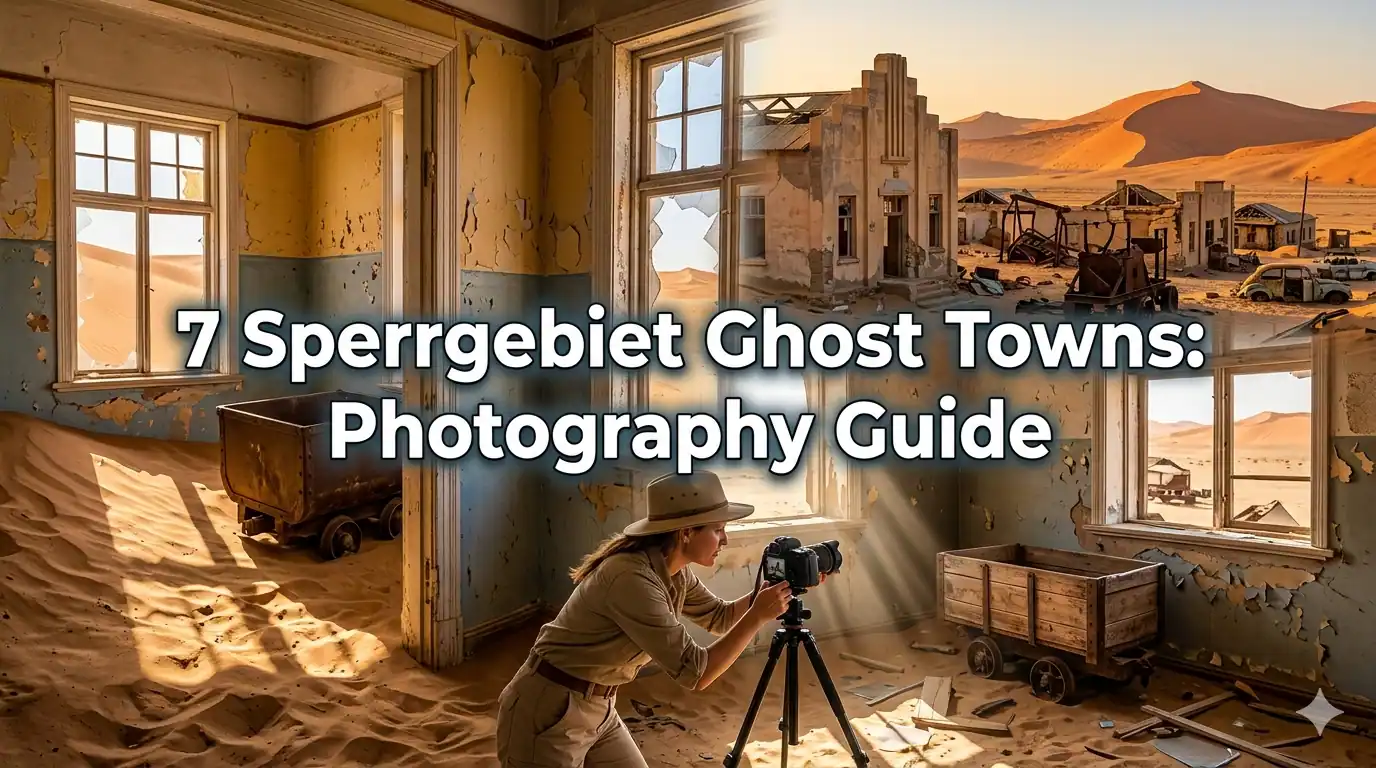
Discovering the Sperrgebiet: Namibia's Forbidden Diamond Zone
The Sperrgebiet, meaning "forbidden territory" in German, represents one of the most restricted and fascinating regions in Southern Africa. This vast expanse of Namib Desert stretching along Namibia's southwestern coast was declared a restricted diamond area in 1908 after the discovery of diamonds near Kolmanskop. For over a century, access has been tightly controlled, creating a time capsule of abandoned towns frozen in various stages of decay. Today, these ghost towns offer photographers an unparalleled opportunity to capture the haunting beauty of human ambition reclaimed by the desert.
The Sperrgebiet spans approximately 26,000 square kilometers, from the Orange River in the south to just north of Lüderitz. This arid landscape, among the oldest deserts on Earth, has preserved abandoned buildings in remarkable condition. The extreme dryness prevents the rot and decay that would quickly destroy structures in more humid climates. Instead, buildings fade slowly, sand drifts through broken windows, and the desert reclaims what humans built with a patience measured in decades.
For photographers, the Sperrgebiet's abandoned diamond towns offer an extraordinary combination of subjects: Art Deco architecture deteriorating in the desert sun, sand-filled ballrooms, rusted mining equipment, and the stark contrast between human ambition and nature's persistence. Each town tells a unique story of boom and bust, hope and abandonment. While access remains restricted and requires permits, the effort to visit these locations rewards photographers with images impossible to capture anywhere else on Earth.
Understanding Access and Permits for the Sperrgebiet

Before planning your photography expedition to the Sperrgebiet's abandoned towns, understanding the permit system is essential. The region remains under diamond mining concessions, primarily managed by Namdeb Diamond Corporation, a partnership between the Namibian government and De Beers. While restrictions have relaxed somewhat in recent years, access still requires advance planning and official authorization.
Photographers can obtain permits through several channels. The most straightforward approach is booking guided tours authorized to enter the Sperrgebiet. Several tour operators in Lüderitz and Windhoek offer multi-day expeditions specifically designed for photographers, including visits to Kolmanskop, Elizabeth Bay, and other accessible ghost towns. These tours handle permit logistics and provide local guides knowledgeable about both photography opportunities and safety considerations.
For independent photographers seeking more flexibility, permits can be applied for through the Ministry of Mines and Energy or Namdeb directly. Applications should be submitted at least 4-6 weeks in advance and must specify intended destinations, dates, and purpose of visit. Permit fees vary depending on the areas you wish to access and duration of stay. Some towns like Kolmanskop have simplified access through daily tour tickets, while more remote locations require special authorization.
Important restrictions to note: certain areas remain completely off-limits due to active mining operations or environmental sensitivity. Always verify current access status before planning visits to specific towns. Carry your permit documentation at all times while in the Sperrgebiet, as checkpoints exist along main routes. Violating access restrictions can result in substantial fines and legal consequences.
Best Time to Photograph Sperrgebiet Ghost Towns
Timing significantly impacts the quality of your photographs in the Sperrgebiet. The region experiences extreme temperature variations, with summer temperatures regularly exceeding 40°C (104°F) and winter nights dropping near freezing. For photography, the shoulder seasons of April-May and September-October offer the best balance of comfortable temperatures and dramatic lighting conditions.
Early morning and late afternoon provide the most flattering light for architectural photography. The low-angle sun casts long shadows through abandoned buildings, emphasizing textures of peeling paint, weathered wood, and drifting sand. Midday light, while harsh, can create striking high-contrast images emphasizing the starkness of decay. Golden hour, particularly sunset, bathes the desert and ruins in warm orange and pink tones that enhance the melancholic beauty of abandonment.
Consider seasonal weather patterns when planning. Winter months (June-August) bring cooler temperatures ideal for extended photography sessions, but also stronger winds that can create challenging dust conditions. Summer brings occasional rain to this arid region, which can create rare opportunities for dramatic storm photography but may make some roads impassable. The famous desert fog, rolling in from the Atlantic, can add atmospheric mood to images but reduces visibility.
Ghost Town #1: Kolmanskop - The Crown Jewel of Decay

Kolmanskop stands as the most famous and accessible of the Sperrgebiet's abandoned towns, and for good reason. Founded in 1908 after railway worker Zacharias Lewala discovered diamonds in the area, Kolmanskop quickly grew into a prosperous mining town featuring impressive German colonial architecture. At its peak, the town boasted a hospital with the first X-ray machine in the southern hemisphere, a power station, school, theater, and even a casino. When richer diamond deposits were discovered further south in the 1920s, residents abandoned Kolmanskop almost overnight, leaving buildings and belongings behind.
Today, Kolmanskop offers photographers an extraordinary canvas of decay. The town's most iconic images feature sand drifts filling rooms to ceiling height, creating surreal landscapes within building interiors. The ballroom, with its sand-covered floor and deteriorating ornate ceiling, has become one of Namibia's most photographed scenes. Hospital rooms with rusted medical equipment, children's bedrooms with peeling paint, and the bowling alley with sand-covered lanes provide endless photographic opportunities.
For the best photography experience at Kolmanskop, arrive early morning when light streams through broken windows at dramatic angles. The town opens for photography tours at sunrise, and the first hour provides the most magical lighting conditions. Bring a wide-angle lens to capture sand-filled rooms and a macro lens for detailed shots of decay textures. Tripods are essential for interior shots where light is limited. The tour typically lasts 2-3 hours, sufficient time to explore thoroughly, though serious photographers may wish to book multiple visits.
Practical considerations: Kolmanskop is located just 15 kilometers from Lüderitz, making it easily accessible. Entry requires purchasing a photography permit in addition to standard tour tickets. The permit allows you to remain after regular tours depart and provides access to additional areas. Wear sturdy shoes as you'll be climbing through sand and debris. Bring water, as the combination of desert heat and physical activity can be dehydrating. Respect the structures by not climbing on unstable surfaces or removing any artifacts.
Ghost Town #2: Elizabeth Bay - The Restricted Beauty

Elizabeth Bay, located approximately 80 kilometers south of Lüderitz, represents one of the Sperrgebiet's most intriguing and restricted ghost towns. Established in 1909, just a year after Kolmanskop's founding, Elizabeth Bay served as a mining settlement during the diamond rush era. Unlike Kolmanskop, which was abandoned relatively quickly, Elizabeth Bay maintained a small population into the 1930s before complete abandonment. The town's coastal location, perched on a hill overlooking the Atlantic Ocean, provides dramatic backdrops that distinguish it from inland ghost towns.
Access to Elizabeth Bay requires special permits beyond standard Sperrgebiet authorization, as the town sits within an active diamond mining area. This restriction has preserved Elizabeth Bay in a more pristine state of decay, with fewer visitors meaning less vandalism and structural damage. For photographers who secure permission to visit, Elizabeth Bay offers uniquely atmospheric subjects: weathered wooden houses slowly collapsing into the desert, rusted mining equipment scattered across the landscape, and panoramic ocean views framing the ruins.
The town's architecture reflects typical early 20th-century German colonial construction, with wooden frames and corrugated iron roofs that have weathered remarkably well in the dry climate. Photographic highlights include the old company store with faded signage, residential structures with interiors still containing remnants of daily life, and mining infrastructure including sorting facilities and equipment sheds. The contrast between the blue Atlantic Ocean, orange desert sands, and weathered gray-brown buildings creates a distinctive color palette.
Photography at Elizabeth Bay benefits from the coastal location's unique lighting conditions. Morning fog rolling in from the ocean can create ethereal, moody atmosphere perfect for fine art photography. Afternoon light emphasizes textures of weathered wood and rusted metal. Sunset provides spectacular opportunities with the town silhouetted against the setting sun over the ocean. Bring lenses ranging from wide-angle for landscape compositions to telephoto for isolating architectural details against the vast desert backdrop.
Important considerations: Elizabeth Bay's restricted status means access is not guaranteed. Work with authorized tour operators who have established relationships with mining authorities. The town is approximately 90 minutes drive from Lüderitz on rough desert roads requiring 4WD vehicles. Carry extra water, fuel, and emergency supplies. Cell phone coverage is non-existent, so inform others of your travel plans. Respect all safety barriers and mining operations in the area.
Ghost Town #3: Pomona - The Forgotten Settlement

Pomona, situated roughly 100 kilometers south of Lüderitz near Elizabeth Bay, represents one of the Sperrgebiet's most remote and least visited ghost towns. Named after the Roman goddess of fruit trees, an ironic designation for a settlement in one of Earth's most arid regions, Pomona was established in 1909 during the height of the diamond rush. The town never achieved the prosperity of Kolmanskop, remaining a smaller settlement focused on processing diamonds from nearby mining operations.
Abandoned in the 1930s when diamond production declined, Pomona has deteriorated more significantly than Kolmanskop due to its coastal exposure and lack of preservation efforts. For photographers, this advanced state of decay offers compelling subjects that speak more powerfully to themes of impermanence and nature's reclamation. The town's structures, primarily wooden buildings with corrugated iron roofs, have partially collapsed, creating dramatic compositions of splintered wood, twisted metal, and encroaching sand.
Photographic opportunities at Pomona include the skeletal remains of the diamond sorting facility, where workers once processed the gems that built these towns. Residential areas feature houses reduced to foundations and scattered debris, allowing photographers to capture the complete cycle from construction to abandonment to near-total reclamation by desert. The old cemetery, with weathered grave markers half-buried in sand, provides somber subjects that remind viewers of the human stories behind these ghost towns.
The remote location of Pomona means fewer visitors and consequently less concern about disturbing other tourists while photographing. This isolation allows for extended photography sessions and experimentation with different techniques. Long exposures capturing the movement of sand and clouds through ruins work particularly well here. The advanced decay also provides excellent opportunities for macro photography of textures: rust patterns on metal, grain of weathered wood, crystalline salt deposits on surfaces.
Access to Pomona requires careful planning and appropriate vehicles. The town is reachable only via 4WD on unmarked desert tracks that can be challenging to navigate. GPS coordinates and detailed maps are essential. The journey from Lüderitz takes approximately 2-3 hours depending on road conditions. Travel with another vehicle if possible for safety. Carry comprehensive emergency supplies including extra water, food, fuel, first aid kit, and communication equipment. Permits are required and should be secured well in advance.
Ghost Town #4: Holsatia - The Mining Relic

Holsatia, located in the central Sperrgebiet region, represents a different category of abandoned settlement compared to the coastal ghost towns. Rather than a residential community, Holsatia functioned primarily as a mining camp and diamond sorting facility serving the surrounding mining operations. Established in the early 1920s, later than the initial diamond rush towns, Holsatia operated into the 1950s before declining production led to abandonment. The town's later establishment means its architecture reflects more modern construction techniques of the 1920s era.
For photographers, Holsatia offers unique subjects focused on industrial archaeology rather than residential decay. The town features substantial remains of diamond processing infrastructure including sorting tables, conveyor systems, and storage facilities. These industrial structures, constructed from concrete and steel rather than wood, have weathered differently than the coastal towns, providing contrasting textures and photographic opportunities. Rust patterns on metal equipment, cracked concrete surfaces, and the geometric patterns of industrial architecture create compelling abstract compositions.
The residential areas of Holsatia, though smaller than towns like Kolmanskop, include several well-preserved buildings that housed mine managers and senior staff. These structures feature more substantial construction with stone foundations and better-quality materials that have survived remarkably well. Interior spaces contain remnants of 1920s-1950s life in a remote mining camp, including old furniture, kitchen equipment, and personal belongings left behind when the town was abandoned.
Photography at Holsatia benefits from the site's relative preservation and interesting mix of industrial and residential architecture. The industrial structures photograph particularly well in early morning or late afternoon light that emphasizes textures and creates dramatic shadows. The geometric patterns of sorting facilities and processing equipment work well with wide-angle lenses. Interior shots of residential buildings require higher ISO settings or tripods due to limited light through small windows.
Access to Holsatia requires special permits as the town sits within active mining concession areas. The location is remote, approximately 150 kilometers from Lüderitz via rough desert tracks. 4WD vehicles are essential, and travel should only be attempted in good weather conditions. The journey takes 3-4 hours each way, making Holsatia best visited as part of a multi-day Sperrgebiet expedition rather than a day trip. Camping may be permitted in designated areas with proper authorization.
Ghost Town #5: Bogenfels - The Coastal Outpost

Bogenfels, positioned near the southern boundary of the Sperrgebiet close to the Orange River, represents the southernmost of Namibia's significant ghost towns. The name, meaning "arched rock" in German, refers to a distinctive natural rock arch on the nearby coast. Established in 1912, later than the initial diamond rush settlements, Bogenfels served as a remote mining outpost and administrative center for southern Sperrgebiet operations. The town's isolation, over 200 kilometers from Lüderitz, meant it developed a distinct character from the more northern settlements.
Bogenfels never achieved large population, typically housing fewer than 200 residents even at its peak. The town's remote location and harsh conditions made life challenging, and when diamond production declined in the 1930s, abandonment came quickly. Today, Bogenfels presents photographers with subjects that emphasize isolation and the struggle of human settlement in extreme environments. The town's buildings, primarily single-story wooden structures, have weathered severely in the coastal desert climate, creating dramatic scenes of decay.
Photographic highlights at Bogenfels include the old administrative buildings with their distinctive German colonial architecture, the church that once served the small community, and residential structures scattered across the desert landscape. The nearby rock arch that gives the town its name provides a stunning natural subject that can be incorporated into compositions with the ghost town ruins. The combination of geological features and human ruins creates diverse photographic opportunities within a single location.
The extreme southern location of Bogenfels means it experiences different weather patterns than towns further north. Fog from the Atlantic is more frequent, creating atmospheric conditions that can add mood to photographs but also challenge visibility. Wind is a constant presence, shaping both the natural landscape and the deterioration of buildings. For photographers, this means opportunities to capture dynamic scenes of blowing sand and dramatic cloud movement, but also the need to protect equipment from abrasive dust.
Access to Bogenfels requires significant planning and preparation. The distance from Lüderitz exceeds 200 kilometers on challenging desert roads that demand experienced 4WD driving. The journey can take 4-5 hours each way depending on conditions. Permits are essential and should be secured well in advance. The remote location means no services or facilities are available, requiring self-sufficiency for the entire visit. Camping may be possible with proper authorization, allowing extended photography sessions across multiple days.
Ghost Town #6: Grilltal - The Valley Settlement

Grilltal, whose name translates to "Grille Valley" or "Cricket Valley," occupies a small valley in the central Sperrgebiet region. Established around 1910 during the diamond rush expansion, Grilltal served as a support settlement for nearby mining operations. The town's valley location provided some protection from the fierce coastal winds that battered more exposed settlements, though conditions remained harsh. Grilltal's population never exceeded a few hundred residents, and the town was largely abandoned by the 1930s as diamond production shifted to more productive areas.
For photographers, Grilltal offers intimate scenes of decay within a protected valley setting. The town's relative shelter from coastal winds means buildings have deteriorated differently than exposed coastal settlements, with more structural elements remaining intact. This allows photographers to capture more complete architectural compositions while still conveying the melancholy of abandonment. The valley setting also provides interesting landscape photography opportunities, with ruins framed by desert mountains and sparse vegetation.
Notable photographic subjects at Grilltal include the old community hall that once served as the social center of the town, residential buildings with interiors still containing artifacts from the 1910s-1930s era, and mining infrastructure including equipment sheds and processing areas. The cemetery, like those at other Sperrgebiet towns, provides poignant subjects that humanize the ghost town narrative. Weathered headstones with German inscriptions tell stories of individuals who lived and died in this remote location.
The valley location of Grilltal creates unique lighting conditions for photography. Mountains surrounding the valley cast long shadows in early morning and late afternoon, creating dramatic contrast and emphasizing textures. Midday sun can be harsh, but the valley setting provides some relief from the intensity experienced in more exposed locations. For photographers interested in astrophotography, Grilltal's remote location and minimal light pollution make it an excellent site for capturing the Milky Way over ghost town ruins.
Access to Grilltal requires 4WD vehicles and navigation skills, as the town is located off main routes and requires travel on unmarked desert tracks. The journey from Lüderitz takes approximately 3 hours. Permits are necessary and should be obtained in advance. The site sees very few visitors, meaning photographers can work without concern for other tourists in their images. However, this isolation also means self-sufficiency is essential. Carry all necessary supplies including water, food, fuel, and emergency equipment.
Ghost Town #7: Oranjemund - The Living Ghost Town

Oranjemund, meaning "Mouth of the Orange" in Dutch, occupies a unique position among Sperrgebiet settlements. Located at the mouth of the Orange River on Namibia's southern border with South Africa, Oranjemund was established in 1936 as a company town to support diamond mining operations. Unlike the other towns on this list, Oranjemund was never completely abandoned and maintained a population of several thousand into the 21st century. However, as diamond mining operations modernized and reduced workforce needs, the town has experienced significant population decline, creating a hybrid character of active community and abandoned zones.
For photographers, Oranjemund offers a different perspective on the ghost town theme: the process of abandonment happening in real-time. Sections of the town remain inhabited and maintained, while other areas show advanced decay. This contrast between occupied and abandoned creates compelling visual narratives about economic change, resource depletion, and the lifecycle of mining towns. The town's location at the Orange River mouth also provides unique landscape photography opportunities not available at inland ghost towns.
Photographic subjects in Oranjemund include abandoned residential areas where houses stand empty with windows broken and yards overgrown, the old company facilities and administrative buildings showing various stages of decay, and the contrast between maintained infrastructure and deteriorating neighborhoods. The river mouth itself, where the Orange River meets the Atlantic Ocean, provides dramatic landscape subjects including wetlands, coastal dunes, and the distinctive confluence of river and ocean.
The town's more recent history means architecture reflects mid-20th century construction rather than early 1900s German colonial style. This provides photographic diversity when documenting multiple Sperrgebiet towns, showing the evolution of settlement architecture across different eras. The presence of some current residents also means opportunities for documentary photography capturing the remaining community's relationship with their town's history and uncertain future.
Access to Oranjemund has historically been highly restricted due to its status as a closed mining town. Recent years have seen gradual opening, but permits and authorization remain necessary for visitors. The town is accessible via road from South Africa's northern Cape region or from within Namibia with proper documentation. Border crossing procedures can be complex, so verify current requirements before planning visits. Accommodation options are limited but available for authorized visitors.
Essential Photography Equipment for Sperrgebiet Ghost Towns

Photographing abandoned towns in the harsh Sperrgebiet environment requires careful equipment selection to balance image quality with durability and practicality. The combination of extreme temperatures, abrasive sand, and remote locations demands gear that can withstand challenging conditions while delivering the image quality necessary for capturing these unique subjects.
Camera bodies should be weather-sealed to protect against dust infiltration. Mirrorless cameras offer advantages in weight and size for travel, but DSLRs provide proven reliability in harsh conditions. Regardless of system, bring protective covers or housing designed for dusty environments. Multiple camera bodies are advisable if available, as a backup ensures you can continue shooting if primary equipment fails or becomes too contaminated with dust.
Lens selection should cover a range of focal lengths. Wide-angle lenses (16-35mm equivalent) are essential for capturing sand-filled rooms, architectural interiors, and landscape contexts. Standard zoom lenses (24-70mm) provide versatility for general photography. Telephoto lenses (70-200mm or longer) allow compression of distant ruins against desert landscapes and isolation of architectural details. Prime lenses offer superior image quality and wider apertures for low-light interior photography, though they lack zoom flexibility.
Tripods are non-negotiable for serious ghost town photography. Interior spaces often require long exposures, and tripods enable sharp images at low ISO settings. Choose sturdy models that can withstand wind, but consider weight limitations for hiking between sites. Carbon fiber tripods offer good strength-to-weight ratios. Bring a remote shutter release or use camera's timer function to eliminate vibration during long exposures.
Protection against sand and dust is critical. Bring lens cleaning supplies including microfiber cloths, lens cleaning fluid, and rocket blowers for removing dust before it scratches glass. Protective filters (UV or clear) shield front lens elements from abrasion. Camera bags should seal well against dust infiltration. Consider bringing plastic bags or dedicated rain covers that can protect equipment during unexpected weather or heavy dust conditions.
Power management requires attention in remote locations. Bring multiple batteries for all devices, as cold desert nights and hot days both drain batteries quickly. Solar chargers can extend shooting time on multi-day expeditions. Memory card capacity should exceed your estimated needs, as the compelling subjects will inspire more shooting than anticipated. Bring card readers and backup storage devices to protect images from loss.
Safety and Preservation Considerations

Photographing abandoned towns in the Sperrgebiet involves responsibilities beyond capturing compelling images. Your safety and the preservation of these historic sites for future photographers and historians require mindful practices and preparation.
Structural safety demands constant attention. Buildings abandoned for decades or over a century have deteriorated significantly. Floors may be rotted through, roofs may collapse, and walls may be unstable. Test surfaces carefully before putting weight on them. Avoid climbing on structures or entering buildings that appear severely compromised. When in doubt, photograph from outside or from safe distances. No photograph justifies injury or worse.
Environmental hazards in the Sperrgebiet extend beyond structural dangers. Extreme temperatures can cause heat stroke or hypothermia depending on season and time of day. Carry adequate water, at minimum 4-5 liters per person per day. Wear appropriate clothing including sun protection, layers for temperature variation, and sturdy footwear. Inform others of your travel plans and expected return times. Carry emergency communication devices such as satellite phones or personal locator beacons, as cell coverage is non-existent in most areas.
Wildlife in the Sperrgebiet includes snakes, scorpions, and spiders that may seek shelter in abandoned buildings. Check carefully before sitting, placing hands, or stepping into dark spaces. Shake out boots and clothing before putting them on. These precautions prevent potentially dangerous encounters.
Preservation ethics require photographers to leave no trace and cause no damage. Never remove artifacts, even seemingly insignificant items. These objects are part of the historical record and removing them degrades the site for future visitors. Do not break windows, kick down doors, or otherwise accelerate deterioration for the sake of photographs. Graffiti and vandalism are unfortunately common at abandoned sites; never add to this destruction.
Respect the history these towns represent. Many were once vibrant communities where people lived, worked, raised families, and built lives. Approach photography with sensitivity to this human history rather than treating sites merely as aesthetic subjects. Consider the ethical implications of your images and how they represent these places and their histories.
Conclusion: Capturing the Sperrgebiet's Haunting Beauty

The abandoned diamond towns of the Sperrgebiet offer photographers an extraordinary opportunity to document the intersection of human ambition and natural forces. From Kolmanskop's sand-filled ballrooms to Elizabeth Bay's coastal ruins, from Pomona's advanced decay to Oranjemund's ongoing transformation, each town tells a unique story of boom and bust, hope and abandonment, construction and reclamation.
Photographing these ghost towns requires preparation, patience, and respect. The permits, planning, and challenging conditions are part of the experience, filtering out casual visitors and rewarding those who commit to the journey with images impossible to capture elsewhere. The Sperrgebiet's extreme environment has preserved these towns in various stages of decay, creating a living museum of architectural history and a photographer's paradise of textures, light, and atmosphere.
As you plan your expedition to photograph these seven abandoned diamond towns, remember that you're documenting places that exist in a fragile balance. Each year, weather and time claim more of these structures. The photographs you create become part of the historical record, preserving moments in the ongoing story of these places. Approach your work with technical skill, artistic vision, and ethical responsibility.
The Sperrgebiet's ghost towns remind us of the impermanence of human endeavors and the persistence of nature. They challenge us to find beauty in decay, meaning in abandonment, and art in the passage of time. For photographers willing to make the journey, these towns offer not just compelling images, but profound reflections on history, ambition, and the landscapes we leave behind. Your camera is ready. The Sperrgebiet awaits.
0 Comments