.webp)
.webp)
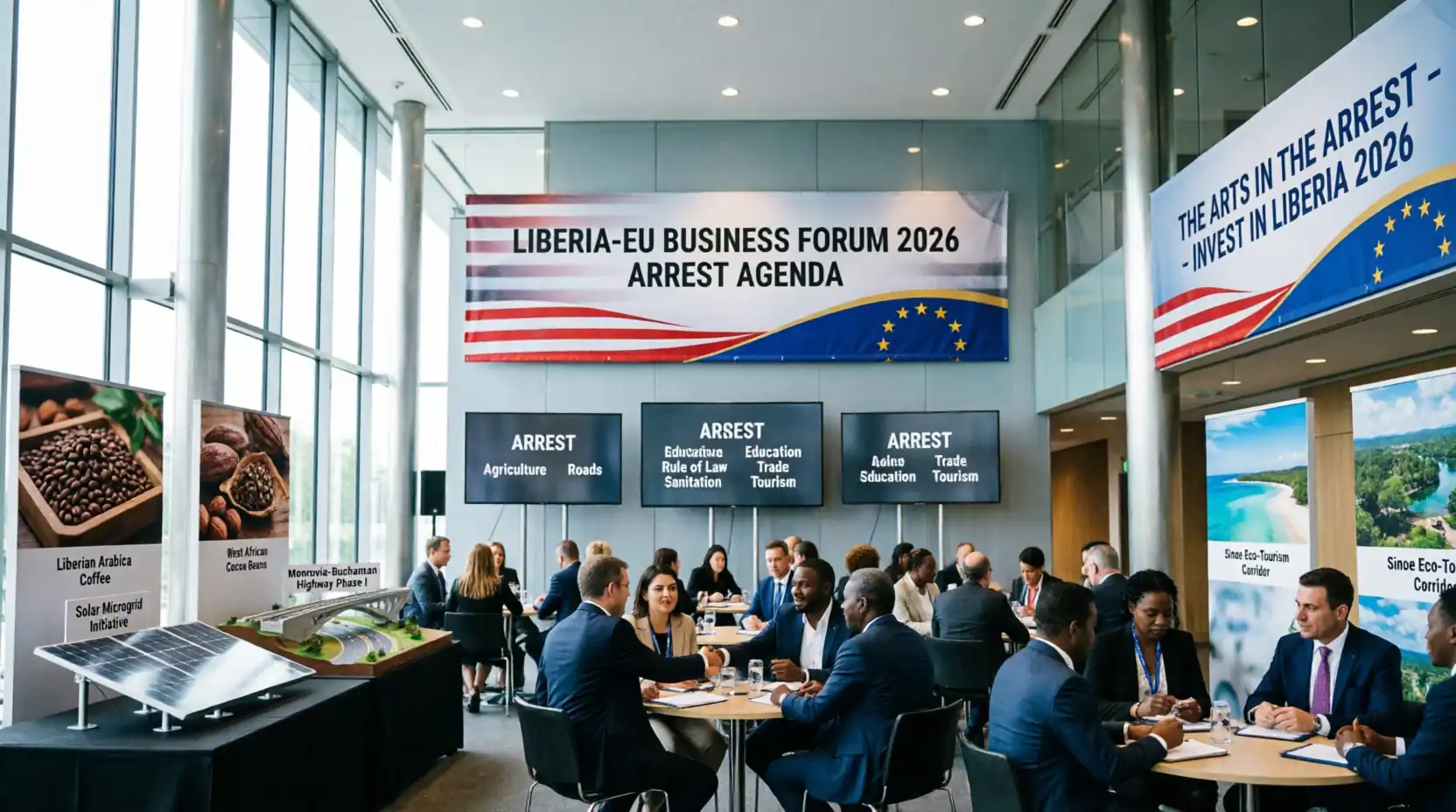
Liberia-EU Business Forum 2026: Investment Opportunities in the ARREST Agenda
In February 2026, Brussels became the stage for a landmark moment in Liberia's economic development journey: the inaugural Liberia-EU Business Forum, held under the compelling theme "The ARTS in the ARREST – Invest in Liberia 2026." This high-level gathering, co-hosted by the Government of Liberia and the European Union, represented far more than a routine business conference—it signaled a strategic pivot toward deepening commercial ties, attracting sustainable foreign direct investment, and accelerating Liberia's transformation through the ambitious ARREST Agenda for Inclusive Development (AAID). For European investors, development partners, and Liberian entrepreneurs, the forum opened a gateway to over €1 billion in identified investment opportunities across priority sectors that promise inclusive growth, job creation, and long-term prosperity for one of West Africa's most historically significant nations.
The ARREST Agenda—Liberia's five-year national development blueprint spanning 2025-2029—serves as the strategic foundation for this investment push. Built on six interconnected pillars (Economic Transformation, Infrastructural Development, Rule of Law, Governance and Anti-Corruption, Environmental Sustainability, and Human Capital Development), the agenda provides a comprehensive framework for sustainable development that aligns with both Liberia's domestic priorities and the European Union's Global Gateway Strategy for values-driven international partnership. By focusing investment on Agriculture, Roads, Rule of Law, Education, Sanitation, Trade, and Tourism—the "ARTS" within ARREST—Liberia and the EU are crafting a partnership model that balances economic opportunity with social impact, environmental stewardship, and institutional strengthening.
This comprehensive guide explores everything investors, business leaders, and development professionals need to know about the Liberia-EU Business Forum 2026 and the investment opportunities within the ARREST Agenda: understanding the ARREST framework and its strategic pillars, detailed sector-by-sector analysis of investment opportunities, practical guidance for engaging with Liberian investment processes, financing mechanisms and partnership models available through EU-Liberia cooperation, risk mitigation strategies for investing in emerging markets, success stories and case studies from early ARREST implementations, and expert insights for maximizing impact while ensuring sustainable, inclusive returns. Whether you're a European SME exploring African markets, an impact investor seeking measurable social returns, a development finance institution scaling partnerships, or a Liberian entrepreneur seeking growth capital, this guide provides the actionable intelligence you need to navigate and capitalize on Liberia's emerging investment landscape.
Understanding the ARREST Agenda: Liberia's Development Blueprint

What Is the ARREST Agenda for Inclusive Development?
The ARREST Agenda for Inclusive Development (AAID) is Liberia's official national development plan for 2025-2029, endorsed by President Joseph Nyuma Boakai and structured as a $8.4 billion investment framework to transition Liberia from low-income to lower-middle-income status . The agenda reflects extensive nationwide consultations with government, civil society, private sector actors, traditional leaders, youth, persons with disabilities, and international partners, ensuring broad-based ownership and alignment with citizen priorities.
Core principles underpinning the AAID:
- Inclusiveness: Ensuring development benefits reach marginalized communities, women, youth, and persons with disabilities
- Sustainability: Balancing economic growth with environmental protection and climate resilience
- Justice and equality: Strengthening rule of law, human rights protection, and equitable access to opportunities
- Accountability: Enhancing transparency, public financial management, and citizen oversight of development resources
- Peace and reconciliation: Building social cohesion and addressing historical grievances to enable stable development
- Local ownership: Empowering Liberian institutions and communities to lead development processes
- 👉 Madagascar 2028: 1 Million Tourists Through 2026 Infrastructure
- 👉 Burundi eVisa 2026: A complete step-by-step guide to the new digital visa application process.
- 👉 Complete Guide to 2026 Auto de Floripes Festival Dates and Cultural Logistics
The Six Strategic Pillars of ARREST
The AAID is organized around six interconnected strategic pillars that guide investment prioritization:
1. Economic Transformation Pillar
- Focus: Investment-led growth, job creation, export diversification, import substitution through industrialization
- Key targets: Increase GDP per capita to $1,050.3; achieve 5.9% average annual GDP growth; enhance food security and nutrition resilience
- Investment priorities: Agricultural value chains, agro-processing, mining sector governance, renewable energy, manufacturing, digital economy
- 👉 Madagascar 2028: 1 Million Tourists Through 2026 Infrastructure
- 👉 Burundi eVisa 2026: A complete step-by-step guide to the new digital visa application process.
- 👉 Complete Guide to 2026 Auto de Floripes Festival Dates and Cultural Logistics
2. Infrastructural Development Pillar
- Focus: Transport, logistics, energy, housing, and ICT infrastructure to reduce business costs and improve connectivity
- Key targets: Pave minimum 485 km of primary roads; increase affordable electricity access in rural and urban communities
- Investment priorities: Road rehabilitation and construction, port modernization, renewable energy projects, broadband expansion, affordable housing
- 👉 Madagascar 2028: 1 Million Tourists Through 2026 Infrastructure
- 👉 Burundi eVisa 2026: A complete step-by-step guide to the new digital visa application process.
- 👉 Complete Guide to 2026 Auto de Floripes Festival Dates and Cultural Logistics
3. Rule of Law Pillar
- Focus: Strengthening legal frameworks, judicial independence, human rights protection, and public trust in institutions
- Key targets: Enhance transparency and effectiveness of justice system; address grievance mechanisms; build institutional capacity
- Investment priorities: Legal tech solutions, judicial training, alternative dispute resolution, legal aid services, anti-corruption technology
- 👉 Madagascar 2028: 1 Million Tourists Through 2026 Infrastructure
- 👉 Burundi eVisa 2026: A complete step-by-step guide to the new digital visa application process.
- 👉 Complete Guide to 2026 Auto de Floripes Festival Dates and Cultural Logistics
4. Governance and Anti-Corruption Pillar
- Focus: Creating functional, accountable state institutions at national and sub-national levels
- Key targets: Strengthen public financial management; enhance electoral transparency; promote political stability and social cohesion
- Investment priorities: E-governance platforms, procurement transparency systems, civic tech, capacity building for public institutions
- 👉 Madagascar 2028: 1 Million Tourists Through 2026 Infrastructure
- 👉 Burundi eVisa 2026: A complete step-by-step guide to the new digital visa application process.
- 👉 Complete Guide to 2026 Auto de Floripes Festival Dates and Cultural Logistics
5. Environmental Sustainability Pillar
- Focus: Responsible natural resource management, biodiversity protection, climate change resilience
- Key targets: Sustainable forest management; biodiversity conservation; climate adaptation and mitigation strategies
- Investment priorities: Renewable energy, sustainable forestry, climate-smart agriculture, waste management, eco-tourism
- 👉 Madagascar 2028: 1 Million Tourists Through 2026 Infrastructure
- 👉 Burundi eVisa 2026: A complete step-by-step guide to the new digital visa application process.
- 👉 Complete Guide to 2026 Auto de Floripes Festival Dates and Cultural Logistics
6. Human Capital Development Pillar
- Focus: Investing in education, healthcare, sanitation, and empowerment of women, youth, and persons with disabilities
- Key targets: Improve life expectancy, literacy rates, and workforce capabilities; capitalize on demographic dividend
- Investment priorities: Education infrastructure, vocational training, healthcare facilities, WASH services, youth employment programs
- 👉 Madagascar 2028: 1 Million Tourists Through 2026 Infrastructure
- 👉 Burundi eVisa 2026: A complete step-by-step guide to the new digital visa application process.
- 👉 Complete Guide to 2026 Auto de Floripes Festival Dates and Cultural Logistics
The "ARTS" Within ARREST: Priority Investment Sectors
Within the broader ARREST framework, the Liberia-EU Business Forum 2026 highlighted seven priority sectors—summarized by the mnemonic "ARTS"—that offer immediate, high-impact investment opportunities :
- Agriculture: Food security, agro-processing, export crops, value chain development
- Roads: Transport infrastructure, logistics, connectivity, rural access
- Rule of Law: Legal frameworks, judicial capacity, business environment reforms
- Education: Skills development, vocational training, education infrastructure
- Sanitation: Water, sanitation, hygiene (WASH), public health infrastructure
- Trade: Export promotion, market access, trade facilitation, regional integration
- Tourism: Eco-tourism, cultural heritage, hospitality infrastructure, destination marketing
- 👉 Madagascar 2028: 1 Million Tourists Through 2026 Infrastructure
- 👉 Burundi eVisa 2026: A complete step-by-step guide to the new digital visa application process.
- 👉 Complete Guide to 2026 Auto de Floripes Festival Dates and Cultural Logistics
These sectors were selected based on their potential for job creation, poverty reduction, export earnings, and alignment with both Liberian development priorities and EU partnership objectives.
Sector Deep-Dive: Investment Opportunities Within the ARTS Framework

Agriculture: From Subsistence to Commercial Value Chains
Liberia's agricultural sector holds transformative potential for inclusive growth:
- Current landscape: Agriculture employs ~60% of Liberia's workforce but contributes only ~40% to GDP, indicating significant productivity gaps and value addition opportunities
- Key opportunities:
- Rice value chain: Local rice production meets only ~40% of domestic demand; investment in milling, storage, and distribution can reduce imports and create jobs
- Cash crops: Rubber, palm oil, cocoa, and coffee have established export markets; opportunities in sustainable certification, processing, and quality improvement
- Agro-processing: Minimal local processing of agricultural products; investment in processing facilities can capture value domestically and create higher-wage jobs
- Agri-tech solutions: Digital platforms for market information, mobile payments, extension services, and climate-smart practices
- Climate-resilient agriculture: Drought-resistant seeds, irrigation systems, soil conservation techniques to address climate vulnerability
- 👉 Madagascar 2028: 1 Million Tourists Through 2026 Infrastructure
- 👉 Burundi eVisa 2026: A complete step-by-step guide to the new digital visa application process.
- 👉 Complete Guide to 2026 Auto de Floripes Festival Dates and Cultural Logistics
- EU partnership advantages:
- Everything But Arms (EBA) initiative provides duty-free, quota-free access to EU market for all Liberian exports except arms
- EU expertise in sustainable agriculture, food safety standards, and value chain development
- Blended finance mechanisms combining grants, concessional loans, and private investment
- 👉 Madagascar 2028: 1 Million Tourists Through 2026 Infrastructure
- 👉 Burundi eVisa 2026: A complete step-by-step guide to the new digital visa application process.
- 👉 Complete Guide to 2026 Auto de Floripes Festival Dates and Cultural Logistics
- Investment models: Outgrower schemes, contract farming, joint ventures with local cooperatives, public-private partnerships for infrastructure
- Risk considerations: Land tenure complexities, climate vulnerability, infrastructure gaps; mitigated through community engagement, climate adaptation planning, and infrastructure co-investment
- 👉 Madagascar 2028: 1 Million Tourists Through 2026 Infrastructure
- 👉 Burundi eVisa 2026: A complete step-by-step guide to the new digital visa application process.
- 👉 Complete Guide to 2026 Auto de Floripes Festival Dates and Cultural Logistics
Roads and Infrastructure: Connecting Markets and Communities
Infrastructure development is foundational to economic transformation:
- Current challenges: Only ~6% of Liberia's road network is paved; high transport costs constrain trade, increase food prices, and limit rural access to services
- Key opportunities:
- Road rehabilitation: Priority corridors connecting agricultural zones to ports and urban markets; opportunities for engineering firms, construction companies, and maintenance contractors
- Rural access roads: Feeder roads to connect smallholder farmers to markets; labor-intensive construction methods can create local employment
- Port modernization: Freeport of Monrovia and Buchanan Port upgrades to handle increased agricultural and mineral exports
- Renewable energy: Solar mini-grids, hydro projects, and grid extensions to power rural communities and businesses
- Digital infrastructure: Fiber optic expansion, mobile network coverage, and last-mile connectivity to enable digital services
- 👉 Madagascar 2028: 1 Million Tourists Through 2026 Infrastructure
- 👉 Burundi eVisa 2026: A complete step-by-step guide to the new digital visa application process.
- 👉 Complete Guide to 2026 Auto de Floripes Festival Dates and Cultural Logistics
- EU partnership advantages:
- Global Gateway Strategy prioritizes sustainable infrastructure investment in partner countries
- European expertise in climate-resilient infrastructure design and construction
- Blended finance instruments de-risking private investment in infrastructure
- 👉 Madagascar 2028: 1 Million Tourists Through 2026 Infrastructure
- 👉 Burundi eVisa 2026: A complete step-by-step guide to the new digital visa application process.
- 👉 Complete Guide to 2026 Auto de Floripes Festival Dates and Cultural Logistics
- Investment models: Public-private partnerships (PPPs), design-build-finance-operate (DBFO) contracts, community-based maintenance schemes
- Risk considerations: Land acquisition, environmental and social safeguards, maintenance funding; addressed through robust feasibility studies, stakeholder engagement, and sustainable financing arrangements
- 👉 Madagascar 2028: 1 Million Tourists Through 2026 Infrastructure
- 👉 Burundi eVisa 2026: A complete step-by-step guide to the new digital visa application process.
- 👉 Complete Guide to 2026 Auto de Floripes Festival Dates and Cultural Logistics
Rule of Law: Enabling Environment for Business
Strong legal frameworks are essential for investment confidence:
- Current context: Liberia has made progress in post-conflict legal reform, but implementation gaps, case backlogs, and limited access to justice remain challenges
- Key opportunities:
- Legal tech solutions: Case management systems, e-filing platforms, legal research databases to improve judicial efficiency
- Alternative dispute resolution: Mediation and arbitration services to reduce court caseloads and provide faster, cheaper dispute resolution for businesses
- Legal capacity building: Training for judges, lawyers, and court staff; curriculum development for legal education
- Business registration and licensing: Streamlining processes through digital platforms to reduce time and cost of starting a business
- Anti-corruption technology: Transparency portals, procurement monitoring systems, whistleblower protection mechanisms
- 👉 Madagascar 2028: 1 Million Tourists Through 2026 Infrastructure
- 👉 Burundi eVisa 2026: A complete step-by-step guide to the new digital visa application process.
- 👉 Complete Guide to 2026 Auto de Floripes Festival Dates and Cultural Logistics
- EU partnership advantages:
- EU expertise in rule of law programming, judicial reform, and anti-corruption initiatives
- Technical assistance for legal framework alignment with international standards
- Support for civil society organizations monitoring governance reforms
- 👉 Madagascar 2028: 1 Million Tourists Through 2026 Infrastructure
- 👉 Burundi eVisa 2026: A complete step-by-step guide to the new digital visa application process.
- 👉 Complete Guide to 2026 Auto de Floripes Festival Dates and Cultural Logistics
- Investment models: Technical assistance contracts, social impact bonds for justice sector reform, public-private partnerships for legal service delivery
- Risk considerations: Political sensitivity of legal reforms, institutional resistance, sustainability of reforms; mitigated through inclusive stakeholder engagement, phased implementation, and local ownership
- 👉 Madagascar 2028: 1 Million Tourists Through 2026 Infrastructure
- 👉 Burundi eVisa 2026: A complete step-by-step guide to the new digital visa application process.
- 👉 Complete Guide to 2026 Auto de Floripes Festival Dates and Cultural Logistics
Education: Building Human Capital for Growth
Investing in education yields long-term economic returns:
- Current landscape: Liberia faces significant education challenges: low enrollment rates, teacher shortages, inadequate infrastructure, and skills mismatches with labor market needs
- Key opportunities:
- Vocational and technical training: Programs aligned with priority sectors (agriculture, construction, renewable energy, digital services) to address skills gaps
- Education infrastructure: Construction and rehabilitation of schools, particularly in rural areas; provision of learning materials and technology
- Teacher training and support: Professional development programs, digital teaching tools, and incentives for rural postings
- STEM education: Science, technology, engineering, and mathematics programs to prepare youth for emerging economic opportunities
- EdTech solutions: Digital learning platforms, mobile education apps, and offline content delivery for areas with limited connectivity
- 👉 Madagascar 2028: 1 Million Tourists Through 2026 Infrastructure
- 👉 Burundi eVisa 2026: A complete step-by-step guide to the new digital visa application process.
- 👉 Complete Guide to 2026 Auto de Floripes Festival Dates and Cultural Logistics
- EU partnership advantages:
- EU experience in education sector reform, vocational training systems, and quality assurance
- Erasmus+ and other mobility programs for student and faculty exchange
- Support for education policy development and institutional strengthening
- 👉 Madagascar 2028: 1 Million Tourists Through 2026 Infrastructure
- 👉 Burundi eVisa 2026: A complete step-by-step guide to the new digital visa application process.
- 👉 Complete Guide to 2026 Auto de Floripes Festival Dates and Cultural Logistics
- Investment models: Public-private partnerships for school management, corporate training programs, social impact investment in education startups
- Risk considerations: Political prioritization of education spending, teacher union dynamics, sustainability of programs; addressed through government commitment, community engagement, and results-based financing
- 👉 Madagascar 2028: 1 Million Tourists Through 2026 Infrastructure
- 👉 Burundi eVisa 2026: A complete step-by-step guide to the new digital visa application process.
- 👉 Complete Guide to 2026 Auto de Floripes Festival Dates and Cultural Logistics
Sanitation and Public Health: Foundations for Productivity
WASH investments deliver health and economic benefits:
- Current challenges: Limited access to safe water and sanitation contributes to disease burden, reduces productivity, and disproportionately affects women and girls
- Key opportunities:
- Urban water systems: Rehabilitation and expansion of water supply networks in Monrovia and secondary cities
- Rural WASH: Community-managed water points, household sanitation solutions, hygiene promotion programs
- Waste management: Solid waste collection, recycling initiatives, and safe disposal systems for urban areas
- Healthcare infrastructure: Clinic and hospital construction, medical equipment supply, telemedicine solutions for remote areas
- Public health innovation: Disease surveillance systems, mobile health applications, community health worker programs
- 👉 Madagascar 2028: 1 Million Tourists Through 2026 Infrastructure
- 👉 Burundi eVisa 2026: A complete step-by-step guide to the new digital visa application process.
- 👉 Complete Guide to 2026 Auto de Floripes Festival Dates and Cultural Logistics
- EU partnership advantages:
- EU expertise in water resource management, sanitation technology, and public health systems
- Experience with community-led total sanitation (CLTS) and other behavior change approaches
- Support for health system strengthening and pandemic preparedness
- 👉 Madagascar 2028: 1 Million Tourists Through 2026 Infrastructure
- 👉 Burundi eVisa 2026: A complete step-by-step guide to the new digital visa application process.
- 👉 Complete Guide to 2026 Auto de Floripes Festival Dates and Cultural Logistics
- Investment models: Output-based aid for WASH services, social impact bonds for health outcomes, public-private partnerships for utility management
- Risk considerations: Community acceptance of new technologies, operation and maintenance funding, behavioral change challenges; mitigated through participatory planning, sustainable financing mechanisms, and long-term behavior change communication
- 👉 Madagascar 2028: 1 Million Tourists Through 2026 Infrastructure
- 👉 Burundi eVisa 2026: A complete step-by-step guide to the new digital visa application process.
- 👉 Complete Guide to 2026 Auto de Floripes Festival Dates and Cultural Logistics
Trade: Leveraging Market Access for Growth
Trade facilitation unlocks economic potential:
- Current context: Liberia benefits from Everything But Arms (EBA) initiative providing duty-free, quota-free access to EU market, but underutilizes this opportunity due to supply-side constraints
- Key opportunities:
- Export diversification: Moving beyond traditional commodities (rubber, iron ore) to higher-value products (processed foods, handicrafts, services)
- Trade facilitation: Customs modernization, border post improvements, digital trade documentation to reduce time and cost of cross-border trade
- Standards and certification: Support for meeting EU food safety, environmental, and social standards to access premium markets
- Regional integration: Leveraging ECOWAS and AfCFTA frameworks to expand trade within Africa
- E-commerce enablement: Digital platforms for Liberian artisans and producers to reach global markets
- 👉 Madagascar 2028: 1 Million Tourists Through 2026 Infrastructure
- 👉 Burundi eVisa 2026: A complete step-by-step guide to the new digital visa application process.
- 👉 Complete Guide to 2026 Auto de Floripes Festival Dates and Cultural Logistics
- EU partnership advantages:
- EBA trade preferences providing competitive advantage for Liberian exports
- EU support for trade capacity building, standards compliance, and market intelligence
- Experience with regional value chains and South-South trade facilitation
- 👉 Madagascar 2028: 1 Million Tourists Through 2026 Infrastructure
- 👉 Burundi eVisa 2026: A complete step-by-step guide to the new digital visa application process.
- 👉 Complete Guide to 2026 Auto de Floripes Festival Dates and Cultural Logistics
- Investment models: Export promotion agencies, trade finance facilities, business support services for SMEs, digital trade platforms
- Risk considerations: Supply chain reliability, quality consistency, logistics costs; addressed through producer organization support, quality infrastructure investment, and logistics partnerships
- 👉 Madagascar 2028: 1 Million Tourists Through 2026 Infrastructure
- 👉 Burundi eVisa 2026: A complete step-by-step guide to the new digital visa application process.
- 👉 Complete Guide to 2026 Auto de Floripes Festival Dates and Cultural Logistics
Tourism: Unlocking Natural and Cultural Heritage
Tourism offers sustainable growth potential:
- Current potential: Liberia possesses pristine beaches, rainforests, cultural heritage sites, and unique historical significance, but tourism remains underdeveloped
- Key opportunities:
- Eco-tourism: Rainforest conservation areas, wildlife viewing, community-based tourism initiatives
- Cultural heritage: Historical sites related to Liberia's founding, traditional villages, cultural festivals
- Coastal tourism: Beach resorts, water sports, fishing tourism along Liberia's Atlantic coastline
- Business tourism: Conference facilities, business hotels, and support services for the growing business travel market
- Tourism infrastructure: Airport upgrades, road access to tourist sites, hospitality training, destination marketing
- 👉 Madagascar 2028: 1 Million Tourists Through 2026 Infrastructure
- 👉 Burundi eVisa 2026: A complete step-by-step guide to the new digital visa application process.
- 👉 Complete Guide to 2026 Auto de Floripes Festival Dates and Cultural Logistics
- EU partnership advantages:
- EU experience in sustainable tourism development, community-based tourism models, and heritage conservation
- European tour operators and travel agencies as potential distribution channels for Liberian tourism products
- Support for tourism policy development, quality standards, and destination marketing
- 👉 Madagascar 2028: 1 Million Tourists Through 2026 Infrastructure
- 👉 Burundi eVisa 2026: A complete step-by-step guide to the new digital visa application process.
- 👉 Complete Guide to 2026 Auto de Floripes Festival Dates and Cultural Logistics
- Investment models: Eco-lodge development, community tourism enterprises, public-private partnerships for infrastructure, tour operator partnerships
- Risk considerations: Seasonality, infrastructure gaps, marketing challenges; mitigated through product diversification, infrastructure co-investment, and collaborative destination marketing
- 👉 Madagascar 2028: 1 Million Tourists Through 2026 Infrastructure
- 👉 Burundi eVisa 2026: A complete step-by-step guide to the new digital visa application process.
- 👉 Complete Guide to 2026 Auto de Floripes Festival Dates and Cultural Logistics
Financing Mechanisms: How EU-Liberia Partnership Enables Investment

EU Financial Instruments for Liberia
Multiple financing channels support ARREST Agenda implementation:
- European Development Fund (EDF): Traditional instrument for ACP countries; supports governance, infrastructure, and human development
- Neighborhood, Development and International Cooperation Instrument (NDICI-Global Europe): Main EU external action instrument; provides grants, blending, and guarantees
- Global Gateway: EU's global infrastructure strategy; prioritizes sustainable, values-based investments in digital, energy, and transport sectors
- European Investment Bank (EIB): Provides loans, guarantees, and equity for viable projects with development impact
- Blended finance: Combining EU grants with private investment to de-risk projects and leverage additional capital
- Guarantees: EU guarantee instruments to mitigate political and commercial risks for private investors
- 👉 Madagascar 2028: 1 Million Tourists Through 2026 Infrastructure
- 👉 Burundi eVisa 2026: A complete step-by-step guide to the new digital visa application process.
- 👉 Complete Guide to 2026 Auto de Floripes Festival Dates and Cultural Logistics
Partnership Models for Investors
- Public-Private Partnerships (PPPs): Collaborative arrangements between government and private sector for infrastructure and service delivery
- Joint ventures: Partnerships between European and Liberian companies combining international expertise with local knowledge
- Outgrower schemes: Contractual arrangements linking smallholder producers to commercial processors or exporters
- Technical assistance partnerships: European firms providing expertise to build Liberian institutional capacity
- Impact investment: Investments seeking measurable social and environmental impact alongside financial return
- Concession agreements: Long-term contracts for operation and maintenance of public assets
- 👉 Madagascar 2028: 1 Million Tourists Through 2026 Infrastructure
- 👉 Burundi eVisa 2026: A complete step-by-step guide to the new digital visa application process.
- 👉 Complete Guide to 2026 Auto de Floripes Festival Dates and Cultural Logistics
De-risking Strategies for Investors
- Political risk insurance: Coverage through multilateral agencies (MIGA, ATI) or EU instruments
- Currency hedging: Mechanisms to manage foreign exchange volatility
- Local partnership: Collaborating with established Liberian businesses to navigate regulatory and cultural landscape
- Phased investment: Starting with pilot projects to test assumptions before scaling
- Technical assistance: EU-funded capacity building to strengthen enabling environment
- Stakeholder engagement: Early and continuous consultation with communities, government, and civil society
- 👉 Madagascar 2028: 1 Million Tourists Through 2026 Infrastructure
- 👉 Burundi eVisa 2026: A complete step-by-step guide to the new digital visa application process.
- 👉 Complete Guide to 2026 Auto de Floripes Festival Dates and Cultural Logistics
Practical Guidance for Engaging with Liberia's Investment Landscape

Understanding Liberia's Investment Framework
Key institutions and processes:
- National Investment Commission (NIC): Primary agency for investment promotion, facilitation, and aftercare; offers one-stop services for investors
- Investment Code: Legal framework providing incentives, protections, and dispute resolution mechanisms for investors
- Public-Private Partnership Unit: Facilitates PPP transactions and ensures value for money in infrastructure projects
- Environmental Protection Agency (EPA): Oversees environmental and social impact assessments for major projects
- Anti-Corruption Commission (LACC): Promotes integrity and investigates corruption in public and private sectors
- 👉 Madagascar 2028: 1 Million Tourists Through 2026 Infrastructure
- 👉 Burundi eVisa 2026: A complete step-by-step guide to the new digital visa application process.
- 👉 Complete Guide to 2026 Auto de Floripes Festival Dates and Cultural Logistics
Steps for European Investors
- Market research: Conduct thorough due diligence on sector opportunities, regulatory requirements, and competitive landscape
- Stakeholder engagement: Consult with NIC, sector ministries, industry associations, and potential local partners
- Business planning: Develop robust business case with clear social and environmental impact metrics
- Regulatory compliance: Ensure alignment with Liberian laws, EU standards, and international best practices
- Financing strategy: Identify appropriate mix of equity, debt, grants, and guarantees for project viability
- Implementation planning: Develop detailed project timeline, risk mitigation plan, and monitoring framework
- Community engagement: Establish transparent communication channels with affected communities from project inception
Support Services for Investors
- Investment facilitation: NIC provides guidance on licensing, incentives, and regulatory compliance
- Business matchmaking: EU-Liberia Business Forum and sector-specific events connect investors with opportunities
- Technical assistance: EU-funded programs support feasibility studies, business plan development, and capacity building
- Legal and advisory services: Local and international firms specializing in Liberian investment law and transaction support
- Aftercare services: NIC and EU delegation provide ongoing support to address operational challenges
- 👉 Madagascar 2028: 1 Million Tourists Through 2026 Infrastructure
- 👉 Burundi eVisa 2026: A complete step-by-step guide to the new digital visa application process.
- 👉 Complete Guide to 2026 Auto de Floripes Festival Dates and Cultural Logistics
Risk Assessment and Mitigation Strategies

Political and Governance Risks
- Risk: Policy uncertainty, regulatory changes, or political instability affecting investment climate
- Mitigation:
- Engage with multiple government stakeholders to build broad-based support
- Include stabilization clauses in investment agreements
- Secure political risk insurance through multilateral agencies
- Monitor political developments and maintain flexible business strategies
- 👉 Madagascar 2028: 1 Million Tourists Through 2026 Infrastructure
- 👉 Burundi eVisa 2026: A complete step-by-step guide to the new digital visa application process.
- 👉 Complete Guide to 2026 Auto de Floripes Festival Dates and Cultural Logistics
- 👉 Madagascar 2028: 1 Million Tourists Through 2026 Infrastructure
- 👉 Burundi eVisa 2026: A complete step-by-step guide to the new digital visa application process.
- 👉 Complete Guide to 2026 Auto de Floripes Festival Dates and Cultural Logistics
Economic and Financial Risks
- Risk: Currency volatility, inflation, limited access to local financing
- Mitigation:
- Structure financing in stable currencies where possible
- Use hedging instruments to manage foreign exchange exposure
- Explore blended finance options combining commercial and concessional capital
- Build local currency revenue streams to match local currency costs
- 👉 Madagascar 2028: 1 Million Tourists Through 2026 Infrastructure
- 👉 Burundi eVisa 2026: A complete step-by-step guide to the new digital visa application process.
- 👉 Complete Guide to 2026 Auto de Floripes Festival Dates and Cultural Logistics
- 👉 Madagascar 2028: 1 Million Tourists Through 2026 Infrastructure
- 👉 Burundi eVisa 2026: A complete step-by-step guide to the new digital visa application process.
- 👉 Complete Guide to 2026 Auto de Floripes Festival Dates and Cultural Logistics
Operational and Implementation Risks
- Risk: Infrastructure gaps, skills shortages, supply chain disruptions
- Mitigation:
- Conduct thorough feasibility studies including infrastructure assessments
- Invest in workforce training and development as part of project design
- Develop contingency plans for supply chain disruptions
- Partner with local firms to leverage existing networks and knowledge
- 👉 Madagascar 2028: 1 Million Tourists Through 2026 Infrastructure
- 👉 Burundi eVisa 2026: A complete step-by-step guide to the new digital visa application process.
- 👉 Complete Guide to 2026 Auto de Floripes Festival Dates and Cultural Logistics
- 👉 Madagascar 2028: 1 Million Tourists Through 2026 Infrastructure
- 👉 Burundi eVisa 2026: A complete step-by-step guide to the new digital visa application process.
- 👉 Complete Guide to 2026 Auto de Floripes Festival Dates and Cultural Logistics
Environmental and Social Risks
- Risk: Community opposition, environmental damage, social conflict
- Mitigation:
- Conduct comprehensive environmental and social impact assessments
- Implement robust stakeholder engagement and grievance mechanisms
- Adopt international environmental and social standards (e.g., IFC Performance Standards)
- Invest in community development initiatives to build local support
- 👉 Madagascar 2028: 1 Million Tourists Through 2026 Infrastructure
- 👉 Burundi eVisa 2026: A complete step-by-step guide to the new digital visa application process.
- 👉 Complete Guide to 2026 Auto de Floripes Festival Dates and Cultural Logistics
- 👉 Madagascar 2028: 1 Million Tourists Through 2026 Infrastructure
- 👉 Burundi eVisa 2026: A complete step-by-step guide to the new digital visa application process.
- 👉 Complete Guide to 2026 Auto de Floripes Festival Dates and Cultural Logistics
Success Stories and Early ARREST Implementations

Agriculture: Rice Value Chain Development
Early initiatives demonstrate ARREST Agenda potential:
- Project: EU-supported rice production and processing initiative in Lofa County
- Approach: Combines smallholder farmer support, milling infrastructure, and market linkages
- Impact: Increased local rice production, reduced import dependence, created rural employment
- Lesson: Integrated value chain approach addressing production, processing, and marketing yields sustainable results
- 👉 Madagascar 2028: 1 Million Tourists Through 2026 Infrastructure
- 👉 Burundi eVisa 2026: A complete step-by-step guide to the new digital visa application process.
- 👉 Complete Guide to 2026 Auto de Floripes Festival Dates and Cultural Logistics
Infrastructure: Renewable Energy Mini-Grids
- Project: Solar mini-grid deployment in rural communities under Global Gateway framework
- Approach: Public-private partnership combining EU grants, private investment, and community management
- Impact: Reliable electricity for households, businesses, and public services; enabled new economic activities
- Lesson: Blended finance and community ownership models enhance sustainability of rural energy projects
- 👉 Madagascar 2028: 1 Million Tourists Through 2026 Infrastructure
- 👉 Burundi eVisa 2026: A complete step-by-step guide to the new digital visa application process.
- 👉 Complete Guide to 2026 Auto de Floripes Festival Dates and Cultural Logistics
Rule of Law: Digital Justice Platform
- Project: E-justice system pilot in selected counties to improve case management and access
- Approach: Technical assistance for system design, training for judicial staff, and community awareness
- Impact: Reduced case processing times, increased transparency, improved public trust in justice system
- Lesson: Technology-enabled reforms require parallel investments in institutional capacity and change management
- 👉 Madagascar 2028: 1 Million Tourists Through 2026 Infrastructure
- 👉 Burundi eVisa 2026: A complete step-by-step guide to the new digital visa application process.
- 👉 Complete Guide to 2026 Auto de Floripes Festival Dates and Cultural Logistics
Expert Insights: Maximizing Impact Through Strategic Investment

For European Investors
- Think long-term: Liberia's development journey requires patient capital and commitment beyond short-term returns
- Embrace partnership: Success depends on genuine collaboration with Liberian stakeholders, not extractive approaches
- Measure impact: Track social and environmental outcomes alongside financial performance to demonstrate value
- Build local capacity: Invest in Liberian talent and institutions to ensure sustainable impact beyond project lifecycle
- Align with ARREST: Ensure investments contribute to national development priorities for maximum policy support and impact
- 👉 Madagascar 2028: 1 Million Tourists Through 2026 Infrastructure
- 👉 Burundi eVisa 2026: A complete step-by-step guide to the new digital visa application process.
- 👉 Complete Guide to 2026 Auto de Floripes Festival Dates and Cultural Logistics
For Liberian Businesses and Entrepreneurs
- Prepare for partnership: Strengthen business systems, financial management, and governance to attract international investment
- Understand EU standards: Familiarize with EU regulatory requirements for market access and partnership eligibility
- Leverage diaspora: Engage Liberian diaspora as bridges to European markets, capital, and expertise
- Focus on value addition: Move beyond raw commodity exports to processed goods and services with higher margins
- Embrace sustainability: Integrate environmental and social considerations into business models to align with EU values
- 👉 Madagascar 2028: 1 Million Tourists Through 2026 Infrastructure
- 👉 Burundi eVisa 2026: A complete step-by-step guide to the new digital visa application process.
- 👉 Complete Guide to 2026 Auto de Floripes Festival Dates and Cultural Logistics
For Development Partners and Donors
- Coordinate strategically: Align interventions with ARREST priorities to avoid fragmentation and maximize impact
- Blend instruments: Combine grants, technical assistance, and risk mitigation to catalyze private investment
- Support institutions: Strengthen Liberian public sector capacity to lead development processes effectively
- Measure what matters: Focus on outcomes (jobs created, incomes increased, services improved) rather than just inputs
- Center inclusivity: Ensure women, youth, and marginalized groups benefit from investment and growth
- 👉 Madagascar 2028: 1 Million Tourists Through 2026 Infrastructure
- 👉 Burundi eVisa 2026: A complete step-by-step guide to the new digital visa application process.
- 👉 Complete Guide to 2026 Auto de Floripes Festival Dates and Cultural Logistics
Looking Ahead: The Road Beyond the Forum

Follow-Up Mechanisms
The Liberia-EU Business Forum 2026 is a beginning, not an end:
- Investment tracking: Joint monitoring framework to track commitments, disbursements, and impacts from forum outcomes
- Regular dialogue: Annual ministerial-level reviews to assess progress, address challenges, and adjust strategies
- Sector working groups: Thematic groups for agriculture, infrastructure, and other priority sectors to advance specific opportunities
- Private sector platforms: Ongoing business councils and networking events to maintain momentum and address operational issues
- Knowledge sharing: Documentation and dissemination of lessons learned to inform future investment and partnership decisions
- 👉 Madagascar 2028: 1 Million Tourists Through 2026 Infrastructure
- 👉 Burundi eVisa 2026: A complete step-by-step guide to the new digital visa application process.
- 👉 Complete Guide to 2026 Auto de Floripes Festival Dates and Cultural Logistics
Scaling Success: From Pilot to Transformation
- Replication: Successful pilot projects in ARREST sectors can be scaled to additional regions or value chains
- Policy learning: Early implementations provide evidence to refine policies, regulations, and investment frameworks
- Capacity building: Lessons from initial partnerships strengthen Liberian institutions' ability to manage future investments
- Market signaling: Successful investments demonstrate Liberia's investment readiness, attracting additional capital
- Regional spillovers: Liberia's progress can inspire and inform development approaches in neighboring ECOWAS countries
- 👉 Madagascar 2028: 1 Million Tourists Through 2026 Infrastructure
- 👉 Burundi eVisa 2026: A complete step-by-step guide to the new digital visa application process.
- 👉 Complete Guide to 2026 Auto de Floripes Festival Dates and Cultural Logistics
Frequently Asked Questions

How can European SMEs access investment opportunities in Liberia?
European SMEs can engage through multiple pathways: participate in sector-specific matchmaking events organized by the EU-Liberia Business Forum; connect with the National Investment Commission for market intelligence and facilitation services; explore partnership opportunities with established Liberian businesses; leverage EU support programs for SME internationalization; and consider starting with technical assistance or pilot projects before scaling investment. The NIC's one-stop services and EU delegation support can help navigate entry processes.
What safeguards ensure investments align with environmental and social standards?
Investments under the ARREST Agenda are expected to comply with Liberian environmental regulations, EU sustainability criteria, and international standards such as the IFC Performance Standards. Environmental and social impact assessments are required for major projects. The EU's Global Gateway Strategy emphasizes "values-based" investment, requiring adherence to high environmental, social, and governance (ESG) standards. Community consultation and grievance mechanisms are integral to project design and implementation.
How does the Everything But Arms (EBA) initiative benefit investors?
The EBA initiative grants Liberia duty-free, quota-free access to the EU market for all products except arms and ammunition . For investors, this means Liberian-produced goods can enter the EU market competitively, enhancing the business case for export-oriented investments in agriculture, manufacturing, and other tradable sectors. Investors should ensure products meet EU standards for food safety, environmental protection, and social responsibility to fully leverage EBA benefits.
What support is available for investors navigating Liberia's regulatory environment?
The National Investment Commission provides one-stop services for investment facilitation, including guidance on licensing, incentives, and regulatory compliance. The EU Delegation to Liberia and European business support organizations offer market intelligence and partnership facilitation. Technical assistance programs funded by the EU can support feasibility studies, business plan development, and regulatory navigation. Engaging local legal and advisory firms with Liberia expertise is also recommended.
How can investors ensure their projects contribute to inclusive development?
Investors can promote inclusivity by: prioritizing job creation for women, youth, and marginalized groups; sourcing locally where feasible to support domestic enterprises; investing in community infrastructure and services; implementing fair labor practices and living wages; engaging communities in project design and monitoring; and measuring social impact alongside financial returns. Aligning projects with ARREST Agenda priorities ensures contributions to national development goals.
Conclusion: A Partnership for Transformative Investment
The Liberia-EU Business Forum 2026 represents more than a conference—it embodies a shared commitment to transformative investment that advances Liberia's development aspirations while delivering sustainable returns for European partners. By anchoring investment in the ARREST Agenda for Inclusive Development, Liberia and the EU are crafting a partnership model that balances economic opportunity with social impact, environmental stewardship, and institutional strengthening.
For European investors, Liberia offers a compelling proposition: a young, dynamic population; abundant natural resources; strategic market access through EBA; and a reform-minded government committed to improving the business environment. The ARREST Agenda provides a clear roadmap for priority investments, while EU partnership instruments offer financing mechanisms and risk mitigation tools to enable responsible investment.
For Liberia, European partnership brings not just capital but expertise, technology, market access, and values-aligned approaches to development. The focus on "ARTS" sectors—Agriculture, Roads, Rule of Law, Education, Sanitation, Trade, and Tourism—targets areas with high potential for job creation, poverty reduction, and inclusive growth.
As we look beyond the Brussels forum, the real work begins: translating commitments into concrete projects, partnerships into lasting impact, and investment into inclusive prosperity. Success will require sustained engagement, adaptive management, and unwavering commitment to the principles of inclusivity, sustainability, and local ownership that underpin the ARREST Agenda.
The opportunity is clear. The framework is established. The partnership is forged. Now is the time for action—for European investors to explore Liberia's potential, for Liberian entrepreneurs to seize growth opportunities, and for development partners to enable transformative investment that leaves no one behind.
Welcome to the new era of Liberia-EU economic partnership. Welcome to investment with impact. Welcome to building inclusive prosperity, together.
0 Comments