.webp)
.webp)
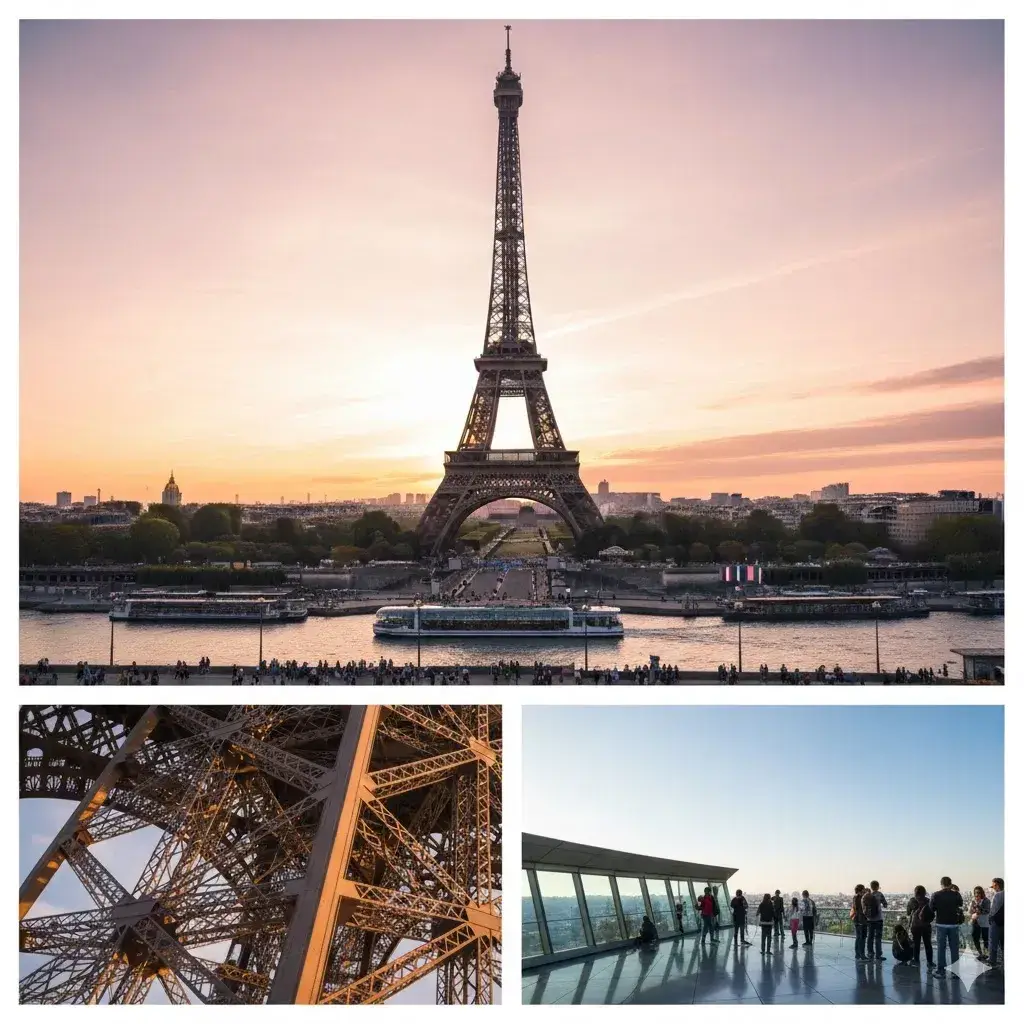
The Eiffel Tower: An Iconic Symbol of French Engineering and Cultural Resilience
Rising majestically above the Parisian skyline, the Eiffel Tower stands as one of the most recognizable structures in human history. This wrought-iron lattice tower, initially conceived as a temporary exhibition piece, has transcended its original purpose to become an enduring symbol of French ingenuity, cultural resilience, and architectural innovation. As we explore this magnificent monument in 2026, it continues to captivate millions of visitors annually, drawing them to witness not just a feat of engineering, but a testament to human ambition and artistic vision.
Located on the Champ de Mars in the 7th arrondissement of Paris, the Eiffel Tower reaches a staggering height of 330 meters (1,083 feet), making it the tallest structure in Paris and one of the most visited paid monuments in the world. Since its completion in 1889, the tower has witnessed over 130 years of history, surviving wars, criticism, and the test of time to emerge as France's most beloved icon. Its distinctive silhouette has become synonymous with romance, innovation, and the timeless allure of Paris itself.
This comprehensive guide delves deep into the fascinating story of the Eiffel Tower—from its controversial beginnings and groundbreaking construction to its engineering marvels, cultural significance, and ongoing preservation efforts. Whether you're planning your first visit or seeking to understand the tower's profound impact on French culture and global architecture, this exploration reveals why the Eiffel Tower remains not just a monument, but a living symbol of human achievement and national pride.
The Vision Behind the Tower: Origins and Purpose
The Eiffel Tower was born from an ambitious vision to create a spectacular centerpiece for the 1889 Exposition Universelle (World's Fair), held to commemorate the 100th anniversary of the French Revolution. In 1884, the French government announced a competition to design a monument that would demonstrate France's industrial prowess and technological advancement to the world. The challenge was to construct a tower 300 meters tall—a height never before achieved by human hands.
Among the 107 submissions, the design by Gustave Eiffel and his engineering company stood out for its boldness and innovation. While Eiffel's name is forever associated with the tower, the initial concept was actually developed by two of his chief engineers, Maurice Koechlin and Émile Nouguier, along with architect Stephen Sauvestre, who added the decorative arches and aesthetic refinements that gave the tower its elegant appearance.
Gustave Eiffel, already renowned for his expertise in metal construction and bridge building, recognized the project's potential and purchased the patent rights to the design. His company's experience with metal frameworks, particularly in railway bridges and the internal structure of the Statue of Liberty, positioned them perfectly to tackle this unprecedented challenge. The tower was intended to be a temporary structure, with a permit allowing it to stand for only 20 years before demolition.
Construction and Engineering Marvel
The construction of the Eiffel Tower, which began on January 28, 1887, represented one of the most ambitious engineering projects of the 19th century. The project employed approximately 300 workers who toiled for over two years, working in all weather conditions to assemble the tower's intricate iron framework. Remarkably, despite the dangerous nature of the work at extreme heights, only one worker died during construction—a testament to Eiffel's meticulous safety protocols and prefabrication techniques.
Key engineering achievements:
- Prefabrication Precision: All 18,038 metal parts were manufactured off-site in Eiffel's factory in Levallois-Perret, with holes drilled to precise specifications. This allowed for rapid assembly using 2.5 million rivets on-site.
- Wind Resistance: The tower's open-lattice design was specifically engineered to minimize wind resistance. The curved shape follows the mathematical curve of maximum strength against wind loads.
- Foundation Work: Each of the four legs rests on massive concrete foundations extending 15 meters (49 feet) deep, with hydraulic presses allowing for precise leveling during construction.
- Thermal Expansion: The tower can sway up to 12 centimeters (4.7 inches) in strong winds and expands by up to 15 centimeters (6 inches) in summer heat due to thermal expansion of the iron.
- 👉 Lithuania EES April 2026: Biometric Entry Guide
- 👉 ETIAS Romania 2026: Mandatory Authorization for Visa-Exempt Travelers
- 👉 Llama and Alpaca Trekking in Triesenberg: The Most Viral Nature Trend for 2026
The construction process was divided into distinct phases. First, workers built massive concrete foundations for each leg, using compressed air caissons for the sections near the Seine River. Then, the four legs were constructed simultaneously, rising at an angle until they met at the first platform at 57 meters. From there, the tower rose vertically through the second platform at 115 meters to the summit at 300 meters (original height).
Gustave Eiffel employed innovative techniques throughout the construction. He used movable scaffolding and steam-powered cranes that climbed with the tower as it rose. The precision of the work was extraordinary—despite the tower's massive scale, the holes for rivets aligned perfectly when the sections were brought together, requiring minimal adjustment.
Initial Controversy and Public Reception
Despite its current status as a beloved icon, the Eiffel Tower faced fierce opposition before and during its construction. In February 1887, a group of prominent French artists, writers, and intellectuals published a petition in the newspaper Le Temps protesting the tower's construction. Signatories included renowned figures like writer Guy de Maupassant, composer Charles Gounod, and poet François Coppée.
The petition famously described the tower as a "gigantic black factory chimney," a "hateful column of bolted sheet metal," and a "vertiginous and ridiculous tower" that would dominate Paris like "a tragic street lamp." Critics argued that the industrial aesthetic of iron and steel was incompatible with Paris's classical architecture and would permanently scar the city's beauty.
Gustave Eiffel defended his creation vigorously, arguing that the tower would have its own beauty derived from mathematical precision and engineering elegance. He stated, "For my part, I believe that the Tower will possess its own beauty. Are we to believe that because one is an engineer, one is not preoccupied by beauty in his constructions, or that in seeking to make them strong and durable, one does not also strive for grace and harmony?"
Interestingly, many critics changed their tune after the tower's completion and the success of the 1889 Exposition. The tower became an instant sensation, attracting nearly 2 million visitors during the exposition alone. However, some detractors remained stubborn—legend has it that Guy de Maupassant regularly ate lunch at the tower's restaurant because it was the only place in Paris where he didn't have to look at the structure he despised.
Architectural Design and Aesthetic Features
The Eiffel Tower's design represents a masterful blend of structural engineering and aesthetic consideration. Standing at 330 meters (including antennas), the tower is composed of puddled iron (a form of wrought iron), weighing approximately 10,100 metric tons. The metal framework consists of 18,038 individual parts connected by 2.5 million rivets, creating an intricate lattice pattern that is both visually striking and structurally efficient.
Three distinct levels:
- First Floor (57 meters/187 feet): Features a glass floor section allowing visitors to look directly down, a restaurant (58 Tour Eiffel), souvenir shops, and exhibition spaces detailing the tower's history.
- Second Floor (115 meters/377 feet): Offers the best panoramic views of Paris, housing the Michelin-starred restaurant Le Jules Verne, macaron bar, and observation decks with telescopes.
- Top Floor/Summit (276 meters/906 feet): Accessible by elevator, featuring Gustave Eiffel's restored office with wax figures, a champagne bar, and breathtaking 360-degree views extending up to 70 kilometers on clear days.
- 👉 Lithuania EES April 2026: Biometric Entry Guide
- 👉 ETIAS Romania 2026: Mandatory Authorization for Visa-Exempt Travelers
- 👉 Llama and Alpaca Trekking in Triesenberg: The Most Viral Nature Trend for 2026
The tower's distinctive brown color, officially called "Eiffel Tower Brown" (Brun Tour Eiffel), is actually a specially formulated paint applied in three shades—darker at the base and lighter at the top—to compensate for atmospheric perspective and create visual uniformity. The tower is repainted every seven years, requiring approximately 60 tons of paint and taking 18 months to complete. This ongoing maintenance protects the iron from rust and corrosion.
Stephen Sauvestre's architectural contributions added elegance to the engineering framework. He designed the decorative arches at the base (though only the north and south arches were fully realized), the glass pavilion on the first floor, and the cupola at the summit. These elements softened the industrial appearance and gave the tower a more monumental, triumphal character appropriate for its role as an entrance arch to the exposition.
Cultural Significance and Symbolism
Over its 135+ year history, the Eiffel Tower has evolved from a controversial temporary structure into France's most potent cultural symbol. It represents not just Paris or France, but embodies broader themes of human achievement, romanticism, and resilience. The tower has witnessed and survived two World Wars, numerous political upheavals, and dramatic social changes, emerging each time as a beacon of French identity and pride.
Symbol of French Innovation: The Eiffel Tower demonstrated France's leadership in engineering and industrial technology during the late 19th century. At a time when the Industrial Revolution was transforming societies, the tower showcased what human ingenuity could achieve through the application of scientific principles and modern materials.
Icon of Romance: The tower has become synonymous with romance and love, attracting countless proposals and serving as a backdrop for romantic moments. Its sparkling light display, added in 2000, enhances this romantic image, with thousands of bulbs creating a dazzling spectacle for five minutes every hour after dusk.
Wartime Resilience: During World War I, the tower served as a radio transmission tower, intercepting enemy communications and contributing to the Allied victory. In World War II, when Paris fell to Nazi Germany in 1940, the French cut the elevator cables to prevent Hitler from easily ascending the tower. The Führer chose not to climb the stairs, and the tower remained standing throughout the occupation—a silent symbol of French resistance.
Global Cultural Presence: The Eiffel Tower appears in countless films,文学作品, paintings, and advertisements, making it one of the most photographed and represented structures in the world. It has inspired replicas worldwide, from Las Vegas to Tokyo, though none match the original's presence and significance.
Technical Specifications and Modern Features
The Eiffel Tower's technical specifications continue to impress engineers and architects today. Beyond its original construction achievements, the tower has been continuously modernized to meet contemporary safety standards and visitor expectations while preserving its historic character.
Current specifications:
- Total Height: 330 meters (1,083 feet) including broadcast antennas
- Weight: Approximately 10,100 metric tons of puddled iron
- Number of Steps: 1,665 steps from ground to top (though visitors can only climb to the second floor)
- Elevators: Five modern elevators (two original hydraulic elevators from 1899 still operate on the east and west legs)
- Visitors: Approximately 7 million visitors annually (pre-pandemic figures)
- Staff: Over 500 employees, including 250 working directly for the operating company
- 👉 Lithuania EES April 2026: Biometric Entry Guide
- 👉 ETIAS Romania 2026: Mandatory Authorization for Visa-Exempt Travelers
- 👉 Llama and Alpaca Trekking in Triesenberg: The Most Viral Nature Trend for 2026
Modern additions and technology:
- Broadcasting: The tower serves as a transmission tower for radio and television broadcasts, with antennas adding 20+ meters to its height.
- Energy Efficiency: Solar panels installed on the first floor roof generate electricity for commercial facilities. LED lighting reduces energy consumption by 50% compared to previous systems.
- Wind Stabilization: Advanced monitoring systems track wind speed and tower movement in real-time, automatically closing upper levels when winds exceed safe limits.
- Security: Following global security concerns, the tower now features bulletproof glass walls, metal detectors, and enhanced surveillance while maintaining aesthetic integrity.
- 👉 Lithuania EES April 2026: Biometric Entry Guide
- 👉 ETIAS Romania 2026: Mandatory Authorization for Visa-Exempt Travelers
- 👉 Llama and Alpaca Trekking in Triesenberg: The Most Viral Nature Trend for 2026
The tower's elevators represent engineering marvels in their own right. The original hydraulic elevators, designed by Léon Edoux and installed in 1899, used water pressure to operate and remain in service on the east and west pillars. These historic elevators were complemented by modern electric elevators that provide faster, more efficient service to upper levels.
Visiting the Eiffel Tower: Practical Guide
For those planning to visit the Eiffel Tower in 2026, understanding the practical aspects ensures a memorable experience. The tower welcomes millions of visitors annually, making advance planning essential.
Ticket Options:
- Stairs to Second Floor: Most economical option (approximately €11.30 for adults). Climb 674 steps to the second floor. Recommended for those in good physical condition.
- Elevator to Second Floor: Standard option (approximately €23.10 for adults). Quick access with spectacular views during ascent.
- Elevator to Top: Premium experience (approximately €36.10 for adults). Includes access to all three levels and Gustave Eiffel's office.
- Guided Tours: Available in multiple languages, providing historical context and skip-the-line access.
- 👉 Lithuania EES April 2026: Biometric Entry Guide
- 👉 ETIAS Romania 2026: Mandatory Authorization for Visa-Exempt Travelers
- 👉 Llama and Alpaca Trekking in Triesenberg: The Most Viral Nature Trend for 2026
Best Times to Visit:
- Early Morning: Opening time (typically 9:00 AM) offers shorter lines and clearer views before crowds arrive.
- Sunset: Experience Paris transitioning from day to night, followed by the sparkling light show.
- Weekdays: Tuesday through Thursday typically see fewer visitors than weekends.
- Off-Season: November through March (excluding holidays) offer shorter wait times, though weather may be less favorable.
- 👉 Lithuania EES April 2026: Biometric Entry Guide
- 👉 ETIAS Romania 2026: Mandatory Authorization for Visa-Exempt Travelers
- 👉 Llama and Alpaca Trekking in Triesenberg: The Most Viral Nature Trend for 2026
Dining Options:
- 58 Tour Eiffel: First-floor restaurant offering contemporary French cuisine with panoramic views.
- Le Jules Verne: Second-floor Michelin-starred restaurant requiring advance reservations (dress code enforced).
- Champagne Bar: Summit-level bar serving premium champagne with breathtaking views.
- Macaron Bar: Second-floor café offering French pastries and light refreshments.
- 👉 Lithuania EES April 2026: Biometric Entry Guide
- 👉 ETIAS Romania 2026: Mandatory Authorization for Visa-Exempt Travelers
- 👉 Llama and Alpaca Trekking in Triesenberg: The Most Viral Nature Trend for 2026
Security and Accessibility: All visitors must pass through security screening. Large bags and suitcases are not permitted. The tower is partially accessible to visitors with reduced mobility, with elevators accommodating wheelchairs up to the second floor.
Preservation and Restoration Efforts
Maintaining the Eiffel Tower's structural integrity and aesthetic beauty requires continuous, meticulous care. The tower undergoes ongoing preservation efforts that balance historical authenticity with modern safety standards and environmental considerations.
The Painting Campaign: The most visible maintenance activity is the comprehensive repainting that occurs every seven years. This massive undertaking requires:
- 60 tons of specially formulated paint
- 50 painters working in teams
- 18 months to complete
- Removal of old paint layers and rust treatment
- Application of three coats in graduated shades
- 👉 Lithuania EES April 2026: Biometric Entry Guide
- 👉 ETIAS Romania 2026: Mandatory Authorization for Visa-Exempt Travelers
- 👉 Llama and Alpaca Trekking in Triesenberg: The Most Viral Nature Trend for 2026
The paint used is lead-free and environmentally friendly, reflecting modern ecological concerns. The three-shade gradient—darkest at the base, lightest at the top—compensates for atmospheric perspective, making the tower appear uniformly colored from ground level.
Structural Monitoring: Advanced technology continuously monitors the tower's condition:
- Sensors track wind speed, temperature, and structural movement
- Laser measurements detect millimeter-level shifts
- Regular ultrasonic testing examines metal thickness and integrity
- Corrosion prevention systems protect vulnerable areas
- 👉 Lithuania EES April 2026: Biometric Entry Guide
- 👉 ETIAS Romania 2026: Mandatory Authorization for Visa-Exempt Travelers
- 👉 Llama and Alpaca Trekking in Triesenberg: The Most Viral Nature Trend for 2026
Recent Renovations: Major projects in recent years include:
- 2018-2024: Comprehensive renovation of the first floor, including glass floors, new facilities, and improved visitor flow
- 2022: Installation of energy-efficient LED lighting system
- Ongoing: Elevator modernization while preserving historic hydraulic systems
- 👉 Lithuania EES April 2026: Biometric Entry Guide
- 👉 ETIAS Romania 2026: Mandatory Authorization for Visa-Exempt Travelers
- 👉 Llama and Alpaca Trekking in Triesenberg: The Most Viral Nature Trend for 2026
The Société d'Exploitation de la Tour Eiffel (SETE), the operating company, invests approximately €15-20 million annually in maintenance and preservation, ensuring the tower remains safe and spectacular for future generations.
Interesting Facts and Lesser-Known Details
Beyond its well-known status, the Eiffel Tower harbors numerous fascinating details that often escape casual visitors:
Secret Apartment: Gustave Eiffel built a private apartment for himself at the tower's summit, complete with furniture, a piano, and large windows offering panoramic views. He hosted famous guests including Thomas Edison. The apartment is now open to visitors, featuring wax figures of Eiffel and Edison.
Height Variations: The tower's height changes with temperature. In summer, thermal expansion can add up to 15 centimeters (6 inches) to its height. The tower also sways slightly in wind, moving up to 12 centimeters.
Names on the Tower: Gustave Eiffel had the names of 72 French scientists, engineers, and mathematicians inscribed on the first-floor frieze to honor their contributions to science and industry. These names were painted over in the early 20th century but restored in 1986-87.
Scrap Metal Sale: In 1925, con artist Victor Lustig famously "sold" the Eiffel Tower for scrap metal—not once, but twice! He convinced scrap dealers that the city couldn't afford maintenance and planned to demolish it. He escaped before his scheme was discovered.
Lighting Rights: The tower's nighttime illumination is copyrighted. While photographing the tower during the day is free, publishing professional photos of the illuminated tower at night technically requires permission from the operating company, though this is rarely enforced for personal use.
Ice Skating: During winter months, a temporary ice skating rink is sometimes installed on the first floor, offering a unique skating experience 57 meters above Paris.
The Eiffel Tower's Global Influence
The Eiffel Tower's impact extends far beyond Paris, influencing architecture, engineering, and popular culture worldwide. Its success demonstrated that metal could be used for monumental structures, paving the way for modern skyscrapers and contemporary architecture.
Architectural Legacy: The tower proved that structural honesty—where form follows function—could create beauty. This principle became fundamental to modernist architecture. The tower's lattice construction influenced later structures like radio towers, bridges, and observation towers globally.
Replicas Worldwide: Over 50 Eiffel Tower replicas exist worldwide, including:
- Las Vegas: Half-scale replica at Paris Las Vegas Hotel (165 meters)
- Tokyo: Tokyo Tower (333 meters), inspired by the Eiffel Tower
- Shenzhen: Window of the World theme park replica
- Texas: Paris, Texas replica with red cowboy hat
- 👉 Lithuania EES April 2026: Biometric Entry Guide
- 👉 ETIAS Romania 2026: Mandatory Authorization for Visa-Exempt Travelers
- 👉 Llama and Alpaca Trekking in Triesenberg: The Most Viral Nature Trend for 2026
Cultural Impact: The tower appears in countless films, from romantic comedies to action thrillers, serving as shorthand for Paris, romance, and adventure. It features in literature, art, music, and fashion, remaining one of the most recognizable symbols globally.
Conclusion: An Enduring Symbol of Human Achievement
More than 135 years after its completion, the Eiffel Tower continues to inspire awe, wonder, and admiration. What began as a controversial temporary exhibition piece has evolved into France's most enduring symbol—a testament to human ingenuity, artistic vision, and cultural resilience. The tower has survived wars, criticism, and the relentless passage of time to emerge as a beloved icon that represents not just Paris or France, but the boundless potential of human achievement.
Gustave Eiffel's masterpiece demonstrates that true innovation requires courage to defy convention, precision in execution, and vision to see beyond immediate criticism. The tower's elegant iron lattice, once condemned as an eyesome, now defines the Parisian skyline and captures hearts worldwide. Its story reminds us that greatness often faces initial resistance, but enduring quality and beauty ultimately triumph.
As we look toward the future, the Eiffel Tower stands ready to welcome new generations of visitors, continuing its role as a beacon of French culture, a marvel of engineering, and a symbol of the romantic spirit that defines Paris. Whether viewed from the Champ de Mars at sunset, admired from a Seine River cruise, or experienced from its lofty heights, the Eiffel Tower remains an unforgettable testament to what humanity can achieve when imagination meets determination.
La Tour Eiffel is more than a monument—it is a living symbol of dreams realized, challenges overcome, and beauty created. It invites us all to look upward, to reach higher, and to believe in the extraordinary possibilities that await when we dare to build our visions.
0 Comments