.webp)
.webp)
What Is Lithuania EES April 2026 Launch?
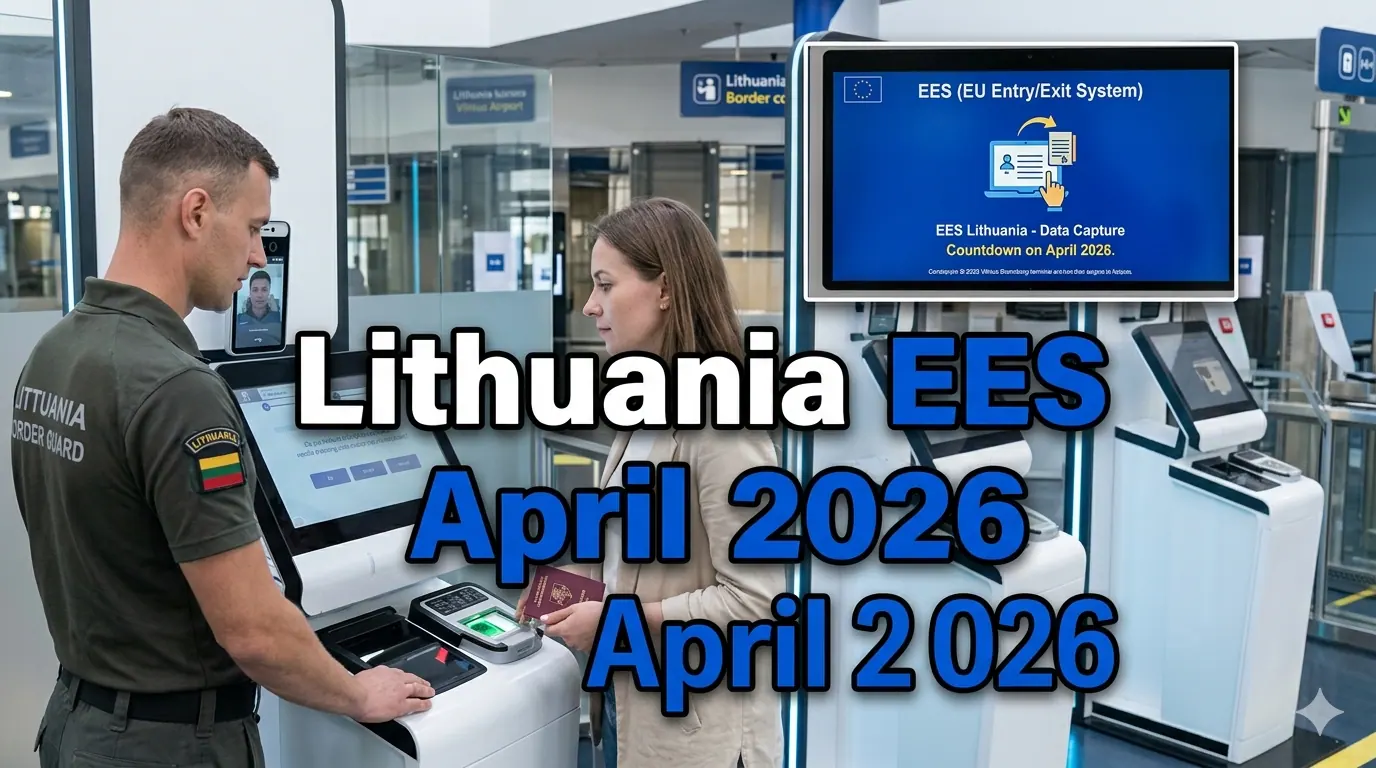
Lithuania EES April 2026 marks a significant transformation in how non-EU nationals enter and exit the Schengen Area through Lithuanian borders. The Entry/Exit System (EES) is an automated IT system designed to register third-country nationals traveling for short stays, replacing the current manual passport stamping process with advanced biometric technology.
Starting in April 2026, when you arrive at Vilnius Airport, Kaunas Airport, or any land border crossing into Lithuania from non-Schengen countries, you'll encounter a completely modernized border control process. The system will electronically record your personal data, including fingerprints and facial images, along with the date and place of your entry and exit. This digital transformation affects millions of travelers annually who visit Lithuania for tourism, business, or family visits.
The EES represents one of the most significant changes to Schengen border procedures in decades. For Lithuania, as a Baltic gateway between Western Europe and Eastern neighbors, this system enhances security while streamlining the entry process for legitimate travelers. The system automatically calculates the duration of your authorized stay, helping prevent overstays and ensuring compliance with the 90/180-day rule that governs short-stay visits in the Schengen Area.
Understanding what to expect during this transition is crucial for anyone planning to visit Lithuania in 2026 and beyond. Whether you're a frequent business traveler, tourist exploring Vilnius Old Town, or visiting family in Kaunas, being prepared for the new biometric entry requirements will ensure a smooth border crossing experience.
Who is affected by Lithuania EES April 2026?
The EES system applies to all third-country nationals, meaning citizens of countries outside the European Union, European Economic Area, and Switzerland. This includes travelers from the United States, United Kingdom, Canada, Australia, India, China, Russia, and many other nations who currently receive passport stamps when entering Lithuania. EU citizens and their family members are exempt from EES registration and will continue to use existing border control procedures.
Why Is Lithuania Implementing EES in April 2026?

Lithuania's implementation of the Entry/Exit System in April 2026 is part of a broader European Union initiative to strengthen external border security while facilitating legitimate travel. The decision to launch EES stems from several critical factors that affect both security and traveler experience across the Schengen Area.
First and foremost, the manual passport stamping system has become increasingly inadequate for managing the volume of international travel in the 21st century. With millions of travelers crossing EU external borders annually, the old system was prone to errors, difficult to monitor effectively, and provided limited data for security analysis. The EES creates a comprehensive digital record that border authorities can access instantly, improving both efficiency and security.
Second, the system addresses a significant gap in border management: tracking overstays. Under the manual system, it was challenging to identify individuals who exceeded their permitted 90-day stay within any 180-day period. The EES automatically calculates authorized stay duration and flags potential overstays, helping Lithuania and other Schengen countries maintain immigration control integrity.
Third, biometric data collection significantly enhances security by preventing identity fraud and the use of forged travel documents. Fingerprints and facial images are unique identifiers that cannot be easily replicated or stolen, making it much harder for individuals to enter the Schengen Area under false identities or with counterfeit documents.
For Lithuania specifically, as a country sharing borders with both Schengen members (Latvia and Poland) and non-Schengen states (Belarus and Russia's Kaliningrad region), the EES provides crucial tools for managing complex border dynamics. The system helps distinguish between legitimate travelers and potential security risks while maintaining Lithuania's commitment to facilitating tourism and business travel.
What happens if EES is delayed again?
The EES launch has been postponed several times since its original 2022 target date. If April 2026 sees another delay, the current manual passport stamping system will remain in place until further notice. Travelers should monitor official EU and Lithuanian government announcements closer to the planned launch date. However, all indications suggest that April 2026 represents a firm commitment, with extensive testing and infrastructure preparation already underway at Lithuanian border checkpoints.
What Biometric Data Will Be Collected at Lithuania Borders?

When you arrive at a Lithuanian border checkpoint after the April 2026 EES launch, border guards will collect specific biometric information that becomes part of your digital travel record. Understanding exactly what data is collected helps you prepare mentally and practically for the new entry process.
Fingerprints: The system will capture digital fingerprints from all four fingers of each hand. This process takes just seconds using specialized scanners at the border control booth. The fingerprints are stored securely in the EES database and linked to your travel document number. On subsequent entries to any Schengen country within the system's retention period, your fingerprints can be verified against the stored data, potentially speeding up the entry process.
Facial Image: A digital photograph will be taken using a camera integrated into the border control system. This isn't just a standard passport photo—it's a biometric facial image that captures specific facial features and measurements. The image serves multiple purposes: verifying your identity against your travel document, enabling automated border control gates for future entries, and providing an additional security layer to prevent document fraud.
Travel Document Data: The system electronically reads the machine-readable zone (MRZ) of your passport, capturing information such as your name, date of birth, nationality, passport number, and expiration date. This data is cross-checked against the biometric information to ensure consistency and authenticity.
Entry and Exit Records: Each time you cross the border, the system records the specific date, time, and location of entry or exit. For Lithuania, this might be Vilnius Airport, the Medininkai land border crossing, or the Klaipėda seaport. These records create a complete travel history within the Schengen Area.
Refusal of Entry Records: If entry is denied for any reason, this information is also recorded in the EES, along with the grounds for refusal. This helps prevent individuals who have been refused entry from attempting to enter through different Schengen countries.
Is biometric data safe in the EES system?
Yes, the EES employs state-of-the-art encryption and data protection measures compliant with EU General Data Protection Regulation (GDPR) standards. Biometric data is stored in secure EU data centers with strict access controls. Only authorized border control officials can access the information, and only for legitimate border management purposes. The data is automatically deleted after three years from your last recorded exit, or sooner if you obtain EU citizenship or long-term residence status.
Step-by-Step: What to Expect at Lithuania Border Control

Knowing exactly what will happen when you arrive at a Lithuanian border checkpoint helps reduce anxiety and ensures you're prepared for the new process. Here's a detailed breakdown of the EES entry procedure you'll experience starting April 2026:
Step 1: Queue Selection
Upon reaching the border control area at Vilnius Airport or a land border, you'll see separate lanes for EU/EEA/Swiss citizens and third-country nationals. As a non-EU traveler subject to EES, you'll join the third-country national queue. Some airports may have dedicated EES lanes clearly marked with signage.
Step 2: Document Submission
When you reach the border control booth, present your valid passport to the border guard. Ensure your passport is machine-readable and has at least three months validity beyond your intended departure date from the Schengen Area. The border guard will scan your passport's machine-readable zone, which automatically populates your data into the EES system.
Step 3: First-Time Registration (4-5 minutes)
If this is your first entry into the Schengen Area under EES (or if your previous biometric data has expired after three years), you'll undergo full registration. The border guard will instruct you to place your fingers on the fingerprint scanner—typically starting with the four fingers of your right hand, then the left hand, and finally both thumbs. The scanner captures high-quality digital images in seconds.
Next, you'll be asked to look at a camera for your facial image. Remove glasses if they have thick frames or tinted lenses, and ensure your face is clearly visible. The camera may take multiple images to ensure quality standards are met. This entire registration process takes approximately 4-5 minutes for first-time users.
Step 4: Verification Questions
The border guard will ask standard entry questions: the purpose of your visit, intended duration of stay, where you'll be staying, and whether you have sufficient funds for your visit. Answer clearly and honestly. Have supporting documents ready if requested, such as hotel reservations, invitation letters, or proof of financial means.
Step 5: System Check and Authorization
While you're providing biometric data, the EES system simultaneously checks your information against various security databases, including the Schengen Information System (SIS), Interpol's Stolen and Lost Travel Documents database, and national watchlists. The system also calculates whether your intended stay complies with the 90/180-day rule based on your previous Schengen visits.
Step 6: Subsequent Entries (30-60 seconds)
On future entries to any Schengen country within three years, the process is significantly faster. You'll still present your passport, but instead of full registration, the system will verify your identity by comparing your fingerprints or facial image against the stored data. This verification takes just 30-60 seconds, after which you'll be granted entry if all conditions are met.
Step 7: Exit Recording
When you leave Lithuania or any Schengen country, you'll pass through border control again. The border guard will scan your passport and may take fingerprints or a facial image to confirm your identity before recording your exit. This exit record is crucial as it stops the clock on your 90-day allowance and proves you complied with visa conditions.
How long will border crossing take with EES?
For first-time registration, expect the entire border control process to take 5-10 minutes, compared to 2-3 minutes under the old stamping system. However, subsequent entries will be faster, typically taking 1-2 minutes—similar to or even quicker than the current system. Lithuanian authorities are implementing additional staff and automated border control gates to minimize wait times during the transition period.
How to Prepare for EES Biometric Entry at Lithuania Borders

Proper preparation ensures your first EES border crossing in Lithuania goes smoothly. Follow these practical steps before your April 2026 trip or any travel after the system launch:
Check Passport Validity and Condition
Your passport must be machine-readable with a biometric chip (indicated by the small camera symbol on the cover). Ensure it has at least three months validity beyond your planned departure date from the Schengen Area. Damaged passports, those with peeling laminate or broken chips, may be rejected. If your passport is old or damaged, renew it before traveling.
Understand the 90/180-Day Rule
The EES system automatically tracks your Schengen stays. Make sure you understand that you can spend a maximum of 90 days within any rolling 180-day period in the entire Schengen Area, not just Lithuania. Use online calculators before traveling to verify you haven't exceeded this limit. The EES will deny entry if you've overstayed, regardless of how much time you've spent specifically in Lithuania.
Gather Supporting Documents
While not always requested, having these documents readily accessible speeds up the border control process:
- Return or onward flight tickets
- Hotel reservations or proof of accommodation
- Travel insurance covering at least €30,000 in medical expenses
- Proof of sufficient funds (bank statements, credit cards)
- Invitation letter if visiting family or friends
- Business invitation or conference registration for work trips
Prepare for Biometric Capture
Ensure your fingers are clean and free from temporary marks like henna, cuts, or bandages that could interfere with fingerprint scanning. If you have permanent finger injuries or conditions that prevent fingerprint capture, inform the border guard—they'll note this in the system and rely more heavily on facial recognition. Remove heavy makeup, face coverings, or thick-framed glasses for the facial image capture.
Arrive Early at Border Crossings
During the initial months after EES implementation, expect longer processing times as both travelers and border guards adjust to the new system. At Vilnius Airport, arrive at least 3 hours before international flights. At land borders, check current wait times on the Lithuanian State Border Guard Service website and plan accordingly, especially during peak travel seasons.
Download the EES Calculator App
The European Commission offers an online calculator to track your Schengen stay days. While not officially required, using this tool helps you stay compliant with the 90/180-day rule and avoid unexpected entry refusals.
Keep Records of Your Travels
Although the EES maintains digital records, it's wise to keep your own documentation of entry and exit dates, boarding passes, and accommodation receipts. This proves invaluable if there are any system errors or disputes about your travel history.
What if my fingerprints can't be captured?
If fingerprints cannot be captured due to temporary conditions (cuts, burns, henna) or permanent disabilities, the border guard will note this in the EES system. You'll still be registered using your facial image and passport data. On subsequent entries, identity verification will rely primarily on facial recognition. Carry medical documentation if you have a permanent condition affecting your fingerprints.
EES Impact on Different Types of Travelers

The Lithuania EES April 2026 launch affects various traveler categories differently. Understanding how the system applies to your specific situation helps you prepare appropriately:
Tourists and Short-Term Visitors
If you're visiting Lithuania for tourism, sightseeing in Vilnius, exploring the Curonian Spit, or attending cultural events, you'll undergo the standard EES registration process. The system helps ensure you don't accidentally overstay the 90-day limit. Keep in mind that days spent in any Schengen country count toward your total—time in France, Germany, or Spain all adds up.
Business Travelers
Frequent business visitors to Lithuania benefit significantly from EES after the initial registration. Once your biometric data is stored, subsequent entries through Vilnius Airport or other Schengen points become faster. However, ensure your business activities comply with short-stay visa rules—EES doesn't change what you're permitted to do in Lithuania, only how your entries and exits are recorded.
Transit Passengers
If you're transiting through Vilnius Airport to a non-Schengen destination, you may still be subject to EES registration depending on your nationality and whether you pass through border control. International transit areas typically don't require EES registration, but if you need to collect baggage or change terminals requiring exit from the transit zone, you'll go through border control and EES processing.
Family Members of EU Citizens
If you're a non-EU family member of an EU citizen exercising free movement rights, you're technically exempt from EES registration. However, you must present proof of the family relationship (marriage certificate, birth certificate) and evidence that you're accompanying or joining the EU family member. Border guards may still record your entry electronically, but the full biometric registration isn't mandatory.
Long-Stay Visa Holders and Residence Permit Holders
If you hold a Lithuanian long-stay visa (type D) or residence permit, you're generally exempt from EES as the system only applies to short-stay travelers. However, if you travel to other Schengen countries for short visits, those countries may record your entry in EES. Always carry your valid residence permit when traveling.
Cruise Ship Passengers
Lithuania's Klaipėda port receives numerous cruise ships. If you're disembarking in Klaipėda for a shore excursion or beginning/ending your cruise there, you'll go through EES processing at the port border control. Cruise passengers on closed-loop itineraries (starting and ending in the same port) may have simplified procedures, but confirm with your cruise line.
Does EES apply to UK citizens after Brexit?
Yes, UK citizens are now considered third-country nationals following Brexit and are subject to EES registration when entering Lithuania or any Schengen country. This applies regardless of whether you're traveling for tourism, business, or visiting family. UK citizens can still visit visa-free for up to 90 days in any 180-day period, but must now provide biometric data under EES.
Common Challenges and How to Overcome Them

While the EES system improves border security and efficiency long-term, the initial implementation may present some challenges. Being aware of potential issues helps you navigate them effectively:
Longer Wait Times During Transition
The first few months after April 2026 may see increased queues at border checkpoints as travelers adapt to the new process and border guards gain experience with the system. To minimize delays:
- Travel during off-peak hours when possible
- Use automated border control gates if eligible (some airports offer these for returning travelers)
- Have all documents organized and easily accessible
- Be patient and cooperative with border staff
Technical System Failures
Like any large-scale IT system, EES may experience occasional technical glitches. If the system is temporarily unavailable, border guards will revert to manual procedures, which can be slower. In rare cases where technical issues prevent registration, you may be allowed entry with instructions to complete registration at a later date. Always keep documentation of such exceptions.
Data Accuracy Concerns
Ensure the information the border guard enters matches your passport exactly. If you notice any discrepancies in how your name or other details are recorded, politely point this out immediately. Corrections are easier to make at the time of entry than later. Request a printout of your entry record if available.
Confusion About 90/180-Day Calculations
The rolling 180-day period can be confusing, especially for frequent travelers. The EES calculates this automatically, but you should independently track your days to avoid surprises. Remember that the 180-day period rolls forward each day—it's not fixed calendar periods. Days spent in the Schengen Area before EES implementation won't be in the system, so keep your own records of pre-2026 travel.
Privacy Concerns
Some travelers worry about biometric data storage. Remember that EES data protection follows strict EU GDPR regulations. Your biometric data is only used for border control purposes, stored securely, and automatically deleted after three years. You have the right to access your data and request corrections if needed by contacting the Lithuanian State Border Guard Service or the relevant data protection authority.
What happens if I overstay under EES?
The EES system automatically flags overstays, making it nearly impossible to leave and re-enter the Schengen Area undetected after exceeding your permitted stay. Consequences include entry bans, fines, deportation, and difficulties obtaining future visas. If you face exceptional circumstances preventing timely departure (medical emergency, flight cancellations), immediately contact the Migration Department of Lithuania to regularize your status before overstaying.
EES vs ETIAS: Understanding the Difference

Many travelers confuse the Entry/Exit System (EES) with the European Travel Information and Authorization System (ETIAS). While both are EU border management systems launching around the same time, they serve different purposes and affect travelers differently:
EES (Entry/Exit System)
- Launch: April 2026
- What it does: Registers biometric data (fingerprints, facial image) and records entry/exit dates
- Who it affects: All third-country nationals, including visa-exempt and visa-required travelers
- When it applies: At every border crossing
- Cost: Free
- Validity: Data stored for 3 years
- Application: Done at border control, not in advance
ETIAS (European Travel Information and Authorization System)
- Launch: Expected mid-2025 (before EES)
- What it does: Pre-travel security screening and travel authorization
- Who it affects: Only visa-exempt third-country nationals (like US, UK, Canadian citizens)
- When it applies: Before travel, online application required
- Cost: €7 (free for under 18 and over 70)
- Validity: 3 years or until passport expires
- Application: Online, at least 96 hours before travel
How They Work Together
Starting in 2026, visa-exempt travelers visiting Lithuania will need both ETIAS authorization (obtained online before travel) and EES registration (completed at the border). ETIAS is a pre-screening check, while EES is the actual entry/exit recording system. Think of ETIAS as permission to travel and EES as the border control process.
If you require a visa to enter Lithuania (such as citizens of India, China, Russia, many African nations), you'll only need EES registration at the border—ETIAS doesn't apply to visa-required travelers since you've already undergone vetting during the visa application process.
Do I need both ETIAS and EES for Lithuania?
If you're a visa-exempt traveler (US, UK, Canadian, Australian citizens, etc.), yes, you'll need both: ETIAS authorization before your trip and EES biometric registration when you arrive at the Lithuanian border. If you need a Schengen visa for Lithuania, you only need EES registration at the border—ETIAS doesn't apply to you.
Practical Travel Tips for Lithuania in 2026

Beyond understanding EES, here are essential tips for traveling to Lithuania in 2026:
Best Time to Visit
Lithuania offers distinct seasonal experiences. Summer (June-August) features long daylight hours, warm weather perfect for exploring Vilnius Old Town and the Baltic coast, and numerous festivals including the Pink Soup Fest. Spring (April-May) brings blooming parks and fewer crowds. Autumn (September-October) showcases stunning fall colors, especially in Trakai. Winter (November-March) offers Christmas markets and winter sports but shorter days and colder temperatures.
Visa Requirements
Check whether you need a Schengen visa well in advance of your trip. Citizens of over 60 countries can visit Lithuania visa-free for up to 90 days. If you need a visa, apply at the Lithuanian embassy or consulate in your country at least 15 days before travel, though applying 1-2 months ahead is recommended. The visa fee is €80 for adults.
Currency and Payments
Lithuania uses the Euro (€). Credit and debit cards are widely accepted in cities, but carry some cash for small vendors, markets, and rural areas. ATMs are readily available in Vilnius, Kaunas, and other cities. Notify your bank of travel plans to avoid card blocks.
Transportation
Vilnius Airport connects to the city center by bus (€1, 30 minutes) or taxi (€15-20, 15 minutes). Within cities, public transport is efficient and affordable. For intercity travel, buses and trains connect major destinations. Consider renting a car to explore rural areas and the Curonian Spit at your own pace.
Accommodation
Book accommodation in advance, especially for summer visits and festivals. Vilnius offers everything from budget hostels (€25-40/night) to luxury hotels (€150+/night). Consider staying in the Old Town for easy access to attractions, or in Užupis for a bohemian atmosphere.
Language
Lithuanian is the official language, but English is widely spoken in tourist areas, hotels, and restaurants, especially among younger people. Learning basic Lithuanian phrases like "Labas" (hello) and "Ačiū" (thank you) is appreciated by locals.
Connectivity
Free WiFi is available in most hotels, cafes, and public spaces. Consider purchasing a local SIM card or an EU-wide eSIM for data coverage. EU residents can use their home mobile plans under roaming rules.
Health and Safety
Lithuania is one of Europe's safest countries with low crime rates. Tap water is safe to drink. EU citizens should bring a European Health Insurance Card (EHIC). Other travelers should purchase comprehensive travel insurance covering at least €30,000 in medical expenses, which is also a Schengen visa requirement.
What are must-see attractions in Lithuania?
Don't miss Vilnius Old Town (UNESCO World Heritage site), Trakai Island Castle, the Hill of Crosses near Šiauliai, the Curonian Spit with its unique sand dunes, and Kaunas Old Town. For nature lovers, Aukštaitija National Park offers pristine lakes and forests. Each destination provides unique insights into Lithuanian history, culture, and natural beauty.
Final Checklist for Lithuania EES April 2026 Travel

As your Lithuania trip approaches, use this comprehensive checklist to ensure you're fully prepared for EES border control:
Before Booking:
☐ Verify passport validity (3+ months beyond departure)
☐ Check if you need a Schengen visa or are visa-exempt
☐ Confirm ETIAS requirement (if visa-exempt)
☐ Research 90/180-day rule compliance
☐ Purchase travel insurance (€30,000+ medical coverage)
Before Travel:
☐ Apply for visa if required (1-2 months ahead)
☐ Obtain ETIAS authorization if applicable (€7, apply 96+ hours before travel)
☐ Book accommodation and keep confirmations
☐ Purchase return/onward flight tickets
☐ Prepare proof of sufficient funds
☐ Download EES stay calculator app
☐ Make copies of important documents
☐ Notify bank of travel plans
At the Border:
☐ Have passport readily accessible
☐ Organize supporting documents (hotel bookings, return ticket, insurance)
☐ Ensure fingers are clean for fingerprint scanning
☐ Remove glasses/face coverings for facial image
☐ Answer border guard questions clearly and honestly
☐ Verify entry data accuracy before leaving the booth
☐ Keep entry documentation if provided
During Your Stay:
☐ Track your Schengen days carefully
☐ Keep accommodation receipts and travel records
☐ Respect the 90-day limit
☐ Carry passport/ID at all times (legal requirement)
☐ Enjoy Lithuania responsibly!
At Exit:
☐ Allow extra time for border control
☐ Present passport for exit recording
☐ Verify exit is recorded properly
☐ Keep boarding pass as proof of departure
Conclusion: Embracing Lithuania's Digital Border Future
The Lithuania EES April 2026 launch represents a significant evolution in how we experience international travel. While the new biometric entry system may seem daunting initially, it ultimately creates a more secure, efficient, and streamlined border control process for legitimate travelers.
Understanding what to expect—从 fingerprint scanning to facial recognition, from the 90/180-day rule to proper documentation preparation—empowers you to navigate the new system confidently. The initial registration takes just a few minutes, and subsequent entries become faster and smoother.
Lithuania remains one of Europe's most welcoming and fascinating destinations, offering rich history, stunning architecture, beautiful nature, and warm hospitality. The EES system doesn't change what makes Lithuania special; it simply modernizes how visitors enter the country.
By preparing properly, understanding your rights and obligations, and approaching the new system with patience, your Lithuania travel experience in 2026 and beyond will be seamless. The biometric entry process is a small price to pay for enhanced security and the convenience of automated border control on future visits.
Mark your calendars, prepare your documents, and get ready to explore everything Lithuania has to offer—from the cobblestone streets of Vilnius Old Town to the mystical Hill of Crosses, from Baltic beaches to tranquil lakes. The EES system is simply the gateway to your Lithuanian adventure.
0 Comments