.webp)
.webp)
Maiden Tower Mystery: Qız Qalası Baku Guide 2026
Introduction: Baku's Most Enigmatic Monument
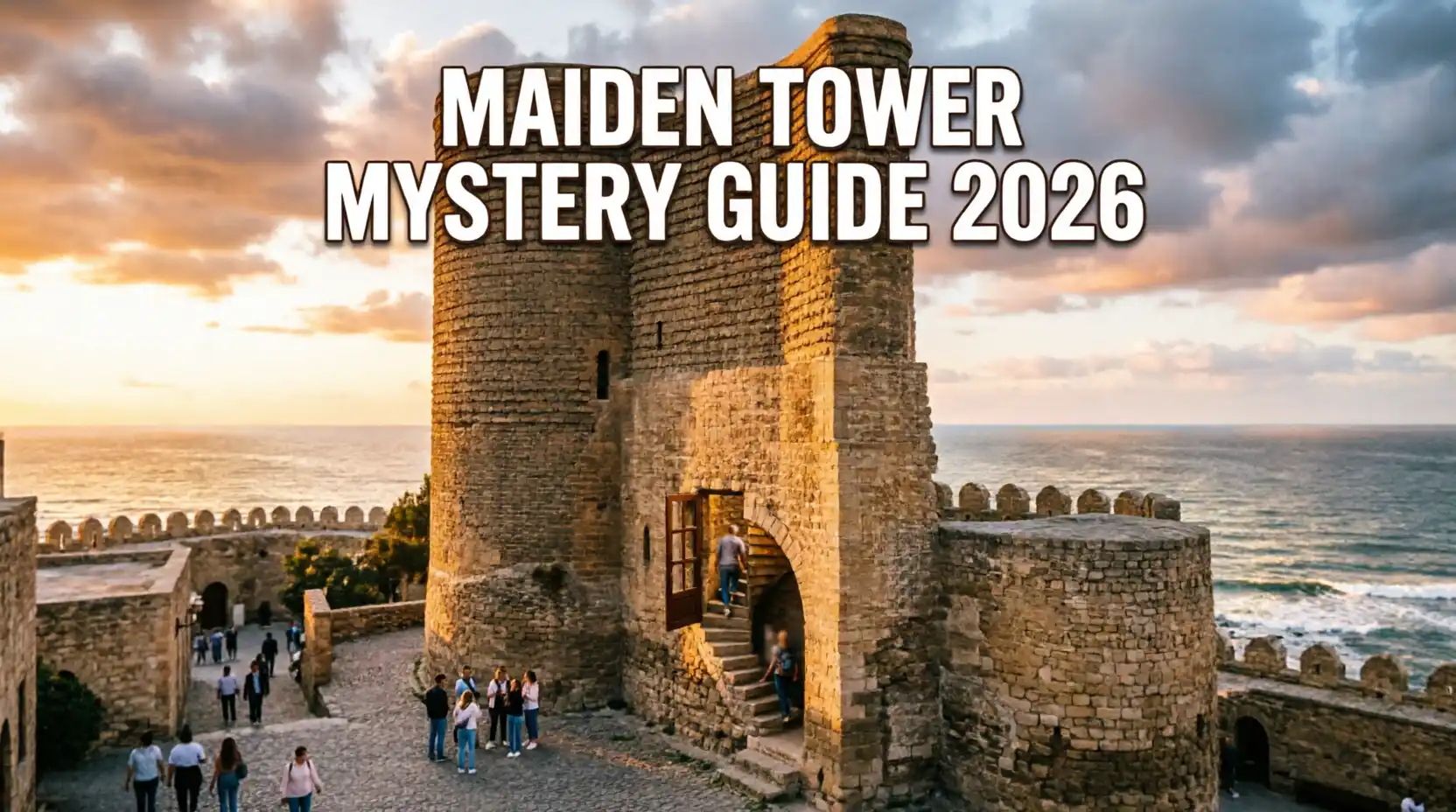
Rising 29.5 meters above the ancient streets of Baku's Old City, the Maiden Tower (Qız Qalası in Azerbaijani) stands as one of Azerbaijan's most iconic and mysterious landmarks. This cylindrical stone tower, with its thick walls, enigmatic orientation, and debated purpose, has captivated historians, architects, and travelers for centuries. Despite extensive archaeological study, fundamental questions about the tower remain unanswered: When was it built? Why was it constructed? What purpose did it originally serve?
Designated a UNESCO World Heritage Site in 2000 as part of the Walled City of Baku, the Maiden Tower has become a symbol of Azerbaijan itself, appearing on the national currency, postage stamps, and official emblems. Yet beneath its status as a national icon lies a web of mysteries that continue to puzzle scholars. The tower's unusual architecture—featuring walls that thicken from 5 meters at the base to just 2.5 meters at the top, an entrance positioned 7 meters above ground level, and a mysterious well-like shaft running through its center—defies simple explanation.
This comprehensive guide explores every facet of the Maiden Tower: the competing theories about its origin and purpose, the tragic legends that give it its name, the architectural features that make it unique, and the practical information you need to visit and climb this ancient monument. Whether you're drawn by historical intrigue, architectural fascination, or the simple desire to stand atop one of the Caucasus region's most enigmatic structures, understanding the Maiden Tower's mysteries enhances every aspect of your visit to Baku's Old City.
The Enduring Mystery: What Was the Maiden Tower Built For?

What makes the Maiden Tower so mysterious?
The Maiden Tower's greatest allure lies in the fundamental uncertainty surrounding its original purpose. Unlike many historical monuments whose functions are well-documented, the Qız Qalası has generated multiple competing theories, each supported by different strands of evidence but none definitively proven. This scholarly debate is precisely what makes the tower so fascinating to visitors and researchers alike.
Major theories about the tower's original purpose:
- Zoroastrian Fire Temple: The most widely accepted theory suggests the tower served as a Zoroastrian fire temple, with the upper platform used for sacred fire rituals. The tower's orientation, the presence of a well shaft (possibly for ritual purification), and Azerbaijan's ancient Zoroastrian heritage support this theory.
- Defensive Fortress: Some historians argue the tower was part of Baku's medieval defensive system, serving as a watchtower or keep. The thick walls, elevated entrance, and strategic position overlooking Baku Bay support a military function.
- Astronomical Observatory: A compelling theory proposes the tower functioned as an astronomical observatory, with specific architectural features aligned to celestial events. The tower's orientation and certain internal features may relate to solar and stellar observations.
- Mausoleum or Tomb: Some scholars suggest the tower was built as a royal mausoleum, though no burial remains have been discovered to confirm this theory.
- Mithraic Temple: A less common theory proposes the tower was dedicated to Mithra, an ancient Indo-Iranian deity, based on certain architectural parallels with Mithraic temples elsewhere.
- Multifunctional Structure: Many researchers now believe the tower likely served multiple purposes over its long history, evolving from religious to defensive to ceremonial functions as Baku itself changed.
- 👉 আজারবাইজান ভিসা ২০২৬: বাংলাদেশী নাগরিকদের জন্য ই-ভিসা ও আবেদন নিয়ম
- 👉 Vietnam Unveiled: A 2026 Roadmap from Sapa’s Peaks to the Mekong’s Pulse
- 👉 Taiwan: Bloomberg's #1 Safest Solo Travel Destination 2026
Why the mystery persists:
- Lack of contemporary documentation: No written records from the tower's construction period survive to explain its purpose
- Multiple construction phases: Evidence suggests the tower was modified over centuries, obscuring original features
- Unique architecture: The tower's design doesn't perfectly match any single building typology from the region
- Later modifications: Medieval and modern alterations have changed or hidden original architectural elements
- Conflicting archaeological evidence: Different excavations have produced evidence supporting different theories
- 👉 আজারবাইজান ভিসা ২০২৬: বাংলাদেশী নাগরিকদের জন্য ই-ভিসা ও আবেদন নিয়ম
- 👉 Vietnam Unveiled: A 2026 Roadmap from Sapa’s Peaks to the Mekong’s Pulse
- 👉 Taiwan: Bloomberg's #1 Safest Solo Travel Destination 2026
This enduring uncertainty is precisely what makes visiting the Maiden Tower so compelling. As you climb its ancient stone stairs, you're not just ascending a monument—you're engaging with a puzzle that has challenged some of the region's finest minds for generations.
Dating the Tower: When Was It Built?

How old is the Maiden Tower?
The question of when the Maiden Tower was constructed is almost as controversial as why it was built. Dating the tower has proven challenging due to multiple construction phases, later modifications, and the difficulty of applying standard archaeological dating methods to such a unique structure.
Competing date ranges proposed by scholars:
- 4th-6th century AD: Some researchers, based on architectural style comparisons and limited archaeological evidence, argue for a late antique or early medieval origin, possibly during the Sassanian Persian period.
- 8th-9th century AD: A middle-ground theory places construction in the early Islamic period, when Baku was growing in importance as a Caspian port city.
- 11th-12th century AD: The most commonly cited dating, supported by architectural analysis and some archaeological findings, places the tower's construction in the 11th or 12th century during the Shirvanshah period.
- 12th century specifically: An inscription on the tower reads "Qubbeye-Mesud" (Masud's Dome), which some scholars interpret as referring to architect Masud ibn Davud, suggesting construction around the 12th century.
- 👉 আজারবাইজান ভিসা ২০২৬: বাংলাদেশী নাগরিকদের জন্য ই-ভিসা ও আবেদন নিয়ম
- 👉 Vietnam Unveiled: A 2026 Roadmap from Sapa’s Peaks to the Mekong’s Pulse
- 👉 Taiwan: Bloomberg's #1 Safest Solo Travel Destination 2026
Evidence used for dating:
- Architectural style: Comparison with other regional towers and fortifications
- Stone masonry techniques: Analysis of cutting, fitting, and bonding methods
- Archaeological excavations: Limited digs around the tower base have uncovered artifacts from different periods
- Historical records: Medieval chronicles mentioning Baku's fortifications
- Inscriptions: The "Masud's Dome" inscription, though its interpretation is disputed
- Carbon dating: Limited organic material available for radiocarbon analysis
- 👉 আজারবাইজান ভিসা ২০২৬: বাংলাদেশী নাগরিকদের জন্য ই-ভিসা ও আবেদন নিয়ম
- 👉 Vietnam Unveiled: A 2026 Roadmap from Sapa’s Peaks to the Mekong’s Pulse
- 👉 Taiwan: Bloomberg's #1 Safest Solo Travel Destination 2026
Most likely scenario:
Current scholarly consensus, though not universal, suggests the tower was built in the 11th or 12th century, possibly on the site of an earlier structure. The tower likely underwent modifications in subsequent centuries, particularly during the Shirvanshah period (12th-16th centuries) when Baku flourished as a regional capital.
What's certain is that the Maiden Tower has stood watch over Baku Bay for at least 800-900 years, witnessing the rise and fall of empires, the transformation of the city from medieval port to modern capital, and countless generations of visitors who, like you, have gazed up at its mysterious form and wondered about its secrets.
Architectural Features: A Masterpiece of Medieval Engineering

What makes the Maiden Tower's architecture unique?
The Maiden Tower's architectural design is as enigmatic as its purpose, featuring several unusual characteristics that distinguish it from other medieval towers in the region. Understanding these features enhances appreciation of the structure and provides clues—though not definitive answers—about its original function.
Overall dimensions and structure:
- Height: 29.5 meters (97 feet) from ground to top platform
- Diameter: Approximately 10.7 meters (35 feet) at the base
- Wall thickness: Remarkably, walls taper from 5 meters (16.4 feet) at the base to just 2.5 meters (8.2 feet) at the top
- Shape: Cylindrical tower with a slight eastward lean
- Foundation: Built on solid rock foundation extending into the bedrock
- 👉 আজারবাইজান ভিসা ২০২৬: বাংলাদেশী নাগরিকদের জন্য ই-ভিসা ও আবেদন নিয়ম
- 👉 Vietnam Unveiled: A 2026 Roadmap from Sapa’s Peaks to the Mekong’s Pulse
- 👉 Taiwan: Bloomberg's #1 Safest Solo Travel Destination 2026
The mysterious entrance:
One of the tower's most puzzling features is its entrance, positioned approximately 7 meters (23 feet) above ground level on the eastern side. This elevated entrance would have required a ladder or removable staircase for access—a defensive feature if the tower was military, or possibly a symbolic threshold if religious.
Today, visitors enter through a modern doorway at ground level created during 20th-century renovations, but the original high entrance remains visible on the eastern facade.
Internal layout:
The tower contains eight floors connected by a narrow spiral staircase built into the thick stone walls. Each floor features a small window or opening, with the upper floors offering increasingly spectacular views of Baku Bay and the Old City.
- Floors 1-3: Smaller spaces, possibly used for storage or ritual purposes
- Floors 4-6: Slightly larger chambers with better lighting
- Floor 7: penultimate level with windows on multiple sides
- Floor 8: Top platform, the tower's crowning feature
- 👉 আজারবাইজান ভিসা ২০২৬: বাংলাদেশী নাগরিকদের জন্য ই-ভিসা ও আবেদন নিয়ম
- 👉 Vietnam Unveiled: A 2026 Roadmap from Sapa’s Peaks to the Mekong’s Pulse
- 👉 Taiwan: Bloomberg's #1 Safest Solo Travel Destination 2026
The central shaft mystery:
Perhaps the tower's most intriguing internal feature is a vertical shaft running from the top platform down through the center of the structure to what appears to be a well or water source at the base. This shaft is approximately 0.5 meters in diameter and its purpose remains hotly debated:
- Ritual purification theory: If the tower was a Zoroastrian fire temple, the shaft may have provided water for ritual cleansing ceremonies
- Ventilation theory: The shaft may have ventilated smoke from a sacred fire burning at the top
- Acoustic theory: Some suggest the shaft amplified sound for astronomical or religious observations
- Structural theory: The shaft may have been a construction feature or served to reduce the tower's weight
- Astronomical observation: The shaft might have been used to observe celestial events at specific times of year
- 👉 আজারবাইজান ভিসা ২০২৬: বাংলাদেশী নাগরিকদের জন্য ই-ভিসা ও আবেদন নিয়ম
- 👉 Vietnam Unveiled: A 2026 Roadmap from Sapa’s Peaks to the Mekong’s Pulse
- 👉 Taiwan: Bloomberg's #1 Safest Solo Travel Destination 2026
The top platform:
The tower's crown is a circular platform surrounded by a stone parapet, offering 360-degree panoramic views of Baku, the Caspian Sea, and the surrounding landscape. This platform is where theories about the tower's purpose converge:
- Fire temple advocates point to the platform as the ideal location for maintaining a sacred flame visible across the city
- Observatory theorists note the unobstructed views ideal for celestial observation
- Defensive proponents highlight the strategic vantage point for monitoring sea approaches to Baku
- 👉 আজারবাইজান ভিসা ২০২৬: বাংলাদেশী নাগরিকদের জন্য ই-ভিসা ও আবেদন নিয়ম
- 👉 Vietnam Unveiled: A 2026 Roadmap from Sapa’s Peaks to the Mekong’s Pulse
- 👉 Taiwan: Bloomberg's #1 Safest Solo Travel Destination 2026
Construction techniques:
The tower was built using locally quarried limestone, with stones carefully cut and fitted together. The mortar used appears to be a mixture of lime, sand, and possibly egg whites or other organic materials—a common medieval technique that created remarkably durable construction.
The tapering walls demonstrate sophisticated engineering understanding, distributing weight efficiently while maximizing internal space. The fact that the tower has survived centuries of earthquakes, wars, and environmental challenges testifies to the skill of its medieval builders.
The Tragic Legend: Why Is It Called the Maiden Tower?

What is the story behind the tower's name?
The name "Maiden Tower" (Qız Qalası in Azerbaijani) is derived from one of the most poignant and tragic legends in Azerbaijani folklore. While historians debate the tower's actual purpose, the romantic tale of a young woman's desperate leap to preserve her honor has captured the popular imagination for centuries and remains the most widely known story associated with the monument.
The legend of the maiden:
According to the most common version of the legend, the tower's story begins with a powerful ruler of Baku—often described as a Shirvanshah king or a wealthy nobleman—who fell in love with his own daughter (in some versions, a beautiful commoner). Consumed by desire, he decided to marry her, despite her horror at the prospect of such an unnatural union.
The maiden, desperate to escape her father's intentions while unable to openly defy him, proposed a cunning plan. She asked him to build a tower—a task that would take considerable time. During the construction, she hoped to find a way to escape or for her father to change his mind.
When the tower was completed, the maiden climbed to its summit. Rather than submit to her father's wishes, she threw herself from the top of the tower to her death on the rocks below. In some versions, the sea (which once came closer to the tower) received her body; in others, she died on the stones at the tower's base.
Overcome with grief and guilt, her father was said to have gone mad or died of sorrow. The tower remained as a monument to the maiden's tragic fate and her ultimate act of resistance.
Alternative interpretations of the name:
While the tragic legend is the most popular explanation for the tower's name, scholars have proposed other possibilities:
- "Virgin" or "Untouched" Tower: The word "qız" in Azerbaijani can mean both "maiden" and "virgin." Some suggest the name refers to the tower never being captured or conquered—remaining "untouched" by enemies.
- Zoroastrian virgin priestesses: If the tower was a fire temple, it may have been tended by virgin priestesses, giving rise to the name.
- Architectural term: Some linguists suggest "qız" may derive from an older word meaning "strong" or "impregnable," describing the tower's defensive capabilities.
- Multiple maidens: An alternative legend speaks of multiple young women who leaped from the tower rather than face capture by invading forces.
- 👉 আজারবাইজান ভিসা ২০২৬: বাংলাদেশী নাগরিকদের জন্য ই-ভিসা ও আবেদন নিয়ম
- 👉 Vietnam Unveiled: A 2026 Roadmap from Sapa’s Peaks to the Mekong’s Pulse
- 👉 Taiwan: Bloomberg's #1 Safest Solo Travel Destination 2026
Cultural significance of the legend:
Regardless of its historical accuracy, the maiden's legend has become deeply embedded in Azerbaijani culture. The story represents:
- Honor and purity: The maiden's willingness to die rather than compromise her values
- Resistance to tyranny: Defiance against unjust authority, even at great personal cost
- Tragic romance: A theme that resonates across cultures and generations
- Feminine strength: The maiden's cleverness in delaying her fate and her ultimate courage
- 👉 আজারবাইজান ভিসা ২০২৬: বাংলাদেশী নাগরিকদের জন্য ই-ভিসা ও আবেদন নিয়ম
- 👉 Vietnam Unveiled: A 2026 Roadmap from Sapa’s Peaks to the Mekong’s Pulse
- 👉 Taiwan: Bloomberg's #1 Safest Solo Travel Destination 2026
The legend has inspired countless poems, songs, plays, and artworks in Azerbaijan, making the Maiden Tower not just a historical monument but a powerful cultural symbol. When you stand at the tower's summit and look down at the rocks below, it's impossible not to think of the tragic maiden and the story that has given this mysterious structure its enduring name.
Visiting the Maiden Tower: Practical Information

How do you visit and climb the Maiden Tower?
The Maiden Tower is one of Baku's most visited attractions, offering both historical intrigue and spectacular views. Here's everything you need to know to plan your visit.
Location and access:
- Address: Icherisheher (Old City), Baku, Azerbaijan
- Position: Southeastern corner of the Old City, near the Caspian Sea waterfront
- Nearest landmarks: Palace of the Shirvanshahs (5-minute walk), Double Gates entrance to Old City (3-minute walk), Baku Boulevard (2-minute walk)
- Accessibility: The tower is easily reached on foot from anywhere in the Old City; cobblestone streets may be challenging for those with mobility issues
- 👉 আজারবাইজান ভিসা ২০২৬: বাংলাদেশী নাগরিকদের জন্য ই-ভিসা ও আবেদন নিয়ম
- 👉 Vietnam Unveiled: A 2026 Roadmap from Sapa’s Peaks to the Mekong’s Pulse
- 👉 Taiwan: Bloomberg's #1 Safest Solo Travel Destination 2026
Opening hours (2026):
- Summer (April-September): 9:00 AM - 7:00 PM daily
- Winter (October-March): 10:00 AM - 6:00 PM daily
- Last entry: 30 minutes before closing time
- Holidays: Open year-round, including public holidays
- 👉 আজারবাইজান ভিসা ২০২৬: বাংলাদেশী নাগরিকদের জন্য ই-ভিসা ও আবেদন নিয়ম
- 👉 Vietnam Unveiled: A 2026 Roadmap from Sapa’s Peaks to the Mekong’s Pulse
- 👉 Taiwan: Bloomberg's #1 Safest Solo Travel Destination 2026
Entrance fees:
- Foreign adults: 15 AZN (~$9 USD)
- Foreign children (under 12): 5 AZN (~$3 USD)
- Students: Discounted rate with valid student ID (typically 10 AZN)
- Local residents: Significantly reduced rate (1-2 AZN)
- Photography: Included in entrance fee; no additional charge
- Video recording: May require additional permit for professional use
- 👉 আজারবাইজান ভিসা ২০২৬: বাংলাদেশী নাগরিকদের জন্য ই-ভিসা ও আবেদন নিয়ম
- 👉 Vietnam Unveiled: A 2026 Roadmap from Sapa’s Peaks to the Mekong’s Pulse
- 👉 Taiwan: Bloomberg's #1 Safest Solo Travel Destination 2026
Ticket purchase:
- Tickets available at the tower entrance
- Cash (Azerbaijani Manat) preferred; credit cards sometimes accepted
- No advance booking required, but expect queues during peak tourist season (April-October)
- Combined tickets with Palace of the Shirvanshahs occasionally available
- 👉 আজারবাইজান ভিসা ২০২৬: বাংলাদেশী নাগরিকদের জন্য ই-ভিসা ও আবেদন নিয়ম
- 👉 Vietnam Unveiled: A 2026 Roadmap from Sapa’s Peaks to the Mekong’s Pulse
- 👉 Taiwan: Bloomberg's #1 Safest Solo Travel Destination 2026
Climbing the tower:
The climb to the top is moderately challenging and requires reasonable fitness:
- Stairs: 108 steps on a narrow, winding spiral staircase
- Width: Staircase is quite narrow (approximately 1 meter wide); passing other visitors requires caution
- Lighting: Limited natural light from small windows; stairs can be dim
- Handrails: Modern safety railings installed; still requires care
- Floors: Eight levels with small landings; you can stop to rest and explore each floor
- Duration: Allow 20-30 minutes for the climb, plus time at the top for views and photos
- Descent: Same staircase; be mindful of climbers coming up
- 👉 আজারবাইজান ভিসা ২০২৬: বাংলাদেশী নাগরিকদের জন্য ই-ভিসা ও আবেদন নিয়ম
- 👉 Vietnam Unveiled: A 2026 Roadmap from Sapa’s Peaks to the Mekong’s Pulse
- 👉 Taiwan: Bloomberg's #1 Safest Solo Travel Destination 2026
What to expect on each floor:
- Floors 1-3: Small exhibits about the tower's history and construction; informational panels in Azerbaijani and English
- Floors 4-6: Windows offering views of the Old City; displays about Baku's medieval history
- Floor 7: Penultimate level with multiple windows; often less crowded
- Floor 8 (top platform): 360-degree panoramic views; photo opportunities; seating areas
- 👉 আজারবাইজান ভিসা ২০২৬: বাংলাদেশী নাগরিকদের জন্য ই-ভিসা ও আবেদন নিয়ম
- 👉 Vietnam Unveiled: A 2026 Roadmap from Sapa’s Peaks to the Mekong’s Pulse
- 👉 Taiwan: Bloomberg's #1 Safest Solo Travel Destination 2026
Accessibility considerations:
- Mobility limitations: The tower is NOT wheelchair accessible; the spiral staircase is challenging even for those with moderate mobility issues
- Heart or respiratory conditions: The climb may be strenuous; assess your fitness level
- Claustrophobia: The narrow staircase and enclosed spaces may be difficult for some visitors
- Young children: Must be supervised closely; staircase has safety railings but requires vigilance
- Alternative: If you cannot climb, the tower's exterior and surrounding area are still worth visiting
- 👉 আজারবাইজান ভিসা ২০২৬: বাংলাদেশী নাগরিকদের জন্য ই-ভিসা ও আবেদন নিয়ম
- 👉 Vietnam Unveiled: A 2026 Roadmap from Sapa’s Peaks to the Mekong’s Pulse
- 👉 Taiwan: Bloomberg's #1 Safest Solo Travel Destination 2026
Best time to visit:
- Early morning (9-10 AM): Fewest crowds; cooler temperatures in summer; best light for photography
- Late afternoon (4-6 PM): Golden hour lighting; sunset views from the top; moderate crowds
- Avoid: Midday in summer (heat and crowds); weekends and holidays (busiest times)
- Seasonal considerations: Spring (April-May) and autumn (September-October) offer ideal weather and moderate tourist numbers
- 👉 আজারবাইজান ভিসা ২০২৬: বাংলাদেশী নাগরিকদের জন্য ই-ভিসা ও আবেদন নিয়ম
- 👉 Vietnam Unveiled: A 2026 Roadmap from Sapa’s Peaks to the Mekong’s Pulse
- 👉 Taiwan: Bloomberg's #1 Safest Solo Travel Destination 2026
Photography Tips: Capturing the Maiden Tower

How do you photograph the Maiden Tower?
The Maiden Tower offers exceptional photography opportunities, from its imposing exterior to panoramic city views from the summit. These tips help you capture the tower at its best.
Exterior photography:
- Best angles:
- From the southeast: Captures the tower with Old City walls in foreground
- From the north: Shows the tower against the backdrop of modern Flame Towers
- From street level: Emphasizes the tower's height and cylindrical form
- From above: If accessible from nearby buildings or walls, elevated perspectives show the tower in context
- 👉 আজারবাইজান ভিসা ২০২৬: বাংলাদেশী নাগরিকদের জন্য ই-ভিসা ও আবেদন নিয়ম
- 👉 Vietnam Unveiled: A 2026 Roadmap from Sapa’s Peaks to the Mekong’s Pulse
- 👉 Taiwan: Bloomberg's #1 Safest Solo Travel Destination 2026
- Optimal lighting:
- Golden hour (1 hour after sunrise, 1 hour before sunset): Warm light enhances the limestone's texture
- Blue hour (30 minutes after sunset): Tower silhouetted against twilight sky
- Overcast days: Soft, even light reduces harsh shadows on the cylindrical surface
- 👉 আজারবাইজান ভিসা ২০২৬: বাংলাদেশী নাগরিকদের জন্য ই-ভিসা ও আবেদন নিয়ম
- 👉 Vietnam Unveiled: A 2026 Roadmap from Sapa’s Peaks to the Mekong’s Pulse
- 👉 Taiwan: Bloomberg's #1 Safest Solo Travel Destination 2026
- Composition tips:
- Include human figures for scale; the tower's massive walls are hard to appreciate without reference
- Use the Old City's narrow streets as leading lines toward the tower
- Frame the tower through archways or windows for layered composition
- Capture details: stone texture, the high entrance, windows, and the central shaft visible from above
- 👉 আজারবাইজান ভিসা ২০২৬: বাংলাদেশী নাগরিকদের জন্য ই-ভিসা ও আবেদন নিয়ম
- 👉 Vietnam Unveiled: A 2026 Roadmap from Sapa’s Peaks to the Mekong’s Pulse
- 👉 Taiwan: Bloomberg's #1 Safest Solo Travel Destination 2026
- 👉 আজারবাইজান ভিসা ২০২৬: বাংলাদেশী নাগরিকদের জন্য ই-ভিসা ও আবেদন নিয়ম
- 👉 Vietnam Unveiled: A 2026 Roadmap from Sapa’s Peaks to the Mekong’s Pulse
- 👉 Taiwan: Bloomberg's #1 Safest Solo Travel Destination 2026
Interior photography:
- Staircase shots:
- Look up or down the spiral for dramatic perspective
- Use slow shutter speed (with tripod if permitted) to capture light streaming through windows
- Include visitors on stairs for scale and human interest
- 👉 আজারবাইজান ভিসা ২০২৬: বাংলাদেশী নাগরিকদের জন্য ই-ভিসা ও আবেদন নিয়ম
- 👉 Vietnam Unveiled: A 2026 Roadmap from Sapa’s Peaks to the Mekong’s Pulse
- 👉 Taiwan: Bloomberg's #1 Safest Solo Travel Destination 2026
- Floor exhibits:
- Photograph informational displays for later reference
- Capture the thick walls and small windows showing construction techniques
- Document the central shaft from different floors
- 👉 আজারবাইজান ভিসা ২০২৬: বাংলাদেশী নাগরিকদের জন্য ই-ভিসা ও আবেদন নিয়ম
- 👉 Vietnam Unveiled: A 2026 Roadmap from Sapa’s Peaks to the Mekong’s Pulse
- 👉 Taiwan: Bloomberg's #1 Safest Solo Travel Destination 2026
- Low-light techniques:
- Increase ISO to 800-3200 for handheld shots
- Use wider aperture (f/2.8-f/4) to maximize light
- Stabilize camera against walls if tripod not permitted
- Shoot in RAW format for better post-processing of challenging lighting
- 👉 আজারবাইজান ভিসা ২০২৬: বাংলাদেশী নাগরিকদের জন্য ই-ভিসা ও আবেদন নিয়ম
- 👉 Vietnam Unveiled: A 2026 Roadmap from Sapa’s Peaks to the Mekong’s Pulse
- 👉 Taiwan: Bloomberg's #1 Safest Solo Travel Destination 2026
- 👉 আজারবাইজান ভিসা ২০২৬: বাংলাদেশী নাগরিকদের জন্য ই-ভিসা ও আবেদন নিয়ম
- 👉 Vietnam Unveiled: A 2026 Roadmap from Sapa’s Peaks to the Mekong’s Pulse
- 👉 Taiwan: Bloomberg's #1 Safest Solo Travel Destination 2026
Panoramic views from the top:
- What to photograph:
- Baku Bay and the Caspian Sea stretching to the horizon
- The Old City's terracotta rooftops and minarets
- Modern skyline including Flame Towers and other contemporary architecture
- The contrast between medieval and modern Baku
- Sunset views (if visiting in late afternoon)
- 👉 আজারবাইজান ভিসা ২০২৬: বাংলাদেশী নাগরিকদের জন্য ই-ভিসা ও আবেদন নিয়ম
- 👉 Vietnam Unveiled: A 2026 Roadmap from Sapa’s Peaks to the Mekong’s Pulse
- 👉 Taiwan: Bloomberg's #1 Safest Solo Travel Destination 2026
- Technical recommendations:
- Wide-angle lens (16-35mm) captures expansive views
- Polarizing filter reduces haze and enhances sky contrast
- Take multiple overlapping shots for panoramic stitching
- Include the tower's parapet in foreground for context
- Use smaller aperture (f/8-f/11) for maximum sharpness across the scene
- 👉 আজারবাইজান ভিসা ২০২৬: বাংলাদেশী নাগরিকদের জন্য ই-ভিসা ও আবেদন নিয়ম
- 👉 Vietnam Unveiled: A 2026 Roadmap from Sapa’s Peaks to the Mekong’s Pulse
- 👉 Taiwan: Bloomberg's #1 Safest Solo Travel Destination 2026
- 👉 আজারবাইজান ভিসা ২০২৬: বাংলাদেশী নাগরিকদের জন্য ই-ভিসা ও আবেদন নিয়ম
- 👉 Vietnam Unveiled: A 2026 Roadmap from Sapa’s Peaks to the Mekong’s Pulse
- 👉 Taiwan: Bloomberg's #1 Safest Solo Travel Destination 2026
Smartphone photography:
- Use HDR mode for high-contrast scenes (bright sky, dark stone)
- Tap to focus and adjust exposure manually
- Portrait mode works well for isolating architectural details
- Panorama mode for 360-degree views from the top
- Night mode for blue hour and evening shots
- Third-party apps (ProCam, Halide) offer manual controls for advanced users
- 👉 আজারবাইজান ভিসা ২০২৬: বাংলাদেশী নাগরিকদের জন্য ই-ভিসা ও আবেদন নিয়ম
- 👉 Vietnam Unveiled: A 2026 Roadmap from Sapa’s Peaks to the Mekong’s Pulse
- 👉 Taiwan: Bloomberg's #1 Safest Solo Travel Destination 2026
Cultural Significance and National Symbol

Why is the Maiden Tower so important to Azerbaijan?
Beyond its architectural and historical significance, the Maiden Tower has become a powerful national symbol for Azerbaijan, representing the country's ancient heritage, cultural identity, and resilience through centuries of change.
Symbol of national identity:
- Currency and emblems: The Maiden Tower appears on Azerbaijan's 10 Manat banknote and has been featured on various coins, postage stamps, and official government emblems
- UNESCO recognition: As part of the Walled City of Baku with the Shirvanshah's Palace and Maiden Tower World Heritage Site (inscribed 2000), the tower represents Azerbaijan's contribution to world cultural heritage
- Tourism icon: The tower is Azerbaijan's most photographed and recognized landmark, appearing in virtually all tourism promotional materials
- Cultural continuity: The tower connects modern Azerbaijan to its ancient past, spanning Zoroastrian, Islamic, Persian, Russian, and Soviet periods
- 👉 আজারবাইজান ভিসা ২০২৬: বাংলাদেশী নাগরিকদের জন্য ই-ভিসা ও আবেদন নিয়ম
- 👉 Vietnam Unveiled: A 2026 Roadmap from Sapa’s Peaks to the Mekong’s Pulse
- 👉 Taiwan: Bloomberg's #1 Safest Solo Travel Destination 2026
Representation in arts and culture:
- Literature: The Maiden Tower features prominently in Azerbaijani poetry, novels, and folklore, often as a symbol of tragic love or national pride
- Music: Composers have created works inspired by the tower and its legend; traditional mugham performances often reference the maiden's story
- Visual arts: Countless paintings, sculptures, and decorative arts feature the tower as a central motif
- Film and theater: The tower's legend has been adapted for stage and screen multiple times
- 👉 আজারবাইজান ভিসা ২০২৬: বাংলাদেশী নাগরিকদের জন্য ই-ভিসা ও আবেদন নিয়ম
- 👉 Vietnam Unveiled: A 2026 Roadmap from Sapa’s Peaks to the Mekong’s Pulse
- 👉 Taiwan: Bloomberg's #1 Safest Solo Travel Destination 2026
Modern cultural events:
- Novruz celebrations: During Azerbaijan's traditional New Year festival (March), the tower is often illuminated and serves as a focal point for celebrations
- National holidays: The tower is prominently featured in Independence Day (May 28) and other national commemorations
- Light shows: Special LED lighting displays on the tower mark significant national and international events
- 👉 আজারবাইজান ভিসা ২০২৬: বাংলাদেশী নাগরিকদের জন্য ই-ভিসা ও আবেদন নিয়ম
- 👉 Vietnam Unveiled: A 2026 Roadmap from Sapa’s Peaks to the Mekong’s Pulse
- 👉 Taiwan: Bloomberg's #1 Safest Solo Travel Destination 2026
Symbol of women's strength:
The maiden's legend has made the tower a symbol of female courage and resistance in Azerbaijani culture. The story of a young woman choosing death over submission resonates as a tale of agency and moral strength, making the tower particularly meaningful in discussions of women's roles in Azerbaijani society.
Conservation and Preservation Efforts

How is the Maiden Tower being protected?
As a UNESCO World Heritage Site and Azerbaijan's most iconic monument, the Maiden Tower receives significant attention from conservation specialists. However, preserving a 900-year-old structure in an active urban environment presents ongoing challenges.
Major restoration projects:
- 20th-century interventions: The tower underwent significant restoration in the 1960s-1970s during the Soviet period, including structural reinforcement and creation of the modern ground-level entrance
- 2010s renovations: Comprehensive restoration work included:
- Structural stabilization and foundation reinforcement
- Stone cleaning and repair of weathered surfaces
- Installation of modern safety features (railings, lighting)
- Creation of museum exhibits on interior floors
- Improved drainage to prevent water damage
- 👉 আজারবাইজান ভিসা ২০২৬: বাংলাদেশী নাগরিকদের জন্য ই-ভিসা ও আবেদন নিয়ম
- 👉 Vietnam Unveiled: A 2026 Roadmap from Sapa’s Peaks to the Mekong’s Pulse
- 👉 Taiwan: Bloomberg's #1 Safest Solo Travel Destination 2026
- Ongoing maintenance: Regular monitoring and minor repairs address weathering, seismic activity effects, and urban pollution impacts
- 👉 আজারবাইজান ভিসা ২০২৬: বাংলাদেশী নাগরিকদের জন্য ই-ভিসা ও আবেদন নিয়ম
- 👉 Vietnam Unveiled: A 2026 Roadmap from Sapa’s Peaks to the Mekong’s Pulse
- 👉 Taiwan: Bloomberg's #1 Safest Solo Travel Destination 2026
Conservation challenges:
- Urban development: Modern construction around the Old City affects the tower's structural stability and visual setting
- Environmental factors: Caspian Sea salt air, wind, and temperature fluctuations accelerate stone weathering
- Tourism pressure: High visitor numbers (hundreds of thousands annually) cause wear on stairs and interior surfaces
- Seismic activity: Azerbaijan is in a seismically active region; the tower must withstand earthquake risks
- Water table changes: Fluctuations in groundwater levels affect the tower's foundation
- 👉 আজারবাইজান ভিসা ২০২৬: বাংলাদেশী নাগরিকদের জন্য ই-ভিসা ও আবেদন নিয়ম
- 👉 Vietnam Unveiled: A 2026 Roadmap from Sapa’s Peaks to the Mekong’s Pulse
- 👉 Taiwan: Bloomberg's #1 Safest Solo Travel Destination 2026
UNESCO monitoring:
As a World Heritage Site, the Maiden Tower is subject to regular UNESCO monitoring and reporting. The organization has expressed concerns about:
- Impact of oil extraction and urban development on the Old City's structural integrity
- Need for comprehensive conservation management plans
- Balance between tourism access and preservation
- Effects of climate change, including Caspian Sea level fluctuations
- 👉 আজারবাইজান ভিসা ২০২৬: বাংলাদেশী নাগরিকদের জন্য ই-ভিসা ও আবেদন নিয়ম
- 👉 Vietnam Unveiled: A 2026 Roadmap from Sapa’s Peaks to the Mekong’s Pulse
- 👉 Taiwan: Bloomberg's #1 Safest Solo Travel Destination 2026
How visitors can help:
- Follow posted guidelines and stay on designated paths
- Don't touch or lean on ancient stonework
- Respect photography restrictions in sensitive areas
- Support conservation through entrance fees and donations
- Report any damage or concerning conditions to site staff
- 👉 আজারবাইজান ভিসা ২০২৬: বাংলাদেশী নাগরিকদের জন্য ই-ভিসা ও আবেদন নিয়ম
- 👉 Vietnam Unveiled: A 2026 Roadmap from Sapa’s Peaks to the Mekong’s Pulse
- 👉 Taiwan: Bloomberg's #1 Safest Solo Travel Destination 2026
Conclusion: A Monument That Endures

The Maiden Tower stands as a testament to human ingenuity, spiritual devotion, and the enduring power of mystery. For nearly a millennium, this enigmatic structure has watched over Baku Bay, surviving earthquakes, invasions, regime changes, and the relentless passage of time. Yet it guards its secrets still, refusing to yield definitive answers about its origins and original purpose.
Perhaps that's precisely why the Maiden Tower continues to captivate us. In an age of instant information and exhaustive documentation, here is a monument that maintains its aura of mystery. As you climb its ancient spiral staircase, passing through floors that have witnessed countless generations before you, you participate in a tradition of wonder and speculation that stretches back centuries.
The tragic legend of the maiden who leaped to her death may or may not be historically true, but it has given the tower a soul—a story that transforms stone and mortar into something deeply human. Whether you're drawn by architectural fascination, historical intrigue, romantic legend, or simply the desire to stand atop one of the Caucasus region's most iconic structures, the Maiden Tower rewards your visit with spectacular views, thoughtful reflection, and perhaps a few new questions to ponder.
As Azerbaijan continues to evolve—balancing rapid modernization with cultural preservation—the Maiden Tower remains a constant, a bridge between past and present, between mystery and knowledge. It reminds us that some questions are worth keeping alive, that not all secrets need solving, and that sometimes the journey of discovery is more valuable than the destination.
When you visit Baku, make time for the Maiden Tower. Climb its stairs, trace its ancient stones, gaze from its summit across the city and sea. Listen to the wind that has swept through this tower for a thousand years. And as you stand where countless others have stood before you, contemplate the mysteries that endure—and the human stories that make stone and mortar matter.
The Maiden Tower awaits. Its secrets are many; its beauty, undeniable; its story, still being written by each new generation of visitors who come to wonder, to explore, and to connect with Azerbaijan's ancient heart.
0 Comments