.webp)
.webp)
Deep Dive Into Mayan Mythology at Chichén Itzá
Quick Answer for Cultural Travelers
Chichén Itzá represents the cosmological and mythological heart of the Maya world, dedicated primarily to Kukulcan, the feathered serpent god who bridges heaven and earth. US citizens need only a valid passport for entry with no visa required for stays under 180 days. The site's iconic El Castillo pyramid demonstrates sophisticated astronomical knowledge aligned with solstices and equinoxes, creating the famous serpent shadow phenomenon. Entry costs $614 MXN ($36 USD) for foreigners, with guides available for $50-100 USD. Best visiting time is October-April during dry season, with equinox visits (March 20-21, September 22-23) offering spectacular mythological demonstrations. Understanding Mayan mythology transforms Chichén Itzá from impressive ruins into a living testament to a civilization that mapped the cosmos in stone, worshipped celestial deities, and engineered structures that still align with heavenly bodies after 1,000 years.
Understanding Mayan Cosmology and Worldview

To truly comprehend Chichén Itzá's mythological significance, one must first grasp the Maya's complex cosmological framework. The Maya perceived the universe as a layered structure with thirteen heavens above the earthly realm and nine underworlds below, all connected by the sacred Ceiba tree—the axis mundi or world tree that served as a cosmic bridge.
This vertical cosmology wasn't abstract philosophy but practical reality that guided every aspect of Maya life, from agriculture to warfare to architecture. Chichén Itzá's structures physically manifest this worldview, with pyramids representing sacred mountains that pierce the veil between realms, allowing communication between humans and deities.
The Maya also understood time as cyclical rather than linear, with celestial bodies moving in predictable patterns that influenced earthly events. This belief system drove their sophisticated astronomical observations and calendar systems, all of which find expression in Chichén Itzá's precise architectural alignments.
For the Maya, mythology wasn't separate from daily life—it was the framework through which they understood existence. Gods weren't distant beings but active participants in human affairs, requiring ritual appeasement and celebration. Chichén Itzá served as a stage for these sacred dramas, where priests performed ceremonies that maintained cosmic order and ensured agricultural fertility, military success, and societal prosperity.
Understanding this context transforms Chichén Itzá from a collection of stone structures into a mythological landscape where every building, carving, and alignment tells a story about the Maya's relationship with the divine, the cosmos, and the natural world.
Kukulcan: The Feathered Serpent Deity

At the heart of Chichén Itzá's mythology stands Kukulcan, the feathered serpent god who embodies the site's spiritual and political power. This deity represents one of the most important and widespread gods in Mesoamerican religion, known as Quetzalcoatl to the Aztecs and appearing in various forms throughout the region.
Kukulcan's dual nature—part serpent, part quetzal bird—symbolizes the connection between earth and sky, matter and spirit, the physical and the divine. The serpent represents the earth, water, and fertility, while the quetzal's feathers signify the heavens, wind, and spiritual transcendence. This duality made Kukulcan a mediator between realms, a bringer of civilization, and a patron of knowledge, agriculture, and priestly wisdom.
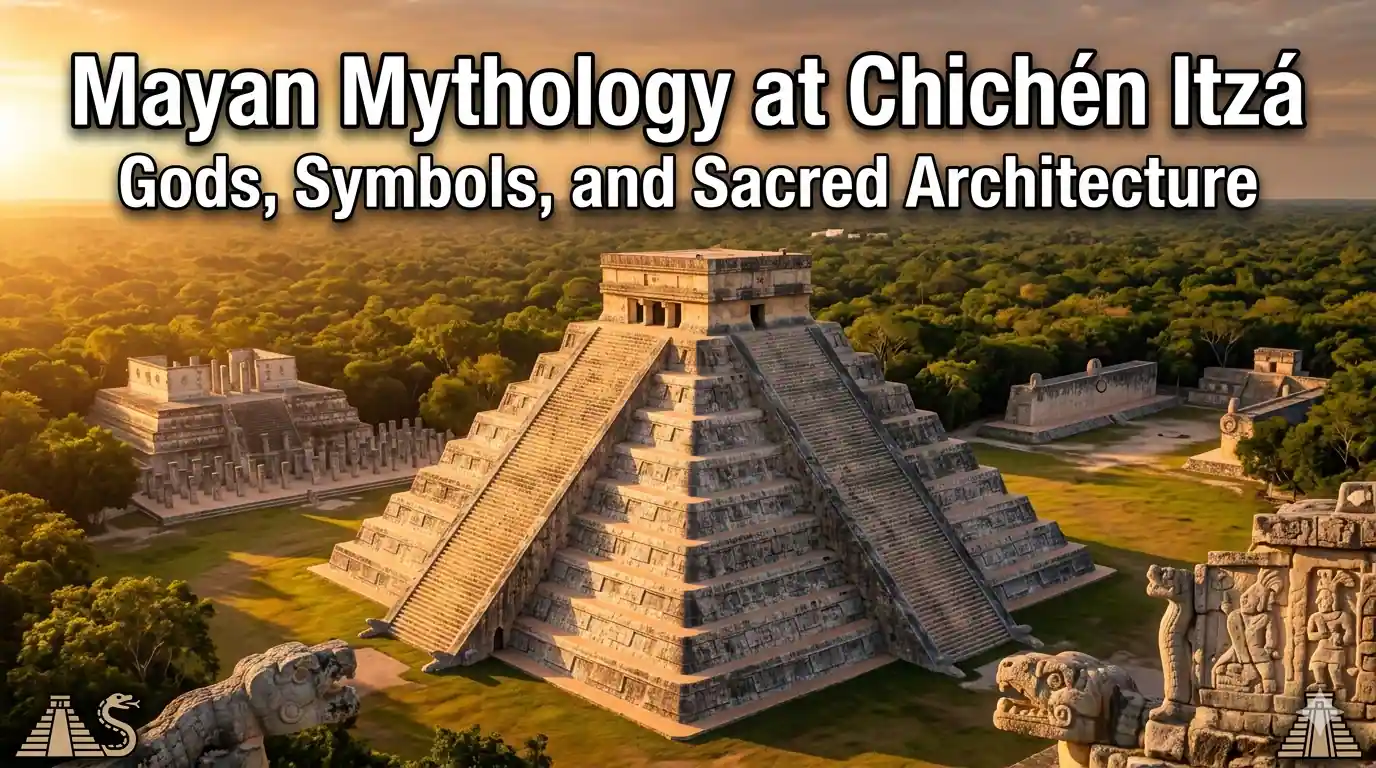
El Castillo, Chichén Itzá's most iconic structure, serves as Kukulcan's earthly manifestation. The pyramid's design encodes sophisticated astronomical and mythological knowledge: its 365 steps represent the solar year, its nine terraces symbolize the nine levels of the underworld (Xibalba), and its precise orientation creates the famous equinox phenomenon where sunlight and shadow create the illusion of a serpent descending the northern staircase.
This serpent shadow isn't accidental but a deliberate architectural achievement demonstrating the Maya's mastery of mathematics, astronomy, and engineering. During the spring and autumn equinoxes, the interplay of light and shadow on the pyramid's stepped edges creates the visual effect of Kukulcan himself descending from the heavens to bless the earth—a powerful reinforcement of the god's presence and the site's sacred nature.
Beyond El Castillo, Kukulcan's presence permeates Chichén Itzá. The Temple of the Warriors features rows of feathered serpent columns, while the Group of a Thousand Columns displays serpent motifs throughout. Carvings depicting the feathered serpent appear on walls, platforms, and ceremonial objects, creating a mythological landscape where the god's protective and civilizing influence is ever-present.
The cult of Kukulcan at Chichén Itzá also reflects broader political and cultural dynamics. Historical evidence suggests the feathered serpent deity arrived in the Yucatán around 900-1000 CE, possibly brought by Toltec influences from central Mexico. This religious transformation coincided with Chichén Itzá's rise to regional dominance, suggesting that Kukulcan worship served both spiritual and political functions, legitimizing elite power and unifying diverse populations under a shared cosmological framework.
The Sacred Cenote: Gateway to Xibalba

The Sacred Cenote (Cenote Sagrado) at Chichén Itzá represents one of the site's most profound mythological features—a natural sinkhole that served as a portal to Xibalba, the Maya underworld. This 60-meter diameter cenote, with its sheer limestone walls dropping 13 meters to the water's surface, held immense religious significance as a place of communication with chthonic deities and ancestral spirits.
For the Maya, cenotes weren't merely water sources but sacred thresholds between worlds. The word "cenote" derives from the Maya term "dz'onot" or "ts'onot," meaning "sacred well." These natural formations, created by the collapse of limestone bedrock exposing groundwater, were especially revered in the Yucatán Peninsula where surface water is scarce and cenotes provide life-sustaining resources.
The Sacred Cenote at Chichén Itzá functioned as a site of ritual sacrifice and offering for centuries. Archaeological excavations, most notably those by Edward Thompson in the early 1900s, recovered thousands of artifacts including gold, jade, pottery, copal incense, and human remains. These offerings weren't random deposits but deliberate rituals intended to appease Chaac, the rain god, and other underworld deities who controlled water, fertility, and agricultural abundance.
Human sacrifice at the Sacred Cenote, while sensationalized by early Spanish chroniclers and later popular culture, served specific religious and cosmological purposes. Victims—often young women, children, or warriors—were believed to serve as messengers to the gods, carrying petitions for rain, successful harvests, or military victory. Some evidence suggests certain individuals may have been honored rather than simply killed, their deaths viewed as sacred duties that maintained cosmic balance.
The mythology surrounding the Sacred Cenote connects to broader Maya beliefs about water, fertility, and renewal. Chaac, the rain god, was believed to dwell in cenotes and caves, emerging to bring life-giving rains. By depositing offerings into the cenote's depths, the Maya maintained reciprocal relationships with these powerful deities, ensuring continued prosperity and cosmic harmony.
Modern archaeological techniques continue to reveal the cenote's secrets. Underwater excavations have uncovered ritual pathways, ceremonial platforms, and evidence of sustained religious activity spanning centuries. The cenote's mythological significance extends beyond Chichén Itzá itself, connecting to a broader network of sacred cenotes throughout the Yucatán that formed a spiritual geography linking communities to the underworld and to each other.
Today, the Sacred Cenote remains a powerful symbol of Maya spirituality and a reminder of the profound connections between landscape, mythology, and religious practice. While swimming is no longer permitted to preserve the site, viewing the cenote offers visitors a tangible connection to the Maya worldview and their understanding of the sacred landscape.
El Caracol: Astronomical Observatory and Venus Worship

El Caracol (The Snail), Chichén Itzá's distinctive round tower, stands as a testament to the Maya's sophisticated astronomical knowledge and their mythological reverence for celestial bodies, particularly Venus. This unique structure, unlike the typical rectangular Maya buildings, features a spiral staircase inside its tower—hence its Spanish name—and demonstrates the civilization's advanced understanding of planetary movements.
The Maya observed Venus with particular devotion, considering it the most important celestial body after the sun and moon. Venus held complex mythological significance, associated with both warfare and fertility, death and rebirth. The planet's appearances and disappearances from the night sky were carefully tracked and incorporated into ritual calendars, with specific phases considered auspicious or inauspicious for various activities, especially warfare.
El Caracol's architectural alignments reflect this Venus worship. The structure's windows and doorways align with significant astronomical events, including Venus's extreme northern and southern rising and setting points. The building's orientation also corresponds to solar events, demonstrating the Maya's ability to integrate multiple celestial cycles into a single architectural framework.
The name "El Caracol" refers to the spiral staircase within the tower, but the structure's circular form itself carries mythological significance. Circular architecture was relatively rare in Maya construction, making El Caracol distinctive. Some scholars suggest the round shape may represent celestial concepts or serve practical astronomical observation purposes, allowing 360-degree views of the horizon.
Venus mythology in Maya cosmology connects to the story of the Hero Twins from the Popol Vuh, the sacred Maya creation text. The twins' journey through Xibalba and their eventual transformation into celestial bodies—including the sun, moon, and possibly Venus—established patterns of death, rebirth, and cosmic order that governed both the heavens and human society.
At Chichén Itzá, Venus observations from El Caracol would have informed ritual timing, warfare decisions, and agricultural planning. Priests-astronomers tracked the planet's 584-day cycle, noting its appearances as the morning star and evening star, each phase carrying different mythological and practical implications. This knowledge wasn't merely scientific but deeply religious, connecting earthly activities to celestial patterns and divine will.
The integration of Venus worship into Chichén Itzá's architecture demonstrates how mythology shaped urban planning and building design. El Caracol wasn't simply an observatory but a sacred space where astronomical observation, religious ritual, and political power converged. By controlling celestial knowledge, Chichén Itzá's elite reinforced their authority as intermediaries between the human and divine realms.
The Great Ball Court: Mythology of Life, Death, and Rebirth

The Great Ball Court at Chichén Itzá, the largest and best-preserved in Mesoamerica, serves as far more than an athletic venue—it represents a mythological theater where the drama of life, death, and cosmic renewal was physically enacted through the sacred ballgame known as pok-ta-pok or pitz.
This ritual sport, played for over 3,000 years across Mesoamerica, carried profound religious significance that transcended mere competition. The ballgame reenacted the Maya creation myth, particularly the story of the Hero Twins, Hunahpu and Xbalanque, whose journey through the underworld and eventual triumph over the lords of Xibalba established the patterns of death and rebirth that governed the cosmos.
According to the Popol Vuh, the Hero Twins' father and uncle were defeated and sacrificed by the underworld lords, their heads placed in a calabash tree. The twins, conceived miraculously, grew up to avenge their father by challenging the underworld lords to the ballgame. Through cunning, skill, and supernatural assistance, they defeated Xibalba's rulers, establishing order and paving the way for human creation.
The Great Ball Court at Chichén Itzá physically manifests this mythology. The court's massive dimensions—168 meters long and 70 meters wide—create an imposing space where ritual and sport merged. Stone rings mounted high on the side walls (6 meters above the playing surface) served as goals, though scoring through these small openings was likely rare. Players used only their hips, thighs, and upper arms to keep a solid rubber ball in play, a physically demanding task that required years of training.
Carved reliefs on the ball court's walls depict scenes of ritual sacrifice, showing decapitated players with blood streaming from their necks in the form of serpents. These images, while disturbing to modern sensibilities, communicated powerful mythological messages about sacrifice, renewal, and the maintenance of cosmic order. The shedding of blood—whether symbolic or actual—was believed to nourish the gods and ensure continued agricultural fertility and societal prosperity.
The ballgame's mythological significance extended beyond the Hero Twins narrative to encompass broader themes of duality and balance: life and death, light and darkness, victory and defeat. The court itself represented a liminal space between worlds, where human action could influence divine forces and cosmic cycles.
At Chichén Itzá, the ball court's proximity to other ceremonial structures—the Temple of the Warriors, the Platform of the Eagles and Jaguars—suggests it functioned as part of a larger ritual complex where sport, sacrifice, and worship converged. The game likely served multiple purposes: religious ceremony, political display, conflict resolution, and entertainment, all infused with mythological meaning.
Understanding the ball court as mythological space rather than mere sports arena transforms how we interpret Chichén Itzá. The structure reminds us that for the Maya, there was no sharp division between the sacred and the secular, between sport and ritual, between human action and cosmic order. Every aspect of life was imbued with mythological significance, and the ball court stands as a powerful monument to this integrated worldview.
Temple of the Warriors and the Cult of Tlaloc

The Temple of the Warriors, one of Chichén Itzá's most impressive structures, reveals the complex religious syncretism that characterized the site during its zenith. This massive stepped pyramid, adorned with rows of carved columns depicting warriors, demonstrates both traditional Maya elements and influences from central Mexico, particularly the Toltec culture.
The temple's name derives from the numerous columns surrounding its base, each carved with figures of warriors in ceremonial attire. These columns once supported a roof, creating a vast colonnaded hall that framed the pyramid and created a dramatic approach to the temple's summit. The warriors depicted aren't merely decorative but represent a mythological and military elite who served as protectors of the sacred space and enforcers of religious and political authority.
At the temple's summit sits a Chac Mool, a distinctive reclining figure found at several Chichén Itzá structures. These sculptures, depicting a figure lying on its back with head turned to one side and holding a bowl or plate on its stomach, served as offering receptacles. Priests placed sacrificial offerings—food, incense, precious objects, or perhaps human hearts—into the bowl, creating a direct physical connection between the human and divine realms.
The Chac Mool's presence indicates Toltec influence at Chichén Itzá, as this sculptural form originated in central Mexico. The figure's name, given by early archaeologists, references Chaac, the Maya rain god, though the sculptures likely represented a more complex deity or ritual function that transcended simple categorization.
The Temple of the Warriors also features feathered serpent columns similar to those at El Castillo, reinforcing Kukulcan's presence throughout the site. These columns, carved with the feathered serpent's body winding around the pillar, create a visual representation of the god's protective embrace surrounding the sacred architecture.
Beneath the visible temple lies an earlier structure, discovered through archaeological excavation. This practice of building new temples over old ones was common in Maya architecture, creating layered monuments that physically manifested the accumulation of sacred power over time. Each reconstruction wasn't merely practical but ritual, imbuing the structure with renewed spiritual potency and demonstrating the continuity of religious tradition.
The warrior cult represented at this temple connects to broader Mesoamerican beliefs about military prowess, sacrifice, and divine favor. Warriors who died in battle or through sacrifice were believed to enjoy special status in the afterlife, accompanying the sun on its daily journey across the sky. This belief system elevated military service to a sacred duty and justified the ritual sacrifice of both enemies and, in some cases, members of the community.
Understanding the Temple of the Warriors requires recognizing how mythology, politics, and military power intertwined at Chichén Itzá. The structure wasn't merely a religious monument but a statement of authority, a reminder of the elite's connection to divine forces, and a warning to potential challengers of the sacred and military power concentrated at the site.
The Observatory of Venus and Celestial Mythology

Beyond El Caracol, Chichén Itzá contains multiple structures aligned with celestial events, demonstrating how thoroughly astronomy and mythology permeated the site's design. The Maya viewed celestial bodies not as distant objects but as deities whose movements directly influenced earthly affairs, making astronomical observation a religious imperative.
The sun, moon, and Venus received particular veneration, each carrying complex mythological associations. The sun god, Kinich Ahau, journeyed daily across the sky and through the underworld at night, dying and being reborn in an eternal cycle that mirrored human existence. The moon goddess, Ixchel, governed fertility, childbirth, and weaving, her phases marking time and influencing agricultural and ritual calendars.
Venus, as previously discussed, held special significance as both morning and evening star, its appearances marking auspicious and inauspicious times for warfare, planting, and other activities. The Maya calculated Venus's 584-day cycle with remarkable precision, incorporating this knowledge into their Long Count calendar and architectural alignments.
At Chichén Itzá, these celestial deities weren't abstract concepts but active presences manifested in stone and ritual. The equinox serpent shadow at El Castillo represents Kukulcan's descent, but it also demonstrates the sun's power to activate sacred architecture at precise moments. Solar alignments throughout the site mark solstices and equinoxes, creating a calendar in stone that guided agricultural and ceremonial activities.
The Maya's celestial mythology also encompassed darker realms. The Milky Way was viewed as the White Road or the Road to Xibalba, a celestial pathway connecting the earthly realm to the underworld. Certain constellations held specific meanings, their appearances signaling seasonal changes or ritual obligations.
Understanding Chichén Itzá's celestial mythology requires recognizing that the Maya didn't separate science from religion. Astronomical observation was a sacred practice, and architectural precision served spiritual purposes. By aligning structures with celestial events, the Maya created a cosmic landscape where heaven and earth met, where deities manifested their presence, and where human ritual could influence divine forces.
Practical Guide: Experiencing Chichén Itzá's Mythology

Visiting Chichén Itzá with mythological understanding transforms the experience from passive sightseeing to active engagement with a living spiritual landscape. These practical strategies help you connect with the site's deeper meanings.
Best Times for Mythological Experiences:
- Equinox Visits (March 20-21, September 22-23): Witness the famous serpent shadow phenomenon at El Castillo. Arrive early (site opens 8 AM) and expect large crowds. The effect is visible for several days around the exact equinox.
- Sunrise Visits: Special access tours allow entry before regular opening hours, providing peaceful contemplation and optimal photography light. The morning sun illuminates structures dramatically, revealing carvings and details obscured by midday glare.
- Solstice Visits (June 21, December 21): Solar alignments create unique lighting effects on various structures, demonstrating the Maya's astronomical precision.
- 👉 Panama Tourist Visa Guide 2026 for US Travelers
- 👉 Why Todos Santos Is Best Pacific Escape for Creative Souls
- 👉 Six Senses Grand Bahama 2026: A complete guide to the Caribbean's newest eco-luxury resort.
- 👉 Is Saint Lucia LGBTQ Friendly: A Complete 2026 Travel Guide and Legal Overview for Inclusive Caribbean Travel
- 👉 MBIA Expansion 2026: New Terminal & Energy Storage Guide
Hiring Knowledgeable Guides:
Official guides at Chichén Itzá cost $50-100 USD for 2-3 hours and provide essential mythological context that signage alone cannot convey. Look for guides certified by INAH (Mexico's National Institute of Anthropology and History) who can explain:
- The symbolism of architectural alignments
- Stories from the Popol Vuh relevant to specific structures
- Details of carvings and reliefs that casual observers miss
- Connections between different structures and their mythological functions
- 👉 Panama Tourist Visa Guide 2026 for US Travelers
- 👉 Why Todos Santos Is Best Pacific Escape for Creative Souls
- 👉 Six Senses Grand Bahama 2026: A complete guide to the Caribbean's newest eco-luxury resort.
- 👉 Is Saint Lucia LGBTQ Friendly: A Complete 2026 Travel Guide and Legal Overview for Inclusive Caribbean Travel
- 👉 MBIA Expansion 2026: New Terminal & Energy Storage Guide
Ask potential guides about their knowledge of Maya mythology specifically, not just historical facts. A good guide will weave together astronomy, religion, politics, and daily life to create a comprehensive picture of Chichén Itzá's significance.
Reading the Popol Vuh Before Your Visit:
The Popol Vuh, the Maya creation text, provides essential mythological context for understanding Chichén Itzá. Key stories include:
- The Hero Twins' journey through Xibalba
- The creation of humans from maize
- The establishment of cosmic order
- The relationship between gods and humans
- 👉 Panama Tourist Visa Guide 2026 for US Travelers
- 👉 Why Todos Santos Is Best Pacific Escape for Creative Souls
- 👉 Six Senses Grand Bahama 2026: A complete guide to the Caribbean's newest eco-luxury resort.
- 👉 Is Saint Lucia LGBTQ Friendly: A Complete 2026 Travel Guide and Legal Overview for Inclusive Caribbean Travel
- 👉 MBIA Expansion 2026: New Terminal & Energy Storage Guide
Reading these stories before visiting helps you recognize their architectural manifestations and appreciate how mythology shaped every aspect of Maya civilization.
Respectful Engagement:
Chichén Itzá remains a sacred site for contemporary Maya people. Demonstrate respect by:
- Not climbing structures (prohibited and damages ancient stone)
- Following designated pathways
- Listening to guide instructions
- Avoiding loud or disruptive behavior
- Recognizing that this isn't merely a tourist attraction but a place of profound cultural and spiritual significance
- 👉 Panama Tourist Visa Guide 2026 for US Travelers
- 👉 Why Todos Santos Is Best Pacific Escape for Creative Souls
- 👉 Six Senses Grand Bahama 2026: A complete guide to the Caribbean's newest eco-luxury resort.
- 👉 Is Saint Lucia LGBTQ Friendly: A Complete 2026 Travel Guide and Legal Overview for Inclusive Caribbean Travel
- 👉 MBIA Expansion 2026: New Terminal & Energy Storage Guide
Photography Tips for Mythological Details:
- Visit early morning or late afternoon for optimal light on carvings
- Use a polarizing filter to reduce glare on stone surfaces
- Focus on specific details—serpent heads, warrior figures, astronomical alignments—rather than only wide shots
- Photograph structures from multiple angles to understand their spatial relationships
- 👉 Panama Tourist Visa Guide 2026 for US Travelers
- 👉 Why Todos Santos Is Best Pacific Escape for Creative Souls
- 👉 Six Senses Grand Bahama 2026: A complete guide to the Caribbean's newest eco-luxury resort.
- 👉 Is Saint Lucia LGBTQ Friendly: A Complete 2026 Travel Guide and Legal Overview for Inclusive Caribbean Travel
- 👉 MBIA Expansion 2026: New Terminal & Energy Storage Guide
Combining with Cenote Visits:
After exploring Chichén Itzá, visit nearby cenotes to experience the sacred wells that complement the site's mythology. Ik Kil, just 3 kilometers from Chichén Itzá, offers swimming in a beautiful cenote that provides tangible connection to the Maya's sacred landscape. Understanding the mythological significance of cenotes enhances this experience beyond mere recreation.
Final Reflections: Chichén Itzá as Living Mythology

Chichén Itzá isn't a dead ruin but a testament to a living cosmological vision that continues to inspire and educate. The Maya who built this city didn't construct monuments to their own glory but created a sacred landscape that connected heaven and earth, past and future, human and divine.
Understanding the mythology embedded in Chichén Itzá's stones transforms how we experience the site. El Castillo becomes more than an impressive pyramid—it's Kukulcan's earthly manifestation, a calendar in stone, a demonstration of astronomical mastery. The Sacred Cenote isn't merely a hole in the ground but a portal to the underworld, a place of communication with deities who controlled rain and fertility. The ball court transcends sport to become a theater of cosmic drama where life, death, and renewal were ritually enacted.
This mythological understanding also fosters respect for contemporary Maya people who maintain connections to their ancestral traditions. While Christianity and modernity have transformed Maya religious practice, the underlying cosmological vision persists in modified forms, creating cultural continuity across a millennium.
For visitors, approaching Chichén Itzá through the lens of mythology enriches the experience immeasurably. You're not just seeing old stones but engaging with a sophisticated civilization that mapped the cosmos, engineered structures aligned with celestial events, and created a sacred geography that continues to inspire wonder.
As you walk among the pyramids, temples, and ball courts, remember that you're traversing a mythological landscape where every structure tells a story, every alignment encodes astronomical knowledge, and every carving communicates with the divine. Chichén Itzá invites you not merely to observe but to contemplate the profound questions that drove its creators: What is our place in the cosmos? How do we maintain harmony between heaven and earth? What debts do we owe to the gods who created and sustain us?
These questions remain as relevant today as they were a thousand years ago. Chichén Itzá's enduring power lies not just in its architectural grandeur but in its capacity to connect us with the universal human quest for meaning, order, and connection with forces greater than ourselves. Visit with curiosity, respect, and openness to the profound wisdom encoded in stone, and you'll discover that Chichén Itzá has much to teach us about mythology, astronomy, engineering, and the enduring human spirit.
0 Comments