.webp)
.webp)
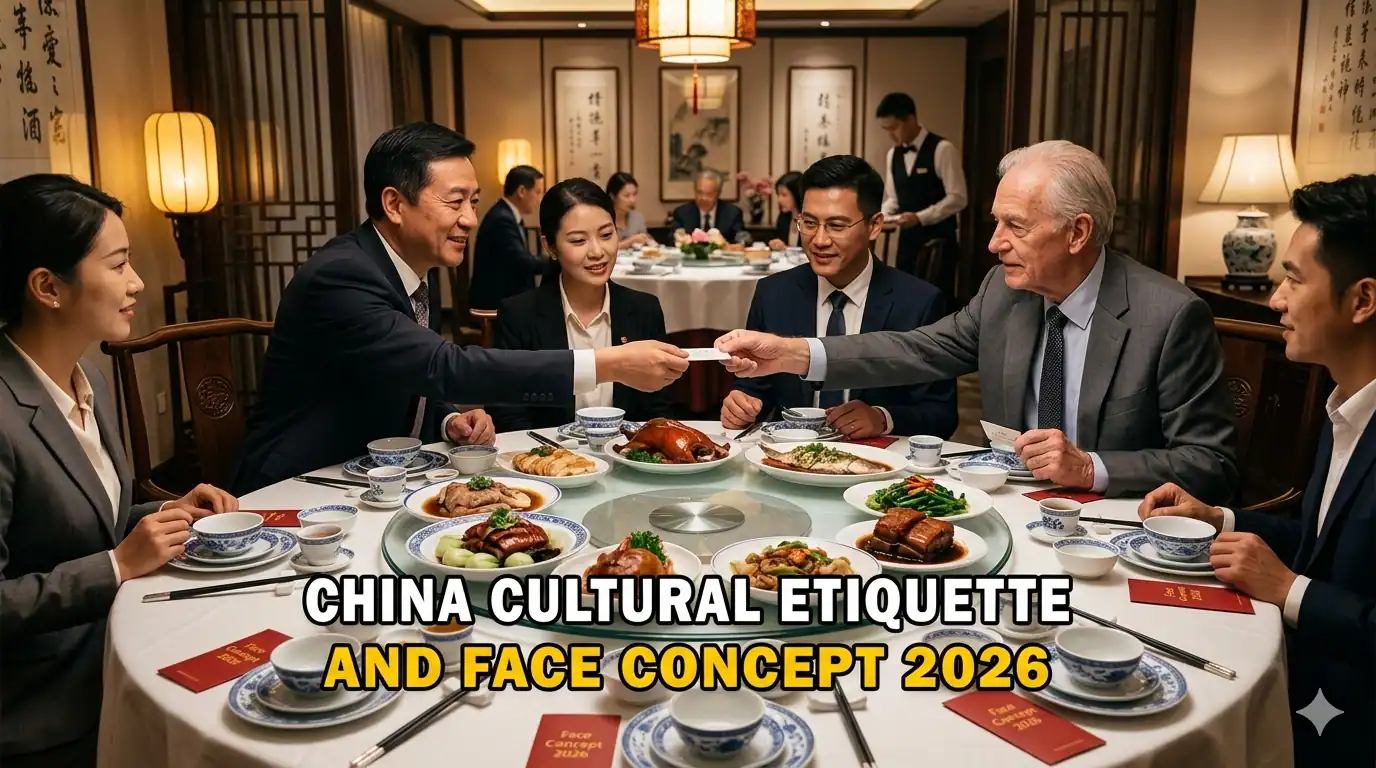
Overview of Chinese Cultural Etiquette for Visitors
Understanding Chinese cultural etiquette represents one of the most critical preparations for successful travel or business engagement in China.
Two foundational concepts shape social interactions throughout China: the concept of face or mianzi and elaborate dining protocols.
Mastering these cultural elements demonstrates respect builds trust and facilitates meaningful connections with Chinese counterparts.
This comprehensive guide explains the nuanced concept of face and provides practical guidance for navigating Chinese dining situations in 2026.
Whether visiting for tourism business or cultural exchange these etiquette principles enhance every interaction in China.
Why Cultural Etiquette Matters in China
Chinese society places exceptional importance on harmony respect and proper social conduct derived from Confucian traditions.
Demonstrating cultural awareness signals respect for Chinese values and facilitates smoother personal and professional relationships.
Misunderstanding etiquette can inadvertently cause offense damage relationships or compromise business objectives.
Foreigners who invest in learning Chinese etiquette often receive warmer reception and greater cooperation from local contacts.
Cultural competence transforms transactions into relationships creating lasting value beyond immediate travel or business goals.
Core Values Underlying Chinese Etiquette
Confucian principles emphasize hierarchy respect for elders and maintenance of social harmony.
Collectivist orientation prioritizes group harmony over individual expression in social settings.
Indirect communication style values subtlety and preservation of relationships over blunt honesty.
Reciprocity and relationship building through guanxi networks form foundation of business and social interactions.
Understanding these values provides context for specific etiquette practices throughout Chinese society.
Understanding the Concept of Face in Chinese Culture

The concept of face or mianzi represents one of the most important yet complex elements of Chinese social interaction.
Face encompasses reputation dignity honor and social standing within interpersonal and professional contexts.
Unlike Western concepts of pride or ego face is inherently relational depending on how others perceive and treat an individual.
Managing face involves both preserving ones own dignity and protecting the dignity of others in social exchanges.
Mastering face dynamics enables foreigners to navigate Chinese social situations with sensitivity and effectiveness.
Types of Face and Their Significance
Lian refers to moral character and integrity representing fundamental trustworthiness in relationships.
Mianzi denotes social prestige and reputation earned through achievement status and proper conduct.
Both forms of face can be given enhanced through respect or lost through embarrassment or criticism.
Face operates at individual family organizational and national levels influencing decisions at all scales.
Understanding which type of face is relevant in specific situations guides appropriate behavioral responses.
How Face Influences Communication and Decision Making
Direct criticism or confrontation risks causing loss of face and damaging relationships permanently.
Indirect communication through suggestions questions or third parties preserves face while addressing issues.
Public praise enhances face while public correction should be avoided in favor of private discussion.
Decision making often involves consensus building to ensure all parties maintain face throughout process.
Patience and relationship building precede substantive business discussions as face must be established first.
Practical Strategies for Managing Face in Interactions
Always address Chinese counterparts with appropriate titles and surnames unless invited to use first names.
Avoid saying no directly instead use phrases like this may be difficult or we will consider this carefully.
Accept compliments graciously with modest deflection rather than enthusiastic agreement.
When mistakes occur acknowledge them privately and focus on solutions rather than assigning blame publicly.
Offer opportunities for Chinese counterparts to save face by providing graceful exits from difficult situations.
Chinese Dining Etiquette Fundamentals

Dining represents one of the most important social contexts in Chinese culture where relationships are built and business is conducted.
Understanding proper dining etiquette demonstrates respect and facilitates positive impressions with Chinese hosts and colleagues.
Chinese banquets follow specific protocols regarding seating ordering serving and toasting that differ significantly from Western practices.
Mastering these fundamentals enables foreigners to participate confidently in Chinese dining situations.
Attention to dining details signals cultural awareness and commitment to relationship building.
Seating Arrangements and Hierarchy
Round tables symbolize unity and equality with seating positions reflecting hierarchical relationships.
Seat of honor faces entrance or offers best view reserved for most senior person or guest of honor.
Host typically sits opposite guest of honor facilitating service and conversation management.
Seniority age and status determine seating with more important guests seated closer to seat of honor.
Wait for host to indicate seating or follow guidance rather than selecting seats independently.
Chopsticks Etiquette and Proper Usage
Hold chopsticks correctly with one stationary and one moving stick manipulated by fingers.
Never stick chopsticks vertically into rice as this resembles funeral rituals and brings bad luck.
Avoid tapping chopsticks on bowls or plates as this resembles beggar behavior and shows poor manners.
Do not pass food directly from chopsticks to chopsticks as this resembles funeral bone handling.
Place chopsticks on chopstick rest or across bowl when not in use rather than leaving on table.
Food Serving and Sharing Protocols
Chinese meals emphasize communal sharing with dishes placed centrally for all diners to access.
Lazy Susan rotating tray facilitates easy access to all dishes without reaching across table.
Use serving chopsticks or spoons provided for transferring food to personal plate or bowl.
Never use personal chopsticks to take food from communal dishes as this violates hygiene norms.
Take modest portions initially with opportunity for seconds demonstrating appreciation without greed.
Advanced Dining Etiquette for Business and Formal Occasions

Formal dining occasions in China involve additional protocols that signal respect and cultural competence.
Business banquets serve important relationship building functions beyond mere sustenance.
Understanding advanced etiquette enables foreigners to navigate high stakes dining situations successfully.
These practices demonstrate commitment to relationship building and cultural respect.
Mastering formal dining etiquette opens doors to deeper business and social connections in China.
Toasting Customs and Ganbei Protocol
Toasting or ganbei represents essential element of Chinese banquets for building rapport and showing respect.
Host typically initiates first toast welcoming guests and expressing good wishes for occasion.
When toasting hold glass with both hands and make eye contact demonstrating sincerity and respect.
Clink glasses with rim lower than senior persons glass showing deference to hierarchy.
Ganbei means dry cup indicating complete consumption though modest sips acceptable for foreigners.
Reciprocate toasts appropriately without initiating excessive drinking that may cause discomfort.
Ordering and Menu Selection Etiquette
Host typically orders meal selecting dishes to demonstrate hospitality and knowledge of guest preferences.
Guests should express appreciation for selections and avoid criticizing or rejecting dishes outright.
When invited to order select modestly and consider dietary restrictions of entire table.
Balance meal with variety of proteins vegetables soups and staple foods reflecting Chinese culinary principles.
Ask host for recommendations demonstrating respect for local knowledge and culinary expertise.
Payment and Bill Settlement Customs
Host typically insists on paying bill as expression of hospitality and face enhancement.
Guests should offer to pay as gesture of politeness though expectation is host will prevail.
Subtle struggle over payment common with host ultimately prevailing as cultural norm.
If determined to contribute arrange payment discreetly in advance or through separate transaction.
Express sincere gratitude for hospitality acknowledging hosts generosity and effort.
Gift Giving Etiquette in Chinese Culture

Gift giving represents important mechanism for building relationships and demonstrating respect in Chinese culture.
Appropriate gifts enhance face for both giver and receiver while inappropriate gifts may cause offense.
Understanding gift giving protocols enables foreigners to navigate this important cultural practice successfully.
Gift customs vary by occasion relationship and region requiring contextual sensitivity.
Thoughtful gift selection and presentation demonstrates cultural awareness and commitment to relationship.
Selecting Appropriate Gifts
High quality items from ones home country or region often appreciated as unique and thoughtful.
Premium tea fine alcohol quality crafts or local specialties make appropriate gifts for business contexts.
Avoid clocks as gifts as word for clock sounds like word for end or death in Chinese.
Avoid sharp objects like knives or scissors as they symbolize cutting relationships.
White or black wrapping paper associated with funerals should be avoided in favor of red or gold.
Gift Presentation and Reception Protocols
Present gifts with both hands demonstrating respect and sincerity in the gesture.
Recipient may initially decline gift as polite gesture of modesty before accepting.
Do not open gifts immediately in front of giver unless specifically invited to do so.
Express appreciation for gift received with modest acknowledgment rather than excessive enthusiasm.
Reciprocate with appropriate gift at suitable occasion maintaining balance in relationship.
Business Gift Giving Considerations
Corporate gifts should reflect company branding while maintaining cultural appropriateness.
Avoid gifts that could be perceived as bribes especially in government or regulated industry contexts.
Group gifts for teams often more appropriate than individual gifts that may create hierarchy issues.
Document gift exchanges appropriately for corporate compliance and transparency requirements.
Consult local colleagues on appropriate gift selection reflecting regional preferences and sensitivities.
Communication Etiquette Beyond Dining

Chinese communication style emphasizes indirectness harmony and relationship preservation across all contexts.
Understanding communication norms enables foreigners to interact effectively in business and social settings.
Verbal and nonverbal cues carry significant meaning requiring attentive interpretation.
Patience and observation facilitate successful navigation of Chinese communication patterns.
Adapting communication style demonstrates respect and facilitates mutual understanding.
Business Card Exchange Protocol
Business card exchange represents formal ritual signaling respect and professional intent.
Present card with both hands with Chinese side facing recipient for easy reading.
Receive card with both hands and take moment to examine before carefully placing in card holder.
Never write on or fold business cards as this shows disrespect for the person.
Keep received cards visible on table during meeting rather than immediately storing away.
Verbal Communication Styles and Expectations
Indirect communication style values implication and context over explicit statement.
Yes may indicate understanding rather than agreement requiring careful interpretation of responses.
Silence often represents thoughtful consideration rather than disagreement or discomfort.
Avoid raising voice or showing anger as this causes loss of face for all parties.
Use honorific titles and formal language until explicitly invited to adopt casual style.
Nonverbal Communication and Body Language
Maintain appropriate physical distance avoiding excessive touching or close proximity.
Eye contact should be respectful but not intense or challenging especially with senior persons.
Bowing slightly when greeting or thanking demonstrates respect though handshakes increasingly common.
Avoid pointing with single finger instead use open hand gesture for indicating direction.
Facial expressions should remain composed avoiding extreme displays of emotion in formal settings.
Regional Variations in Chinese Etiquette

China vast geography and diverse ethnic composition create regional variations in etiquette practices.
Understanding regional differences enables more nuanced and appropriate cultural engagement.
Major cultural regions exhibit distinct characteristics while sharing core Confucian values.
Adapting to local customs demonstrates deeper cultural competence and respect.
Consult local colleagues for region specific guidance when traveling beyond major cities.
Northern China Etiquette Characteristics
Beijing and northern regions emphasize formality hierarchy and official protocol.
Dining portions tend to be larger with emphasis on hearty meats and wheat based foods.
Communication style may be more direct though still maintaining face considerations.
Business relationships often develop through formal channels and institutional connections.
Winter climate influences social patterns with more indoor gatherings and formal occasions.
Southern China Etiquette Characteristics
Shanghai Guangdong and southern regions exhibit more pragmatic and commercially oriented etiquette.
Dining emphasizes freshness variety and delicate preparation with rice as staple food.
Communication style may be more flexible though relationship building remains essential.
Business relationships often develop through personal networks and mutual benefit arrangements.
Warmer climate supports more casual outdoor socializing though formal occasions maintain protocol.
Western China and Ethnic Minority Considerations
Sichuan Yunnan and western regions feature distinctive local customs alongside Han Chinese norms.
Ethnic minority areas like Tibet Xinjiang and Inner Mongolia have unique cultural protocols.
Dining customs may include distinctive ingredients preparation methods and serving styles.
Religious considerations influence etiquette in areas with significant Buddhist Muslim or other religious populations.
Research specific regional and ethnic customs before visiting to ensure appropriate conduct.
Practical Application Strategies for Foreign Visitors

Translating cultural knowledge into effective behavior requires practice observation and adaptation.
Foreign visitors benefit from concrete strategies for applying etiquette principles in real situations.
Preparation and mindfulness facilitate successful navigation of Chinese cultural contexts.
Continuous learning and adjustment enhance cultural competence over time.
Patience and humility enable foreigners to build meaningful relationships despite cultural differences.
Pre Travel Preparation Recommendations
Research specific destinations and contexts to understand relevant etiquette expectations.
Practice basic Mandarin greetings and polite phrases demonstrating effort and respect.
Prepare appropriate business cards with Chinese translation on reverse side.
Select culturally appropriate gifts in advance considering regional preferences and taboos.
Connect with local contacts or cultural consultants for situation specific guidance.
On Site Observation and Adaptation Techniques
Observe local behavior carefully before acting especially in unfamiliar situations.
Follow lead of Chinese counterparts regarding timing formality and interaction style.
Ask respectful questions when uncertain demonstrating interest in learning proper conduct.
Apologize sincerely for inadvertent mistakes focusing on relationship repair rather than self justification.
Express gratitude for guidance and patience acknowledging cultural learning process.
Building Long Term Cultural Competence
View cultural learning as ongoing process rather than one time preparation.
Seek feedback from trusted Chinese colleagues on interaction style and cultural adaptation.
Reflect on experiences to identify patterns and areas for continued improvement.
Invest in language learning as deeper communication enables deeper cultural understanding.
Approach cultural differences with curiosity and respect rather than judgment or comparison.
Common Etiquette Mistakes and How to Avoid Them

Even well intentioned foreigners may commit etiquette missteps due to cultural differences.
Understanding common mistakes enables prevention and appropriate response when errors occur.
Recovery from mistakes often matters more than perfect initial conduct.
Humility and willingness to learn facilitate relationship repair after cultural missteps.
Every mistake represents opportunity for deeper cultural understanding and connection.
Frequent Dining Etiquette Errors
Using personal chopsticks for communal dishes violates hygiene norms and shows poor manners.
Beginning to eat before host or senior person signals disrespect for hierarchy.
Refusing food or drink outright rather than accepting modestly may offend hospitable hosts.
Leaving food on plate may suggest dissatisfaction though finishing everything may prompt more serving.
Departing immediately after meal without appropriate conversation may seem rushed or ungrateful.
Face Management Missteps
Public criticism or correction causes loss of face and damages relationships permanently.
Direct refusal or negative response without face saving alternatives creates uncomfortable situations.
Overly enthusiastic agreement followed by non action damages credibility and trust.
Ignoring hierarchical protocols in seating toasting or communication shows cultural insensitivity.
Failing to reciprocate hospitality or gifts appropriately disrupts relationship balance.
Recovery Strategies for Etiquette Mistakes
Acknowledge mistake privately with sincere apology focusing on impact rather than intent.
Offer face saving solutions that allow all parties to move forward with dignity.
Demonstrate commitment to learning through subsequent appropriate behavior.
Seek guidance from cultural mentors on repairing relationships after missteps.
View mistakes as learning opportunities rather than failures in cultural adaptation.
Modern Evolutions in Chinese Etiquette

Chinese etiquette continues evolving with globalization technological change and generational shifts.
Understanding contemporary adaptations enables foreigners to engage effectively with modern Chinese society.
Traditional values persist while expressions adapt to new contexts and expectations.
Flexibility and observation facilitate navigation of evolving etiquette norms.
Respect for core principles combined with adaptation to contemporary practice demonstrates cultural competence.
Technology and Digital Communication Etiquette
WeChat has become essential platform for both personal and professional communication in China.
Response time expectations may differ from Western norms with patience often valued over immediacy.
Digital red packets or hongbao follow traditional gift giving principles in digital format.
Social media interactions should maintain face considerations and relationship sensitivity.
Video calls and virtual meetings require same etiquette attention as in person interactions.
Generational Differences in Etiquette Expectations
Younger Chinese may adopt more casual communication styles while maintaining core respect values.
Business contexts often maintain traditional formality regardless of participant age.
Urban professionals may blend international and Chinese etiquette practices in hybrid approaches.
When uncertain default to more formal traditional etiquette which rarely causes offense.
Observe and follow lead of Chinese counterparts regarding formality level and interaction style.
International Business Context Adaptations
Chinese professionals engaging internationally often adapt etiquette to accommodate foreign counterparts.
Hybrid etiquette practices emerge in cross cultural business contexts blending multiple traditions.
Clarity about expectations and openness to mutual adaptation facilitate successful international engagement.
Core principles of respect relationship and face remain relevant even in adapted contexts.
Explicit discussion of etiquette expectations can prevent misunderstandings in international settings.
0 Comments