.webp)
.webp)
Asia Travel Guide Best Countries to Visit Complete Itinerary Cost and Tips for 2026
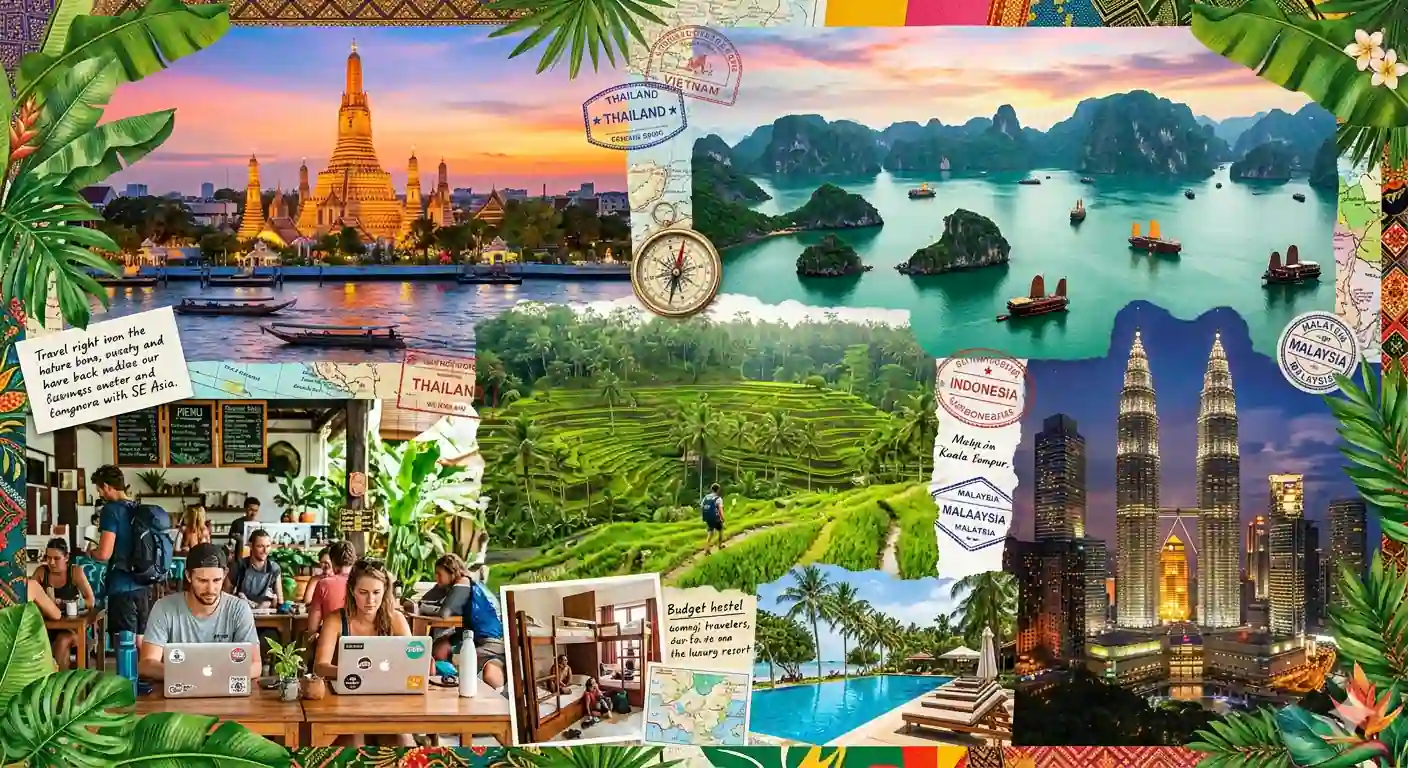
Complete Asia Travel Guide for 2026
Southeast Asia remains one of the world's most captivating travel destinations, offering incredible diversity across Thailand, Vietnam, Indonesia, and Malaysia.
These four countries combine ancient temples, pristine beaches, vibrant cities, and world-class cuisine at budgets ranging from thirty dollars to three hundred dollars per day.
Whether you are a budget backpacker, luxury traveler, or digital nomad, this region provides unmatched value and unforgettable experiences.
This comprehensive guide covers everything you need to know about visiting Southeast Asia in 2026, including visa requirements, costs, itineraries, and insider tips.
Why Visit Southeast Asia in 2026
Southeast Asia continues to dominate global travel rankings for good reason.
The region offers exceptional value for money with costs significantly lower than Europe or North America while maintaining high quality standards.
You can enjoy luxury accommodations, gourmet meals, and exciting activities at a fraction of Western prices.
The cultural diversity across Thailand, Vietnam, Indonesia, and Malaysia provides endless exploration opportunities.
Each country maintains unique traditions, languages, religions, and culinary specialties that create rich travel experiences.
Digital infrastructure has improved dramatically, making Southeast Asia increasingly popular among remote workers.
Thailand launched its Destination Thailand Visa offering five-year validity with 180-day stays per entry.
Malaysia's DE Rantau Digital Nomad Pass allows one-year stays with renewal options for location-independent professionals.
Indonesia introduced the E33G Remote Worker Visa specifically designed for digital nomads wanting to base in Bali.
Safety remains excellent across the region with Southeast Asia emerging as one of the world's safest travel havens in 2026.
Thailand ranks as one of the safest countries in Southeast Asia according to Berkshire Hathaway Travel Protection.
The region's accessibility continues improving with expanded flight routes and simplified entry requirements.
Visa Requirements for Southeast Asia
Understanding visa requirements is essential for planning your Southeast Asia adventure.
Each country maintains different policies based on your nationality and intended stay duration.
Thailand Visa Requirements 2026
Thailand offers visa-exempt entry to citizens from 93 countries including the United States, United Kingdom, Canada, Australia, and most European nations.
Visa-exempt travelers receive 60 days upon arrival without requiring advance visa application.
All travelers must complete the Thailand Digital Arrival Card online before landing.
Your passport must remain valid for at least six months beyond your entry date.
Immigration officers may request proof of onward travel showing your exit from Thailand.
Proof of funds requirement stands at 20,000 Thai Baht per person or 40,000 Baht per family.
This equals approximately 550 to 1,100 US dollars in cash or equivalent hard currency.
For longer stays, Thailand's Destination Thailand Visa provides exceptional flexibility.
The DTV visa costs 10,000 Baht or about 280 US dollars and remains valid for five years.
Each entry allows 180 days with unlimited re-entries during the validity period.
Financial requirements include proof of 500,000 Baht in savings or approximately 14,500 USD.
This visa specifically targets digital nomads, remote workers, and freelancers working for companies outside Thailand.
Vietnam Visa Requirements 2026
Vietnam offers visa-free entry to citizens of 38 countries with stay durations ranging from 14 to 90 days.
Most Western nationals require a visa for Vietnam, available through e-visa or visa on arrival.
The Vietnam e-visa system provides the most convenient application method for 2026 travelers.
E-visas offer 30 to 90-day validity with single or multiple entry options.
Some applicants now receive 90-day visas under new policies implemented in 2026.
Requirements include a passport valid six months beyond entry with at least two blank pages.
You must upload a digital passport photo with white background measuring 4x6 centimeters without glasses.
A completed application form and credit or debit card for payment are also required.
Note that American Express cards are not accepted for visa fee payments.
Processing typically takes 3 to 5 business days through the official government portal.
Vietnam introduced two new visa categories in July 2026 for digital technology professionals and special talent workers.
Indonesia Visa Requirements 2026
Indonesia provides visa-free entry to selected nationalities and expanded Visa on Arrival access in 2026.
Citizens from ASEAN countries and several other nations receive free visit visas.
Most travelers qualify for Visa on Arrival costing 35 US dollars or approximately 500,000 Indonesian Rupiah.
The VoA allows 30-day stays with one 30-day extension possible for a total of 60 days.
Applying for e-VOA online before travel is strongly recommended to avoid airport queues.
Only use the official Indonesian Immigration website to avoid scam sites charging excessive fees.
Requirements include a passport with at least six months validity and one full blank page.
You must show a return or onward ticket when entering Indonesia.
For digital nomads, Indonesia offers the B211A social or cultural visa allowing 60 days initially.
This visa can be extended multiple times up to 180 days total for approximately 300 dollars.
The E33G Remote Worker Visa provides one-year validity specifically for remote workers.
Application fees total 630 dollars plus 150 dollars processing fee.
You must prove employment with a company or clients outside Indonesia.
Malaysia Visa Requirements 2026
Malaysia offers visa-free entry to citizens from many countries for stays ranging from 14 to 90 days depending on nationality.
United States, United Kingdom, Canadian, Australian, and most European passport holders receive 90 days visa-free.
Indian nationals enjoy visa exemption until December 31, 2026 for social visits up to 30 days.
This represents a special temporary arrangement extended through 2026.
All travelers must complete the Malaysia Digital Arrival Card before entry.
Your passport requires minimum six months validity from your arrival date.
Proof of onward travel and sufficient funds may be requested at immigration.
No routine vaccinations are required for most travelers entering Malaysia.
Yellow Fever certificate is mandatory only if arriving from endemic areas.
For longer stays, Malaysia's DE Rantau Digital Nomad Pass offers excellent opportunities.
The program allows one-year residence with renewal options for remote workers.
Minimum income requirement is 24,000 dollars annually or 2,000 dollars monthly.
You must work for a company outside Malaysia and apply before arrival.
Flight Costs and Transportation
International flight costs to Southeast Asia vary significantly based on departure location and season.
From North America, expect to pay 800 to 1,500 dollars for round-trip economy tickets.
European travelers typically find fares between 600 and 1,200 dollars round-trip.
Booking 2 to 3 months in advance usually secures the best prices.
Consider flying into Bangkok, Singapore, or Kuala Lumpur as major regional hubs.
These cities offer extensive connecting flight networks throughout Southeast Asia.
Budget airlines like AirAsia, Scoot, and VietJet provide affordable regional connections.
Short hops between countries often cost 50 to 150 dollars one-way.
Domestic flights within each country remain inexpensive compared to Western standards.
Travel Costs Budget Breakdown
Southeast Asia offers remarkable flexibility for different budget levels.
Understanding daily costs helps you plan effectively and avoid surprises.
Budget Backpacker Costs
Budget travelers can comfortably explore Southeast Asia on 30 to 50 dollars per day.
This requires staying in hostels, eating street food, and using public transportation.
A realistic monthly budget ranges from 550 to 750 dollars for strict budget travel.
Vietnam, Cambodia, Laos, and Northern Thailand offer the best value for budget travelers.
Hostel dorm beds cost 5 to 15 dollars per night depending on location and quality.
Street food meals range from 2 to 5 dollars and are often delicious and safe.
Local buses and trains provide ultra-affordable transportation between cities.
Budget activities like temple visits, beach days, and hiking cost minimal amounts.
Mid-Range Travel Costs
Mid-range travelers spending 100 dollars daily enjoy significantly more comfort.
A comfortable mid-range month costs 1,200 to 2,000 dollars covering all expenses.
Private hotel rooms or Airbnbs range from 25 to 60 dollars per night.
Restaurant meals cost 5 to 15 dollars with excellent quality and variety.
Air-conditioned buses, domestic flights, and private taxis become affordable options.
Guided tours, cooking classes, and adventure activities fit comfortably within budget.
This level allows mixing budget and splurge experiences throughout your trip.
Luxury Travel Costs
Luxury travelers spending 200 dollars or more daily experience Southeast Asia in style.
Five-star hotels and resorts cost 100 to 300 dollars per night offering exceptional value.
Fine dining experiences cost 30 to 80 dollars per person including drinks.
Private drivers, business class flights, and exclusive tours become accessible.
Luxury spa treatments, yacht charters, and premium experiences remain affordable compared to Western prices.
You can live like royalty in Southeast Asia for a fraction of European or American luxury costs.
Country-Specific Cost Comparison
Thailand offers moderate costs with excellent tourism infrastructure.
Daily budgets range from 35 dollars for backpackers to 150 plus dollars for luxury travelers.
Bangkok and Phuket tend to be more expensive than northern cities like Chiang Mai.
Vietnam provides exceptional value as one of the region's most affordable destinations.
You can travel comfortably on 25 to 40 dollars daily as a budget traveler.
Mid-range costs average 50 to 80 dollars per day with excellent food and accommodation.
Indonesia varies significantly between islands with Bali being more expensive than Java.
Bali costs 30 to 50 dollars daily for budget travelers and 80 to 150 for mid-range.
Jakarta and Yogyakarta offer lower costs than tourist-heavy Bali.
Malaysia sits in the moderate range with good infrastructure and reasonable prices.
Daily budgets of 35 to 60 dollars work for budget to mid-range travel.
Kuala Lumpur costs more than smaller cities and rural areas.
Recommended Itineraries
Planning the right itinerary maximizes your Southeast Asia experience.
These suggested routes balance popular destinations with hidden gems.
Two Week Southeast Asia Itinerary
Start in Bangkok spending three days exploring temples, markets, and street food.
Fly to Chiang Mai for three days of mountain culture and elephant sanctuaries.
Continue to Siem Reap, Cambodia for two days visiting Angkor Wat.
Fly to Ho Chi Minh City, Vietnam for three days of history and cuisine.
End with three days in Hanoi exploring the Old Quarter and Ha Long Bay.
This itinerary covers four countries focusing on cultural highlights.
One Month Southeast Asia Itinerary
Begin with one week in Thailand covering Bangkok, Ayutthaya, and Chiang Mai.
Spend three days on Thai islands like Koh Samui or Phuket for beaches.
Travel to Laos for four days in Luang Prabang experiencing French colonial architecture.
Cross into Vietnam spending one week from Hanoi to Hoi An.
Continue south to Ho Chi Minh City and Mekong Delta for five days.
End with one week in Cambodia visiting Phnom Penh and Angkor Wat.
This route follows the classic backpacker trail through mainland Southeast Asia.
Two Month Comprehensive Itinerary
Start in Thailand with two weeks covering north, central, and southern regions.
Spend one week in Malaysia exploring Kuala Lumpur, Penang, and Langkawi.
Continue to Indonesia with two weeks split between Java and Bali.
Visit Yogyakarta for Borobudur and Prambanan temples.
Spend one week in Bali enjoying beaches, rice terraces, and cultural sites.
Fly to Vietnam for two weeks traveling from south to north or vice versa.
Include Hanoi, Ha Long Bay, Hoi An, Ho Chi Minh City, and Mekong Delta.
End with one week in Cambodia focusing on Angkor Wat and Phnom Penh.
This comprehensive route covers all four countries thoroughly.
Three Month Deep Dive Itinerary
Allocate three weeks each to Thailand, Vietnam, and Indonesia.
Spend two weeks in Malaysia with time for Borneo wildlife experiences.
This extended timeline allows slower travel and deeper cultural immersion.
You can add side trips to less-visited areas and repeat favorite destinations.
Longer stays reduce transportation costs and travel fatigue.
Backpacking Route Tips
The classic Banana Pancake Trail remains popular for good reason.
This route connects major backpacker hubs with established infrastructure.
Start in Bali before island hopping through Indonesia.
Fly to Singapore and travel north through Malaysia to Thailand.
Continue through Laos, Vietnam, and Cambodia completing the circle.
Six-month itineraries allow thorough exploration of all seven countries.
Consider seasonal weather patterns when planning your route direction.
November to February offers the best overall weather across mainland Southeast Asia.
Digital Nomad Guide
Southeast Asia has become the world's premier digital nomad destination.
Excellent internet, low costs, and supportive visa policies attract remote workers globally.
Best Cities for Digital Nomads
Chiang Mai, Thailand remains the original digital nomad capital.
Coworking spaces cost 50 to 100 dollars monthly with reliable high-speed internet.
The city offers affordable living, great food, and established expat communities.
Bali, Indonesia attracts nomads with its tropical paradise setting.
Canggu and Ubud feature numerous coworking spaces and networking events.
Internet speeds average 20 to 50 Mbps suitable for most remote work.
Ho Chi Minh City, Vietnam provides urban energy at incredibly low costs.
District 1 and District 2 house many cafes with strong WiFi.
Monthly living costs can be as low as 800 to 1,200 dollars.
Kuala Lumpur, Malaysia offers modern infrastructure and excellent connectivity.
The city features world-class coworking spaces and reliable internet.
Costs remain moderate with good healthcare and international amenities.
Digital Nomad Visa Options
Thailand's Destination Thailand Visa leads the region in flexibility.
The five-year multiple-entry visa allows 180-day stays per entry.
You can extend each stay for an additional 180 days if needed.
Cost is 10,000 Baht or approximately 280 dollars making it incredibly affordable.
Financial requirement of 500,000 Baht savings ensures financial stability.
Malaysia's DE Rantau Pass targets tech workers and digital professionals.
The one-year visa with renewal option provides stability for longer projects.
Minimum income of 24,000 dollars annually is reasonable for most remote workers.
Indonesia's E33G Remote Worker Visa specifically serves Bali-based nomads.
One-year validity allows deep immersion in Indonesian culture.
Total fees of 780 dollars are higher but still reasonable for the benefits.
Coworking and Connectivity
Coworking spaces throughout Southeast Asia offer professional environments.
Monthly memberships range from 50 to 200 dollars depending on city and amenities.
Most spaces include high-speed internet, meeting rooms, and networking events.
Popular chains include Hubud in Bali, Punspace in Chiang Mai, and Dojo Bali.
Internet speeds average 20 to 100 Mbps in major cities.
Mobile data is inexpensive with unlimited plans costing 10 to 20 dollars monthly.
Buying local SIM cards upon arrival provides immediate connectivity.
Safety and Health Considerations
Southeast Asia remains remarkably safe for travelers in 2026.
The region experiences no global bans or major security restrictions.
Southeast Asia's diversity, safety, and accessibility make it attractive amid global uncertainty.
General Safety Tips
Thailand ranks as one of the safest countries in Southeast Asia for travelers.
Violent crime against tourists is rare across all four countries.
Petty theft like bag snatching and pickpocketing occurs in tourist areas.
Keep valuables secure and maintain awareness in crowded places.
Use hotel safes for passports, extra cash, and expensive electronics.
Avoid displaying expensive jewelry or flashing large amounts of cash.
Scams targeting tourists exist but are generally non-violent.
Common scams include overcharging, fake tour operators, and gem scams.
Research common scams before arrival to recognize and avoid them.
Traffic accidents pose the greatest safety risk in Southeast Asia.
Road conditions and driving standards differ significantly from Western countries.
Always wear helmets on motorbikes and use reputable transportation.
Avoid riding motorbikes without proper experience and international license.
Health and Vaccinations
No routine vaccinations are required for Malaysia and most of Southeast Asia.
Yellow Fever certificate is only needed if arriving from endemic areas.
Recommended vaccinations include Hepatitis A and B, Typhoid, and Tetanus.
Japanese Encephalitis vaccine is recommended for rural areas and long stays.
Rabies pre-exposure vaccination is wise for adventure travelers and long-term visitors.
Travel insurance with medical evacuation coverage is essential.
Healthcare quality varies with excellent facilities in major cities.
Bangkok, Singapore, and Kuala Lumpur offer world-class private hospitals.
Medical costs remain affordable compared to Western countries.
Carry prescription medications in original containers with doctor's notes.
Some medications legal in your country may be controlled substances in Southeast Asia.
Food and Water Safety
Street food is generally safe and represents the best culinary experiences.
Choose busy stalls with high turnover ensuring fresh ingredients.
Watch food being cooked thoroughly in front of you.
Avoid raw vegetables and fruits you cannot peel yourself.
Drink only bottled or filtered water throughout the region.
Avoid ice in drinks unless certain it is made from purified water.
Carry oral rehydration salts and basic medications for stomach issues.
Best Time to Visit
Timing your Southeast Asia trip significantly impacts weather and experience.
The region has distinct seasonal patterns varying by country.
Overall Best Time
November to February represents the best overall time for most travelers.
This period offers cooler, drier weather across Thailand, Vietnam, and mainland Southeast Asia.
Temperatures are comfortable and rainfall is minimal during these months.
This is peak tourist season so expect higher prices and more crowds.
Book accommodations and flights well in advance for this period.
Country-Specific Weather Patterns
Thailand's best visiting time is November to February during cool, dry season.
Temperatures range from 70 to 85 Fahrenheit with low humidity.
March to May becomes very hot with temperatures exceeding 95 Fahrenheit.
June to October is rainy season with afternoon downpours but lower prices.
Vietnam's ideal time is November to April with comfortable temperatures and low rainfall.
The country's length creates regional weather variations.
North Vietnam has distinct winter and summer seasons.
Central Vietnam experiences rainy season from September to December.
South Vietnam remains warm year-round with wet and dry seasons.
Indonesia's best time is May to September during dry season.
Bali and surrounding islands are most pleasant during these months.
October to April brings rainy season with brief but intense afternoon storms.
The country's equatorial location means consistent temperatures year-round.
Malaysia and West Thailand are best between November and April.
Weather is hot and sunny with occasional brief showers.
East Thailand performs best between April and September.
Malaysia experiences monsoon seasons varying by coast.
West coast is driest November to April while east coast is driest April to October.
Shoulder Season Advantages
March to April and September to October offer shoulder season benefits.
These months provide pleasant weather with fewer tourists.
Prices for accommodations and flights drop significantly.
You can enjoy popular destinations without overwhelming crowds.
Weather remains generally good with occasional rain showers.
Cultural Etiquette and Tips
Understanding local customs enhances your travel experience significantly.
Southeast Asian cultures value respect, humility, and harmony.
General Etiquette
Remove shoes before entering temples and private homes.
Dress modestly at religious sites covering shoulders and knees.
Never point your feet at people or Buddha images.
The head is considered sacred so avoid touching people's heads.
Use your right hand for eating and passing objects.
The left hand is considered unclean in many Southeast Asian cultures.
Speak softly and avoid public displays of anger or frustration.
Saving face is important so handle conflicts diplomatically.
Learn basic greetings in local languages showing respect.
A simple hello or thank you in the local language goes far.
Temple Etiquette
Always dress conservatively when visiting Buddhist temples.
Women must never touch monks or hand objects directly to them.
Sit with feet tucked behind you never pointing at Buddha images.
Photography is usually allowed but ask permission first.
Some temples charge small entrance fees of 1 to 5 dollars.
Tipping Customs
Tipping is not mandatory but appreciated for good service.
Restaurants may include service charges in bills at upscale establishments.
Leave small tips of 1 to 2 dollars for tour guides and drivers.
Hotel porters appreciate 1 to 2 dollars per bag.
Round up taxi fares or add 10 percent for good service.
Money and Budgeting Tips
Managing money effectively maximizes your Southeast Asia experience.
Each country uses different currency requiring some planning.
Currencies and Exchange
Thailand uses Thai Baht with approximately 35 Baht equaling 1 USD.
Vietnam uses Vietnamese Dong with about 25,000 Dong per 1 USD.
Indonesia uses Indonesian Rupiah with roughly 15,000 Rupiah per 1 USD.
Malaysia uses Malaysian Ringgit with approximately 4.5 Ringgit per 1 USD.
Exchange money at authorized money changers or banks for best rates.
Avoid airport exchange counters offering poor rates except for small amounts.
ATMs are widely available in cities and tourist areas.
Expect ATM fees of 2 to 5 dollars per withdrawal.
Notify your bank of travel plans to avoid card blocks.
Carry backup cards from different accounts or banks.
Cash Versus Cards
Cash remains king in Southeast Asia especially for street vendors and markets.
Always carry small denominations for easier transactions.
Credit cards work at hotels, restaurants, and larger shops.
Visa and Mastercard are widely accepted while American Express less so.
Some merchants add 3 percent fees for credit card payments.
Mobile payment apps like GrabPay and GoPay are increasingly popular.
Daily Budget Management
Track daily spending using budgeting apps or simple spreadsheets.
Set daily limits based on your overall trip budget.
Allocate more budget for experiences and less for material goods.
Remember that overspending early means cutting back later.
Build in buffer days for unexpected expenses or opportunities.
Packing Essentials
Packing appropriately for Southeast Asia's tropical climate ensures comfort.
Lightweight, breathable clothing works best in hot, humid conditions.
Clothing
Pack light, quick-dry fabrics that handle humidity well.
Include modest clothing for temple visits covering shoulders and knees.
Bring a light jacket or sweater for air-conditioned buses and planes.
Rain jacket or poncho is essential especially during rainy season.
Comfortable walking shoes and sandals with good grip are necessary.
Swimwear is needed for beaches, pools, and water activities.
Electronics
Universal power adapter works across Southeast Asia.
Most countries use 220-volt electricity with various plug types.
Portable power bank keeps devices charged during long travel days.
Unlocked phone allows use of local SIM cards for cheap data.
Noise-canceling headphones improve long flights and bus rides.
Health and Toiletries
Bring prescription medications in original containers with copies of prescriptions.
Basic first aid kit with bandages, antiseptic, and pain relievers.
Insect repellent with DEET prevents mosquito-borne diseases.
Sunscreen with high SPF protects against strong tropical sun.
Hand sanitizer and wet wipes for hygiene on the go.
Oral rehydration salts and anti-diarrheal medication for stomach issues.
Documents
Passport valid for at least six months beyond travel dates.
Printed copies of visas, flight confirmations, and hotel bookings.
Travel insurance policy with emergency contact numbers.
Photocopies or digital scans of important documents stored separately.
International driving permit if planning to rent motorbikes or cars.
Common Mistakes to Avoid
Learning from others' mistakes saves time, money, and frustration.
These common errors are easily avoidable with proper planning.
Planning Mistakes
Trying to see too much in too little time creates exhaustion.
Slow travel allows deeper experiences and reduces transportation costs.
Not checking visa requirements in advance causes entry problems.
Some visas require application before arrival with processing time.
Ignoring seasonal weather patterns leads to disappointing experiences.
Research climate for each destination during your travel dates.
Booking everything in advance eliminates flexibility.
Leave room for spontaneous discoveries and recommendations.
Budget Mistakes
Underestimating costs leads to stressful money situations.
Build in buffer for unexpected expenses and opportunities.
Not accounting for visa fees, travel insurance, and vaccinations.
These pre-trip costs add up significantly before departure.
Exchanging all money at airports results in poor rates.
Exchange small amounts at airports then use ATMs or money changers.
Cultural Mistakes
Disrespecting religious customs creates offense and embarrassment.
Research basic etiquette before visiting temples and sacred sites.
Expecting Western standards and convenience causes frustration.
Embrace differences as part of the travel experience.
Being loud, aggressive, or demanding damages relationships.
Patience, kindness, and respect open doors everywhere.
Final Recommendations
Southeast Asia offers incredible value, diversity, and adventure for 2026 travelers.
Thailand, Vietnam, Indonesia, and Malaysia each provide unique experiences.
Budget travelers can thrive on 30 to 50 dollars daily while luxury travelers enjoy world-class amenities for 200 plus dollars.
Digital nomads benefit from excellent infrastructure and supportive visa policies including Thailand's five-year DTV.
November to February offers the best overall weather across the region.
Safety remains excellent with Southeast Asia emerging as one of the world's safest travel destinations.
Proper planning, cultural respect, and open-mindedness ensure unforgettable experiences.
This remarkable region rewards curious travelers with lifelong memories and transformative journeys.
Start planning your Southeast Asia adventure today and discover why millions fall in love with this incredible part of the world.
0 Comments