.webp)
.webp)
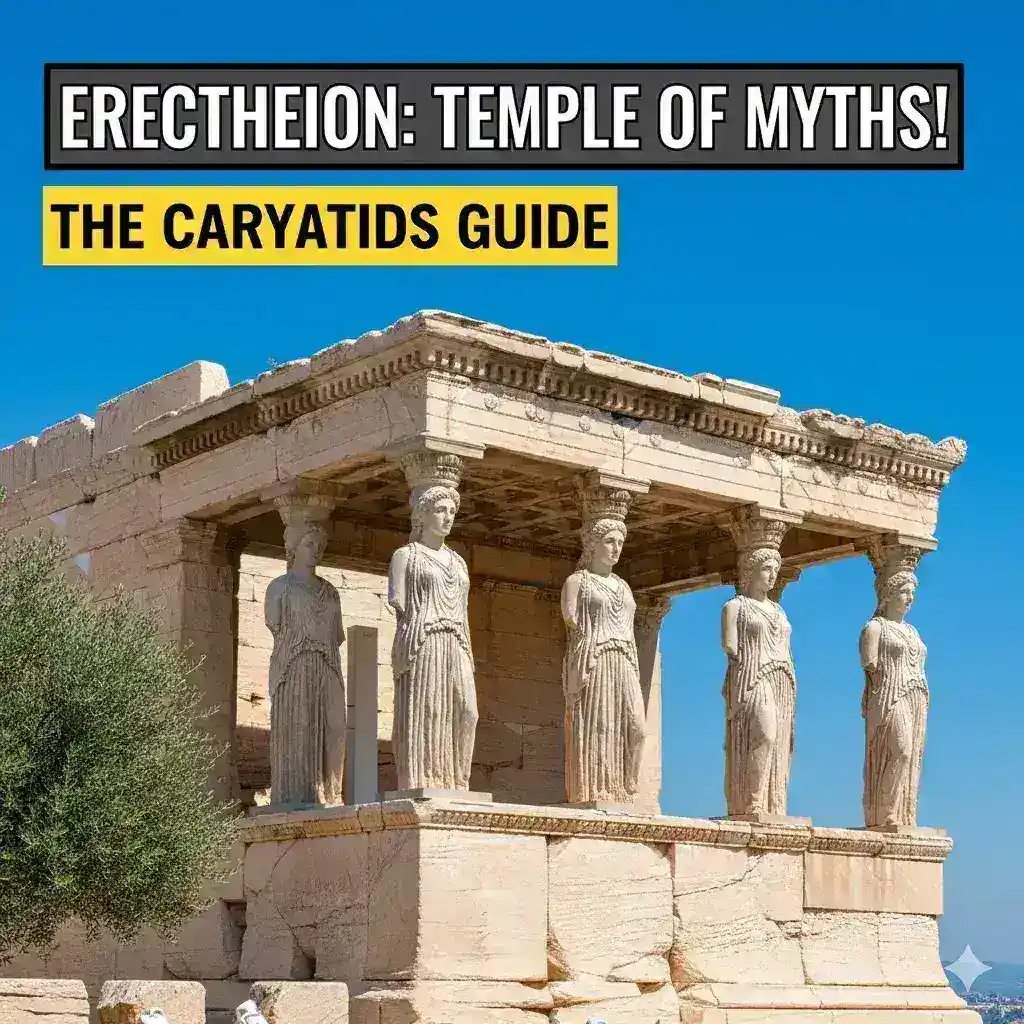
THE ERECHTHEION: THE TEMPLE OF THE CARYATIDS AND ANCIENT MYTHS
On the north side of the Acropolis in Athens, set against the backdrop of the more famous Parthenon, stands one of the most enigmatic and beautiful buildings of classical Greece: the Erechtheion. This extraordinary temple, constructed between 421 and 406 BCE during the height of Athenian power, defies the symmetrical conventions of Greek architecture to embrace complexity, mythology, and sacred geography. Its most iconic feature, the Porch of the Caryatids, where six sculpted female figures support the roof in place of columns, has become one of the most recognizable images of ancient Greece. But the Erechtheion offers far more than photographic beauty; it is a profound expression of Athenian religious practice, mythological memory, and architectural innovation.
This comprehensive guide invites you to explore the Erechtheion with deeper understanding and greater appreciation. We will examine the historical context that shaped this unusual temple, decode the mythological narratives embedded in its design, analyze the architectural innovations that make it a masterpiece of Ionic architecture, and provide practical information for visiting in 2026. Whether you are a mythology enthusiast, an architecture student, a history lover, or simply a curious traveler, this guide will help you prepare for an encounter with one of antiquity's most fascinating buildings.
Understanding the Erechtheion requires engaging with the layers of meaning that ancient Athenians invested in this sacred space. By approaching the temple with curiosity and respect, you will discover not just ancient stones but a living dialogue between myth and history, between human aspiration and divine presence.
HISTORICAL CONTEXT: BUILDING ON SACRED GROUND
The Erechtheion was constructed during a pivotal moment in Athenian history. Following the devastating Persian invasion of 480 BCE, which destroyed earlier temples on the Acropolis, the Athenian statesman Pericles initiated an ambitious rebuilding program to celebrate Athenian democracy, artistic achievement, and devotion to the goddess Athena. While the Parthenon, dedicated to Athena Parthenos, represented the triumph of order and rationality, the Erechtheion embraced complexity, ambiguity, and the layered sacredness of the Acropolis rock.
The temple's name derives from Erechtheus, a mythical king of Athens who was closely associated with Athena and Poseidon. According to legend, Erechtheus was either born from the earth or raised by Athena herself, and his tomb was believed to be located within the temple complex. This connection to foundational myths made the Erechtheion not merely a religious building but a monument to Athenian identity and origins.
Construction of the Erechtheion began around 421 BCE, during the Peace of Nicias in the Peloponnesian War, and was completed in 406 BCE, just before Athens' defeat by Sparta. The architect is unknown, though ancient sources sometimes attribute the design to Mnesicles, who also designed the Propylaea. The sculptor Phidias, who oversaw the Parthenon's artistic program, may have influenced the Erechtheion's decorative elements, though direct evidence is lacking.
The temple's unusual design reflects its complex religious function. Unlike the Parthenon, which was dedicated primarily to Athena, the Erechtheion housed multiple cults and sacred objects. It honored Athena Polias (Athena of the City), Poseidon-Erechtheus, Hephaestus, and other deities and heroes. It incorporated ancient shrines, sacred trees, and miraculous signs that predated the classical temple. This multiplicity of purposes required an asymmetrical, adaptive design that responded to the uneven terrain and the location of sacred features.
The Erechtheion survived the centuries with remarkable resilience. Like the Parthenon, it was converted into a Christian church in the Byzantine era and later used as a harem under Ottoman rule. The building suffered damage during the Venetian bombardment of the Acropolis in 1687, though less severely than the Parthenon. In the nineteenth century, archaeological excavations began to reveal the temple's original form, and in the twentieth and twenty-first centuries, extensive restoration projects have stabilized the structure and revealed new insights into ancient construction techniques.
Today, the Erechtheion stands as a UNESCO World Heritage Site and a testament to the creativity and spiritual depth of classical Athens. For visitors in 2026, the temple offers a unique opportunity to engage with the complexities of ancient Greek religion, the ingenuity of classical architecture, and the enduring power of myth to shape human experience.
ARCHITECTURAL INNOVATION: IONIC ELEGANCE AND ASYMMETRICAL DESIGN
The Erechtheion represents one of the finest examples of Ionic architecture in ancient Greece, contrasting with the Doric order of the nearby Parthenon. Its design embodies sophistication, adaptability, and a deep understanding of how architecture can express religious meaning.
Overall Design and Layout:
The Erechtheion measures approximately 22.8 meters long by 11.2 meters wide, significantly smaller than the Parthenon but no less impressive in its complexity. The temple is built on sloping ground, with the east end approximately three meters higher than the west end. Rather than leveling the site, the architects embraced the uneven terrain, creating a building with multiple levels, irregular floor plans, and varied roof lines.
The temple features a distinctive asymmetrical plan with three main sections: the east cella dedicated to Athena Polias, the west cella honoring Poseidon-Erechtheus and other deities, and the famous Porch of the Caryatids on the south side. This tripartite organization reflects the multiple cults housed within the building and the sacred features incorporated into its design.
Ionic Order and Decorative Elements:
The Erechtheion's columns exemplify the Ionic order, characterized by slender proportions, fluted shafts, and volute capitals resembling scrolled ram's horns. The columns are more slender than their Doric counterparts, creating a sense of elegance and refinement. The entablature features a continuous frieze, originally decorated with sculpted figures attached to the background using metal pins, a technique that allowed for greater detail and dynamism.
Decorative elements include intricately carved moldings, egg-and-dart patterns, and bead-and-reel motifs that demonstrate the extraordinary skill of Athenian craftsmen. The doorframes and window surrounds feature elaborate profiles that enhance the building's sense of refinement and sacredness.
The Porch of the Caryatids:
The Erechtheion's most famous feature is the Porch of the Caryatids, where six sculpted female figures support the roof in place of columns. These Caryatids, approximately 2.3 meters tall, stand in contrapposto pose with one leg slightly bent, creating a sense of graceful movement despite their structural function. Their elaborate drapery, intricately carved hair, and serene expressions demonstrate the highest achievements of classical sculpture.
The Caryatids are not merely decorative; they carry profound symbolic meaning. In Greek architecture, female figures used as supports were called caryatids, possibly derived from the women of Caryae in Laconia who were said to have been punished by being forced to carry burdens. However, the Erechtheion's Caryatids transcend punishment to embody grace, strength, and sacred service. They may represent Kekrops, the mythical first king of Athens, or serve as eternal attendants to Athena.
Of the original six Caryatids, five remain in Athens: four are displayed in the Acropolis Museum, and one remains in situ on the temple (protected from the elements). The sixth Caryatid, along with fragments of the others, was removed by Lord Elgin in the early nineteenth century and is now housed in the British Museum. The replicas currently on the temple were carved in the 1970s and 1980s using modern techniques to protect the originals from further weathering.
Sacred Features and Adaptive Design:
The Erechtheion's unusual design was dictated by the need to incorporate multiple sacred features into a single building. These included:
- The sacred olive tree of Athena, believed to have been miraculously created during Athena's contest with Poseidon
- The salt sea well of Poseidon, a natural spring that produced salt water
- The tomb of Cecrops, the mythical first king of Athens
- The shrine of Pandrosos, daughter of Cecrops and priestess of Athena
- The marks of Poseidon's trident on the rock, evidence of his contest with Athena
Rather than demolishing or relocating these features, the architects designed the temple to accommodate them, resulting in the building's distinctive asymmetry. The east porch provides access to Athena's sanctuary; the west cella incorporates Poseidon's well and the trident marks; the north porch offers a grand entrance with Ionic columns; and the south porch with Caryatids overlooks the sacred olive tree.
This adaptive approach demonstrates a profound respect for sacred geography and a willingness to subordinate architectural convention to religious meaning. The Erechtheion is not a monument to human mastery over nature but a dialogue between human creativity and divine presence.
MYTHOLOGICAL NARRATIVES: ATHENA, POSEIDON, AND THE FOUNDING OF ATHENS
The Erechtheion is inseparable from the mythological narratives that gave meaning to ancient Athenian identity. Understanding these stories enriches the experience of visiting the temple.
The Contest of Athena and Poseidon:
According to myth, the gods Athena and Poseidon competed for patronage of the city that would become Athens. Each offered a gift to demonstrate their value to the people. Poseidon struck the Acropolis rock with his trident, producing a spring of salt water (or, in some versions, a horse). Athena planted an olive tree, which provided food, oil, and wood. The Athenians, guided by their king Cecrops, chose Athena's gift as more useful, and the goddess became the city's patron.
The Erechtheion incorporated physical evidence of this myth: the salt sea well attributed to Poseidon and the sacred olive tree attributed to Athena. By housing both features, the temple acknowledged the power of both deities while affirming Athena's ultimate victory. This nuanced approach reflects the complexity of Greek religion, which often embraced multiple perspectives rather than insisting on singular truths.
Erechtheus and the Origins of Athens:
Erechtheus, the temple's namesake, was a foundational figure in Athenian mythology. According to some traditions, he was born from the earth and raised by Athena; according to others, he was an early king who established important religious practices. His tomb was believed to be located within the Erechtheion, making the temple not just a place of worship but a memorial to Athens' mythical origins.
The connection to Erechtheus also linked the temple to themes of sacrifice and civic duty. In one version of the myth, Erechtheus sacrificed his daughters to ensure Athenian victory in war, demonstrating the ultimate commitment to the city's survival. This narrative resonated with Athenian ideals of civic virtue and the willingness to sacrifice personal interests for the common good.
Pandrosos and the Sacred Olive Tree:
Pandrosos, daughter of Cecrops and sister to Aglaurus and Herse, played a crucial role in Athenian mythology. According to myth, Athena entrusted Pandrosos and her sisters with a basket containing the infant Erichthonius (sometimes identified with Erechtheus), instructing them not to look inside. Two sisters disobeyed and were driven mad; Pandrosos alone remained faithful and was honored with a shrine within the Erechtheion complex.
Pandrosos was also associated with the sacred olive tree, which was believed to have been destroyed by the Persians but miraculously regrown in a single day after the Persian Wars. This story of destruction and renewal resonated deeply with Athenians who had witnessed their city's devastation and rebirth. The Erechtheion's incorporation of the olive tree shrine made it a monument to resilience and divine favor.
These mythological narratives were not mere stories; they were foundational to Athenian identity and religious practice. The Erechtheion gave physical form to these narratives, allowing worshippers to engage with them through ritual, architecture, and sacred objects. For modern visitors, understanding these stories transforms the temple from a ruin into a living expression of ancient beliefs and values.
THE CARYATIDS: SCULPTURAL MASTERPIECES AND SYMBOLIC FIGURES
The Porch of the Caryatids is the Erechtheion's most iconic feature and one of the most celebrated works of classical sculpture. Understanding these figures enhances appreciation of their artistic achievement and symbolic meaning.
Artistic Achievement:
The Caryatids demonstrate the extraordinary skill of classical Greek sculptors. Each figure stands in contrapposto, with weight shifted onto one leg, creating a sense of natural movement despite their structural function. Their drapery is carved with extraordinary precision, revealing the forms beneath while creating complex patterns of light and shadow. Their hair is elaborately styled, with intricate braids and curls that frame serene, idealized faces.
Despite their uniform appearance from a distance, close examination reveals subtle variations among the Caryatids. Each figure has a slightly different pose, expression, and drapery pattern, suggesting that they were carved by different hands or that the sculptors intentionally introduced variety to enhance visual interest. This attention to detail reflects the classical Greek belief that beauty arises from both harmony and diversity.
Structural Innovation:
The Caryatids are not merely decorative; they serve a crucial structural function, supporting the roof of the south porch. This integration of sculpture and architecture demonstrates the classical Greek understanding that beauty and utility are not opposed but complementary. The figures' sturdy forms and balanced poses convey both grace and strength, embodying the ideal of kalokagathia (the unity of beauty and goodness) that was central to Greek ethics.
To distribute the weight of the roof, the Caryatids' heads are carved with thick, basket-like capitals that provide a stable base for the entablature. Their arms are held close to their bodies, and their drapery falls in vertical folds that reinforce their structural role. This ingenious solution to an architectural problem demonstrates the creativity and technical mastery of classical Greek builders.
Symbolic Meaning:
The Caryatids carry multiple layers of symbolic meaning. As female figures supporting a sacred building, they may represent eternal attendants to Athena, embodying devotion, service, and grace. Their serene expressions and dignified poses convey a sense of sacred duty and spiritual composure.
Some scholars suggest that the Caryatids represent Kekrops, the mythical first king of Athens, who was sometimes depicted as half-man, half-serpent. Others propose that they commemorate the women of Caryae in Laconia, who were said to have been punished by being forced to carry burdens. However, the Erechtheion's Caryatids transcend punishment to embody honor, service, and sacred beauty.
The Original Caryatids and Their Preservation:
Of the original six Caryatids, five remain in Athens and one is in London. The British Museum holds Caryatid II, removed by Lord Elgin in 1801-1802. The Acropolis Museum displays Caryatids I, III, IV, V, and VI in a specially designed gallery that allows visitors to view them from multiple angles and appreciate their sculptural details.
The Caryatid remaining in situ on the Erechtheion is a high-quality replica carved in the 1970s. The originals were moved indoors to protect them from Athens' air pollution, acid rain, and weathering. Modern conservation techniques, including laser cleaning and climate-controlled display, help preserve these irreplaceable works of art for future generations.
The question of whether the British Museum should return the Elgin Caryatid to Athens remains a subject of international debate. The Acropolis Museum was designed with a gallery specifically intended to display all six Caryatids together in their original architectural context, should repatriation occur. For visitors, understanding this controversy adds depth to the experience of viewing both the Erechtheion and the museum's collections.
VISITOR INFORMATION FOR 2026
Planning a visit to the Erechtheion in 2026 requires some preparation to ensure a smooth and rewarding experience.
Tickets and Admission:
Entry to the Erechtheion is included with admission to the Acropolis. Tickets can be purchased online in advance or at the site. In 2026, advance online booking is strongly recommended, especially for peak season (April to October), to avoid long queues and ensure entry at your preferred time.
Ticket options include:
- Single-site ticket for the Acropolis only (approximately 20 euros)
- Combined ticket (valid for five days, approximately 30 euros) providing entry to the Acropolis, Ancient Agora, Roman Agora, Hadrian's Library, Kerameikos, Aristotle's Lyceum, and Temple of Olympian Zeus
The combined ticket offers excellent value if you plan to visit multiple archaeological sites. Reduced rates are available for students, seniors, and EU youth.
Opening Hours:
The Acropolis, including the Erechtheion, is generally open daily from 8 AM to 8 PM in summer (April to October) and 8 AM to 5 PM in winter (November to March), though hours may vary for holidays and special events. The last entry is typically thirty minutes before closing. Check the official Hellenic Ministry of Culture website for current hours before your visit.
Best Times to Visit:
To avoid crowds and enjoy optimal lighting for photography, consider these strategies:
- Arrive at opening time (8 AM) for the smallest crowds and soft morning light
- Visit in late afternoon for golden hour lighting and fewer tour groups
- Avoid midday in summer, when heat and crowds peak
- Consider visiting on weekday mornings rather than weekends
Weather Considerations:
Athens has a Mediterranean climate with hot, dry summers and mild, wet winters. Summer temperatures can exceed 35 degrees Celsius (95 degrees Fahrenheit), so bring water, sunscreen, and a hat. The Acropolis offers little shade, so plan accordingly. Winter visits offer cooler temperatures and fewer crowds, though rain is possible and marble surfaces may be slippery.
Accessibility:
The Acropolis has made efforts to improve accessibility, though the ancient site presents challenges due to its rocky terrain and historic structures. A paved path and elevator provide access to the summit for visitors with mobility challenges, and wheelchairs are available for loan. However, the Erechtheion's uneven floor levels and narrow passages may limit access to some areas. Contact the site in advance to arrange assistance if needed.
Viewing the Caryatids:
The Porch of the Caryatids is visible from multiple vantage points on the Acropolis. For the best views:
- Approach from the east to see the figures in profile against the Parthenon
- Stand at a distance to appreciate their structural function and sculptural details
- Use binoculars or a zoom lens to examine drapery and facial details
- Visit the Acropolis Museum to see the original Caryatids up close in a climate-controlled environment
Photography Tips:
- Golden hour (early morning or late afternoon) provides the most dramatic lighting for the marble surfaces
- Use a polarizing filter to reduce glare and enhance the texture of the stone
- Include the Parthenon in the background for context and scale
- Capture details: the Caryatids' drapery, the Ionic capitals, the sacred rock beneath the temple
- Respect other visitors and avoid blocking pathways for photos
PRACTICAL TIPS FOR ENHANCING YOUR VISIT
Guided Tours vs. Self-Guided Exploration:
Both options have merits. Guided tours provide expert context, mythological insights, and efficient navigation of the Acropolis. Licensed guides can bring the Erechtheion to life with stories of Athena, Poseidon, and ancient Athenian religious practice. Self-guided exploration offers flexibility to linger at favorite spots and discover details at your own pace. Audio guides and mobile apps provide a middle ground, offering commentary without the structure of a group tour.
What to Bring:
- Comfortable walking shoes with good grip (marble can be slippery)
- Water bottle (refill stations available on the Acropolis)
- Sunscreen, hat, and sunglasses (limited shade on the rock)
- Camera with extra batteries and memory cards
- Light jacket or layers (can be windy on the summit)
- Small backpack for essentials
- Printed or digital copy of your ticket confirmation
- Binoculars for examining sculptural details from a distance
Crowd Avoidance Strategies:
- Book timed-entry tickets online in advance
- Arrive at opening time or late afternoon
- Visit during shoulder seasons (April-May, September-October)
- Explore the north side of the Acropolis where the Erechtheion is located, which is often less crowded than the Parthenon approach
- Combine your visit with the Acropolis Museum, which is less crowded and provides essential context
Combining with Other Sites:
The Erechtheion is part of a rich archaeological landscape on the Acropolis. Consider combining your visit with:
- The Parthenon: The iconic temple dedicated to Athena Parthenos
- The Propylaea: The monumental gateway to the Acropolis
- The Temple of Athena Nike: The small but exquisite temple on the southwest bastion
- The Acropolis Museum: Essential for understanding the sculptures and artifacts from the Acropolis
- The Ancient Agora: The heart of ancient Athenian public life, featuring the Temple of Hephaestus
CULTURAL SIGNIFICANCE: WHY THE ERECHTHEION MATTERS TODAY
The Erechtheion is more than an ancient ruin; it is a profound expression of human creativity, religious devotion, and architectural innovation. Its significance extends far beyond its historical context to offer insights relevant to contemporary life.
Architectural Legacy:
The Erechtheion's adaptive design, which embraced complexity rather than imposing rigid symmetry, offers a model for contemporary architecture that responds to context, history, and meaning. Its integration of sculpture and structure, beauty and utility, demonstrates that functional design can be profoundly beautiful. The Caryatids, in particular, have influenced architectural decoration from the Renaissance to neoclassical government buildings worldwide.
Mythological Resonance:
The mythological narratives embedded in the Erechtheion—Athena's contest with Poseidon, the sacrifice of Erechtheus, the faithfulness of Pandrosos—continue to resonate as stories about choice, sacrifice, and civic virtue. These narratives remind us that human societies are shaped not just by laws and institutions but by the stories we tell about who we are and what we value.
Religious Complexity:
The Erechtheion's incorporation of multiple cults and sacred features demonstrates the complexity and inclusivity of ancient Greek religion. Rather than insisting on singular truths, the temple embraced multiple perspectives, acknowledging the power of different deities and the layered sacredness of place. This nuanced approach offers a model for contemporary interfaith dialogue and religious pluralism.
Conservation and Heritage:
The ongoing restoration of the Erechtheion, using modern technology and traditional techniques, demonstrates the commitment to preserving cultural heritage for future generations. The debate over the repatriation of the Elgin Caryatid raises important questions about cultural ownership, colonialism, and the role of museums in preserving and interpreting global heritage. Engaging with these questions enriches the experience of visiting the temple and its museum.
CONCLUSION: ENGAGING WITH ANCIENT WISDOM
Standing before the Erechtheion on the Acropolis is an experience that transcends ordinary tourism. As sunlight illuminates the weathered marble of the Caryatids, as the Parthenon rises in the background, and as the city of Athens spreads below, visitors encounter something profound: the enduring power of human creativity to give form to myth, to embody devotion in stone, and to create beauty that speaks across millennia.
In 2026, as the world grapples with challenges of sustainability, cultural preservation, and meaningful connection, the Erechtheion offers not just a window into the past but inspiration for the future. The ancient Athenians who built this temple believed in the power of art, story, and sacred space to elevate human life. Their achievement, though imperfect and incomplete, continues to challenge and inspire us to create, to question, and to aspire.
As you plan your visit to the Erechtheion, approach this sacred space with curiosity, humility, and respect. Listen to the stories the stones tell, engage with the complexities of myth and history, and allow the beauty of the Caryatids to move you. In doing so, you join the long line of travelers, scholars, and dreamers who have found meaning on this rocky summit.
May your encounter with the Erechtheion deepen your appreciation for the achievements of the past and inspire your contribution to the future. As the ancient Greeks understood, true greatness lies not in monuments alone but in the ideas, values, and actions that give them meaning. May you carry that understanding forward, wherever your journey leads.
Useful resources include the Hellenic Ministry of Culture and Sports for ticket information and site updates, the Acropolis Museum for exhibits and educational programs, and the UNESCO World Heritage Centre for conservation information. Emergency services in Greece can be reached at 112. Disclaimer: Information is accurate as of early 2026. Site hours, ticket prices, and policies may change; verify details before travel. This guide is for informational purposes only and does not constitute professional travel or historical advice.
0 Comments