.webp)
.webp)
Oceania Travel Guide Australia New Zealand Cost and Tips 2026
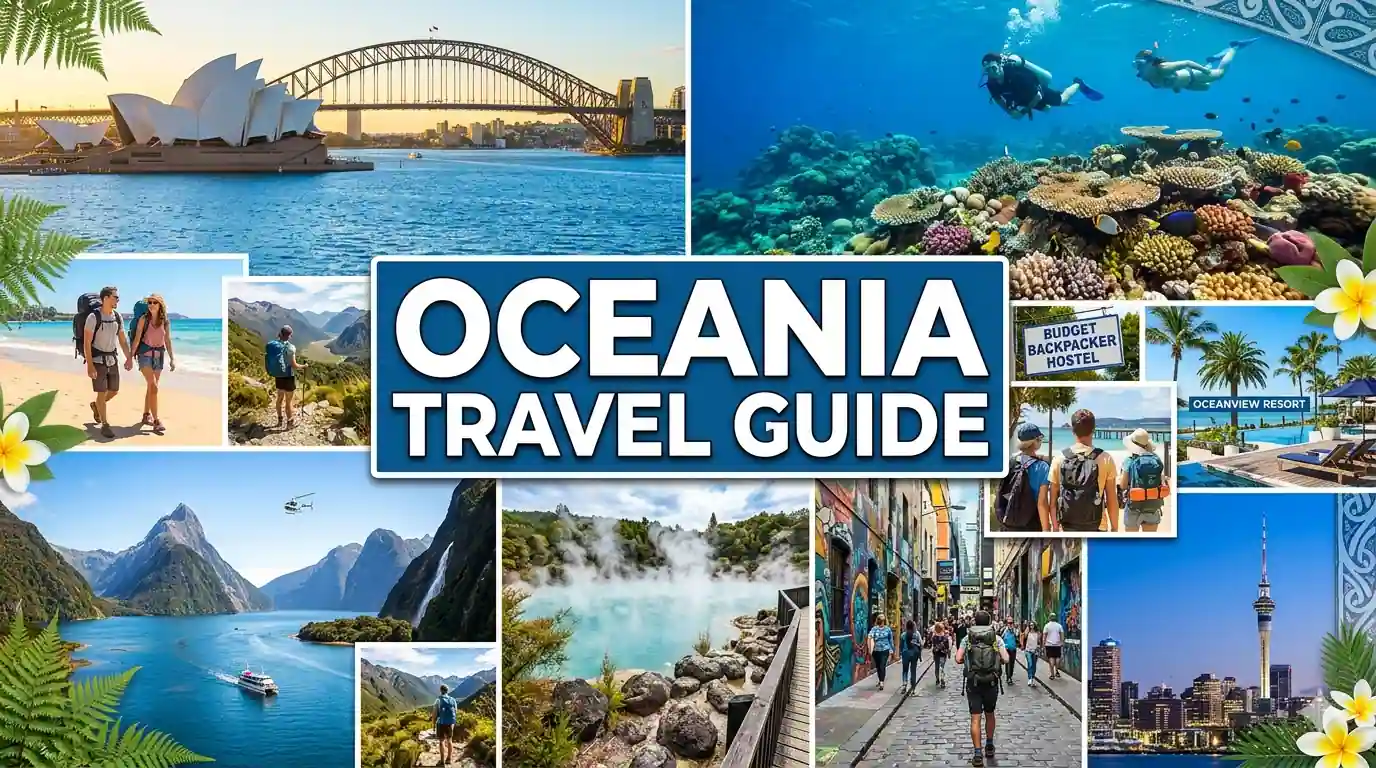
Complete Oceania Travel Guide for 2026
Australia and New Zealand offer world-class travel experiences with stunning landscapes, vibrant cities, unique wildlife, and outdoor adventures across the Southern Hemisphere.
This comprehensive guide covers essential information for visiting Oceania in 2026 including visa requirements, realistic costs, transportation options, itineraries, and expert travel tips for both countries.
Whether you are planning a city-focused urban adventure or an outdoor nature exploration, this resource provides verified and practical guidance for your journey Down Under.
Why Visit Australia and New Zealand in 2026
Australia and New Zealand combine natural beauty, modern infrastructure, and outdoor adventure opportunities that attract millions of visitors annually.
Both countries offer exceptional safety standards, excellent healthcare, and English-speaking environments ideal for international travelers.
Unique wildlife encounters include kangaroos, koalas, kiwi birds, and marine life found nowhere else on Earth.
Diverse landscapes range from tropical rainforests and coral reefs to snow-capped mountains and dramatic fjords.
World-class cities deliver vibrant food scenes, cultural attractions, and cosmopolitan lifestyles.
Countries and Destinations Covered
This guide focuses on Australia and New Zealand with detailed coverage of major cities and natural attractions.
Australia Major Cities Overview
Sydney features the iconic Opera House, Harbour Bridge, and beautiful beaches like Bondi and Manly.
Melbourne offers renowned coffee culture, street art laneways, and sporting events with European flair.
Brisbane provides gateway access to the Gold Coast and Sunshine Coast beach destinations.
Perth delivers isolated west coast beauty with pristine beaches and wine regions.
Adelaide serves as a base for exploring wine country and Kangaroo Island wildlife.
New Zealand Major Cities Overview
Auckland combines urban sophistication with harbor views and volcanic cone hikes.
Wellington features compact walkability, craft beer culture, and film industry connections.
Christchurch offers garden city charm with ongoing regeneration following earthquake recovery.
Queenstown provides adventure tourism capital status with skiing and bungee jumping.
Nature Destinations in Australia
The Great Barrier Reef represents the world's largest coral reef system with exceptional diving and snorkeling.
Uluru stands as an iconic red rock monolith sacred to Indigenous Anangu people in the Outback.
The Twelve Apostles showcase dramatic limestone stacks along Victoria's Great Ocean Road.
Kakadu National Park features ancient rock art, wetlands, and diverse wildlife in the Northern Territory.
Nature Destinations in New Zealand
Fiordland National Park includes Milford Sound and Doubtful Sound with dramatic fjord landscapes.
Tongariro National Park offers volcanic terrain and the famous Tongariro Alpine Crossing hike.
Aoraki Mount Cook National Park features New Zealand's highest peak with glacier experiences.
Abel Tasman National Park provides golden beaches and coastal hiking in the South Island.
Visa and Entry Requirements for Oceania
Understanding entry requirements is essential before planning your Australia and New Zealand journey.
Australia visa requirements overview
Most visitors require a visa or electronic travel authority to enter Australia for tourism purposes.
The Electronic Travel Authority or ETA allows short stays for tourism and business from eligible countries.
ETA applications are submitted online through official Australian government immigration portals.
Visitor visas typically allow stays up to three, six, or twelve months depending on circumstances.
All visa applications must be completed through official Department of Home Affairs websites.
Passports must be valid for the duration of your intended stay in Australia.
New Zealand visa requirements overview
New Zealand offers visa waiver entry for citizens of many countries for stays up to three months.
Visa waiver visitors must obtain an NZeTA or New Zealand Electronic Travel Authority before travel.
NZeTA applications are processed through official Immigration New Zealand government websites.
Visitor visas are required for longer stays or nationals from non-waiver countries.
Proof of onward travel and sufficient funds may be requested at border entry.
Trans-Tasman travel considerations
Travel between Australia and New Zealand is common with frequent flight connections.
Each country maintains separate visa requirements even for trans-Tasman travel.
Check visa validity for both countries if planning to visit during one trip.
Some visa categories allow multiple entries facilitating travel between both nations.
Understanding High Travel Costs in Oceania
Australia and New Zealand rank among the world's more expensive travel destinations requiring careful budget planning.
Why Oceania travel costs are high
Geographic isolation increases costs for imported goods, fuel, and transportation infrastructure.
High labor costs and strong currencies contribute to elevated prices for services and accommodation.
Limited competition in some sectors like domestic flights keeps prices higher than other regions.
Remote destinations require additional transport costs increasing overall trip expenses.
Quality standards and safety regulations add costs but ensure excellent visitor experiences.
Budget management strategies for Oceania
Book flights and accommodation well in advance to secure better rates especially during peak seasons.
Consider traveling during shoulder seasons for lower prices while maintaining good weather.
Self-catering accommodation with kitchen facilities reduces dining costs significantly.
Utilize free attractions including beaches, hiking trails, and public parks extensively.
Travel between cities by bus or budget airlines rather than last-minute flights.
Consider campervan travel combining transport and accommodation for nature-focused itineraries.
Australia and New Zealand Cost Breakdown in USD
Understanding realistic costs helps you budget effectively for your Oceania adventure.
All prices below are presented in United States Dollars with local currency equivalents noted.
Budget Traveler Costs per Day
Budget travelers can explore Oceania on 70 to 100 USD per day with strategic planning.
Hostel dorm beds cost 25 to 45 USD per night in major cities and tourist areas.
Self-catering and budget meals keep daily food costs around 20 to 35 USD.
Public transportation and budget intercity buses cost 10 to 20 USD daily.
Free walking tours, beaches, and hiking minimize entertainment expenses.
New Zealand tends to be slightly less expensive than Australia for budget travel.
Mid-Range Traveler Costs per Day
Mid-range travelers spending 150 to 250 USD daily enjoy greater comfort and flexibility.
Private rooms in motels or mid-range hotels cost 80 to 150 USD per night.
Restaurant meals including one nice dinner range from 40 to 70 USD daily for food.
Domestic flights, car rental, and tours cost 30 to 60 USD daily for transport.
Paid attractions, guided tours, and activities budget 20 to 40 USD daily.
This level allows mixing free experiences with select premium activities comfortably.
Luxury Traveler Costs per Day
Luxury travelers spending 350 to 600 plus USD daily experience Oceania in style.
Four and five-star hotels range from 200 to 450 USD per night in major cities.
Fine dining and wine experiences cost 80 to 150 USD daily for food and beverages.
Private tours, domestic flights, and premium car rental cost 100 to 200 USD daily.
Exclusive experiences like helicopter tours and luxury lodges budget 150 to 400 USD daily.
Luxury travel in remote areas like the Outback or Fiordland commands premium pricing.
Country-Specific Cost Comparison
Sydney and Melbourne rank as Australia's most expensive cities for accommodation and dining.
Perth and Adelaide offer moderate costs with good value for mid-range travelers.
Auckland is New Zealand's most expensive city though still cheaper than Sydney.
Queenstown commands premium prices especially during ski season and summer peaks.
Regional areas and smaller towns generally offer better value than major cities.
Transportation Options in Australia and New Zealand
Understanding transportation helps you travel efficiently across these vast countries.
Domestic flights versus driving
Domestic flights save significant time for long distances between major cities.
Major airlines include Qantas, Virgin Australia, Jetstar in Australia and Air New Zealand, Jetstar in New Zealand.
Book domestic flights 4 to 8 weeks in advance for best fares especially during peak periods.
Driving provides flexibility for exploring regional areas and scenic routes at your own pace.
Consider driving for distances under 500 kilometers where total travel time may be comparable.
Long-distance drives over 800 kilometers favor flying to maximize time at destinations.
Car rental and road trip planning
Car rental provides excellent flexibility for exploring both countries' diverse landscapes.
Requirements include valid driver's license, credit card, and minimum age typically 21 to 25.
International Driving Permits are recommended for non-English licenses though not always required.
Insurance is essential and often expensive verify coverage carefully before declining.
Driving is on the left side of the road in both Australia and New Zealand.
Distances in Australia are vast plan fuel stops carefully in remote Outback regions.
Campervan and motorhome travel
Campervan travel combines transport and accommodation popular for nature-focused itineraries.
Rental costs range from 50 to 150 USD daily depending on vehicle size and season.
Holiday parks provide powered sites with facilities for campervans throughout both countries.
Freedom camping is restricted in many areas research regulations before overnight parking.
Campervan travel works best for flexible itineraries without strict daily schedules.
Public transportation in cities
Major cities offer efficient public transport including trains, buses, and trams.
Sydney uses Opal cards, Melbourne uses Myki, and Auckland uses AT HOP for fare payment.
Day passes and multi-day cards offer savings for frequent public transport users.
Public transport is significantly cheaper than taxis or ride-hailing for urban travel.
Ride-hailing apps like Uber operate in major cities providing convenient alternatives.
Best Time to Visit Australia and New Zealand
Timing your trip significantly impacts weather, crowds, and costs across the Southern Hemisphere.
Understanding Southern Hemisphere seasons
Seasons are opposite to the Northern Hemisphere with summer from December to February.
Winter runs from June to August bringing cooler temperatures and ski season to mountains.
Spring occurs September to November with blooming flowers and mild temperatures.
Autumn spans March to May offering comfortable weather and fewer crowds.
Best time to visit Australia
September to November and March to May offer pleasant weather with fewer tourists.
December to February is peak summer season with beach weather but higher prices and crowds.
Tropical northern regions including Queensland are best visited May to October during dry season.
Southern regions like Melbourne and Tasmania are pleasant December to March.
Great Barrier Reef diving is best June to October with excellent visibility.
Best time to visit New Zealand
November to April provides the warmest weather ideal for outdoor activities and hiking.
December to February is peak summer season with long daylight hours and festival events.
March to May offers autumn colors, comfortable temperatures, and fewer crowds.
Ski season runs June to October in South Island mountain resorts.
Shoulder seasons of spring and autumn provide best value with good weather.
Working Holiday Visa Opportunities
Both Australia and New Zealand offer working holiday visas for young travelers seeking extended stays.
Australia Working Holiday Visa overview
The subclass 417 Working Holiday visa allows stays up to 12 months for eligible nationalities.
Applicants must be aged 18 to 30 or 35 depending on passport country.
The visa permits work to supplement travel funds though employment cannot be the primary purpose.
Second and third-year extensions are available completing specified regional work.
Applications are submitted through official Australian Department of Home Affairs websites.
New Zealand Working Holiday Visa overview
New Zealand Working Holiday visas allow stays from 12 to 23 months depending on nationality.
Age requirements typically range from 18 to 30 or 35 years old.
The visa permits temporary employment to fund travel experiences throughout New Zealand.
Some categories allow study for limited periods alongside work and travel.
Applications must be completed through official Immigration New Zealand government portals.
Important working holiday considerations
Working holiday visas are not employment visas and have work limitations.
Proof of sufficient funds is required upon entry typically several thousand USD.
Health and character requirements must be met for visa approval.
Visas are issued on a quota basis for some nationalities apply early.
Always verify current requirements through official government immigration websites.
Nature and Adventure Activities
Australia and New Zealand excel in outdoor adventures and nature-based experiences.
Adventure activities in Australia
Great Barrier Reef snorkeling and diving offer world-class marine encounters.
Surfing at iconic breaks like Bondi Beach, Bells Beach, and Byron Bay attracts enthusiasts.
Hiking ranges from coastal walks to Outback treks and rainforest trails.
Rock climbing, abseiling, and canyoning are popular in the Blue Mountains.
Wildlife encounters include swimming with whale sharks, dolphins, and sea lions.
Adventure activities in New Zealand
Queenstown is known as the adventure capital with bungee jumping, skydiving, and jet boating.
Hiking or tramping includes world-renowned Great Walks like the Milford Track.
Skiing and snowboarding operate at excellent South Island resorts during winter months.
White water rafting, canyon swinging, and paragliding offer adrenaline experiences.
Glacier hiking on Franz Josef and Fox Glaciers provides unique alpine adventures.
National parks and protected areas
Australia has over 500 national parks protecting diverse ecosystems and landscapes.
New Zealand maintains 13 national parks showcasing volcanic, alpine, and coastal environments.
Park entry fees are generally modest supporting conservation and facility maintenance.
Camping permits are required for overnight stays in many backcountry locations.
Leave No Trace principles are essential protecting fragile environments in both countries.
Recommended Oceania Itineraries
Well-planned itineraries maximize your time across these vast countries.
Seven Day Australia Highlights Itinerary
Start in Sydney spending three days exploring the Opera House, Harbour Bridge, and Bondi Beach.
Fly to Cairns for two days visiting the Great Barrier Reef and Daintree Rainforest.
Continue to Melbourne for two days experiencing laneways, coffee culture, and sporting venues.
This itinerary covers Australia's east coast highlights with efficient flight connections.
Book reef tours and popular attractions in advance especially during peak seasons.
Seven Day New Zealand South Island Itinerary
Begin in Christchurch spending one day exploring the garden city and recovery sites.
Rent a car and drive to Lake Tekapo for one night stargazing at the Dark Sky Reserve.
Continue to Queenstown for three days of adventure activities and stunning lake views.
Visit Milford Sound on a day trip or overnight cruise for fjord experiences.
Return to Queenstown or Christchurch for departure depending on flight arrangements.
Ten Day Australia and New Zealand Combined Itinerary
Start in Sydney with three days for iconic landmarks and coastal walks.
Fly to Auckland for two days exploring harbors, volcanic cones, and nearby islands.
Continue to Queenstown for three days of adventure activities and scenic beauty.
End with two days in Melbourne experiencing culture, food, and laneway exploration.
This route covers highlights from both countries requiring careful visa planning.
Allow buffer time for international flights between countries and potential delays.
Two Week Comprehensive Australia Itinerary
Spend four days in Sydney including Blue Mountains day trip.
Fly to Cairns for three days exploring the Great Barrier Reef and rainforest.
Continue to Uluru for two days experiencing the Outback and Indigenous culture.
Finish in Melbourne for four days with Great Ocean Road day trip included.
This itinerary showcases Australia's diversity from coast to Outback.
Domestic flights connect distant destinations efficiently though add to overall costs.
Safety and Health Considerations
Australia and New Zealand are among the world's safest travel destinations.
General safety guidelines
Both countries maintain low crime rates with violent crime against tourists being rare.
Exercise standard precautions against petty theft in tourist areas and cities.
Emergency services are accessed by dialing 000 in Australia and 111 in New Zealand.
Healthcare is excellent though travel insurance remains essential for visitors.
Beach safety is important swim between flags at patrolled beaches and heed warnings.
Health precautions and requirements
No routine vaccinations are required for entry from most countries.
Travel insurance with medical coverage is strongly recommended for all visitors.
Sun protection is critical with high UV levels requiring SPF 30 plus sunscreen.
Tap water is safe to drink throughout both countries urban and rural areas.
Prescription medications should be carried in original packaging with doctor's notes.
Environmental hazards awareness
Australia has venomous snakes and spiders though encounters are uncommon in urban areas.
Marine stingers exist in tropical waters November to May wear stinger suits when advised.
Shark encounters are rare but follow local beach safety advice and signage.
Weather can change rapidly especially in mountains and coastal areas check forecasts.
Remote area travel requires preparation including extra water, fuel, and communication devices.
Cultural Awareness and Etiquette
Understanding local customs enhances your experience in Australia and New Zealand.
Australian culture and customs
Australian culture values informality, friendliness, and a laid-back attitude.
Tipping is appreciated but not mandatory with 10 percent standard for good service.
Punctuality is expected for business though social events may be more flexible.
Indigenous culture and history are increasingly recognized and respected.
Beach culture is significant respect coastal environments and safety guidelines.
New Zealand culture and customs
New Zealand or Aotearoa culture blends Māori and Pākehā European influences.
Māori protocols or tikanga should be respected when visiting marae or cultural sites.
Environmental consciousness is strong practice Leave No Trace principles.
The concept of manaakitanga or hospitality is central to New Zealand culture.
Rugby is culturally significant though not mandatory knowledge for visitors.
Money and Banking Tips
Managing money effectively enhances your Oceania travel experience.
Currencies and exchange
Australia uses Australian Dollars with approximately 0.65 USD to 1 AUD.
New Zealand uses New Zealand Dollars with approximately 0.60 USD to 1 NZD.
Exchange money at banks or ATMs for competitive rates avoid airport exchanges.
Credit and debit cards are widely accepted throughout both countries.
Contactless payment is common for most transactions including public transport.
Budget planning strategies
Set a daily budget and track spending to avoid overspending in expensive destinations.
Build in buffer funds for unexpected costs or spontaneous opportunities.
Consider travel rewards credit cards offering points for flights and accommodation.
Notify your bank of travel plans to prevent card blocks for international transactions.
Carry some cash for small purchases though card usage dominates.
Final Recommendations for Oceania Travel
Australia and New Zealand reward thoughtful planning with unforgettable experiences.
Start with one country rather than trying to see both on a short first visit.
Prioritize experiences over checklist tourism allowing time for spontaneous discoveries.
Embrace outdoor activities and nature as central to the Oceania travel experience.
Respect Indigenous cultures and environments as a guest in these remarkable lands.
Build flexibility into your itinerary for weather-dependent activities and travel delays.
Travel insurance covering medical evacuation is essential especially for remote adventures.
The distance and cost of visiting Oceania make it worthwhile to plan extended stays.
Australia and New Zealand's natural beauty, outdoor culture, and welcoming people create transformative travel experiences.
Begin planning your Oceania adventure today using verified information from official government and tourism sources.
0 Comments