.webp)
.webp)
Exploring the Rock Art of the Barrouallie Petroglyphs: A Prehistoric Site Guide to Saint Vincent's Indigenous Heritage
Introduction: Discovering Saint Vincent's Ancient Rock Art
Nestled in the coastal town of Barrouallie on the leeward side of Saint Vincent lies one of the Caribbean's most significant prehistoric sites: the Barrouallie Petroglyphs. These ancient rock carvings, etched into volcanic stone centuries ago by the island's indigenous inhabitants, offer a tangible connection to the Kalinago (Carib) and earlier Arawak peoples who called this volcanic island home long before European contact. For visitors interested in archaeology, indigenous history, and cultural heritage, the Barrouallie Petroglyphs represent an unmissable opportunity to witness firsthand the artistic expression and spiritual beliefs of Saint Vincent's original inhabitants.
Petroglyphs—images created by carving, pecking, or incising rock surfaces—serve as enduring records of prehistoric cultures worldwide. In the Caribbean, and particularly in Saint Vincent, these rock art sites provide crucial insights into the cosmology, daily life, and ceremonial practices of indigenous peoples who navigated the Caribbean Sea, cultivated the land, and developed complex societies adapted to island environments. The Barrouallie site, with its collection of carved faces, geometric patterns, and symbolic designs, stands as a testament to the sophisticated artistic traditions of the region's first peoples.
This comprehensive guide explores the Barrouallie Petroglyphs in detail, providing historical context, describing the rock art itself, offering practical visiting information, and discussing the broader significance of these carvings within Caribbean archaeology. Whether you are an archaeology enthusiast, a cultural heritage traveler, or simply curious about Saint Vincent's prehistoric past, this guide equips you with the knowledge needed to appreciate and respectfully engage with this important archaeological site.
Historical Context: Indigenous Peoples of Saint Vincent

Understanding the Barrouallie Petroglyphs requires knowledge of the indigenous peoples who created them. Saint Vincent's prehistoric timeline encompasses several distinct cultural periods, each contributing to the island's rich archaeological heritage.
The earliest inhabitants of Saint Vincent were Arawak-speaking peoples who migrated from South America through the Lesser Antilles beginning around 2000-3000 years ago. These early settlers, often referred to as Saladoid or Ostionoid peoples based on their pottery styles, practiced agriculture, fishing, and established trade networks across the Caribbean. They created the earliest known rock art in the region, though attributing specific petroglyphs to particular groups remains challenging for archaeologists.
By the 15th century, at the time of European contact, the Kalinago (Island Caribs) dominated Saint Vincent. The Kalinago were skilled navigators, warriors, and artisans who resisted European colonization fiercely. Saint Vincent, which they called Hairouna (meaning "Land of the Blessed"), became a refuge for Kalinago fleeing European encroachment on other islands, as well as for escaped and shipwrecked Africans who intermarried with the indigenous population, creating the unique Garifuna (Black Carib) culture.
The Kalinago and Rock Art Traditions
The Kalinago created rock art at numerous sites throughout the Caribbean, including petroglyphs and pictographs (painted images). These carvings served multiple purposes: marking territorial boundaries, recording mythological narratives, designating ceremonial spaces, and possibly serving as astronomical markers or navigational aids. The concentration of petroglyphs near water sources, coastal areas, and elevated locations suggests strategic placement related to settlement patterns and spiritual geography.
Barrouallie's location on the leeward coast, with access to marine resources and freshwater streams, made it an attractive settlement area for prehistoric peoples. The presence of petroglyphs here indicates the site's importance within the broader indigenous landscape of Saint Vincent, possibly serving as a ceremonial center, territorial marker, or communal gathering place.
The Barrouallie Petroglyphs: Description and Interpretation

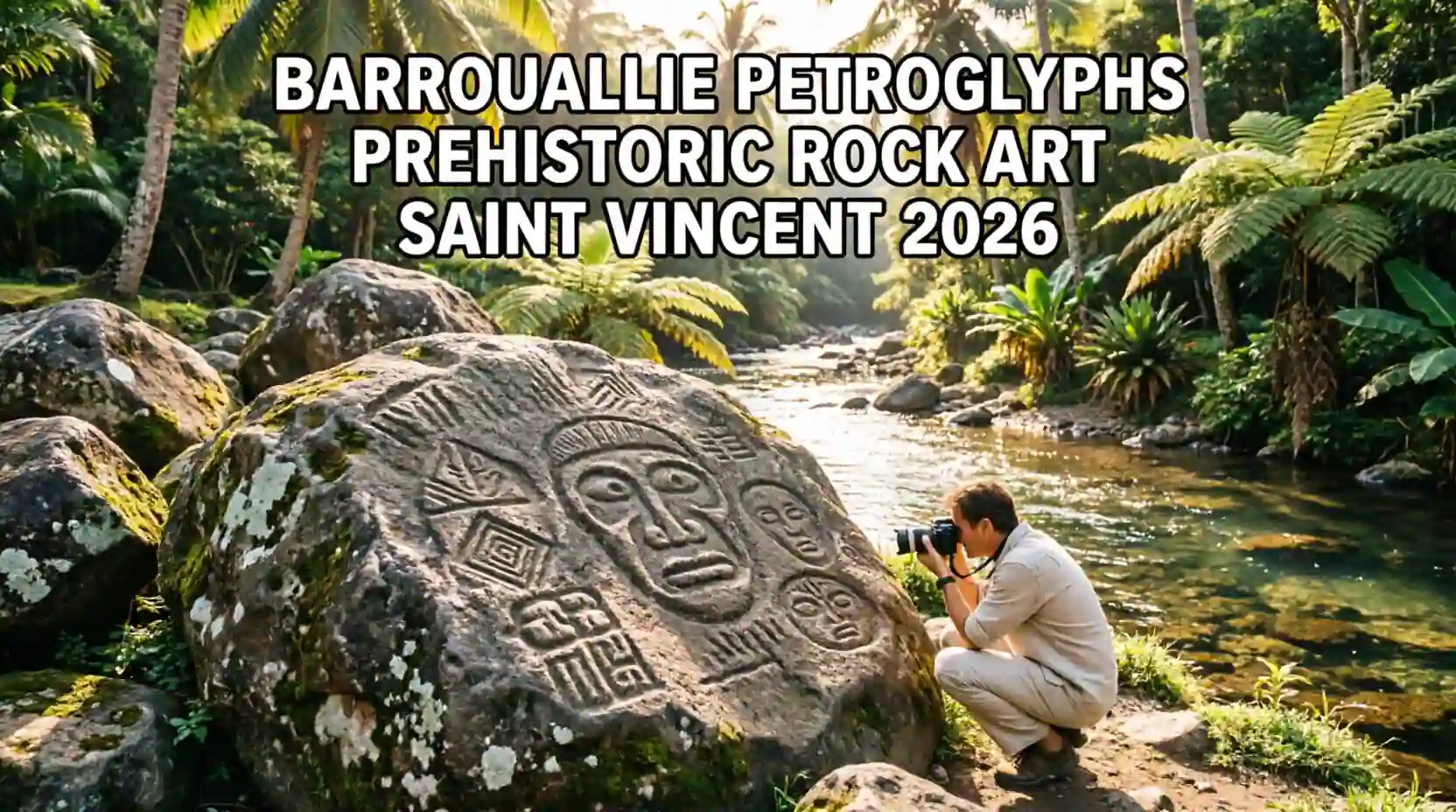
The Barrouallie Petroglyphs consist of multiple carved stones featuring a variety of designs that reflect the artistic conventions and symbolic vocabulary of prehistoric Caribbean cultures. While the exact number of petroglyphs and their state of preservation can vary due to weathering and conservation efforts, the site typically displays several distinct carved boulders or rock outcrops.
Common Motifs and Designs
Anthropomorphic faces represent the most recognizable and frequent motif at Barrouallie and many Caribbean petroglyph sites. These carved faces typically feature circular or oval outlines with incised eyes, noses, and mouths. Some faces display elaborate headdresses or decorative elements, possibly representing deities, ancestors, or important individuals. The faces at Barrouallie vary in size and detail, suggesting they may have been created over an extended period or by different artists with varying skill levels.
Geometric patterns including circles, spirals, concentric rings, and grid-like designs appear throughout the site. These abstract motifs may represent cosmological concepts, celestial bodies, water, or other natural phenomena important to indigenous worldviews. Spirals, in particular, are common in Caribbean rock art and may symbolize cycles of life, water movement, or spiritual journeys.
Zoomorphic (animal) designs, though less common than faces and geometric patterns, may depict local fauna such as fish, birds, or reptiles. These carvings could relate to hunting practices, totemic beliefs, or mythological narratives involving animals.
Complex composite designs combine multiple elements—faces with geometric patterns, animals integrated with abstract symbols—suggesting sophisticated symbolic systems and possibly narrative or ceremonial functions.
Carving Techniques and Materials
The petroglyphs were created by pecking, grinding, or incising the volcanic rock surface using stone tools. Artisans likely used harder stones like flint or chert to carve into the softer volcanic tuff or basalt that characterizes the Barrouallie area. The depth and precision of the carvings vary, with some designs deeply incised and others more superficially marked.
Over centuries, weathering, lichen growth, and erosion have affected the visibility and preservation of the carvings. Some petroglyphs remain clearly visible, while others require careful observation or raking light (light at a low angle) to discern the designs. Conservation efforts aim to stabilize the site and prevent further deterioration while maintaining the authenticity of the carvings.
Interpretive Challenges
Interpreting prehistoric rock art presents significant challenges. Without written records from the creators, archaeologists and anthropologists must rely on comparative analysis with ethnographic accounts, oral traditions, and similar sites throughout the Caribbean and South America. While we can describe what the petroglyphs depict, understanding their original meanings, functions, and cultural significance requires careful, respectful scholarship that acknowledges the limitations of our knowledge.
Contemporary Kalinago and Garifuna communities maintain cultural connections to these ancestral sites, and their perspectives on the petroglyphs' meanings and significance are invaluable. Engaging with indigenous voices and respecting indigenous knowledge systems is essential for ethical interpretation of these sites.
Location and Access: Visiting the Barrouallie Petroglyphs

The Barrouallie Petroglyphs are located in or near the town of Barrouallie on Saint Vincent's leeward coast, approximately 15-20 kilometers north of Kingstown, the capital. The site's exact location may vary in different sources, as there are multiple petroglyph sites in the Barrouallie area, and some may be on private property or in locations requiring local guidance to access.
Getting to Barrouallie
From Kingstown, Barrouallie is accessible via the main leeward coast road. Public transportation via minibuses runs regularly between Kingstown and Barrouallie, with fares typically costing 2-3 Eastern Caribbean Dollars (approximately 1-2 USD). The journey takes approximately 30-45 minutes depending on traffic and stops.
Taxis offer a more convenient but more expensive option, with fares from Kingstown to Barrouallie ranging from 30-50 USD depending on negotiation and whether it is a one-way or round trip. Renting a car provides maximum flexibility for exploring Barrouallie and other leeward coast sites, with daily rental rates typically 50-80 USD.
Finding the Petroglyphs
Upon arriving in Barrouallie, visitors should seek local guidance to locate the petroglyphs. The site may not be prominently marked with tourist signage, and local residents can provide directions and context. Consider asking at the Barrouallie community center, local guesthouses, or the town's small shops for assistance.
Some petroglyph sites may be on private property or require permission to access. Always respect property rights and seek authorization before entering private land. Local guides not only facilitate access but also provide valuable cultural and historical context that enhances understanding of the site.
Best Times to Visit
The petroglyphs can be visited year-round, though lighting conditions affect visibility. Morning or late afternoon light at a low angle (raking light) makes the carved designs more visible by creating shadows in the incised lines. Midday sun, particularly when directly overhead, can make the carvings difficult to see.
The dry season (January-May) offers more predictable weather and easier access, though the site can be visited during the wet season with appropriate rain gear. Avoid visiting during heavy rain, as paths may become slippery and the rocks wet and potentially dangerous.
Archaeological Significance and Regional Context

The Barrouallie Petroglyphs hold significance not only for Saint Vincent but for understanding broader patterns of prehistoric Caribbean culture, migration, and artistic expression. Placing the site within its regional context reveals connections to other rock art sites throughout the Lesser Antilles and South America.
Caribbean Rock Art Traditions
Rock art sites are found throughout the Caribbean, from Cuba and Hispaniola in the Greater Antilles to Trinidad and Tobago in the south. Each island group displays distinctive styles and motifs while sharing certain common elements that suggest cultural exchange, shared ancestry, or convergent evolution of symbolic systems.
In the Lesser Antilles, significant petroglyph sites exist in Dominica (including the famous Trapeze Rock), St. Kitts, Nevis, and other islands. Comparative analysis of these sites helps archaeologists trace migration routes, cultural interactions, and the spread of artistic conventions across the Caribbean archipelago.
The stylistic similarities between Barrouallie and other Lesser Antillean sites suggest connections between indigenous communities across islands, possibly through trade, intermarriage, shared ceremonial practices, or seasonal movement between islands.
South American Connections
The indigenous peoples of the Caribbean maintained connections with South America, particularly the Orinoco River basin in present-day Venezuela and the Guianas. Petroglyph styles in the Caribbean show similarities to rock art in these South American regions, supporting archaeological and linguistic evidence of migration from South America into the Caribbean.
Certain motifs found at Barrouallie—particularly spiral designs and specific face styles—have parallels in Venezuelan and Guyanese rock art, suggesting either direct cultural transmission or shared ancestral traditions brought by migrating peoples.
Research and Documentation
Archaeological research at Barrouallie and similar sites employs various methods including detailed photography, 3D scanning, rubbing techniques (where appropriate and non-destructive), and comparative stylistic analysis. Researchers document the location, orientation, size, and condition of each petroglyph, creating records that aid in preservation and study.
Ongoing research seeks to date the petroglyphs more precisely, though this remains challenging as rock art cannot typically be dated directly using radiocarbon methods. Archaeologists may date associated archaeological deposits, use stylistic comparisons, or employ emerging techniques like lichenometry or optically stimulated luminescence to estimate ages.
Preservation and Conservation Challenges

The Barrouallie Petroglyphs face multiple threats to their preservation, requiring ongoing conservation efforts to ensure these irreplaceable cultural heritage sites survive for future generations. Understanding these challenges highlights the importance of responsible tourism and community-based conservation.
Natural Deterioration
Volcanic rock, while relatively durable, is subject to weathering from rain, wind, temperature fluctuations, and biological growth. Lichens, mosses, and algae colonize rock surfaces, gradually obscuring carvings and potentially accelerating stone degradation through chemical and physical processes.
Vegetation growth around the petroglyphs can cause physical damage as roots expand and shift stones. Tropical storms and hurricanes, common in the Caribbean, can cause flooding, landslides, or direct impact damage to rock art sites.
Human Impacts
Urban development, infrastructure projects, and land use changes pose risks to archaeological sites in Barrouallie and surrounding areas. Without proper protection and planning, petroglyphs can be destroyed or damaged by construction, quarrying, or agricultural activities.
Vandalism, though hopefully rare, remains a threat to rock art sites worldwide. Graffiti, attempted removal of carvings, or careless behavior can cause irreversible damage. Even well-intentioned visitors can inadvertently harm petroglyphs by touching the carvings (oils from skin can accelerate deterioration), climbing on rocks, or leaving trash.
Conservation Efforts
Conservation of the Barrouallie Petroglyphs requires collaboration between government agencies, local communities, archaeologists, and indigenous groups. The Saint Vincent and the Grenadines National Trust, along with the Department of Culture and other organizations, plays a role in protecting and managing archaeological sites.
Conservation strategies may include: physical stabilization of rocks to prevent movement or collapse, vegetation management to prevent root damage while maintaining natural setting, installation of protective barriers or shelters (balanced against maintaining site authenticity), documentation and monitoring to track condition changes, and community education to foster local stewardship.
Sustainable tourism that generates economic benefits for local communities while minimizing impacts on the site represents a key conservation strategy. When local residents benefit from heritage tourism, they have stronger incentives to protect and preserve archaeological resources.
Guidelines for Responsible Visiting

Visiting the Barrouallie Petroglyphs is a privilege that carries responsibility. As a visitor to this irreplaceable cultural heritage site, your actions can either contribute to its preservation or accelerate its deterioration. Following these guidelines ensures that future generations can also learn from and appreciate these ancient carvings.
Respect the Site
Never touch the carved surfaces. The oils, dirt, and moisture from your hands can accelerate deterioration of the rock and obscure the carvings over time. Even seemingly harmless touching, repeated over thousands of visitors, causes cumulative damage.
Do not climb on, sit on, or lean against the petroglyph-bearing rocks. Physical pressure can cause cracks, dislodge stones, or accelerate weathering. Maintain a respectful distance that allows you to observe the carvings clearly without risking contact.
Never attempt to enhance visibility by applying water, chalk, paint, or any other substance to the carvings. Such actions, even if well-intentioned, can cause permanent damage and are considered vandalism.
Leave No Trace
Carry out all trash, including food wrappers, bottles, and biodegradable items. Trash attracts animals, creates eyesores, and can damage the site. Practice Leave No Trace principles to minimize your impact.
Do not remove any stones, artifacts, or natural materials from the site. Even small rocks or fragments may have archaeological significance, and removal constitutes looting of cultural heritage.
Avoid making loud noises or disruptive behavior that disturbs the site's atmosphere or disrespects its cultural significance. Approach the petroglyphs with the reverence due to ancestral heritage.
Engage Respectfully with Local Culture
Seek permission before photographing local residents or private property near the site. Respect refusals gracefully.
Consider hiring a local guide who can provide cultural context, facilitate appropriate access, and ensure your visit benefits the local community economically. Guides often share knowledge not available in guidebooks and can answer questions about the site's significance.
Learn about the Kalinago and Garifuna peoples, their history, and their contemporary culture. Understanding the living descendants of the people who created these petroglyphs enriches your appreciation of the site and fosters respect for indigenous heritage.
Support Conservation
If there are entrance fees, donation boxes, or local conservation initiatives, consider contributing. Even small donations support ongoing preservation efforts.
Share your experience responsibly on social media, emphasizing the importance of preservation and respectful visitation. Avoid posting exact GPS coordinates if the site is vulnerable to vandalism or overcrowding.
Report any damage, vandalism, or threats to the site to local authorities or heritage organizations. Your vigilance helps protect the petroglyphs for future visitors.
Exploring Beyond Barrouallie: Other Indigenous Heritage Sites

While the Barrouallie Petroglyphs represent one of Saint Vincent's most accessible prehistoric sites, the island contains other archaeological and cultural heritage locations that provide additional windows into indigenous history. Combining visits to multiple sites creates a more comprehensive understanding of Saint Vincent's prehistoric and historic indigenous cultures.
Petroglyphs and Rock Art Sites
Other petroglyph sites exist throughout Saint Vincent, though they may be less accessible or documented than Barrouallie. Some are located in remote areas requiring local guides and more strenuous hiking. Ask at the National Trust, local museums, or with knowledgeable guides about other rock art sites that may be appropriate for visitors.
Each site displays unique characteristics and motifs, and comparing different petroglyph locations reveals patterns in indigenous settlement, territorial marking, and ceremonial geography across the island.
Archaeological Sites and Museums
The Saint Vincent and the Grenadines National Museum in Kingstown houses archaeological artifacts including pottery, tools, and other materials recovered from indigenous sites throughout the islands. The museum provides context for understanding the petroglyphs within broader patterns of indigenous material culture, subsistence, and social organization.
Archaeological excavations at various locations have revealed settlement sites, burial grounds, and ceremonial spaces that complement the rock art record. While many archaeological sites are not open to public visitation to protect them from damage, museum exhibits and educational programs share findings from these investigations.
Garifuna Cultural Heritage
The Garifuna people, descendants of Kalinago and African peoples, maintain vibrant cultural traditions in Saint Vincent and throughout the Caribbean and Central America. While the Barrouallie Petroglyphs predate the formation of Garifuna culture, understanding contemporary Garifuna heritage provides insight into the enduring indigenous presence in the region.
Garifuna communities preserve traditional music, dance, language, and crafts that reflect both African and indigenous Caribbean influences. Attending Garifuna cultural events, visiting Garifuna communities respectfully, or learning about Garifuna history adds depth to understanding Saint Vincent's indigenous heritage across time periods.
Planning Your Visit: Practical Information

Successful visits to the Barrouallie Petroglyphs require some preparation to ensure you can access the site, understand what you are seeing, and minimize your impact. This practical information helps you plan effectively.
What to Bring
Comfortable walking shoes with good traction are essential, as paths to petroglyph sites may be uneven, rocky, or muddy depending on weather conditions.
Water and sun protection including hat, sunscreen, and sunglasses. The Caribbean sun is intense, and you may be walking or standing outdoors for extended periods.
Insect repellent to protect against mosquitoes and other insects common in tropical environments.
Camera for documentation, though avoid using flash photography which can be disruptive. A camera with good low-light capability helps capture the carvings in natural light.
Notebook and pencil if you wish to sketch or take detailed notes. Some visitors find that drawing the petroglyphs enhances observation and retention.
Cash in Eastern Caribbean Dollars for transportation, potential guide fees, donations, or purchases from local vendors.
Time Required
Plan for 1-2 hours at the petroglyph site itself, depending on your level of interest and whether you have a guide. Additional time is needed for transportation to and from Barrouallie, and you may wish to explore the town, visit the beach, or have a meal locally.
Consider making Barrouallie part of a broader leeward coast day trip that might include other beaches, viewpoints, or cultural sites, maximizing your exploration of this region of Saint Vincent.
Accessibility Considerations
Petroglyph sites typically involve uneven terrain, rocks, and potentially steep or slippery paths. The Barrouallie site may not be accessible for visitors with mobility impairments or those who cannot navigate rough terrain. Contact local tourism offices or guides in advance to inquire about specific accessibility conditions if this is a concern.
Language and Communication
English is the official language of Saint Vincent and the Grenadines, and most residents speak English fluently. Vincentian Creole, an English-based creole with African and French influences, is also widely spoken. Learning a few basic greetings or phrases in Creole can enhance interactions with local residents and demonstrate respect for local culture.
Conclusion: Connecting with Ancient Heritage
The Barrouallie Petroglyphs offer a rare and precious opportunity to connect directly with the artistic expression and spiritual world of Saint Vincent's indigenous ancestors. These ancient carvings, created centuries ago by hands long turned to dust, speak across time of human creativity, symbolic thought, and the universal desire to leave a mark on the world.
Visiting the petroglyphs is more than a tourist activity; it is an act of witnessing, of acknowledging the deep history of human presence in the Caribbean that predates European colonization by millennia. The faces carved in stone remind us that indigenous peoples were not merely inhabitants of these islands but creators of complex cultures, sophisticated art, and meaningful connections to place that endure in the archaeological record and in living indigenous communities today.
As you stand before these ancient carvings, consider the hands that created them, the beliefs they expressed, and the continuity of indigenous presence in Saint Vincent from prehistoric times through the Kalinago resistance to European colonization, through the formation of Garifuna culture, to contemporary indigenous identity and heritage preservation efforts. The petroglyphs are not relics of a dead past but living connections to ancestors whose legacy continues to shape Saint Vincent's cultural landscape.
By visiting respectfully, learning thoughtfully, and supporting conservation efforts, you contribute to preserving these irreplaceable cultural treasures for future generations. The Barrouallie Petroglyphs will continue to inspire wonder, provoke questions, and connect visitors to the deep human history of the Caribbean, serving as silent teachers of art, culture, and the enduring human impulse to create meaning in stone.
0 Comments