.webp)
.webp)
America 250: A Coast-to-Coast Guide to the 250th Anniversary of Independence
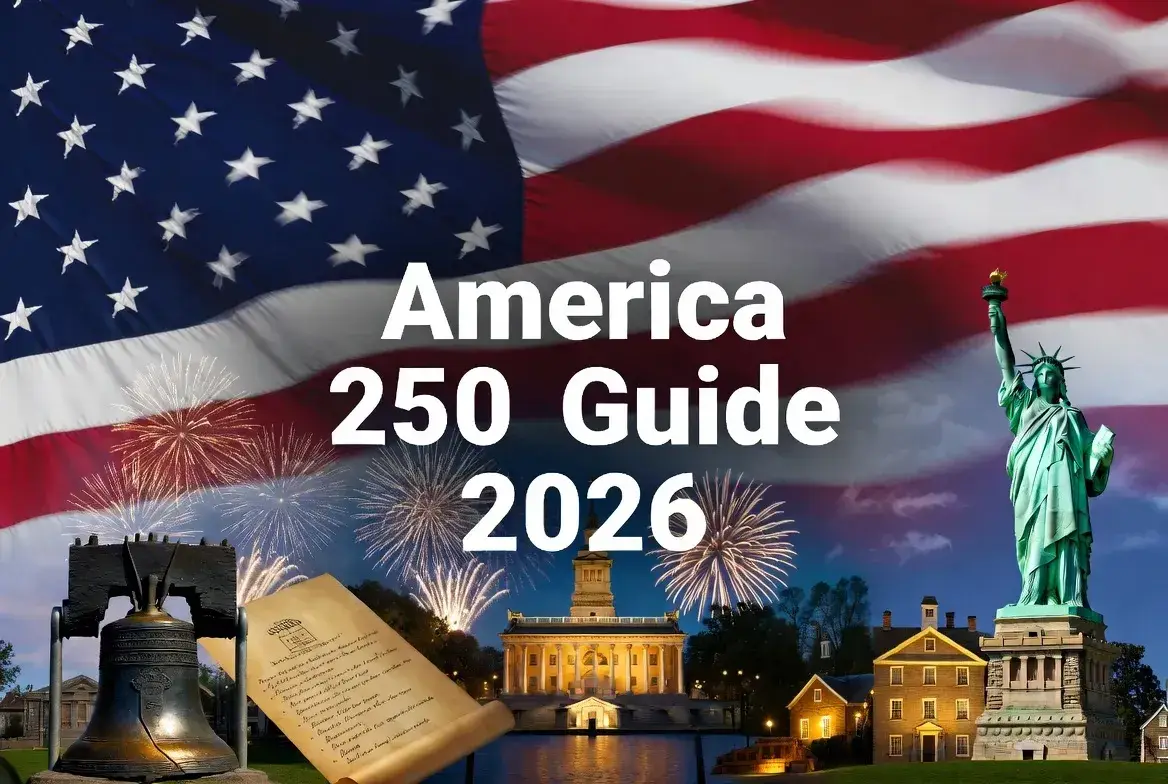
In 2026, the United States will commemorate one of the most significant milestones in its history: the 250th anniversary of the signing of the Declaration of Independence. This semiquincentennial celebration represents more than just a birthday party for a nation; it is an opportunity to reflect on the founding ideals that shaped America, the struggles and sacrifices that forged a nation, and the ongoing journey toward forming a more perfect union. From the hallowed grounds of Independence Hall in Philadelphia to the battlefields where freedom was won, from the homes of founding fathers to the museums preserving revolutionary artifacts, America 250 offers unprecedented opportunities for travelers to connect with the nation's founding story.
This comprehensive guide takes you on a journey through the most significant sites, events, and experiences celebrating America's 250th anniversary. Whether you are a history enthusiast, a family seeking educational travel, a patriot wanting to honor our heritage, or simply a curious traveler eager to understand the American story, this guide will help you plan meaningful experiences across the nation. We will explore the major celebration hubs, Revolutionary War battlefields, presidential homes, museums with special exhibitions, and the communities planning extraordinary commemorations. By approaching this anniversary with respect and curiosity, you will gain deeper appreciation for the ideals, struggles, and people who created a nation dedicated to the proposition that all people are created equal.
PHILADELPHIA: THE BIRTHPLACE OF AMERICA
No exploration of America 250 begins without Philadelphia, the city where independence was declared and the Constitution was forged. In 2026, Philadelphia will serve as the epicenter of the nation's semiquincentennial celebrations, with events planned throughout the year culminating in extraordinary commemorations on July 4, 2026.
Independence Hall stands as the most sacred ground of American democracy. It was here, in the Assembly Room, that the Second Continental Congress debated and adopted the Declaration of Independence in July 1776, and where the Constitutional Convention met in 1787 to draft the United States Constitution. In 2026, visiting Independence Hall requires advance timed-entry tickets, which will be in especially high demand during the anniversary year. The National Park Service anticipates unprecedented crowds and recommends booking tickets months in advance. Ranger-led tours provide essential context about the debates, compromises, and courage required to found a nation.
The Liberty Bell, housed in the Liberty Bell Center adjacent to Independence Hall, remains an enduring symbol of American freedom. Its inscription, "Proclaim Liberty Throughout All the Land Unto All the Inhabitants thereof," continues to inspire movements for justice and equality. In 2026, expect extended hours and special exhibitions exploring the bell's history and its role in American culture. The center will feature enhanced interpretive programs connecting the bell's message to contemporary struggles for freedom.
Independence National Historical Park encompasses numerous sites essential to understanding America's founding. Congress Hall, where the U.S. Congress met from 1790 to 1800, offers insights into the early republic's challenges. The Supreme Court Chamber in Congress Hall witnessed the young nation's first judicial decisions. Old City Hall and New Hall house museums exploring Philadelphia's role in the revolution. The Benjamin Franklin Museum celebrates one of America's most versatile founding fathers.
The Museum of the American Revolution, which opened in 2017, will feature special exhibitions throughout 2026. Its collection includes George Washington's war tent, rare manuscripts, weapons, and interactive exhibits that bring the revolutionary era to life. The museum's galleries explore not just military history but the diverse experiences of soldiers, civilians, women, African Americans, and Native Americans during the revolution.
Philadelphia's 2026 America 250 celebrations will include year-round programming, with special emphasis on July 4, 2026. Planned events include reenactments of the first public reading of the Declaration of Independence, colonial music and dance performances, historical lectures by leading scholars, and family-friendly activities throughout Independence National Historical Park. The city anticipates hosting millions of visitors and is preparing extensive infrastructure to accommodate crowds while preserving the historic character of the area.
BOSTON AND THE CRADLE OF LIBERTY
Boston, where revolution was born in the hearts and minds of colonists, offers essential sites for understanding the path to independence. The city's Freedom Trail, a 2.5-mile red-brick path, connects sixteen historically significant sites and provides an ideal framework for exploring revolutionary Boston.
The trail begins at Boston Common, America's oldest public park, which served as a British military encampment during the occupation of Boston. From there, the path leads to the Massachusetts State House, with its distinctive golden dome, and through neighborhoods where revolutionaries plotted resistance. Park Street Church, where William Lloyd Garrison would later deliver his first anti-slavery speech, stands as a testament to Boston's ongoing role in movements for freedom.
The Granary Burying Ground holds the graves of Samuel Adams, John Hancock, and Paul Revere, revolutionaries whose names are synonymous with American independence. Walking among these weathered stones, visitors connect with the human stories behind historical events. King's Chapel and Burying Ground, the Old Corner Bookstore, and the Old South Meeting House each tell parts of Boston's revolutionary story.
The Old State House, built in 1713, was the center of British colonial government and the site where the Declaration of Independence was first read to Bostonians from its balcony. The building's museum explores the events leading to revolution, including the Boston Massacre, which occurred directly in front of the building in 1770.
Faneuil Hall, known as the "Cradle of Liberty," hosted fiery speeches by Samuel Adams and other patriots urging resistance to British rule. The building's Great Hall remains a gathering place for citizens exercising their democratic rights. Adjacent Quincy Market, built in the 1820s, now houses restaurants and shops but maintains the area's tradition as a public marketplace.
Paul Revere's House, the oldest remaining structure in downtown Boston, provides intimate glimpses into colonial life. The modest wooden house, built around 1680, contrasts sharply with the grand public buildings of the revolution, reminding visitors that ordinary people made extraordinary history. The nearby Old North Church, where "one if by land, two if by sea" lanterns signaled British troop movements, remains an active parish and museum.
The USS Constitution, "Old Ironsides," moored in Charlestown Navy Yard, represents American naval power during the early republic. Though launched after the revolution in 1797, the ship embodies the maritime spirit that fueled colonial resistance. The nearby Bunker Hill Monument commemorates the first major battle of the Revolutionary War, where colonial forces proved they could stand against British regulars.
Boston's 2026 America 250 celebrations will include special exhibitions at the Boston Tea Party Ships and Museum, where visitors can participate in reenactments of the famous protest. The Museum of Fine Arts and other cultural institutions will feature exhibitions exploring revolutionary-era art and culture. The city plans extensive programming connecting revolutionary history to contemporary discussions about democracy, equality, and civic engagement.
WILLIAMSBURG AND THE COLONIAL SOUTH
Colonial Williamsburg, the restored eighteenth-century capital of Virginia, offers immersive experiences of colonial life and the political ferment that led to revolution. In 2026, this living history museum will play a central role in America 250 commemorations, with enhanced programming exploring Virginia's crucial role in the independence movement.
The Capitol building, where the Virginia House of Burgesses met, was the laboratory of American self-government. Here, Patrick Henry delivered his famous "Give me liberty, or give me death" speech in 1775, galvanizing resistance to British rule. The building's restored chambers allow visitors to witness reenactments of colonial debates and understand the political arguments that justified independence.
The Governor's Palace, residence of Virginia's royal governors, symbolizes British imperial authority. Its elegant rooms and formal gardens contrast with the simpler architecture of colonial homes, illustrating the social hierarchies that revolutionaries challenged. The palace's museum explores the lives of both the governors and the enslaved people who maintained the estate.
Bruton Parish Church, where George Washington and other founding fathers worshipped, remains an active Episcopal parish. Its simple colonial architecture and historic graveyard provide quiet spaces for reflection on the spiritual dimensions of America's founding. The church's connection to figures like Washington and Thomas Jefferson illuminates the role of faith in colonial society.
The Raleigh Tavern, a reconstructed colonial inn, was a gathering place for patriots plotting resistance. Its restored public rooms demonstrate how taverns served as centers of political discussion and organizing in colonial America. The tavern's kitchen and gardens illustrate colonial foodways and daily life.
Colonial Williamsburg's 2026 programming will feature special events exploring diverse perspectives on the revolution, including the experiences of enslaved people, women, Native Americans, and ordinary colonists. The foundation's commitment to presenting a more complete and honest history of the era will be particularly evident during the anniversary year.
Nearby Jamestown, the first permanent English settlement in North America, and Yorktown, where the Revolutionary War effectively ended with British surrender, complete the "Historic Triangle" of colonial Virginia. Both sites will feature enhanced America 250 programming throughout 2026.
MOUNT VERNON AND THE FATHER OF HIS COUNTRY
George Washington's Mount Vernon, located on the Potomac River south of Washington, D.C., offers intimate insights into the life of America's most essential founding father. In 2026, Mount Vernon will serve as a focal point for national commemorations, with special exhibitions and events exploring Washington's leadership during the revolution and his service as the nation's first president.
The mansion house, with its distinctive cupola and colonnades, overlooks the Potomac River and embodies the classical ideals that influenced America's founders. Restored to its appearance during Washington's lifetime, the house reveals both the public and private dimensions of Washington's life. The mansion's rooms, furnished with period artifacts, demonstrate the tastes and lifestyle of the eighteenth-century gentry.
Washington's tomb, where he and Martha Washington are interred, provides a solemn space for reflection on his legacy. The simple sarcophagus, inscribed with his name, contrasts with the grandeur of his public achievements, reminding visitors of Washington's mortality and his wish for a quiet retirement after service to his country.
The estate's outbuildings, including the kitchen, smokehouse, and slave quarters, present a more complete picture of plantation life. Mount Vernon's commitment to interpreting the lives of the enslaved people who lived and worked on the estate provides essential context for understanding the contradictions between America's founding ideals and the reality of slavery.
The museum and education center features extensive exhibitions on Washington's military leadership, his presidency, and his personal life. Artifacts include Washington's camp chest from the revolutionary war, his dentures, and personal correspondence that reveals his character and convictions.
Mount Vernon's 2026 America 250 programming will include special exhibitions exploring Washington's role in the revolution and the early republic. The estate plans enhanced educational programs connecting Washington's leadership to contemporary questions about civic virtue, democratic governance, and national unity.
WASHINGTON, D.C.: THE NATION'S CAPITAL
Though not founded until after independence, Washington, D.C. serves as the physical embodiment of American democracy and will play a central role in America 250 celebrations. The National Mall, stretching from the Capitol to the Lincoln Memorial, provides a ceremonial space for national commemorations.
The Capitol building, home to the United States Congress, stands as a symbol of representative democracy. Its dome, completed during the Civil War, represents the preservation of the union that the founders created. Visitor centers offer tours of the Rotunda, where the Declaration of Independence, Constitution, and Bill of Rights are displayed, and the National Statuary Hall, where each state is represented by statues of notable citizens.
The National Archives, where the original Declaration of Independence, Constitution, and Bill of Rights are preserved, will be a pilgrimage site during 2026. Viewing these founding documents, with their faded ink and weathered parchment, creates powerful connections to the men who drafted them and the ideals they expressed. The Archives will feature special exhibitions exploring the creation and legacy of these documents.
Museums along the National Mall will feature America 250 exhibitions throughout 2026. The National Museum of American History will present exhibitions exploring the revolution's material culture and its ongoing influence on American life. The National Gallery of Art will feature exhibitions of revolutionary-era art and portraiture. The Smithsonian American Art Museum will explore how artists have depicted the founding era.
The Washington Monument, though completed long after Washington's death, remains the most visible symbol of the nation's capital. Its obelisk form, inspired by ancient Egyptian architecture, reflects the classical influences on American design. The monument's interior features commemorative stones from states, organizations, and foreign nations.
The Jefferson Memorial, with its neoclassical design and inscriptions from Jefferson's writings, honors the principal author of the Declaration of Independence. The memorial's location on the Tidal Basin, surrounded by cherry trees, creates a serene space for contemplating Jefferson's complex legacy.
Washington, D.C.'s 2026 America 250 celebrations will culminate in extraordinary events on and around July 4, 2026. The National Park Service, in partnership with other organizations, is planning a multi-day celebration featuring concerts, historical reenactments, educational programs, and a spectacular fireworks display. The city anticipates hosting millions of visitors and is preparing extensive security and infrastructure measures.
REVOLUTIONARY WAR BATTLEFIELDS
The battlefields where American independence was won through blood and sacrifice offer powerful spaces for understanding the costs of freedom. In 2026, these sites will feature enhanced programming connecting military history to the broader story of American independence.
Valley Forge, where Washington's army endured a brutal winter in 1777-1778, demonstrates the perseverance required to win independence. The site's reconstructed huts, museum, and miles of trails allow visitors to experience the landscape where the Continental Army was transformed into a professional fighting force. Valley Forge's 2026 programming will emphasize the diverse people who supported the army, including women, African Americans, and Native Americans.
Yorktown, where British forces surrendered in 1781, effectively ended major combat operations. The battlefield's earthworks, artillery positions, and surrender field allow visitors to walk the ground where independence was secured. The visitor center's museum and film provide context for the siege and its significance. Yorktown's 2026 commemorations will include special events marking the anniversary of the surrender.
Saratoga, where American forces defeated a British army in 1777, convinced France to ally with the United States, transforming a colonial rebellion into a world war. The battlefield's monuments, including the famous Boot Monument to Benedict Arnold, tell the story of this crucial victory. Saratoga's 2026 programming will explore the battle's international significance.
Gettysburg, though a Civil War battlefield rather than a Revolutionary War site, represents the preservation of the union that the founders created. In 2026, Gettysburg will connect its Civil War history to the revolutionary era, exploring how the ideals of 1776 were tested and ultimately preserved in 1863.
Other significant Revolutionary War sites including Lexington and Concord, where the first shots were fired; Bunker Hill, where colonial forces proved they could fight; and Cowpens, where American tactics defeated British forces, will all feature enhanced America 250 programming.
COAST-TO-COAST CELEBRATIONS
While the East Coast holds the densest concentration of revolutionary sites, America 250 celebrations will span the entire nation, reflecting how the ideals of 1776 have spread across the continent.
In New England, towns and cities throughout Massachusetts, Connecticut, New Hampshire, and Rhode Island will commemorate their roles in the revolution. Salem, Massachusetts, will explore its maritime contributions to independence. Portsmouth, New Hampshire, will highlight its naval heritage. Newport, Rhode Island, will examine its complex position as a colonial port occupied by British forces.
The Mid-Atlantic region, including New York, New Jersey, Pennsylvania, and Delaware, will feature extensive programming. New York City, occupied by British forces for much of the war, will explore the experiences of loyalists and patriots. New Jersey, site of numerous battles and Washington's crossing of the Delaware, will commemorate its role as the "crossroads of the revolution."
Southern states including Maryland, Virginia, North Carolina, South Carolina, and Georgia will highlight their contributions to independence. Charleston, South Carolina, one of the war's most contested cities, will feature major commemorations. The Carolinas' backcountry, where brutal partisan warfare raged, will explore the civil war within the revolution.
Western states will connect their histories to the revolutionary era, examining how the ideals of 1776 influenced westward expansion and the creation of new states. California, though not settled by Americans until long after independence, will explore how revolutionary ideals influenced the nation's westward movement.
PLANNING YOUR AMERICA 250 JOURNEY
Visiting America 250 sites requires advance planning, especially for 2026 when crowds will be unprecedented. Here is essential information for travelers.
Timing your visit: While July 4, 2026 will be the focal point of celebrations, visiting during spring or fall 2026 will allow you to experience America 250 programming with somewhat smaller crowds. Many sites are planning year-long commemorations, so you do not need to visit during the peak summer season to participate in meaningful events.
Booking accommodations: Hotels in Philadelphia, Boston, Williamsburg, and Washington, D.C. will book up quickly for 2026, especially around July 4. Reserve accommodations as early as possible, and consider staying in nearby communities if major cities are fully booked. Alternative lodging options including vacation rentals and bed-and-breakfasts may offer availability when hotels are full.
Transportation: Major airports serving America 250 sites include Philadelphia International, Boston Logan, Washington Dulles and Reagan National, and Norfolk International for Williamsburg. Amtrak provides rail service connecting Boston, New York, Philadelphia, Baltimore, and Washington, D.C. along the Northeast Corridor. Renting a car provides flexibility for visiting battlefields and rural sites.
Tickets and reservations: Many historic sites require advance timed-entry tickets, which will be especially important during 2026. Reserve tickets for Independence Hall, Mount Vernon, Colonial Williamsburg, and other popular sites months in advance. Consider purchasing combination tickets or passes that provide access to multiple sites.
Accessibility: National Park Service sites and major museums are accessible to visitors with disabilities, though some historic buildings have limitations due to their age and preservation requirements. Check individual site websites for accessibility information and request accommodations in advance when needed.
Family travel: America 250 offers exceptional educational opportunities for children. Many sites offer junior ranger programs, hands-on activities, and age-appropriate interpretive materials. Plan shorter visits with frequent breaks, and balance educational sites with recreational activities to maintain children's engagement.
SUSTAINABLE AND RESPONSIBLE TOURISM
Visiting America 250 sites carries responsibility to preserve these irreplaceable treasures for future generations. In 2026, sustainable tourism practices are essential for protecting historic resources while accommodating increased visitation.
Respect historic sites: Stay on designated paths, do not touch artifacts or historic structures, and follow all posted guidelines. Photography is generally permitted, but flash may be prohibited in museums and historic buildings. Drones are typically prohibited at historic sites without special permits.
Support local communities: Choose locally-owned accommodations, restaurants, and tour operators to ensure tourism benefits reach the communities preserving these historic resources. Purchase souvenirs from site bookstores and local artisans rather than mass-produced items.
Minimize environmental impact: Many historic sites face challenges from climate change, pollution, and overtourism. Reduce your carbon footprint by using public transportation when possible, carrying reusable water bottles and bags, and choosing eco-certified accommodations.
Engage thoughtfully: America's founding era involved contradictions between ideals of liberty and the realities of slavery, displacement of Native Americans, and limitations on women's rights. Approach historic sites with willingness to engage with complex and sometimes uncomfortable history. Listen to diverse perspectives and recognize that the American story includes many voices.
CONCLUSION: REFLECTING ON AMERICA'S JOURNEY
America 250 represents more than a celebration of the past; it is an opportunity to reflect on the ongoing journey toward forming a more perfect union. The sites, events, and experiences described in this guide connect us to the people and ideas that created a nation dedicated to the proposition that all people are created equal.
As you plan your America 250 journey, approach these historic places with curiosity, humility, and respect. Listen to the stories they tell, engage with the complexities they represent, and consider how the ideals of 1776 continue to shape contemporary America. By visiting these sites thoughtfully, you honor not just the past but the ongoing work of building a nation that lives up to its founding promises.
May your America 250 journey deepen your appreciation for the sacrifices made to secure independence, the wisdom of those who founded a nation, and the responsibility we all share to preserve and perfect the American experiment. As you walk the battlefields, stand in the rooms where history was made, and contemplate the documents that declared independence, may you find inspiration to participate in the ongoing work of democracy.
Useful resources include the National Park Service America 250 website at nps.gov/subjects/america250, the U.S. Semiquincentennial Commission at us250.org, and individual site websites for specific programming and ticket information. Emergency services can be reached at 911 throughout the United States. Disclaimer: Information is accurate as of early 2026. Event schedules, hours, and policies may change; verify details before travel. This guide is for informational purposes only and does not constitute professional travel advice.
0 Comments