.webp)
.webp)
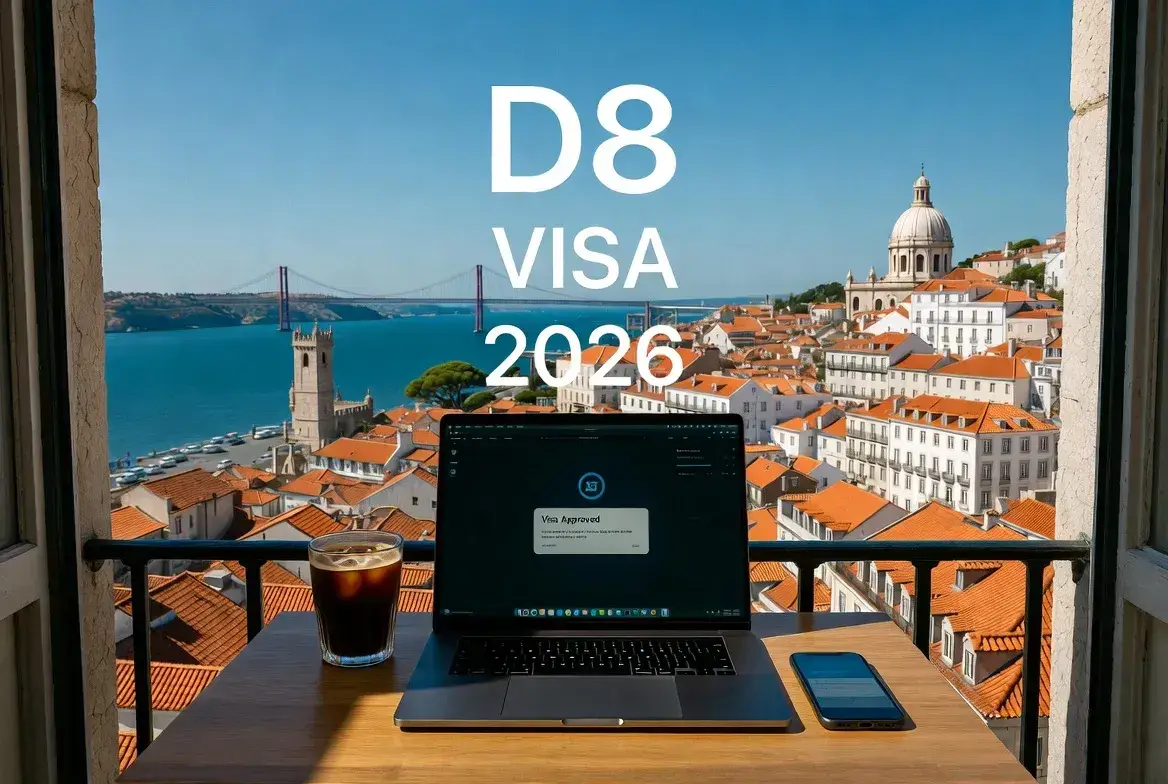
Portugal D8 Visa 2026: Why the Monthly Income Requirement Rose to €3,680 This Year
Portugal's D8 Digital Nomad Visa has become one of Europe's most sought-after pathways for remote workers seeking to live in the sun-drenched landscapes of the Iberian Peninsula. However, as of January 2026, applicants have noticed a significant change: the minimum monthly income requirement has increased to €3,680. This adjustment has raised questions among prospective digital nomads about why the threshold changed, how it affects applications, and what it means for future planning.
This comprehensive guide explains the reasons behind the €3,680 income requirement, breaks down the calculation methodology, outlines updated application procedures, and provides practical strategies for meeting the new financial thresholds. Whether you're preparing your first D8 application or reassessing your eligibility under the 2026 rules, this article will equip you with the knowledge to navigate Portugal's digital nomad visa landscape with confidence.
Understanding the D8 Visa: Portugal's Pathway for Remote Workers
Introduced in October 2022, the D8 Visa (commonly called the Digital Nomad Visa) allows non-EU/EEA/Swiss citizens who work remotely for foreign employers or clients to obtain legal residency in Portugal. The visa comes in two forms:
- Temporary Stay Visa: Valid for up to one year, renewable for short periods; ideal for testing life in Portugal without long-term commitment.
- Residence Visa: Initially valid for four months to enter Portugal, then exchanged for a two-year residence permit renewable for successive three-year periods, with a pathway to permanent residency or citizenship after five years.
- 👉 Bulgaria Digital Nomad Visa 2026: Income and Application Guide
- 👉 Mareterra Monaco 2026: Complete Guide to the Eco-District
- 👉 Is Lauterbrunnen Overrated? The 2026 Guide to Switzerland’s Secret Waterfalls
The D8 Visa targets freelancers, remote employees, contractors, and entrepreneurs earning income from sources outside Portugal. Unlike the D7 Visa (designed for passive income recipients like retirees), the D8 requires active income from remote work.
Why €3,680? The Calculation Behind the 2026 Income Threshold
The €3,680 monthly income requirement is not arbitrary—it is directly tied to Portugal's national minimum wage (salário mínimo nacional), which increased to €920 per month effective January 2026.
The Formula:
Under Portuguese immigration regulations (Article 77 of Law 23/2007 and implementing rules), D8 Visa applicants must demonstrate monthly income equivalent to four times the national minimum wage.
- 2025 Minimum Wage: €870 × 4 = €3,480/month
- 2026 Minimum Wage: €920 × 4 = €3,680/month
- 👉 Bulgaria Digital Nomad Visa 2026: Income and Application Guide
- 👉 Mareterra Monaco 2026: Complete Guide to the Eco-District
- 👉 Is Lauterbrunnen Overrated? The 2026 Guide to Switzerland’s Secret Waterfalls
This multiplier ensures that digital nomads have sufficient means to support themselves without relying on Portuguese social services, while also aligning visa requirements with domestic labor protections.
Why the Minimum Wage Increased:
Portugal's government raised the minimum wage to €920 as part of broader economic measures to combat inflation, improve living standards for Portuguese workers, and maintain purchasing power amid rising costs. While this policy primarily benefits local employees, it automatically triggers adjustments to immigration financial thresholds, as visa requirements are legally indexed to the minimum wage.
Updated Financial Requirements for D8 Visa Applicants in 2026
Beyond the primary applicant's income, the D8 Visa allows family reunification. Financial thresholds scale accordingly:
Income Requirements by Family Composition (2026):
| Family Composition | Minimum Monthly Income | Annual Equivalent | Suggested Savings in Portuguese Bank |
|---|---|---|---|
| Single applicant | €3,680 | €44,160 | €11,040 (3 months' income) |
| Couple | €5,520 | €66,240 | €16,560 |
| Couple + 1 child | €6,624 | €79,488 | €19,872 |
| Couple + 2 children | €7,728 | €92,736 | €23,184 |
Source: Calculation based on 4× minimum wage for main applicant + 50% for spouse + 30% per child.
Savings Requirement:
In addition to proving monthly income, applicants must demonstrate access to savings equivalent to at least 12 months of the Portuguese minimum wage (€920 × 12 = €11,040) held in a Portuguese bank account. This serves as a financial safety net and is mandatory for both the initial visa application and the subsequent residence permit process with AIMA (Agência para a Integração, Migrações e Asilo).
Acceptable Proof of Income:
- Remote Employees: Employment contract + recent payslips + bank statements showing salary deposits from foreign employer.
- Freelancers/Contractors: Client contracts, invoices, service agreements, and bank statements showing consistent foreign-sourced income.
- Business Owners: Business registration documents, tax returns, and bank statements demonstrating profitable remote operations.
- 👉 Bulgaria Digital Nomad Visa 2026: Income and Application Guide
- 👉 Mareterra Monaco 2026: Complete Guide to the Eco-District
- 👉 Is Lauterbrunnen Overrated? The 2026 Guide to Switzerland’s Secret Waterfalls
Important: Income must originate outside Portugal. Earnings from Portuguese clients or employers do not qualify for the D8 Visa.
How the Income Increase Affects Different Applicant Scenarios
The €3,680 threshold impacts applicants differently depending on their circumstances:
Scenario 1: Single Applicant with Stable Remote Job
If you earn €4,000/month from a foreign employer, you comfortably exceed the €3,680 requirement. Focus on documenting consistent income history (6-12 months of bank statements) and securing a Portuguese bank account with the required €11,040 savings.
Scenario 2: Freelancer with Variable Income
If your freelance income fluctuates, consulates and AIMA look for consistency rather than isolated high-earning months. Aim to show an average of €3,680+ over the past 6-12 months. If your recent income falls short, consider delaying your application until you can document a stronger track record.
Scenario 3: Applicant Adding Family Members
Adding a spouse increases the required income by 50% of the minimum wage (€460/month), and each child adds 30% (€276/month). Plan your finances accordingly: a couple with one child needs €6,624/month total.
Scenario 4: Applicant Already in Process
If you submitted your D8 application in late 2025 but your AIMA residence appointment falls in 2026, authorities will assess your financial means based on the 2026 thresholds, not the rules at the time of initial submission. Update your documentation to reflect the €3,680 requirement to avoid delays or requests for additional evidence.
Step-by-Step: Applying for the D8 Visa Under 2026 Rules
Step 1: Gather Required Documents
- Valid passport (6+ months validity beyond intended stay)
- Completed national visa application form
- Proof of remote income meeting €3,680/month threshold (contracts, payslips, invoices, bank statements)
- Portuguese bank account statement showing €11,040+ savings
- Proof of accommodation in Portugal (12-month lease preferred; shorter terms may be accepted with explanation)
- Health insurance covering €30,000+ valid in Portugal
- Criminal background check (issued within 90 days, apostilled, translated to Portuguese)
- NIF (Portuguese tax number) – obtainable via consulate or local representative
- Cover letter explaining your remote work, motivation for moving to Portugal, and commitment to visa compliance
- 👉 Bulgaria Digital Nomad Visa 2026: Income and Application Guide
- 👉 Mareterra Monaco 2026: Complete Guide to the Eco-District
- 👉 Is Lauterbrunnen Overrated? The 2026 Guide to Switzerland’s Secret Waterfalls
Step 2: Apply at Portuguese Consulate
Submit your application in person at the Portuguese embassy or consulate in your country of legal residence. Book appointments early—wait times can range from weeks to months. Pay the visa fee (typically €90-€120).
Step 3: Receive Entry Visa and Travel to Portugal
If approved, you'll receive a 120-day entry visa allowing two entries to Portugal. Use this window to travel to Portugal and schedule your AIMA residence appointment.
Step 4: Attend AIMA Appointment for Residence Permit
At your AIMA appointment, submit biometric data and finalize your residence permit application. Bring updated documentation, especially proof that your income still meets the €3,680 threshold. Processing typically takes 2-6 weeks.
Step 5: Receive Residence Card and Settle In
Once approved, you'll receive a two-year residence permit card. Register your address locally, enroll in Portugal's tax system if staying 183+ days/year, and maintain compliance with visa conditions.
Common Pitfalls and How to Avoid Them
Pitfall 1: Underestimating the Savings Requirement
Many applicants focus solely on the €3,680 monthly income but overlook the mandatory €11,040 savings in a Portuguese bank. Open your Portuguese account early and maintain the required balance throughout the application process.
Pitfall 2: Submitting Inconsistent Income Documentation
AIMA and consulates scrutinize income stability. Avoid gaps in employment documentation or unexplained large deposits. If your income is variable, provide a clear explanation and supplementary evidence (e.g., multi-year tax returns).
Pitfall 3: Using Portuguese-Sourced Income
The D8 Visa requires income from outside Portugal. Earnings from Portuguese clients, even if you work remotely, do not qualify. Ensure your contracts and bank statements clearly show foreign-sourced revenue.
Pitfall 4: Missing the Family Income Calculation
Adding dependents increases the income threshold. Calculate requirements accurately: spouse adds €460/month, each child adds €276/month. Underestimating these amounts can lead to application delays or refusal.
Pitfall 5: Letting Documents Expire
Criminal background checks are valid for only 90 days. Time your document collection so that all materials remain valid through your consulate appointment and AIMA residence interview.
Tax Implications for D8 Visa Holders in Portugal
Becoming a Portuguese tax resident has significant implications for D8 Visa holders:
When Do You Become a Tax Resident?
You are considered a Portuguese tax resident if you spend more than 183 days in Portugal within a 12-month period or establish habitual residence there.
Taxation of Worldwide Income:
As a tax resident, you are subject to Portuguese income tax on your worldwide income, with progressive rates ranging from 14% to 48%. However, Portugal's tax system offers certain deductions and allowances that may reduce your effective rate.
The End of NHR (Non-Habitual Resident) Regime:
Portugal's favorable NHR tax regime, which previously offered reduced rates for new residents, largely ended for new applicants as of January 1, 2024. While transitional rules may apply to those who registered before the deadline, most new D8 applicants will be taxed under standard Portuguese rules. Consult a Portuguese tax advisor to optimize your situation.
Double Taxation Treaties:
Portugal has double taxation agreements with many countries (including the US, UK, Canada, and Australia). These treaties may prevent you from being taxed twice on the same income. Verify whether your home country has a treaty with Portugal and how it applies to your remote work income.
Social Security Considerations:
If you already contribute to social security in your home country and Portugal has a bilateral agreement with that country, you may be exempt from Portuguese social security contributions. Confirm your status with a tax professional.
Strategic Tips for Meeting the €3,680 Requirement
Tip 1: Build a Buffer Above the Threshold
Aim to demonstrate income 10-20% above €3,680 (e.g., €4,000-€4,400/month). This buffer protects against currency fluctuations, conservative interpretation by officials, or unexpected requests for additional evidence.
Tip 2: Document Income Consistently
Collect 6-12 months of bank statements showing regular deposits that meet or exceed the threshold. Consistency matters more than occasional high-earning months.
Tip 3: Open Your Portuguese Bank Account Early
Establish your Portuguese bank account as soon as you obtain your NIF. Deposit the required €11,040+ and maintain the balance throughout your application. Some banks (e.g., ActivoBank, Millennium BCP) are more expat-friendly.
Tip 4: Prepare a Clear Cover Letter
Include a concise cover letter explaining your remote work arrangement, income sources, and commitment to complying with D8 Visa conditions. This helps officials quickly understand your eligibility.
Tip 5: Consult an Immigration Professional
If your situation is complex (variable income, multiple income sources, family members), consider consulting a Portuguese immigration lawyer or visa specialist. They can help structure your application to maximize approval chances.
Frequently Asked Questions
Q: Why exactly is the D8 income requirement €3,680?
A: It equals four times Portugal's 2026 national minimum wage of €920. This multiplier is mandated by immigration regulations to ensure applicants have sufficient means of subsistence.
Q: Does the €3,680 requirement apply to the visa application or the residence permit?
A: It applies to both stages. Consulates assess it during the initial visa application; AIMA reassesses it during the residence permit appointment. If your appointment falls in 2026, the €3,680 threshold applies regardless of when you started your application.
Q: Can I combine multiple income sources to meet €3,680?
A: Yes, as long as all income is from remote work for foreign sources and you can document each source clearly. Combine employment income, freelance contracts, and business revenue if needed.
Q: What if my income is in a currency other than euros?
A: Convert your income to euros using the official exchange rate at the time of application. Provide documentation showing the conversion and consistency over time.
Q: Can I use cryptocurrency income to qualify?
A: Cryptocurrency income may be accepted if you can provide verifiable documentation (exchange statements, tax filings) showing consistent conversion to fiat currency meeting the threshold. Consult your consulate for specific guidance.
Q: What happens if my income drops below €3,680 after approval?
A: You must maintain the income threshold throughout your residency. Significant drops could affect permit renewals. Keep documentation updated and consult AIMA if your circumstances change.
Conclusion: Planning Ahead for D8 Success in 2026
The increase of Portugal's D8 Visa income requirement to €3,680 per month in 2026 reflects a straightforward legal adjustment tied to the national minimum wage rise to €920. While this change raises the financial bar for applicants, it also brings clarity and consistency to the application process.
For prospective digital nomads, the key to success lies in early preparation: document consistent income, open a Portuguese bank account with the required savings, and ensure all materials align with the updated thresholds. By understanding the calculation methodology, anticipating family reunification costs, and navigating tax implications thoughtfully, you can position your application for approval under the 2026 rules.
Portugal remains one of Europe's most attractive destinations for remote workers, offering a high quality of life, rich culture, and a clear pathway to long-term residency. The D8 Visa, even with its updated requirements, continues to provide a valuable opportunity for location-independent professionals to build a life in this vibrant country.
As you plan your application, remember that the €3,680 threshold is not just a number—it represents Portugal's commitment to ensuring that new residents can thrive without burdening public resources. Meet the requirement thoughtfully, prepare your documentation meticulously, and embark on your Portuguese adventure with confidence.
Your D8 Visa journey starts with preparation. Plan wisely, document thoroughly, and welcome the Portuguese lifestyle that awaits.
0 Comments