.webp)
.webp)
Canada Entry Requirements for US Citizens (2026 Essential Guide)
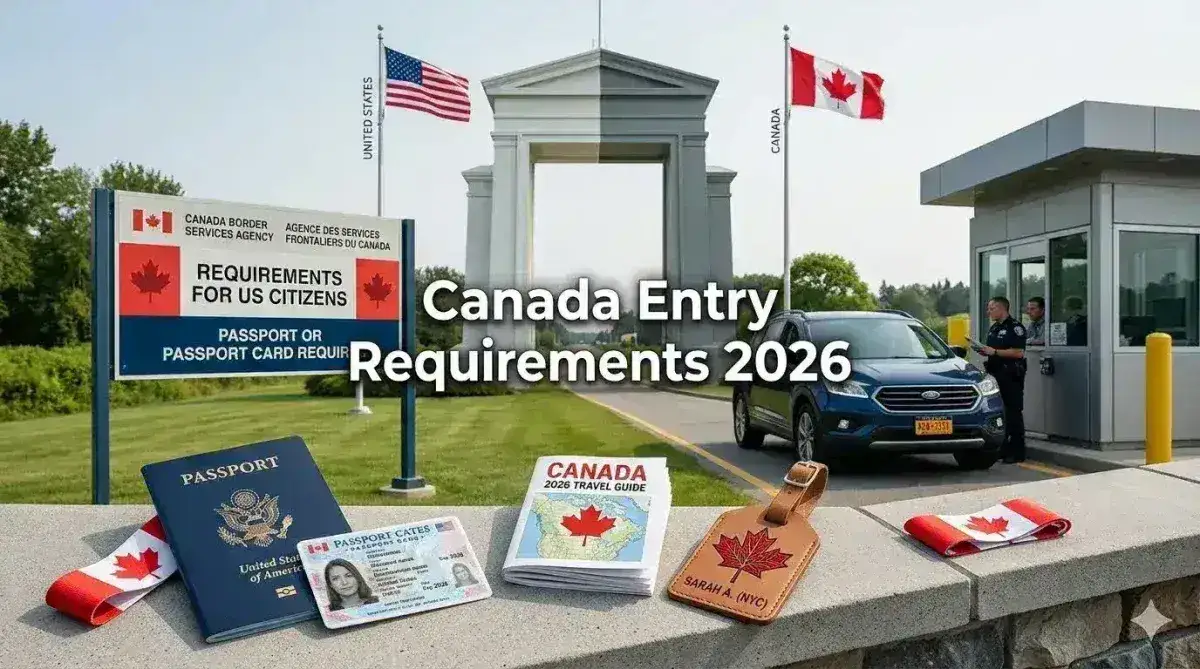
Traveling to Canada from the United States is one of the most popular international trips for Americans, whether for tourism, business, visiting family, or outdoor adventures. However, entry requirements have evolved significantly since the implementation of the Western Hemisphere Travel Initiative (WHTI), and US citizens need to understand the current documentation requirements for 2026 travel. This comprehensive guide provides everything you need to know about entering Canada as a US citizen, including passport requirements by travel method, alternative documentation options, special considerations for children, and practical tips for smooth border crossings.
The fundamental rule is that US citizens must present WHTI-compliant documentation when entering Canada. While a valid US passport book is the gold standard and works for all travel methods, there are alternative documents acceptable for land and sea travel. Understanding which documents you need based on your travel method can prevent delays, denied entry, or ruined travel plans. This guide covers air, land, and sea entry requirements, passport alternatives, application procedures, and essential tips for 2026 travel to Canada.
PASSPORT REQUIREMENTS BY TRAVEL METHOD
Traveling by Air to Canada
If you are flying to Canada from the United States in 2026, the requirements are straightforward and absolute: you must have a valid US passport book. No exceptions, no alternatives.
The Transportation Security Administration and Canadian border authorities require all air travelers, including infants, children, and elderly passengers, to present a valid passport book when flying internationally. Passport cards, Enhanced Driver's Licenses, birth certificates, or other forms of identification are not acceptable for international air travel under any circumstances.
Your passport book must be valid for the duration of your stay in Canada. While Canada does not officially require six months of passport validity beyond your planned departure date (unlike some countries that do), it is strongly recommended to have at least six months of validity remaining. This precaution helps avoid complications with airlines, which may have their own policies, or with border officials who exercise discretion in entry decisions.
When traveling by air, you will present your passport at multiple checkpoints: during airline check-in, at TSA security screening in the United States, and upon arrival at Canadian border services. Canadian border officers will review your passport, may ask questions about your travel purpose and length of stay, and will determine your admissibility to Canada.
Important exemption for US citizens: You do NOT need an Electronic Travel Authorization (eTA) when flying to Canada. The eTA requirement applies to visa-exempt foreign nationals from other countries flying to Canada, but US citizens are specifically exempt from this requirement. Your valid US passport book is sufficient for air entry.
Traveling by Land to Canada
Crossing into Canada by land (by car, bus, train, or on foot) has different requirements than air travel, though WHTI-compliant documentation is still mandatory.
For US citizens entering Canada by land, you must present one of the following WHTI-compliant documents:
- Valid US passport book
- Valid US passport card
- Trusted Traveler Program card (NEXUS, FAST)
- Enhanced Driver's License from a participating state
- Enhanced Tribal Card for eligible tribal members
The passport card is a wallet-sized, less expensive alternative to the passport book that is valid for land and sea travel to Canada, Mexico, and the Caribbean. However, it cannot be used for international air travel. For frequent land border crossers who never fly internationally, the passport card offers convenience and cost savings.
Enhanced Driver's Licenses are available in Washington, Minnesota, South Dakota, Michigan, New York, and Vermont. These licenses cost thirty to fifty dollars more than standard driver's licenses and contain RFID chips that enable quick verification at border crossings. They are valid for land and sea travel to Canada but not for air travel.
Trusted Traveler Programs like NEXUS provide significant benefits for frequent travelers. NEXUS cards allow expedited processing at dedicated lanes at many land border crossings, airports, and marine ports. The program requires a background check, interview, and fifty-dollar application fee for five-year membership, but the time savings at busy borders can be substantial.
While Canadian border officers have some discretion and may occasionally accept other documentation for US citizens at land borders, particularly for brief day trips, this is not guaranteed and policies can change. Relying on anything other than WHTI-compliant documents risks being denied entry or facing significant delays and secondary inspection.
When returning to the United States from Canada by land, US Customs and Border Protection requires all travelers, including children, to present a passport book, passport card, Trusted Traveler Program card, or Enhanced Driver's License. Birth certificates alone are no longer sufficient for re-entry to the United States for adults.
Traveling by Sea to Canada
Cruise travel and private boat travel to Canada have specific documentation requirements that differ slightly from air and land travel.
For cruise passengers on closed-loop cruises (cruises that begin and end at the same US port), US citizens can technically travel with an original or certified copy of their birth certificate plus a government-issued photo ID such as a driver's license. For children under sixteen, a birth certificate alone may suffice.
However, this represents the absolute minimum requirement, and there are important caveats to consider:
- If you miss the ship's departure from a Canadian port, you will need a passport book to fly to the next port or return home
- Some cruise lines require passports regardless of government minimums as part of their own policies
- If you need to fly home from Canada due to a medical emergency or other urgent situation, you will need a passport book
- Some Canadian ports may have different or additional requirements
For cruises that begin in one port and end in another (open-loop cruises), a passport book is required without exception.
For private boat travel, all US citizens must present WHTI-compliant documentation when entering Canada by water. This includes passport books, passport cards, Enhanced Driver's Licenses, or Trusted Traveler cards.
Despite the minimum requirements allowing birth certificates for closed-loop cruises, travel experts, cruise lines, and border authorities strongly recommend that all travelers carry a valid passport book. The relatively small cost and effort of obtaining a passport provides invaluable flexibility and peace of mind in case of unexpected circumstances.
PASSPORT BOOK VERSUS PASSPORT CARD: CHOOSING THE RIGHT DOCUMENT
Understanding the differences between a passport book and passport card is essential for selecting the appropriate documentation for your Canada travel plans.
Passport Book Features:
- Valid for all international travel by air, land, or sea without restriction
- Required for any international air travel
- Accepted worldwide for entry to any country
- Contains multiple visa pages for entry stamps and visa stickers
- Costs one hundred thirty dollars for adult first-time applicants, one hundred ten dollars for renewals
- Processing time is six to eight weeks for routine service, two to three weeks for expedited service (plus additional fees)
- Valid for ten years for adults age sixteen and older, five years for children under sixteen
Passport Card Features:
- Valid ONLY for land and sea travel to Canada, Mexico, Caribbean nations, and Bermuda
- NOT valid for any international air travel whatsoever
- Wallet-sized format, more convenient to carry than a book
- Cannot be used for travel to countries outside North America and the Caribbean
- Costs thirty dollars for adult first-time applicants, fifteen dollars for renewals
- Same processing times as passport book applications
- Valid for ten years for adults, five years for children
Which Document Should You Choose?
If you plan to fly to Canada or anywhere internationally, you MUST have a passport book. The passport card cannot be used for air travel under any circumstances.
If you only travel to Canada by land or sea and have no plans to fly internationally, a passport card might technically suffice. However, most travel experts and border officials recommend obtaining both the book and card when you apply. The card costs only thirty dollars extra when applied for simultaneously with the book, and provides flexibility for routine land border crossings while allowing you to keep your more valuable passport book secure.
The combination approach is popular among frequent Canada travelers: use the convenient passport card for routine land border crossings and keep the passport book stored safely for emergencies or unexpected air travel needs. This strategy provides maximum flexibility with minimal additional cost.
SPECIAL REQUIREMENTS FOR CHILDREN AND MINORS
Traveling to Canada with children requires additional documentation beyond just a passport. Both Canada and the United States have implemented safeguards to prevent child abduction and trafficking, and border officers carefully scrutinize minors traveling without both parents.
Passport Requirements for Children:
- All children, including infants and newborns, need their own passport or WHTI-compliant document for international travel
- Children's passports are valid for five years rather than ten like adult passports
- Both parents must appear in person when applying for a child's passport
- If one parent cannot appear, they must provide a notarized consent form (DS-3053)
- Single parents must provide documentation of sole custody such as court orders or death certificates
Additional Documentation for Minors Entering Canada:
Canada has specific recommendations for minors under eighteen traveling without both parents or legal guardians:
If traveling with both parents:
- Child's passport or other WHTI-compliant document
- No additional documentation typically required, though carrying a birth certificate is recommended as backup
If traveling with one parent:
- Child's passport or WHTI-compliant document
- A consent letter from the non-traveling parent is strongly recommended, though not always strictly required
- The letter should include the child's name, travel dates, destinations, accompanying parent's name, and non-traveling parent's contact information
- Having the letter notarized adds credibility and may prevent delays
If traveling alone or with someone other than parents:
- Child's passport or WHTI-compliant document
- Consent letters from BOTH parents or legal guardians are strongly recommended
- Contact information for parents or guardians
- Details about who is supervising the child in Canada and where they will stay
If one parent has sole custody:
- Child's passport or WHTI-compliant document
- Court order or legal documentation proving sole custody
- Death certificate if one parent is deceased
These requirements are strictly enforced, particularly when children are returning to the United States from Canada. US Customs and Border Protection carefully scrutinizes minors traveling without both parents to prevent international child abduction.
Even when not strictly required, carrying a consent letter is always a good idea when children travel without both parents. The Government of Canada provides a template consent letter on their official website that travelers can adapt for their specific needs.
ENHANCED DRIVER'S LICENSES AND TRUSTED TRAVELER PROGRAMS
For frequent land border crossers, alternatives to traditional passports offer convenience and expedited processing at border crossings.
Enhanced Driver's Licenses:
- Available in Washington, Minnesota, South Dakota, Michigan, New York, and Vermont
- Costs thirty to fifty dollars more than a standard driver's license
- Valid for land and sea travel to Canada but not for air travel
- Contains an RFID chip that enables quick verification at border crossings
- Valid for four to eight years depending on the issuing state
- Must apply in person at a state Department of Motor Vehicles with proof of citizenship and identity
Trusted Traveler Programs:
NEXUS Program:
- Joint United States-Canada program for pre-approved, low-risk travelers
- Provides expedited processing at dedicated lanes at land borders, airports, and marine ports of entry
- Includes Global Entry benefits for US citizens when entering the United States
- Application fee is fifty US dollars for five-year membership
- Requires comprehensive background check and in-person interview at an enrollment center
- Valid for land, sea, and air travel between the United States and Canada
FAST Program:
- Free and Secure Trade program designed primarily for commercial drivers and importers
- Provides expedited processing for commercial vehicles crossing the border
- Not typically relevant for personal leisure travel
Benefits of Trusted Traveler Programs:
- Dedicated lanes with significantly shorter wait times at busy border crossings
- Reduced questioning and streamlined processing for pre-approved travelers
- Global Entry benefits for NEXUS holders who are US citizens
- Valid for five years with a relatively low application fee compared to time savings
Consider applying for NEXUS if you cross the Canada-US border frequently. The time savings at busy border crossings like Detroit-Windsor, Buffalo-Fort Erie, or Blaine-Surrey can be substantial, especially during peak travel times like holidays and summer weekends.
PASSPORT APPLICATION AND RENEWAL PROCEDURES FOR 2026
If you need a passport for Canada travel in 2026, understanding the application process is essential for timely preparation.
First-Time Adult Passport Application:
Required documents include:
- Completed DS-11 form (do not sign until instructed by acceptance agent)
- Proof of US citizenship such as original birth certificate, naturalization certificate, or previous passport
- Government-issued photo ID such as driver's license, state ID, or military ID
- One passport photo meeting specific requirements: two by two inches, white background, taken within six months
- Application fee: one hundred thirty dollars for passport book, plus thirty dollars for passport card if desired
- Execution fee: thirty-five dollars paid to the acceptance facility
Where to apply:
- Post offices with passport services
- Public libraries offering passport acceptance
- County clerk offices
- Other designated passport acceptance facilities
Processing times as of 2026:
- Routine service: six to eight weeks
- Expedited service: two to three weeks (additional sixty-dollar fee)
- Urgent travel within fourteen days: schedule appointment at a regional passport agency
Passport Renewal for Adults:
Eligibility requirements for renewal by mail:
- Your previous passport is undamaged and was issued when you were sixteen or older
- Your previous passport was issued within the last fifteen years
- Your previous passport is in your current name, or you have legal documentation of name change
Required documents for renewal:
- Completed DS-82 form
- Your most recent passport
- One passport photo if your appearance has changed significantly
- Fee: one hundred ten dollars for passport book renewal, plus thirty dollars for passport card if desired
Renewal can be completed by mail; no in-person appearance is required if you meet the eligibility criteria.
Children's Passport Application:
- Both parents must appear in person with the child
- Child's birth certificate (original or certified copy)
- Both parents' photo IDs
- One passport photo meeting standard requirements
- DS-11 form completed but not signed
- Both parents sign the form in front of the acceptance agent
- Fee: one hundred dollars for passport book, plus fifteen dollars for passport card if desired, plus thirty-five-dollar execution fee
If one parent cannot appear in person, they must provide notarized Form DS-3053 (Statement of Consent) to authorize the passport application.
EXPEDITED PASSPORT SERVICES FOR URGENT TRAVEL
If you need a passport quickly for Canada travel in 2026, several expedited options exist:
Expedited Service by Mail:
- Processing time: two to three weeks
- Additional fee: sixty dollars
- Available for both new applications and renewals
- Still requires mailing your application to the processing center
Regional Passport Agency Appointment:
- For travel within fourteen calendar days (or twenty-eight days if you need a visa)
- Must schedule appointment by calling the National Passport Information Center at 1-877-487-2778
- Bring proof of travel such as flight itinerary or hotel reservation
- Can receive passport in one to two business days
- Same fees as expedited mail service
Third-Party Expediting Services:
- Private companies that specialize in expediting passport processing
- Can obtain passports in as little as twenty-four hours in true emergencies
- Significantly more expensive, typically one hundred to three hundred dollars or more in addition to government fees
- Legitimate option for genuine emergencies when government expedited service is insufficient
- Always verify that any third-party company is registered with the US State Department
PRACTICAL TIPS FOR SMOOTH CANADA BORDER CROSSINGS IN 2026
Before You Travel:
1. Check passport expiration date: Ensure your passport is valid for your entire planned stay in Canada. While Canada does not require six months validity, your airline might, and it is good practice to have extra validity.
2. Make copies of important documents: Photocopy or photograph your passport's data page. Store copies separately from your passport and email a copy to yourself. Leave a copy with a trusted contact at home.
3. Check current entry requirements: Visit the Canada Border Services Agency website or consult with your airline for the most current requirements before travel, as policies can change.
4. Consider travel insurance: Comprehensive travel insurance can cover passport replacement, emergency medical evacuation, trip interruption, and other unexpected circumstances.
5. Download border wait time apps: The CBSA and CBP offer apps and websites showing current border wait times at major crossings, helping you plan your crossing time.
At the Border or Airport:
1. Have documents readily accessible: Keep your passport, consent letters for children, and other required documents easily accessible for inspection.
2. Answer questions honestly and concisely: Border officers may ask about your travel purpose, length of stay, destination, and items you are bringing into Canada. Answer clearly and truthfully.
3. Declare items properly: Be prepared to declare goods you are bringing into Canada, including alcohol, tobacco, firearms, and purchases exceeding personal exemption limits.
4. Be patient and respectful: Border crossings can involve wait times and questioning. Maintaining a patient, respectful demeanor facilitates smoother processing.
While in Canada:
1. Carry identification: Keep a photocopy of your passport with you and leave your actual passport in a hotel safe when possible to reduce loss or theft risk.
2. Know your nearest US Consulate: US Consulates are located in major Canadian cities including Toronto, Vancouver, Montreal, Calgary, and Halifax. Know where the nearest one is in case of emergency.
3. Report lost or stolen passports immediately: Contact the nearest US Embassy or Consulate immediately if your passport is lost or stolen to begin the replacement process.
4. Respect your authorized stay: While Canada does not typically stamp passports with specific exit dates for US citizens, you are generally allowed to stay up to one hundred eighty days as a visitor. Do not overstay your welcome.
COMMON SCENARIOS AND FREQUENTLY ASKED QUESTIONS
I am driving to Canada for a weekend shopping trip to Niagara Falls. Do I need a passport?
Yes. You need a passport book, passport card, or Enhanced Driver's License to cross the border and re-enter the United States. A standard driver's license alone is not sufficient under WHTI requirements.
My passport expires three months after my Canada vacation. Is that okay?
Yes, Canada does not require six months of passport validity. However, check with your airline as some carriers have their own policies. It is still recommended to renew if your passport expires within six months of travel to avoid any complications.
I lost my passport while in Canada. What do I do?
First, report the loss to local Canadian police and obtain a police report. Second, contact the nearest US Embassy or Consulate immediately to report the loss and begin the replacement process. Third, schedule an emergency passport appointment and bring proof of US citizenship, photo ID, passport photo, and travel itinerary. Emergency passports can often be issued within twenty-four hours.
Can I use my passport card to fly to Toronto?
No. Passport cards are NOT valid for international air travel under any circumstances. You must have a passport book for any flight to Canada, regardless of destination.
My child is traveling with their grandparents to Canada. What documents are needed?
The child needs a valid passport or other WHTI-compliant document. Notarized consent letters from BOTH parents are strongly recommended. Grandparents should carry copies of parents' photo IDs and contact information. Consider including the travel itinerary and contact information for where the child will stay.
I have a criminal record. Can I still enter Canada?
Canada can deny entry to individuals with certain criminal convictions, including driving under the influence offenses. If you have a criminal record, you may need to apply for criminal rehabilitation or a Temporary Resident Permit before traveling. Contact the Canadian Embassy or consult with an immigration attorney before traveling if you have concerns.
I am a dual citizen of the United States and Canada. What passport should I use?
Canadian law requires Canadian citizens to enter and exit Canada using their Canadian passport. US law requires US citizens to use their US passport to enter and exit the United States. If you hold both passports, use your Canadian passport when dealing with Canadian border services and your US passport when dealing with US Customs and Border Protection.
CONCLUSION: PREPARE PROPERLY FOR SMOOTH CANADA TRAVEL
The answer to whether US citizens need a passport to visit Canada is generally yes, with the specific type of documentation depending on your mode of travel. For air travel, a passport book is absolutely mandatory without exception. For land and sea travel, you have more options including passport cards and Enhanced Driver's Licenses, but some form of WHTI-compliant documentation is required.
The key takeaways for 2026 Canada travel are:
1. Always travel with WHTI-compliant documentation to avoid being denied entry or unable to return home
2. Passport books provide maximum flexibility for all types of travel and are strongly recommended for all travelers
3. Children need their own passports and additional documentation when traveling without both parents
4. US citizens do NOT need an Electronic Travel Authorization when flying to Canada
5. Apply for or renew passports well in advance of travel, allowing six to eight weeks minimum for processing
6. Keep copies of your passport and know where the nearest US Consulate is located in case of emergency
7. When in doubt, bring more documentation rather than less to facilitate smooth border processing
Canada remains one of the most popular and accessible international destinations for US travelers. With proper preparation and the correct documentation, your trip can be smooth, enjoyable, and memorable. Do not let documentation issues derail your vacation plans. Check your passport validity today, apply for any needed documents well in advance, and travel with confidence knowing you have everything you need for a successful trip to Canada in 2026.
Safe travels, and enjoy everything Canada has to offer.
Useful Resources:
- US State Department Passport Services: travel.state.gov
- Canada Border Services Agency: cbsa-asfc.gc.ca
- US Customs and Border Protection: cbp.gov
- Smart Traveler Enrollment Program: step.state.gov
- National Passport Information Center: 1-877-487-2778
- NEXUS Program Information: cbsa-asfc.gc.ca/nexus
Disclaimer: Entry requirements, fees, and procedures can change. Always verify current requirements with official government sources before travel. This guide is for informational purposes only and does not constitute legal or immigration advice.
0 Comments