.webp)
.webp)
Best Regions in Mexico for Sustainable and Eco-Conscious Tourism
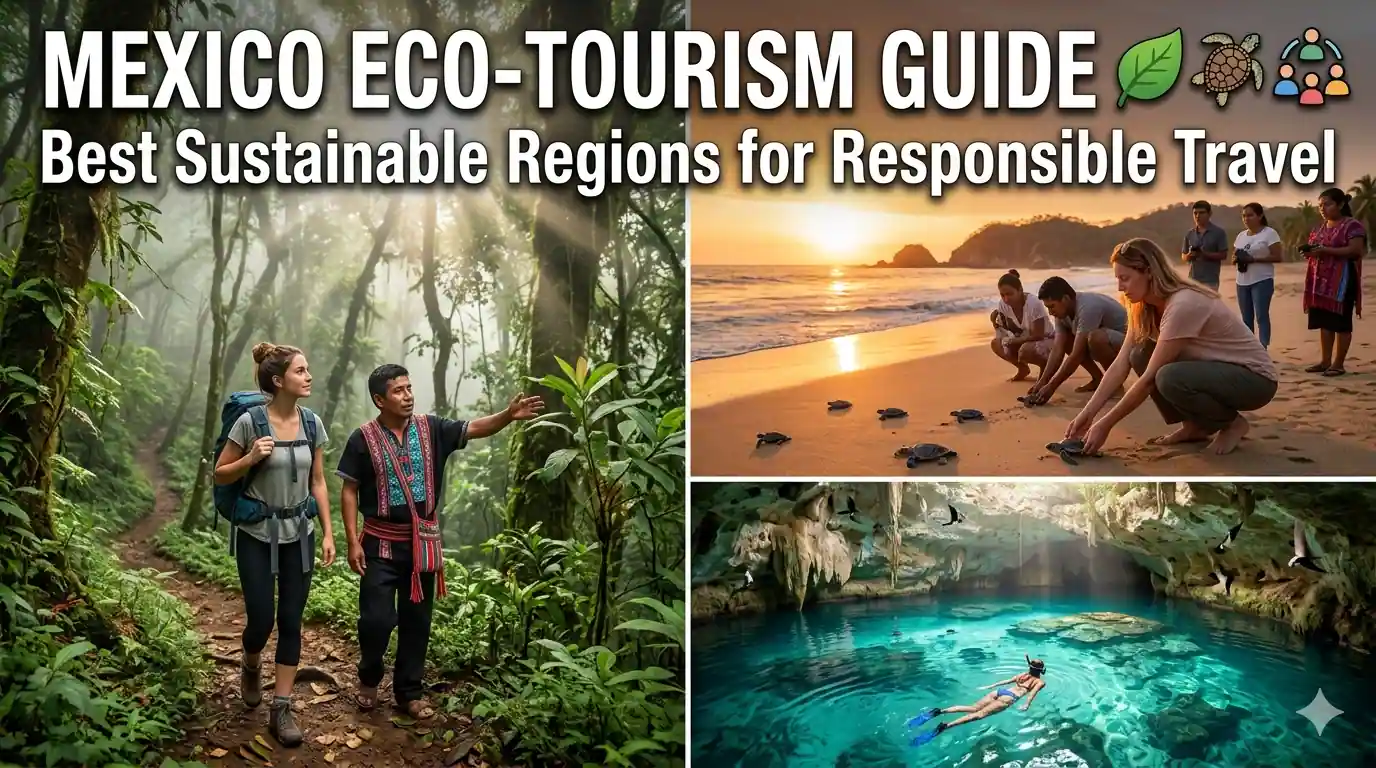
Quick Answer for Eco-Travelers
Mexico's top sustainable tourism regions include Oaxaca's Sierra Norte for community-owned ecotourism, Chiapas' Lacandón Jungle for indigenous-led rainforest experiences, Baja California Sur for ethical whale watching, Quintana Roo's Sian Ka'an Biosphere for marine conservation, and the Yucatán Peninsula for cenote stewardship programs. US citizens need only a valid passport for entry with no visa required for stays under 180 days. Look for operators with SECTUR certification, Rainforest Alliance membership, or Mexico's new community-based tourism certification to ensure authentic sustainability. Budget $40-120 USD daily for eco-conscious travel including community-owned cabins ($25-60/night), local meals ($8-20), and certified tours ($30-80). Best visiting time is October-April during dry season for optimal hiking and wildlife viewing. By choosing community-based tourism, travelers directly support indigenous economies, conservation efforts, and cultural preservation while experiencing Mexico's extraordinary biodiversity and heritage.
Why Mexico Leads in Sustainable Tourism Innovation

Mexico stands at the forefront of global sustainable tourism, combining extraordinary biodiversity with innovative community-based models that prioritize local empowerment over mass tourism extraction. With 182 protected natural areas and one of the world's highest levels of endemic species richness, the country possesses unparalleled ecological capital to share responsibly with visitors.
What distinguishes Mexico's approach is its integration of social, cultural, and environmental dimensions. Sustainable tourism here isn't merely about minimizing impact—it's about creating participatory exchanges where travelers learn from indigenous knowledge, support local economies directly, and contribute to conservation outcomes that benefit communities long-term.
This philosophy has gained international recognition. When the Rutopía initiative won the 2024 Green Destinations Story Awards in Berlin, it signaled a broader shift: ecotourism evolving from niche preservation to a strategic instrument for rural development and cultural continuity. Projects like Rutopía connect travelers with indigenous and rural communities across Mexico, weaving ecological stewardship with immersive cultural experiences shaped by local knowledge and communal ownership.
For conscious travelers, Mexico offers a rare opportunity: to explore spectacular landscapes while ensuring tourism dollars flow directly to the people who protect them. Whether hiking cloud forests with Zapotec guides in Oaxaca, releasing sea turtle hatchlings in Mazunte, or paddling through Sian Ka'an's mangroves with Maya naturalists, sustainable tourism in Mexico transforms travel from consumption to contribution.
Top Sustainable Tourism Regions in Mexico

These regions represent Mexico's most innovative and impactful sustainable tourism models, where community ownership, conservation outcomes, and authentic cultural exchange converge.
Oaxaca: Sierra Norte and Coastal Communities
Oaxaca stands as Mexico's exemplar for community-based ecotourism. The Sierra Norte region, 70 kilometers north of Oaxaca City, features the Pueblos Mancomunados—a network of eight indigenous Zapotec villages jointly managing over 100 kilometers of maintained hiking and mountain biking trails through pine-oak cloud forest.
This model represents ecotourism done right: entirely community-owned, with every entrance fee, cabin rental, and guide fee flowing directly to participating villages. Travelers stay in rustic but comfortable community cabins ($25-40 USD/night), hike with local guides who share ecological and cultural knowledge, and experience birdwatching among 300+ species including the resplendent quetzal.
On Oaxaca's coast, Mazunte tells a powerful story of transformation. Once dependent on sea turtle hunting, the village pivoted after Mexico's 1990 ban by creating Cosméticos Naturales—a cosmetics cooperative using locally sourced plant ingredients. Today the cooperative employs most villagers and funds turtle conservation, while visitors can participate in hatchling releases at Playa Mermejita. This economic transformation with conservation outcomes demonstrates sustainable tourism's potential to heal both ecosystems and communities.
Chiapas: Lacandón Jungle and Highland Cooperatives
Eastern Chiapas harbors the Lacandón Jungle, North America's largest remaining tropical rainforest outside the Amazon. The Lacandón Maya—direct descendants of classic Maya civilization—maintain their ancestral territory through community-led tourism initiatives in villages like Lacanjá Chansayab and Metzabok.
Responsible visits involve booking exclusively through established community guides, respecting photography protocols, and arranging stays through certified operators like ECOSUR. Experiences include guided jungle walks spotting howler monkeys and toucans, canoe trips on pristine rivers, and learning about traditional Maya agroforestry practices that sustainably manage forest resources.
In Chiapas' highlands, indigenous coffee cooperatives offer agroforestry tours where visitors learn about organic shade-grown coffee production, participate in harvest activities seasonally, and purchase fair-trade beans directly from farmers. These experiences support sustainable agriculture while preserving traditional land management knowledge.
Baja California Sur: Ethical Marine Wildlife Tourism
Baja California Sur's Pacific coast hosts one of the world's most remarkable wildlife phenomena: gray whale migration. Between January and March, local fishing communities in Laguna San Ignacio and Laguna Ojo de Liebre have transitioned from fishing to ethical whale watching, offering small-group panga tours where whales often initiate close encounters.
These community-led operations prioritize whale welfare through strict viewing guidelines, limit group sizes to minimize disturbance, and reinvest profits into marine conservation and community development. The experience—floating silently as a curious gray whale approaches your small boat—creates profound connection while supporting sustainable livelihoods.
Baja also features terrestrial eco-lodges like Las Guacamayas in the Sierra de la Laguna biosphere reserve, where solar power, rainwater collection, and local employment demonstrate integrated sustainability. Hiking, birdwatching, and stargazing in this UNESCO biosphere reserve offer low-impact immersion in Baja's unique desert-meets-ocean ecosystem.
Quintana Roo: Sian Ka'an and Cenote Stewardship
The Sian Ka'an Biosphere Reserve, a UNESCO World Heritage Site south of Tulum, represents Mexico's largest protected area and a model for community-managed marine conservation. Local Maya communities operate small-group boat tours through mangrove channels, coral reefs, and freshwater cenotes, sharing ecological knowledge while monitoring ecosystem health.
These tours limit group sizes, use low-impact vessels, and include conservation fees that fund reef restoration and community projects. Visitors snorkel with sea turtles, spot manatees in seagrass beds, and learn about traditional Maya fishing practices that sustainably harvest marine resources.
Across the Yucatán Peninsula, community-led cenote stewardship programs protect these sacred freshwater sinkholes through visitor education, capacity limits, and biodegradable product requirements. Eco-managed cenotes like Ich Ek and Chikin Ha offer swimming and snorkeling while funding local conservation initiatives and employing community members as guides and stewards.
Michoacán: Monarch Butterfly Conservation Tourism
Each winter, millions of monarch butterflies migrate to Michoacán's oyamel fir forests. Local communities in the Monarch Butterfly Biosphere Reserve manage visitor access through designated trails, guided tours, and conservation fees that fund forest protection and community development.
Visiting November through March, travelers witness one of nature's most spectacular migrations while supporting communities that have shifted from logging to conservation-based livelihoods. Guides explain butterfly biology, forest ecology, and the transnational conservation efforts protecting this extraordinary phenomenon across North America.
Regional Sustainability Comparison:
| Region | Primary Focus | Community Model | Best For | Avg Daily Cost USD |
| Oaxaca Sierra Norte | Cloud forest hiking, birding | Pueblos Mancomunados cooperative | Hikers, birders, cultural immersion | $40-70 |
| Oaxaca Coast (Mazunte) | Sea turtle conservation | Cosméticos Naturales cooperative | Conservation volunteers, beach lovers | $45-80 |
| Chiapas Lacandón | Rainforest ecology, Maya culture | Lacandón community guides | Adventure travelers, cultural learners | $50-90 |
| Baja California Sur | Marine wildlife, desert ecology | Fishing community cooperatives | Wildlife enthusiasts, photographers | $60-120 |
| Quintana Roo (Sian Ka'an) | Marine conservation, cenotes | Maya community tour operators | Snorkelers, eco-divers, nature lovers | $55-100 |
| Michoacán (Monarch Reserve) | Butterfly migration, forest conservation | Forest community tourism committees | Nature photographers, conservationists | $45-75 |
Understanding Sustainable Tourism Certifications in Mexico

Navigating Mexico's growing eco-tourism landscape requires understanding certification programs that distinguish genuine sustainability from greenwashing. These credentials help travelers identify operators committed to environmental protection, community benefit, and cultural respect.
SECTUR Certification: Mexico's Ministry of Tourism (SECTUR) operates a national tourism certification system recognizing businesses meeting sustainability criteria across environmental management, social responsibility, and cultural preservation. Look for the Distintivo S (Sustainability Distinction) logo when selecting hotels, tour operators, or restaurants.
Rainforest Alliance: This international certification verifies tourism businesses meeting rigorous standards for biodiversity conservation, community well-being, and sustainable operations. Rainforest Alliance-certified operators in Mexico undergo regular audits and continuous improvement processes.
Green Key and EarthCheck: These global eco-certifications recognize hotels and resorts implementing comprehensive sustainability management systems. Green Key-certified properties in Mexico demonstrate measurable reductions in water and energy use, waste diversion, and community engagement.
Mexico's Community-Based Tourism Certification: Launched in 2025, this world-first certification empowers local communities to control visitor impact and benefit distribution. It verifies that tourism initiatives are community-owned, culturally appropriate, and economically equitable—a crucial tool for ensuring tourism supports rather than exploits indigenous and rural communities.
GSTC Recognition: The Global Sustainable Tourism Council provides the international benchmark for sustainable tourism. Mexican operators with GSTC-recognized certification meet globally validated criteria for sustainable management, socioeconomic benefits, cultural heritage protection, and environmental conservation.
Red Flags for Greenwashing:
- Vague claims like "eco-friendly" without specific certifications or measurable practices
- Profits flowing primarily to outside operators rather than local communities
- Lack of transparency about conservation fees or community benefit distribution
- Large group sizes that overwhelm fragile ecosystems or cultural sites
- Wildlife interactions that prioritize tourist photos over animal welfare
- 👉 Cuba D'Viajeros 2026: Step-by-step guide to the mandatory digital entry form.
- 👉 Dominica Sperm Whale Reserve 2026: Marine Life Guide
- 👉 Costa Rica Digital Nomad Visa 2026: Why the $3,000 monthly income rule is a game-changer.
- 👉 Nicaragua Trip Cost from Miami: 2-Week Budget Guide
- 👉 Hyatt Placencia Belize 2026: Luxury Resort Opening Guide
Questions to Ask Operators:
- What percentage of revenue stays in the local community?
- How are guides and staff recruited and compensated?
- What specific conservation outcomes does your operation support?
- How do you limit visitor impact on sensitive ecosystems or cultural sites?
- Can you provide references from recent travelers or community partners?
- 👉 Cuba D'Viajeros 2026: Step-by-step guide to the mandatory digital entry form.
- 👉 Dominica Sperm Whale Reserve 2026: Marine Life Guide
- 👉 Costa Rica Digital Nomad Visa 2026: Why the $3,000 monthly income rule is a game-changer.
- 👉 Nicaragua Trip Cost from Miami: 2-Week Budget Guide
- 👉 Hyatt Placencia Belize 2026: Luxury Resort Opening Guide
Choosing certified operators isn't just about avoiding harm—it's about actively contributing to positive change. Your tourism dollars become investment in conservation, cultural continuity, and community resilience when directed toward verified sustainable enterprises.
Cost Breakdown for Sustainable Travel in Mexico

Understanding realistic costs helps travelers budget for meaningful eco-tourism experiences while supporting community-based models that prioritize people and planet over profit maximization.
Accommodation Costs (Per Night in USD):
| Category | Price Range | Examples | Sustainability Features |
| Community Cabins | $25-45 | Pueblos Mancomunados, Lacandón villages | Locally built, community-owned, minimal impact |
| Eco-Lodges | $60-120 | Las Guacamayas, Hotel Cielo y Selva | Solar power, rainwater harvesting, local employment |
| Certified Hotels | $80-180 | Green Key or EarthCheck properties | Resource efficiency, waste reduction, community programs |
| Conservation Stays | $100-250 | Research station homestays, volunteer programs | Direct conservation funding, scientific contribution |
Food and Dining (Daily in USD):
- Community meals: $8-15 (home-cooked regional cuisine)
- Eco-lodge dining: $15-30 (farm-to-table, local ingredients)
- Certified restaurants: $20-40 (sustainable sourcing, fair wages)
- Street food/markets: $5-12 (supporting local vendors)
- 👉 Cuba D'Viajeros 2026: Step-by-step guide to the mandatory digital entry form.
- 👉 Dominica Sperm Whale Reserve 2026: Marine Life Guide
- 👉 Costa Rica Digital Nomad Visa 2026: Why the $3,000 monthly income rule is a game-changer.
- 👉 Nicaragua Trip Cost from Miami: 2-Week Budget Guide
- 👉 Hyatt Placencia Belize 2026: Luxury Resort Opening Guide
Tours and Activities (Per Experience in USD):
| Activity Type | Community-Led | Certified Operator | Conservation Focus |
| Guided Hiking | $25-40 | $35-55 | $40-70 (includes conservation fee) |
| Wildlife Watching | $30-50 | $45-75 | $60-100 (research contribution) |
| Cultural Immersion | $20-35 | $30-50 | $35-60 (artisan support) |
| Marine Activities | $40-65 | $55-85 | $70-120 (reef restoration) |
Sample 5-Day Sustainable Travel Budget (Per Person):
| Expense Category | Budget Eco | Mid-Range Sustainable | Premium Conservation |
| Accommodation (4 nights) | $100-180 | $240-480 | $400-1,000 |
| Food (5 days) | $40-75 | $75-150 | $100-200 |
| Tours/Activities | $125-200 | $225-375 | $350-600 |
| Local Transport | $30-60 | $60-120 | $100-200 |
| Conservation Fees | $20-40 | $40-80 | $80-150 |
| Travel Insurance | $40-60 | $60-90 | $90-150 |
| Estimated Total | $355-615 | $700-1,295 | $1,120-2,300 |
These estimates exclude international flights. Sustainable travel in Mexico often costs less than conventional tourism because community-based models eliminate middlemen and prioritize value over luxury. The premium for certified operators reflects genuine investments in conservation, fair wages, and cultural preservation—ensuring your spending creates positive impact.
Getting to Sustainable Destinations in Mexico

Reaching Mexico's eco-tourism regions requires strategic planning, as many community-based destinations prioritize low-impact access over mass tourism convenience.
Flight Access:
Most sustainable destinations connect via Mexico City (MEX), Cancún (CUN), or Oaxaca (OAX) airports. Direct international flights serve these hubs from major US, Canadian, and European cities.
| Destination Region | Nearest Airport | Ground Transport | Travel Time from Airport |
| Oaxaca Sierra Norte | OAX | Shared van or rental car | 1.5-2 hours |
| Oaxaca Coast (Mazunte) | OAX or HUX | ADO bus or rental car | 3-4 hours from OAX |
| Chiapas Lacandón | TGZ or VSA | Pre-arranged community transport | 4-6 hours |
| Baja California Sur | LAP or SJD | Rental car or community shuttle | 1-3 hours |
| Quintana Roo (Sian Ka'an) | CUN | ADO bus to Tulum + local transport | 2-3 hours |
| Michoacán (Monarch Reserve) | MLM or MEX | Rental car or certified tour transfer | 2-4 hours |
Ground Transportation Strategies:
- Shared Vans (Colectivos): Budget-friendly and lower-carbon than private cars. Common in Oaxaca and Chiapas; confirm schedules with accommodations.
- Community Shuttles: Many eco-lodges and community tourism projects offer pre-arranged transfers that support local employment and reduce environmental impact.
- Rental Cars: Provide flexibility for remote destinations but choose fuel-efficient or hybrid vehicles. Verify parking and road conditions with your host.
- ADO Buses: Mexico's first-class bus system offers comfortable, reliable connections between major cities at low cost and carbon footprint.
- 👉 Cuba D'Viajeros 2026: Step-by-step guide to the mandatory digital entry form.
- 👉 Dominica Sperm Whale Reserve 2026: Marine Life Guide
- 👉 Costa Rica Digital Nomad Visa 2026: Why the $3,000 monthly income rule is a game-changer.
- 👉 Nicaragua Trip Cost from Miami: 2-Week Budget Guide
- 👉 Hyatt Placencia Belize 2026: Luxury Resort Opening Guide
Carbon Offset Considerations:
While sustainable tourism minimizes local impact, international travel carries carbon emissions. Consider offsetting flights through verified programs that support Mexican conservation projects, such as reforestation in the Sierra Madre or mangrove restoration in Sian Ka'an.
Packing for Low-Impact Travel:
- Reusable water bottle and purification method (many eco-lodges provide filtered water)
- Biodegradable sunscreen and insect repellent (required at many cenotes and marine sites)
- Quick-dry, modest clothing respecting local cultural norms
- Reusable shopping bag for market visits
- Small gifts for community hosts (school supplies preferred over candy or money)
- Solar charger for remote areas with limited electricity
- 👉 Cuba D'Viajeros 2026: Step-by-step guide to the mandatory digital entry form.
- 👉 Dominica Sperm Whale Reserve 2026: Marine Life Guide
- 👉 Costa Rica Digital Nomad Visa 2026: Why the $3,000 monthly income rule is a game-changer.
- 👉 Nicaragua Trip Cost from Miami: 2-Week Budget Guide
- 👉 Hyatt Placencia Belize 2026: Luxury Resort Opening Guide
Best Time to Visit for Sustainable Experiences

Timing affects wildlife viewing, weather comfort, crowd levels, and community tourism availability across Mexico's eco-regions.
Dry Season (October-April):
Optimal conditions for most sustainable tourism activities:
- Weather: Sunny days, cool nights, minimal rainfall. Temperatures vary by elevation: 60-80°F (15-27°C) in highlands, 70-90°F (21-32°C) on coasts.
- Wildlife: Monarch butterflies in Michoacán (November-March), gray whales in Baja (January-March), bird migrations in Oaxaca (October-April).
- Accessibility: Roads and trails in best condition; community tours operating at full capacity.
- Crowds: Peak tourism December-March; book community accommodations 2-3 months ahead.
- 👉 Cuba D'Viajeros 2026: Step-by-step guide to the mandatory digital entry form.
- 👉 Dominica Sperm Whale Reserve 2026: Marine Life Guide
- 👉 Costa Rica Digital Nomad Visa 2026: Why the $3,000 monthly income rule is a game-changer.
- 👉 Nicaragua Trip Cost from Miami: 2-Week Budget Guide
- 👉 Hyatt Placencia Belize 2026: Luxury Resort Opening Guide
Rainy Season (May-September):
Distinct advantages for eco-conscious travelers:
- Weather: Afternoon thunderstorms typical, lasting 1-2 hours; mornings usually clear. Lush vegetation and flowing waterfalls.
- Wildlife: Sea turtle nesting on Oaxaca coast (June-October), migratory birds arriving, amphibians active.
- Crowds: Significantly fewer tourists; better availability for community tours and accommodations.
- Pricing: 20-30% discounts on many eco-lodges and tours during low season.
- Considerations: Some remote roads may become impassable; verify access with operators before booking.
- 👉 Cuba D'Viajeros 2026: Step-by-step guide to the mandatory digital entry form.
- 👉 Dominica Sperm Whale Reserve 2026: Marine Life Guide
- 👉 Costa Rica Digital Nomad Visa 2026: Why the $3,000 monthly income rule is a game-changer.
- 👉 Nicaragua Trip Cost from Miami: 2-Week Budget Guide
- 👉 Hyatt Placencia Belize 2026: Luxury Resort Opening Guide
Regional Seasonal Highlights:
| Region | Peak Season | Shoulder Season | Low Season | Best For |
| Oaxaca Sierra Norte | Nov-Mar | Apr-May, Oct | Jun-Sep | Hiking, birding, cultural immersion |
| Oaxaca Coast | Dec-Apr | May-Jun, Oct-Nov | Jul-Sep | Turtle conservation, beach relaxation |
| Chiapas Lacandón | Nov-Apr | May, Oct | Jun-Sep | Jungle ecology, Maya culture |
| Baja California Sur | Jan-Mar | Apr-May, Nov-Dec | Jun-Oct | Whale watching, marine wildlife |
| Quintana Roo | Dec-Apr | May-Jun, Oct-Nov | Jul-Sep | Cenotes, marine conservation |
| Michoacán | Nov-Mar | Apr-May, Oct | Jun-Sep | Monarch butterflies, forest ecology |
Shoulder seasons (April-May, October-November) often provide the optimal balance: favorable weather, manageable crowds, and good availability for community-based experiences. These periods also align with agricultural cycles in many regions, offering opportunities to participate in planting or harvest activities.
Sample Sustainable Itineraries

These itineraries balance ecological immersion, cultural exchange, and practical logistics while supporting community-based tourism models.
5-Day Oaxaca Community Immersion:
- Day 1: Arrive Oaxaca City, meet Pueblos Mancomunados coordinator, transfer to Sierra Norte village. Evening welcome meal with host family.
- Day 2: Guided cloud forest hike with Zapotec naturalist, birdwatching for quetzals, afternoon weaving demonstration in Teotitlán del Valle.
- Day 3: Mountain biking between villages, visit to community coffee cooperative, traditional cooking class with local ingredients.
- Day 4: Transfer to Oaxaca coast, afternoon sea turtle conservation orientation at Mazunte, sunset beach walk.
- Day 5: Morning hatchling release (seasonal), visit Cosméticos Naturales cooperative, return to Oaxaca City for departure.
- 👉 Cuba D'Viajeros 2026: Step-by-step guide to the mandatory digital entry form.
- 👉 Dominica Sperm Whale Reserve 2026: Marine Life Guide
- 👉 Costa Rica Digital Nomad Visa 2026: Why the $3,000 monthly income rule is a game-changer.
- 👉 Nicaragua Trip Cost from Miami: 2-Week Budget Guide
- 👉 Hyatt Placencia Belize 2026: Luxury Resort Opening Guide
7-Day Chiapas Lacandón Adventure:
- Days 1-2: Arrive Palenque, guided tour of Maya ruins with local archaeologist, transfer to Lacandón community with pre-arranged transport.
- Days 3-4: Jungle trekking with Lacandón guides, canoe trips on jungle rivers, learning about traditional agroforestry and medicinal plants.
- Day 5: Visit to Bonampak ruins with community interpreter, afternoon cultural exchange with village elders.
- Day 6: Transfer to San Cristóbal de las Casas, afternoon weaving cooperative visit, evening traditional music performance.
- Day 7: Morning highland coffee tour with indigenous cooperative, departure from Tuxtla Gutiérrez airport.
- 👉 Cuba D'Viajeros 2026: Step-by-step guide to the mandatory digital entry form.
- 👉 Dominica Sperm Whale Reserve 2026: Marine Life Guide
- 👉 Costa Rica Digital Nomad Visa 2026: Why the $3,000 monthly income rule is a game-changer.
- 👉 Nicaragua Trip Cost from Miami: 2-Week Budget Guide
- 👉 Hyatt Placencia Belize 2026: Luxury Resort Opening Guide
4-Day Baja Whale Watching Focus:
- Day 1: Arrive La Paz, orientation with community whale watching cooperative, sunset panga tour for dolphin spotting.
- Day 2: Full-day gray whale watching in Laguna San Ignacio (January-March), lunch prepared by local fishermen's families.
- Day 3: Morning marine ecology workshop with local naturalist, afternoon snorkeling with sea lions at Espíritu Santo Island (sustainable operator).
- Day 4: Visit to community-led desert ecology project, purchase of local crafts supporting conservation, departure.
- 👉 Cuba D'Viajeros 2026: Step-by-step guide to the mandatory digital entry form.
- 👉 Dominica Sperm Whale Reserve 2026: Marine Life Guide
- 👉 Costa Rica Digital Nomad Visa 2026: Why the $3,000 monthly income rule is a game-changer.
- 👉 Nicaragua Trip Cost from Miami: 2-Week Budget Guide
- 👉 Hyatt Placencia Belize 2026: Luxury Resort Opening Guide
Itinerary Planning Principles:
- Build in buffer days for weather-dependent activities like whale watching or turtle releases
- Allow time for cultural exchange—rushing undermines the relationship-building central to community tourism
- Coordinate with community operators in advance; many require pre-booking due to limited capacity
- Include conservation activities (beach cleanups, tree planting) where available to deepen impact
- Balance active days with rest to respect both traveler energy and community rhythms
- 👉 Cuba D'Viajeros 2026: Step-by-step guide to the mandatory digital entry form.
- 👉 Dominica Sperm Whale Reserve 2026: Marine Life Guide
- 👉 Costa Rica Digital Nomad Visa 2026: Why the $3,000 monthly income rule is a game-changer.
- 👉 Nicaragua Trip Cost from Miami: 2-Week Budget Guide
- 👉 Hyatt Placencia Belize 2026: Luxury Resort Opening Guide
Safety and Responsible Travel Practices

Sustainable tourism requires attention to personal safety, cultural respect, and environmental protection. These practices ensure positive outcomes for travelers and host communities.
Personal Safety in Remote Areas:
- Share your itinerary with trusted contacts and check in regularly
- Carry a basic first-aid kit, water purification method, and emergency communication device
- Use authorized guides for wilderness activities; never venture into remote areas alone
- Respect weather advisories and trail closures—ecosystems are fragile and conditions change rapidly
- Keep valuables secure but avoid displaying expensive electronics that may create economic disparities
- 👉 Cuba D'Viajeros 2026: Step-by-step guide to the mandatory digital entry form.
- 👉 Dominica Sperm Whale Reserve 2026: Marine Life Guide
- 👉 Costa Rica Digital Nomad Visa 2026: Why the $3,000 monthly income rule is a game-changer.
- 👉 Nicaragua Trip Cost from Miami: 2-Week Budget Guide
- 👉 Hyatt Placencia Belize 2026: Luxury Resort Opening Guide
Cultural Respect and Community Engagement:
- Learn basic greetings in local languages (Zapotec, Maya, Lacandón); effort demonstrates respect
- Ask permission before photographing people, homes, or cultural practices; accept refusals gracefully
- Dress modestly in indigenous communities, covering shoulders and knees as sign of respect
- Participate in cultural activities as invited guest, not spectator; follow community protocols
- Buy crafts directly from artisans at fair prices; avoid bargaining that devalues traditional skills
- 👉 Cuba D'Viajeros 2026: Step-by-step guide to the mandatory digital entry form.
- 👉 Dominica Sperm Whale Reserve 2026: Marine Life Guide
- 👉 Costa Rica Digital Nomad Visa 2026: Why the $3,000 monthly income rule is a game-changer.
- 👉 Nicaragua Trip Cost from Miami: 2-Week Budget Guide
- 👉 Hyatt Placencia Belize 2026: Luxury Resort Opening Guide
Environmental Stewardship:
- Follow Leave No Trace principles: pack out all waste, stay on designated trails, minimize campfire impact
- Use biodegradable products only in natural water bodies; many cenotes and marine sites require this
- Respect wildlife viewing distances; never feed animals or disrupt natural behaviors
- Conserve water and energy at eco-lodges; many remote operations rely on limited resources
- Offset your travel carbon through verified programs supporting Mexican conservation projects
- 👉 Cuba D'Viajeros 2026: Step-by-step guide to the mandatory digital entry form.
- 👉 Dominica Sperm Whale Reserve 2026: Marine Life Guide
- 👉 Costa Rica Digital Nomad Visa 2026: Why the $3,000 monthly income rule is a game-changer.
- 👉 Nicaragua Trip Cost from Miami: 2-Week Budget Guide
- 👉 Hyatt Placencia Belize 2026: Luxury Resort Opening Guide
Health Considerations:
- Drink only bottled or purified water; many eco-lodges provide filtered water refills
- Apply reef-safe sunscreen and insect repellent; high UV exposure at altitude requires diligence
- Carry prescription medications in original containers with copies of prescriptions
- Consider travel insurance covering medical evacuation, especially for remote eco-destinations
- Acclimatize gradually to elevation changes; many sustainable destinations are in highland areas
- 👉 Cuba D'Viajeros 2026: Step-by-step guide to the mandatory digital entry form.
- 👉 Dominica Sperm Whale Reserve 2026: Marine Life Guide
- 👉 Costa Rica Digital Nomad Visa 2026: Why the $3,000 monthly income rule is a game-changer.
- 👉 Nicaragua Trip Cost from Miami: 2-Week Budget Guide
- 👉 Hyatt Placencia Belize 2026: Luxury Resort Opening Guide
Emergency Preparedness:
- Save local emergency numbers: 911 works throughout Mexico with English-speaking operators
- Keep accommodation addresses and contact information saved offline for areas with limited connectivity
- Register with your embassy's travel program for safety updates and emergency assistance
- Carry cash in small peso denominations; many community operations don't accept cards
- Know the location of the nearest medical facility; remote eco-destinations may have limited services
- 👉 Cuba D'Viajeros 2026: Step-by-step guide to the mandatory digital entry form.
- 👉 Dominica Sperm Whale Reserve 2026: Marine Life Guide
- 👉 Costa Rica Digital Nomad Visa 2026: Why the $3,000 monthly income rule is a game-changer.
- 👉 Nicaragua Trip Cost from Miami: 2-Week Budget Guide
- 👉 Hyatt Placencia Belize 2026: Luxury Resort Opening Guide
Final Recommendations for Impactful Eco-Travel

Mexico's sustainable tourism regions offer transformative experiences that connect travelers with extraordinary biodiversity, rich cultural heritage, and innovative community models. These final principles maximize positive impact while ensuring memorable journeys.
Prioritize Community Ownership: Choose experiences where local communities control tourism operations, set visitor limits, and receive direct economic benefits. This ensures tourism supports rather than exploits the people and places you visit.
Embrace Slow Travel: Spend more time in fewer places to deepen cultural connections, reduce transportation emissions, and allow communities to share their stories authentically. A week in one region creates more meaningful impact than rushing through multiple destinations.
Learn Before You Go: Research the cultural context, ecological significance, and community protocols of your destination. Understanding the "why" behind sustainable practices enhances appreciation and ensures respectful engagement.
Travel Light, Pack Thoughtfully: Minimize luggage weight to reduce transportation emissions. Bring reusable items, biodegradable products, and culturally appropriate clothing. Every packing choice reflects your commitment to low-impact travel.
Share Responsibly: When posting about your experiences, highlight specific community operators, conservation outcomes, and cultural insights. Thoughtful storytelling inspires others to travel responsibly while directing support to verified sustainable enterprises.
Continue the Connection: Sustainable tourism doesn't end when you return home. Maintain relationships with community partners through fair-trade purchases, conservation donations, or advocacy for responsible travel practices. Your ongoing engagement amplifies the positive impact of your visit.
Trust the Process: Community-based tourism operates on different rhythms than mass tourism. Flexibility, patience, and openness to unexpected moments create the most rewarding experiences. Allow local knowledge to guide your journey.
Mexico's leadership in sustainable tourism demonstrates that travel can be a force for conservation, cultural preservation, and community empowerment. By choosing certified operators, respecting local protocols, and prioritizing impact over convenience, you become part of a global movement redefining what tourism can achieve.
The regions highlighted here—Oaxaca's cloud forests, Chiapas' ancient jungles, Baja's marine wonders, Quintana Roo's sacred cenotes, and Michoacán's butterfly sanctuaries—invite you to experience Mexico's extraordinary heritage while ensuring it thrives for generations to come. Travel with intention, engage with humility, and discover how sustainable tourism transforms both traveler and destination.
Your journey matters. Choose wisely, travel responsibly, and leave a legacy of positive impact across Mexico's remarkable landscapes and communities.
0 Comments