.webp)
.webp)
5 reasons why "Panam City" is Asia's most beautiful abandoned archaeological site.
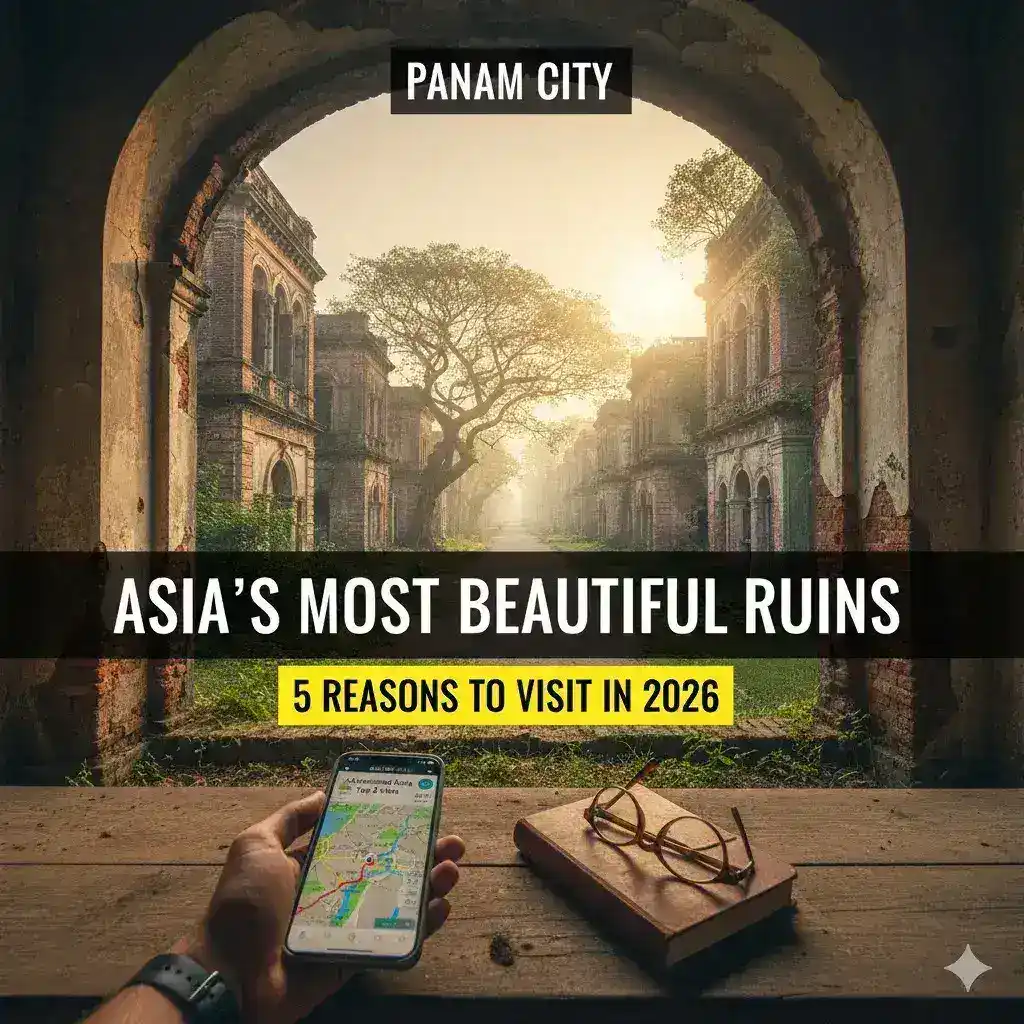
Discovering Panam City: Where Time Stood Still in Colonial Splendor
In the heart of Bangladesh, just a short distance from the bustling capital of Dhaka, lies a place where time appears to have frozen over a century ago. Panam City, an abandoned Hindu merchant town in Sonargaon, stands as one of Asia's most hauntingly beautiful archaeological sites – a silent testament to a prosperous past, colonial ambition, and the inevitable march of time. This remarkable collection of Indo-European architecture, left to decay amidst overgrown vegetation and weathered facades, offers visitors a rare glimpse into a bygone era while presenting an aesthetic beauty that rivals any abandoned site on the continent.
While Asia boasts numerous abandoned cities and archaeological wonders – from the ancient ruins of Angkor Wat to the ghost towns of China's Silk Road – Panam City occupies a unique position. Its beauty lies not in grand monuments or imperial palaces, but in the intimate scale of its merchant houses, the intricate fusion of architectural styles, and the poetic way nature has reclaimed these colonial structures. The city's abandonment in the early 20th century created a time capsule that preserves an entire urban fabric, complete with streets, homes, and public spaces that tell the story of Bangladesh's mercantile golden age.
This comprehensive guide explores the five compelling reasons why Panam City deserves recognition as Asia's most beautiful abandoned archaeological site, examining its architectural uniqueness, historical significance, aesthetic appeal, cultural importance, and the profound emotional impact it has on all who walk its silent streets. Whether you're a history enthusiast, architecture lover, photographer, or simply someone seeking extraordinary travel experiences, Panam City offers an encounter with beauty in decay that is both deeply moving and visually stunning.
Reason #1: Extraordinary Indo-European Architectural Fusion

The first and perhaps most striking reason Panam City stands out among Asia's abandoned sites is its remarkable architectural character – a sophisticated blend of Bengali, Mughal, British colonial, and European influences that creates a visual language unlike any other abandoned city on the continent.
The Unique Architectural Identity
Panam City's approximately 52 surviving structures represent a distinct architectural style that emerged in the late 19th and early 20th centuries. Unlike the purely indigenous architecture found in many South Asian heritage sites, or the strictly European colonial buildings in other former colonies, Panam City's buildings showcase a genuine fusion that reflects the cosmopolitan nature of its former inhabitants.
The merchant houses feature:
- Classical European elements: Corinthian and Ionic columns, pedimented facades, arched windows with keystones, and symmetrical layouts inspired by Palladian architecture
- Bengali adaptations: High ceilings for ventilation, inner courtyards (uchitan), terracotta ornamentation, and sloping roofs suited to monsoon climate
- Mughal influences: Pointed arches, decorative brackets, jali (perforated screens), and ornamental plasterwork
- Portuguese and Dutch touches: Tile work, window shutters, and verandah designs from earlier European trading presence
- 👉 Walking the Via Dolorosa: Jerusalem's Sacred Path of the Cross
- 👉 How to use Nepal's new digital trekking permits (TIMS 2.0) in 2026.
- 👉 Philippines Digital Nomad Visa 2026: Application Guide
Architectural Details That Captivate
What makes these buildings particularly beautiful is the attention to detail, even in decay. Ornate cornices still cling to facades despite decades of weathering. Intricate plasterwork, though cracked and peeling, reveals the skill of craftsmen who created floral motifs, geometric patterns, and classical designs. The buildings' proportions follow classical principles, creating harmonious streetscapes that please the eye even in their ruined state.
The use of materials adds to the aesthetic appeal. Red brick, lime mortar, terracotta tiles, and imported cement created structures that were both durable and beautiful. As these materials age, they develop a patina that enhances their visual interest – bricks darken with moss, plaster crumbles to reveal underlying textures, and metal fixtures oxidize into beautiful verdigris.
Comparison to Other Asian Abandoned Sites
While other Asian abandoned cities showcase impressive architecture, few demonstrate such sophisticated cultural synthesis. China's abandoned villages typically feature purely vernacular architecture. Japan's ghost towns show modern construction. Southeast Asian ruins often consist of religious monuments rather than urban residential fabric. Panam City's merchant houses represent a unique urban architectural heritage that tells the story of global trade, cultural exchange, and local adaptation in a way that is both visually stunning and historically significant.
Reason #2: Perfect State of Atmospheric Preservation

The second reason Panam City claims the title of Asia's most beautiful abandoned site is its remarkable state of preservation – not pristine restoration, but the kind of atmospheric decay that creates profound beauty and emotional resonance.
The Poetry of Decay
Panam City was abandoned relatively recently in historical terms – most structures date from 1850-1920, and the city was largely deserted by the 1960s. This means the buildings haven't crumbled into the unrecognizable ruins of ancient sites, nor have they been demolished and replaced. Instead, they exist in a liminal state between habitation and ruin that creates extraordinary visual and emotional impact.
The preservation is "perfect" not because everything is intact, but because the decay itself has aesthetic value:
- Structural integrity: Most buildings still stand complete, with walls, roofs, and floors largely intact, allowing visitors to walk through rooms and imagine former life
- Controlled deterioration: Nature is reclaiming the city gradually – vegetation grows through cracks but hasn't demolished structures; roofs leak but haven't completely collapsed
- Authentic patina: Decades of weathering have created beautiful textures – peeling paint, rusted ironwork, moss-covered bricks, and water-stained walls that tell the story of time's passage
- Intact urban fabric: The street layout, building positions, and spatial relationships remain clear, preserving the city's original character
- 👉 Walking the Via Dolorosa: Jerusalem's Sacred Path of the Cross
- 👉 How to use Nepal's new digital trekking permits (TIMS 2.0) in 2026.
- 👉 Philippines Digital Nomad Visa 2026: Application Guide
The Role of Nature in Creating Beauty
Nature's reclamation of Panam City adds layers of beauty that pristine restoration could never achieve. Banyan trees send roots through crumbling walls, creating organic sculptures. Vines cascade down facades like green waterfalls. Grass grows through cracked floors, softening hard surfaces. This interplay between human construction and natural growth creates what photographers and artists call "ruin porn" – images that are simultaneously melancholic and beautiful.
The seasonal changes add variety to the experience. During monsoon season, the city becomes lush and verdant, with vegetation at its most vigorous. In winter, clearer skies and drier conditions reveal architectural details more sharply. Each season offers different photographic and aesthetic opportunities.
Comparison to Over-Restored Sites
Many Asian archaeological sites have been heavily restored, sometimes to the point of losing authenticity. While restoration preserves structures, it can also sanitize them, removing the emotional impact of time's passage. Panam City's beauty lies in its authenticity – what you see is real decay, not reconstructed facades. This honesty creates a more powerful aesthetic and emotional experience.
Reason #3: Rich Historical Narrative and Cultural Significance

The third reason Panam City stands as Asia's most beautiful abandoned site is the compelling historical narrative embedded in its streets and buildings – a story of prosperity, plague, partition, and abandonment that gives emotional depth to the architectural beauty.
The Golden Age of Sonargaon's Merchants
To understand Panam City's beauty, one must understand its history. The city flourished in the late 19th and early 20th centuries as a center for Bengal's textile trade, particularly muslin and later, cotton. The wealthy Hindu merchant families who built these houses were part of a cosmopolitan trading class that connected Bengal to global markets.
These merchants accumulated enormous wealth and expressed it through architecture. Each house was a statement of status, taste, and cultural sophistication. The buildings reflect their owners' education, worldliness, and desire to blend European modernity with Bengali tradition. This historical context transforms the buildings from mere structures into biographical documents – each facade tells the story of a family's aspirations and achievements.
The Tragic Abandonment
The city's abandonment adds poignancy to its beauty. Several factors contributed to Panam City's decline:
- Plague outbreak: In the early 20th century, bubonic plague struck the region, causing many residents to flee
- Economic changes: The decline of traditional textile industries and the rise of industrial manufacturing reduced merchants' prosperity
- Partition of 1947: The division of India and Pakistan led to mass migration, with many Hindu families leaving for India
- 1965 war: Indo-Pakistan war accelerated departure of remaining Hindu population
- Urban shift: Economic activity moved to Dhaka and other cities
- 👉 Walking the Via Dolorosa: Jerusalem's Sacred Path of the Cross
- 👉 How to use Nepal's new digital trekking permits (TIMS 2.0) in 2026.
- 👉 Philippines Digital Nomad Visa 2026: Application Guide
This history of forced abandonment – driven by disease, economic upheaval, and religious partition – adds layers of meaning to the empty streets. The beauty is tinged with tragedy, making the site emotionally resonant as well as visually striking.
Cultural Heritage Significance
Panam City represents important aspects of South Asian cultural heritage:
- Merchant culture: Preserves the urban fabric of Bengal's trading class
- Religious history: Documents Hindu presence and contribution to Bengal's development
- Colonial encounter: Shows how local populations adapted and synthesized colonial influences
- Urban planning: Demonstrates 19th-century Bengali urban design principles
- Craft traditions: Showcases traditional building techniques and decorative arts
- 👉 Walking the Via Dolorosa: Jerusalem's Sacred Path of the Cross
- 👉 How to use Nepal's new digital trekking permits (TIMS 2.0) in 2026.
- 👉 Philippines Digital Nomad Visa 2026: Application Guide
This cultural significance enhances the site's beauty by providing intellectual and emotional context. Visitors don't just see pretty ruins; they encounter a place that tells important stories about South Asian history, identity, and heritage.
Reason #4: Intimate Scale and Photogenic Urban Layout
The fourth reason Panam City deserves recognition as Asia's most beautiful abandoned site is its intimate human scale and exceptionally photogenic urban layout – qualities that create aesthetic experiences impossible in larger, more monumental archaeological sites.
The Beauty of Human Scale
Unlike vast archaeological complexes like Angkor Wat or Mohenjo-daro, Panam City operates at an intimate, human scale. The buildings are two to three stories high – tall enough to impress but not so massive as to overwhelm. Streets are narrow, creating enclosed spaces that feel cozy rather than grandiose. This scale allows visitors to:
- Appreciate details: Architectural ornamentation is visible at close range, not lost in vastness
- Imagine daily life: The human scale makes it easy to envision how people lived, worked, and moved through these spaces
- Feel connection: The intimate proportions create emotional intimacy with the site
- Explore thoroughly: The compact size allows comprehensive exploration in a single visit
- 👉 Walking the Via Dolorosa: Jerusalem's Sacred Path of the Cross
- 👉 How to use Nepal's new digital trekking permits (TIMS 2.0) in 2026.
- 👉 Philippines Digital Nomad Visa 2026: Application Guide
Photogenic Street Layout
Panam City's main street – the central spine running through the merchant quarter – is one of the most photogenic urban spaces in Asia. The street's beauty derives from several factors:
Symmetry and rhythm: Buildings line both sides of the street in a rhythmic pattern, creating visual harmony. The repetition of facades, windows, and doors establishes a pleasing cadence.
Perspective and vanishing points: The straight street creates strong linear perspective, with buildings receding toward vanishing points that draw the eye deep into the scene. This makes for dramatically compelling photographs.
Light and shadow: The narrow street and tall buildings create interesting light patterns, with shadows shifting throughout the day. Morning and afternoon light creates particularly beautiful contrasts.
Textural variety: Different buildings show different states of decay, creating visual interest through varied textures, colors, and conditions.
Versatile Photographic Opportunities
For photographers, Panam City offers extraordinary versatility:
- Architectural photography: Detailed facades, ornamental elements, structural compositions
- Street photography: Empty streets creating eerie atmosphere, play of light and shadow
- Detail shots: Decaying textures, vegetation reclaiming structures, ornamental fragments
- Portrait photography: Atmospheric backdrop for environmental portraits
- Time-lapse and long exposure: Changing light, moving clouds, atmospheric effects
- 👉 Walking the Via Dolorosa: Jerusalem's Sacred Path of the Cross
- 👉 How to use Nepal's new digital trekking permits (TIMS 2.0) in 2026.
- 👉 Philippines Digital Nomad Visa 2026: Application Guide
The site's photogenic quality has made it increasingly popular with photographers, filmmakers, and content creators, further establishing its reputation as a visually stunning destination.
Walkability and Accessibility
The compact layout makes Panam City highly walkable. Visitors can explore the entire site on foot in 2-3 hours, moving at a leisurely pace. This accessibility enhances the aesthetic experience – you can linger in beautiful spots, return to favorite buildings, and discover hidden details without exhausting yourself. The walkability also means the site is accessible to visitors of various ages and fitness levels.
Reason #5: Emotional Resonance and Spiritual Atmosphere
The fifth and perhaps most profound reason Panam City stands as Asia's most beautiful abandoned site is its extraordinary emotional resonance and spiritual atmosphere – qualities that transform a visit from simple sightseeing into a deeply moving experience.
The Aesthetics of Absence
Panam City's beauty is fundamentally tied to absence – the absence of people, of activity, of the sounds and smells of urban life. This absence creates what philosophers call "negative aesthetics" – beauty derived not from what is present, but from what is missing.
Walking through Panam City, you encounter:
- Silence: The profound quiet of empty streets, broken only by birdsong and wind
- Stillness: Buildings frozen in time, caught between past vitality and future ruin
- Emptiness: Rooms that once echoed with family life now stand vacant
- Memory: Physical traces of departed lives – a crumbling staircase, a faded wall painting, an overgrown courtyard
- 👉 Walking the Via Dolorosa: Jerusalem's Sacred Path of the Cross
- 👉 How to use Nepal's new digital trekking permits (TIMS 2.0) in 2026.
- 👉 Philippines Digital Nomad Visa 2026: Application Guide
This aesthetics of absence creates a contemplative atmosphere that invites reflection on time, memory, impermanence, and the human condition. The beauty is melancholic, poignant, and deeply moving.
Spiritual and Meditative Qualities
Many visitors report spiritual or meditative experiences in Panam City. The site's atmosphere encourages:
Mindfulness: The quiet, slow pace and absence of distractions promote present-moment awareness. You notice details – the texture of brick, the pattern of light, the sound of your footsteps – with heightened attention.
Contemplation: The visible passage of time, the evidence of impermanence, and the traces of departed lives naturally prompt philosophical reflection on mortality, legacy, and meaning.
Connection: Despite the absence of current inhabitants, many visitors feel a sense of connection to the people who once lived here – an empathetic bridge across time.
Peace: The silence and stillness create a peaceful atmosphere that contrasts sharply with the noise and chaos of modern urban life, offering a form of urban retreat.
The Sublime in Decay
Panam City evokes what philosophers call "the sublime" – an aesthetic experience that combines beauty with awe, pleasure with terror, attraction with repulsion. The site is beautiful, but its beauty is tinged with awareness of death, decay, and loss. This combination creates a more powerful emotional experience than simple prettiness.
The sublime quality emerges from:
- Scale of abandonment: An entire city deserted, creating awe at the magnitude of loss
- Power of nature: Witnessing nature's patient reclamation of human construction
- Time's passage: Visible evidence of decades of decay reminding us of our own mortality
- Historical tragedy: Awareness of the suffering and displacement that caused abandonment
- 👉 Walking the Via Dolorosa: Jerusalem's Sacred Path of the Cross
- 👉 How to use Nepal's new digital trekking permits (TIMS 2.0) in 2026.
- 👉 Philippines Digital Nomad Visa 2026: Application Guide
This sublime experience is rare in tourist destinations and gives Panam City emotional depth that transcends visual beauty alone.
Personal Transformation
Many visitors report that Panam City changed their perspective or stayed with them long after their visit. The site's combination of beauty, history, and emotional resonance creates memorable experiences that prompt reflection and sometimes personal transformation. This lasting impact is a mark of truly significant places.
Practical Information: Visiting Panam City
If Panam City's beauty has inspired you to visit, here's essential practical information:
Location and Access
Location: Panam City is located in Sonargaon, Narayanganj District, approximately 29 kilometers southeast of Dhaka, Bangladesh.
How to Reach:
- From Dhaka: Take a bus or CNG to Sonargaon (1-1.5 hours)
- Local transport: From Sonargaon town, hire a rickshaw or CNG to Panam City (15-20 minutes)
- Private vehicle: Can hire a car/driver from Dhaka for the day (BDT 3,000-5,000)
- Tour groups: Many Dhaka tour operators offer Sonargaon/Panam City day trips
- 👉 Walking the Via Dolorosa: Jerusalem's Sacred Path of the Cross
- 👉 How to use Nepal's new digital trekking permits (TIMS 2.0) in 2026.
- 👉 Philippines Digital Nomad Visa 2026: Application Guide
Best Time to Visit
Season: November to March (winter/cool season) offers the most comfortable weather
Time of day:
- Early morning (7-9 AM): Best light for photography, cooler temperatures, fewer visitors
- Late afternoon (3-5 PM): Golden hour lighting, atmospheric shadows
- Avoid: Midday heat (11 AM - 2 PM) and monsoon season (June-September)
- 👉 Walking the Via Dolorosa: Jerusalem's Sacred Path of the Cross
- 👉 How to use Nepal's new digital trekking permits (TIMS 2.0) in 2026.
- 👉 Philippines Digital Nomad Visa 2026: Application Guide
Entry Fees and Hours
- Entry fee: BDT 50-100 for foreigners; BDT 20-50 for Bangladeshi citizens
- Hours: Typically 9:00 AM - 5:00 PM daily
- Guides: Local guides available for BDT 300-500; recommended for historical context
- 👉 Walking the Via Dolorosa: Jerusalem's Sacred Path of the Cross
- 👉 How to use Nepal's new digital trekking permits (TIMS 2.0) in 2026.
- 👉 Philippines Digital Nomad Visa 2026: Application Guide
What to Bring
- Comfortable walking shoes (uneven surfaces)
- Water and snacks (limited facilities on-site)
- Camera with extra batteries
- Sun protection (hat, sunscreen)
- Insect repellent
- Cash for entry fees, guides, and transport
- 👉 Walking the Via Dolorosa: Jerusalem's Sacred Path of the Cross
- 👉 How to use Nepal's new digital trekking permits (TIMS 2.0) in 2026.
- 👉 Philippines Digital Nomad Visa 2026: Application Guide
Safety Considerations
- Buildings are unstable – don't enter structurally compromised structures
- Watch for snakes, especially in monsoon season
- Stay on established paths
- Don't climb on walls or roofs
- Visit with a companion when possible
- Inform someone of your travel plans
- 👉 Walking the Via Dolorosa: Jerusalem's Sacred Path of the Cross
- 👉 How to use Nepal's new digital trekking permits (TIMS 2.0) in 2026.
- 👉 Philippines Digital Nomad Visa 2026: Application Guide
Facilities
- Limited restrooms on-site
- Small food vendors near entrance
- No accommodation in Panam City itself
- Stay in Dhaka or Sonargaon town
- 👉 Walking the Via Dolorosa: Jerusalem's Sacred Path of the Cross
- 👉 How to use Nepal's new digital trekking permits (TIMS 2.0) in 2026.
- 👉 Philippines Digital Nomad Visa 2026: Application Guide
Conservation Challenges and Responsible Tourism
Panam City faces significant conservation challenges that threaten its future:
Threats to the Site
- Natural decay: Continued weathering, vegetation growth, and structural deterioration
- Vandalism: Theft of architectural elements, graffiti
- Uncontrolled tourism: Damage from visitors climbing on structures
- Lack of funding: Insufficient resources for proper conservation
- Development pressure: Surrounding urban expansion
- Climate change: Increased rainfall, flooding, and extreme weather
- 👉 Walking the Via Dolorosa: Jerusalem's Sacred Path of the Cross
- 👉 How to use Nepal's new digital trekking permits (TIMS 2.0) in 2026.
- 👉 Philippines Digital Nomad Visa 2026: Application Guide
How to Visit Responsibly
Visitors can help preserve Panam City's beauty for future generations:
- Don't touch or climb: Respect barriers and warning signs
- Pack out trash: Don't leave litter
- Don't remove anything: No souvenirs from the site
- Use local guides: Supports local economy and promotes proper interpretation
- Share responsibly: When posting photos, encourage respectful tourism
- Support conservation: Consider donating to preservation efforts if possible
- 👉 Walking the Via Dolorosa: Jerusalem's Sacred Path of the Cross
- 👉 How to use Nepal's new digital trekking permits (TIMS 2.0) in 2026.
- 👉 Philippines Digital Nomad Visa 2026: Application Guide
Panam City in Context: Comparing to Other Asian Abandoned Sites
To fully appreciate why Panam City stands out, it helps to understand how it compares to other famous abandoned sites in Asia:
Panam City vs. Angkor Wat, Cambodia
Angkor Wat is larger, older, and more monumental, but Panam City offers more intimate scale and better preservation of urban fabric. Angkor Wat is a religious complex; Panam City shows daily life.
Panam City vs. Hashima Island, Japan
Both are 20th-century abandonments, but Hashima is industrial while Panam City is residential/commercial. Panam City has more architectural variety and cultural synthesis.
Panam City vs. Kuldhara, India
Both are abandoned villages with tragic histories, but Panam City has more sophisticated architecture and better structural preservation.
Panam City vs. Ancient Towns of China
Chinese ancient towns are often restored and reoccupied. Panam City's authenticity of decay creates different aesthetic and emotional impact.
The Future of Panam City
Panam City's future remains uncertain. Conservation efforts are underway, but resources are limited. The site's increasing popularity with tourists and photographers brings both opportunities and challenges.
Conservation Efforts
- Department of Archaeology (Bangladesh) has listed Panam City as a protected site
- Some structural stabilization work has been done
- UNESCO has expressed interest in the site
- Local community groups advocate for preservation
- 👉 Walking the Via Dolorosa: Jerusalem's Sacred Path of the Cross
- 👉 How to use Nepal's new digital trekking permits (TIMS 2.0) in 2026.
- 👉 Philippines Digital Nomad Visa 2026: Application Guide
Balancing Access and Preservation
The challenge is allowing visitors to experience Panam City's beauty while preventing damage that would destroy that beauty. Sustainable tourism management, visitor education, and adequate funding are essential.
Conclusion: A Beauty That Demands to Be Experienced
Panam City's claim as Asia's most beautiful abandoned archaeological site rests on five powerful pillars: extraordinary Indo-European architectural fusion that creates visual uniqueness; perfect atmospheric preservation that makes decay itself beautiful; rich historical narrative that adds emotional depth; intimate scale and photogenic layout that create accessible aesthetic experiences; and profound emotional resonance that transforms visits into meaningful encounters.
But beyond these analytical reasons, Panam City's beauty is ultimately something that must be experienced firsthand. Photographs can capture its visual appeal, and descriptions can convey its history, but only standing in those silent streets, walking through those empty rooms, and feeling that haunting atmosphere can truly communicate why this place is so special.
Panam City reminds us that beauty isn't only found in pristine perfection or grand monuments. Sometimes the most profound beauty exists in decay, in absence, in the quiet testimony of places that once thrived and now wait patiently for the future. It's a beauty that speaks to the human condition – our aspirations, our achievements, our impermanence, and our enduring desire to create meaning and beauty even in the face of inevitable decline.
For travelers seeking extraordinary experiences, for photographers chasing compelling images, for history lovers wanting to touch the past, and for anyone who appreciates beauty in all its complex forms, Panam City offers an encounter that will linger in memory long after the visit ends. It's not just Asia's most beautiful abandoned site – it's one of the continent's most moving, meaningful, and unforgettable places.
Visit Panam City while it still stands. Walk its silent streets. Feel its atmosphere. Capture its beauty. And in doing so, you'll understand why this abandoned merchant town deserves recognition as one of Asia's most extraordinary archaeological treasures.
0 Comments