.webp)
.webp)
Introduction: The Enigmatic Smiles of Angkor
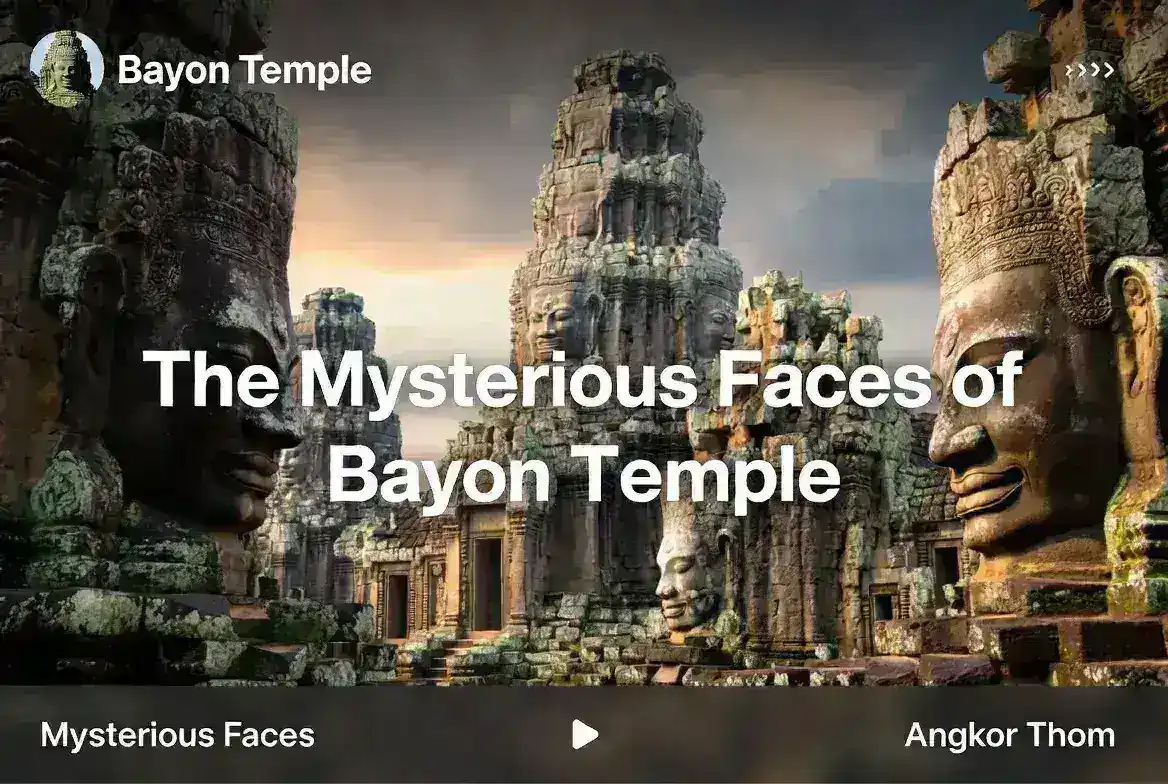
Deep within the ancient city of Angkor Thom in Cambodia stands one of the most enigmatic and captivating temples ever built—Bayon Temple. Unlike any other structure in the Angkor complex, Bayon is famous for its 216 massive stone faces that gaze serenely in all directions from 54 towers. These mysterious visages, carved with subtle smiles and closed eyes, have puzzled archaeologists, historians, and visitors for centuries. Who do these faces represent? What message were they meant to convey? And how did ancient Khmer craftsmen create such masterful expressions nearly 800 years ago?
Built in the late 12th and early 13th centuries by King Jayavarman VII, Bayon Temple represents a dramatic departure from the Hindu temples that preceded it. As a Buddhist temple dedicated to Avalokiteshvara, the bodhisattva of compassion, Bayon reflects the profound spiritual and political transformation of the Khmer Empire under Jayavarman VII's rule. The temple's faces, whether representing the king himself, the bodhisattva, or both, embody the unique fusion of divine authority and compassionate rule that characterized Jayavarman's reign.
This comprehensive guide explores the mysteries of Bayon Temple's faces—their history, symbolism, artistic significance, and the enduring questions that continue to captivate visitors. From the temple's architectural marvels to the latest archaeological theories, discover why these ancient stone faces remain one of the world's most compelling archaeological enigmas.
The History and Construction of Bayon Temple

King Jayavarman VII's Vision
Bayon Temple was constructed during the reign of King Jayavarman VII (1181-1218), one of Cambodia's greatest and most prolific builder-kings. Unlike his predecessors who built Hindu temples dedicated to Shiva or Vishnu, Jayavarman VII was a devout Mahayana Buddhist who commissioned Bayon as the state temple of his new capital city, Angkor Thom.
The construction of Bayon began around 1190 CE and continued into the early 13th century. The temple was built at the exact center of Angkor Thom, symbolizing Mount Meru, the cosmic center of the universe in both Hindu and Buddhist cosmology. Its location at the intersection of the north-south and east-west axes of the city emphasized its importance as the spiritual and political heart of the Khmer Empire.
What makes Bayon particularly remarkable is that it was built relatively quickly compared to other Angkorian temples. The construction employed thousands of workers, artisans, and sculptors who worked simultaneously on different sections of the temple. This rapid construction, combined with subsequent modifications by later kings, has resulted in a complex architectural puzzle that continues to challenge archaeologists today.
Architectural Evolution
Bayon Temple underwent several phases of construction and modification:
First Phase (1190-1200):
- Original construction: Built as a Buddhist temple by Jayavarman VII
- Dedication: Dedicated to Avalokiteshvara, the bodhisattva of compassion
- Design: Featured the iconic face towers and extensive bas-reliefs
- Materials: Primarily sandstone with laterite core
- 👉 Iran Travel Guide: Unveiling the Hidden World Beyond the Headlines
- 👉 Bahrain Food Festival 2026 Ultimate Survival Guide and Tips
- 👉 Holiday Home Restoration Laws and Real Estate Guide for Tourists 2026
Second Phase (Early 13th Century):
- Modifications: Additions and alterations by Jayavarman VIII
- Hindu influence: Some Buddhist imagery replaced with Hindu iconography
- Structural changes: Addition of eastern terrace and libraries
- 👉 Iran Travel Guide: Unveiling the Hidden World Beyond the Headlines
- 👉 Bahrain Food Festival 2026 Ultimate Survival Guide and Tips
- 👉 Holiday Home Restoration Laws and Real Estate Guide for Tourists 2026
Third Phase (13th-14th Century):
- Theravada Buddhism: Adaptations for Theravada Buddhist worship
- Continued use: Temple remained active place of worship
- Modifications: Various additions and alterations
- 👉 Iran Travel Guide: Unveiling the Hidden World Beyond the Headlines
- 👉 Bahrain Food Festival 2026 Ultimate Survival Guide and Tips
- 👉 Holiday Home Restoration Laws and Real Estate Guide for Tourists 2026
The Temple's Layout
Bayon's architectural plan is complex and somewhat irregular compared to other Angkorian temples:
- Outer gallery: Measures 140m x 160m with extensive bas-reliefs
- Inner gallery: Smaller enclosure with additional carvings
- Central sanctuary: Circular arrangement of face towers
- Towers: 54 towers (originally may have been more) with faces
- Orientation: Unusual east-facing orientation
- 👉 Iran Travel Guide: Unveiling the Hidden World Beyond the Headlines
- 👉 Bahrain Food Festival 2026 Ultimate Survival Guide and Tips
- 👉 Holiday Home Restoration Laws and Real Estate Guide for Tourists 2026
The temple lacks a moat and outer wall, which is unusual for a major Angkorian temple. Instead, it relies on the walls and moat of Angkor Thom itself for protection and symbolic boundaries.
The Mysterious Faces: Numbers and Locations

How Many Faces?
One of the most commonly asked questions about Bayon Temple is: how many faces are there? The answer is more complex than one might expect.
Current count:
- Visible faces: Approximately 216 faces remain visible today
- Original number: May have exceeded 250 faces when first built
- Towers: 54 towers, each with faces on four sides (though not all towers have four faces)
- Central towers: The central sanctuary has the largest and most detailed faces
- 👉 Iran Travel Guide: Unveiling the Hidden World Beyond the Headlines
- 👉 Bahrain Food Festival 2026 Ultimate Survival Guide and Tips
- 👉 Holiday Home Restoration Laws and Real Estate Guide for Tourists 2026
The faces are distributed across the temple's towers in a seemingly random pattern, though recent studies suggest there may be a deliberate arrangement based on Buddhist cosmology and the temple's symbolic function.
Where to Find the Best Faces
For visitors seeking the most impressive and well-preserved faces, certain areas of the temple offer superior viewing:
Central Sanctuary:
- Quality: Largest and most detailed faces
- Preservation: Best preserved due to protected location
- Access: Requires climbing steep stairs
- Photography: Best light in early morning and late afternoon
- 👉 Iran Travel Guide: Unveiling the Hidden World Beyond the Headlines
- 👉 Bahrain Food Festival 2026 Ultimate Survival Guide and Tips
- 👉 Holiday Home Restoration Laws and Real Estate Guide for Tourists 2026
Eastern Terrace:
- Features: Several well-preserved face towers
- Access: Easier to reach than central sanctuary
- Views: Good angles for photography
- 👉 Iran Travel Guide: Unveiling the Hidden World Beyond the Headlines
- 👉 Bahrain Food Festival 2026 Ultimate Survival Guide and Tips
- 👉 Holiday Home Restoration Laws and Real Estate Guide for Tourists 2026
Upper Level Galleries:
- Location: Surrounding the central sanctuary
- Faces: Mix of well-preserved and weathered examples
- Context: Can see faces in relation to bas-reliefs
- 👉 Iran Travel Guide: Unveiling the Hidden World Beyond the Headlines
- 👉 Bahrain Food Festival 2026 Ultimate Survival Guide and Tips
- 👉 Holiday Home Restoration Laws and Real Estate Guide for Tourists 2026
Who Do the Faces Represent?

The Great Debate
The identity of the Bayon faces has been one of the most hotly debated topics in Khmer archaeology. Several theories have been proposed over the years:
Theory 1: Avalokiteshvara (Bodhisattva of Compassion)
- Evidence: Temple was originally Buddhist, dedicated to Avalokiteshvara
- Support: Faces display serene, compassionate expression typical of bodhisattva imagery
- Symbolism: Four faces represent bodhisattva's ability to see in all directions
- Scholarly support: Widely accepted by Buddhist scholars
- 👉 Iran Travel Guide: Unveiling the Hidden World Beyond the Headlines
- 👉 Bahrain Food Festival 2026 Ultimate Survival Guide and Tips
- 👉 Holiday Home Restoration Laws and Real Estate Guide for Tourists 2026
Theory 2: King Jayavarman VII
- Evidence: Faces resemble depictions of Jayavarman VII in other carvings
- Political symbolism: King as divine ruler, embodying compassion
- Historical context: Jayavarman VII saw himself as bodhisattva-king
- Support: Supported by some art historians and archaeologists
- 👉 Iran Travel Guide: Unveiling the Hidden World Beyond the Headlines
- 👉 Bahrain Food Festival 2026 Ultimate Survival Guide and Tips
- 👉 Holiday Home Restoration Laws and Real Estate Guide for Tourists 2026
Theory 3: Combination of Both
- Evidence: Faces combine royal and divine characteristics
- Concept: Devaraja (god-king) concept merged with Buddhist ideology
- Interpretation: Jayavarman VII as earthly manifestation of Avalokiteshvara
- Modern consensus: Increasingly accepted by scholars
- 👉 Iran Travel Guide: Unveiling the Hidden World Beyond the Headlines
- 👉 Bahrain Food Festival 2026 Ultimate Survival Guide and Tips
- 👉 Holiday Home Restoration Laws and Real Estate Guide for Tourists 2026
Theory 4: Guardian Deities
- Evidence: Faces positioned to guard the temple and city
- Function: Protective function watching over Angkor Thom
- Symbolism: Four cardinal directions, cosmic protection
- 👉 Iran Travel Guide: Unveiling the Hidden World Beyond the Headlines
- 👉 Bahrain Food Festival 2026 Ultimate Survival Guide and Tips
- 👉 Holiday Home Restoration Laws and Real Estate Guide for Tourists 2026
Facial Features and Expression
The faces at Bayon share distinctive characteristics that contribute to their mysterious appeal:
Eyes:
- Closed or half-closed: Suggesting meditation and inner vision
- Almond-shaped: Typical of Khmer artistic style
- Serene expression: Conveying peace and compassion
- 👉 Iran Travel Guide: Unveiling the Hidden World Beyond the Headlines
- 👉 Bahrain Food Festival 2026 Ultimate Survival Guide and Tips
- 👉 Holiday Home Restoration Laws and Real Estate Guide for Tourists 2026
Mouth:
- Subtle smile: Often called the "Bayon smile"
- Closed lips: Suggesting serenity and control
- Slight upward curve: Enigmatic expression
- 👉 Iran Travel Guide: Unveiling the Hidden World Beyond the Headlines
- 👉 Bahrain Food Festival 2026 Ultimate Survival Guide and Tips
- 👉 Holiday Home Restoration Laws and Real Estate Guide for Tourists 2026
Nose:
- Broad: Typical of Khmer features
- Well-defined: Despite weathering
- 👉 Iran Travel Guide: Unveiling the Hidden World Beyond the Headlines
- 👉 Bahrain Food Festival 2026 Ultimate Survival Guide and Tips
- 👉 Holiday Home Restoration Laws and Real Estate Guide for Tourists 2026
Ears:
- Elongated: Symbol of nobility and enlightenment
- Ornamented: Some faces show ear ornaments
- 👉 Iran Travel Guide: Unveiling the Hidden World Beyond the Headlines
- 👉 Bahrain Food Festival 2026 Ultimate Survival Guide and Tips
- 👉 Holiday Home Restoration Laws and Real Estate Guide for Tourists 2026
Crown/Headdress:
- Elaborate: Some faces wear crowns or headdresses
- Symbolic: Indicating divine or royal status
- 👉 Iran Travel Guide: Unveiling the Hidden World Beyond the Headlines
- 👉 Bahrain Food Festival 2026 Ultimate Survival Guide and Tips
- 👉 Holiday Home Restoration Laws and Real Estate Guide for Tourists 2026
Artistic and Cultural Significance

Khmer Sculptural Mastery
The faces of Bayon represent the pinnacle of Khmer sculptural achievement. The artisans who carved these faces demonstrated extraordinary skill in several areas:
Technical Mastery:
- Material: Sandstone, relatively soft when quarried but hardens with exposure
- Scale: Each face is approximately 2-3 meters tall
- Precision: Remarkable detail despite massive scale
- Consistency: Similar quality across hundreds of faces
- 👉 Iran Travel Guide: Unveiling the Hidden World Beyond the Headlines
- 👉 Bahrain Food Festival 2026 Ultimate Survival Guide and Tips
- 👉 Holiday Home Restoration Laws and Real Estate Guide for Tourists 2026
Artistic Innovation:
- Expression: Move away from rigid, formal poses to more naturalistic expressions
- Individuality: Each face has subtle variations
- Emotion: Conveying compassion and serenity through stone
- Three-dimensionality: Faces carved in high relief, almost free-standing
- 👉 Iran Travel Guide: Unveiling the Hidden World Beyond the Headlines
- 👉 Bahrain Food Festival 2026 Ultimate Survival Guide and Tips
- 👉 Holiday Home Restoration Laws and Real Estate Guide for Tourists 2026
Buddhist Iconography
The faces embody key Buddhist concepts and iconography:
Four Faces:
- Four Noble Truths: Core Buddhist teaching
- Four Directions: Compassion extending in all directions
- Four Brahmaviharas: Loving-kindness, compassion, sympathetic joy, equanimity
- 👉 Iran Travel Guide: Unveiling the Hidden World Beyond the Headlines
- 👉 Bahrain Food Festival 2026 Ultimate Survival Guide and Tips
- 👉 Holiday Home Restoration Laws and Real Estate Guide for Tourists 2026
Compassionate Gaze:
- Avalokiteshvara: Bodhisattva who hears the cries of the world
- Universal compassion: Watching over all beings
- Protection: Guardian of the temple and city
- 👉 Iran Travel Guide: Unveiling the Hidden World Beyond the Headlines
- 👉 Bahrain Food Festival 2026 Ultimate Survival Guide and Tips
- 👉 Holiday Home Restoration Laws and Real Estate Guide for Tourists 2026
Political Symbolism
Beyond religious significance, the faces served important political functions:
- Royal authority: King's presence watching over the city
- Legitimacy: Divine right to rule
- Control: Symbolic surveillance of the kingdom
- Unity: Faces visible from throughout Angkor Thom
- 👉 Iran Travel Guide: Unveiling the Hidden World Beyond the Headlines
- 👉 Bahrain Food Festival 2026 Ultimate Survival Guide and Tips
- 👉 Holiday Home Restoration Laws and Real Estate Guide for Tourists 2026
The Bas-Reliefs: Stories in Stone

Outer Gallery Bas-Reliefs
While the faces are Bayon's most famous feature, the temple's extensive bas-relief galleries provide crucial context for understanding the faces and the temple's purpose:
Historical Scenes:
- Naval battle: Khmer forces against Cham invaders on Tonle Sap Lake
- Land battles: Detailed depictions of warfare
- March to war: Army procession with elephants, horses, and soldiers
- King Jayavarman VII: Depictions of the king in battle and ceremony
- 👉 Iran Travel Guide: Unveiling the Hidden World Beyond the Headlines
- 👉 Bahrain Food Festival 2026 Ultimate Survival Guide and Tips
- 👉 Holiday Home Restoration Laws and Real Estate Guide for Tourists 2026
Daily Life:
- Market scenes: Vendors, customers, daily commerce
- Cooking: Food preparation and cooking methods
- Construction: Building techniques and labor
- Entertainment: Cockfights, games, music
- Childbirth: Rare depiction of childbirth in Khmer art
- 👉 Iran Travel Guide: Unveiling the Hidden World Beyond the Headlines
- 👉 Bahrain Food Festival 2026 Ultimate Survival Guide and Tips
- 👉 Holiday Home Restoration Laws and Real Estate Guide for Tourists 2026
Religious Ceremonies:
- Buddhist rituals: Ceremonies and worship
- Royal ceremonies: Court life and royal functions
- Processions: Religious and royal processions
- 👉 Iran Travel Guide: Unveiling the Hidden World Beyond the Headlines
- 👉 Bahrain Food Festival 2026 Ultimate Survival Guide and Tips
- 👉 Holiday Home Restoration Laws and Real Estate Guide for Tourists 2026
Inner Gallery Bas-Reliefs
The inner gallery features more mythological and religious scenes:
- Creation myths: Hindu and Buddhist cosmology
- Devas and Asuras: Gods and demons
- Churning of Ocean of Milk: Though less prominent than at Angkor Wat
- Buddhist jatakas: Stories of Buddha's previous lives
- 👉 Iran Travel Guide: Unveiling the Hidden World Beyond the Headlines
- 👉 Bahrain Food Festival 2026 Ultimate Survival Guide and Tips
- 👉 Holiday Home Restoration Laws and Real Estate Guide for Tourists 2026
Visiting Bayon Temple: Practical Guide

Best Time to Visit
To experience the faces of Bayon at their most spectacular:
Time of Day:
- Early morning (7:00-9:00 AM): Soft light, fewer crowds, faces illuminated from east
- Late afternoon (3:00-5:00 PM): Warm golden light, dramatic shadows
- Midday: Harsh light, but good for seeing facial details
- 👉 Iran Travel Guide: Unveiling the Hidden World Beyond the Headlines
- 👉 Bahrain Food Festival 2026 Ultimate Survival Guide and Tips
- 👉 Holiday Home Restoration Laws and Real Estate Guide for Tourists 2026
Season:
- Dry season (November-March): Clear skies, best photography conditions
- Wet season (May-October): Dramatic clouds, fewer tourists, lush surroundings
- 👉 Iran Travel Guide: Unveiling the Hidden World Beyond the Headlines
- 👉 Bahrain Food Festival 2026 Ultimate Survival Guide and Tips
- 👉 Holiday Home Restoration Laws and Real Estate Guide for Tourists 2026
Photography Tips
Capturing the faces requires specific techniques:
Equipment:
- Wide-angle lens (16-35mm): For capturing multiple faces and towers
- Telephoto lens (70-200mm): For detail shots of individual faces
- Standard zoom (24-70mm): Versatile for various compositions
- Tripod: Useful for low light in galleries
- 👉 Iran Travel Guide: Unveiling the Hidden World Beyond the Headlines
- 👉 Bahrain Food Festival 2026 Ultimate Survival Guide and Tips
- 👉 Holiday Home Restoration Laws and Real Estate Guide for Tourists 2026
Composition:
- Multiple faces: Frame several faces together for impact
- Single face: Fill the frame with one face for intimacy
- Context: Include temple architecture for scale
- Light: Side lighting emphasizes facial features
- 👉 Iran Travel Guide: Unveiling the Hidden World Beyond the Headlines
- 👉 Bahrain Food Festival 2026 Ultimate Survival Guide and Tips
- 👉 Holiday Home Restoration Laws and Real Estate Guide for Tourists 2026
Settings:
- Aperture: f/8 to f/11 for sharpness throughout
- ISO: Keep low (100-400) for best quality
- Shutter speed: Adjust for lighting conditions
- RAW format: Maximum flexibility in post-processing
- 👉 Iran Travel Guide: Unveiling the Hidden World Beyond the Headlines
- 👉 Bahrain Food Festival 2026 Ultimate Survival Guide and Tips
- 👉 Holiday Home Restoration Laws and Real Estate Guide for Tourists 2026
Exploring the Temple
Recommended route:
- Enter from east: Main entrance through eastern gopura
- Outer gallery: Explore bas-reliefs clockwise
- Inner gallery: Continue to inner bas-reliefs
- Central sanctuary: Climb to upper levels for best faces
- Upper terraces: Explore face towers from different angles
- Eastern terrace: Additional face towers and views
Time needed:
- Minimum: 1.5-2 hours
- Recommended: 3-4 hours
- Photography enthusiasts: Half day or more
- 👉 Iran Travel Guide: Unveiling the Hidden World Beyond the Headlines
- 👉 Bahrain Food Festival 2026 Ultimate Survival Guide and Tips
- 👉 Holiday Home Restoration Laws and Real Estate Guide for Tourists 2026
Conservation and Preservation

Threats to the Faces
The faces of Bayon face numerous threats to their preservation:
Natural Weathering:
- Rain: Erosion from monsoon rains
- Wind: Wind erosion of sandstone
- Temperature: Expansion and contraction from temperature changes
- Vegetation: Roots damaging stone
- 👉 Iran Travel Guide: Unveiling the Hidden World Beyond the Headlines
- 👉 Bahrain Food Festival 2026 Ultimate Survival Guide and Tips
- 👉 Holiday Home Restoration Laws and Real Estate Guide for Tourists 2026
Human Impact:
- Touching: Oils from hands accelerate deterioration
- Vandalism: Graffiti and theft
- Tourism: Wear from millions of visitors
- Pollution: Air pollution affecting stone
- 👉 Iran Travel Guide: Unveiling the Hidden World Beyond the Headlines
- 👉 Bahrain Food Festival 2026 Ultimate Survival Guide and Tips
- 👉 Holiday Home Restoration Laws and Real Estate Guide for Tourists 2026
Conservation Efforts
International teams are working to preserve Bayon Temple:
- APSARA Authority: Cambodian government agency responsible for Angkor
- International partnerships: France, Japan, China, and other countries
- Restoration projects: Ongoing structural stabilization
- Documentation: 3D scanning and digital preservation
- Visitor management: Controlling access to fragile areas
- 👉 Iran Travel Guide: Unveiling the Hidden World Beyond the Headlines
- 👉 Bahrain Food Festival 2026 Ultimate Survival Guide and Tips
- 👉 Holiday Home Restoration Laws and Real Estate Guide for Tourists 2026
The Faces in Popular Culture

Global Icon
The faces of Bayon have become one of the most recognizable images of Southeast Asian archaeology:
- Photography: Featured in countless travel magazines and books
- Film: Appeared in documentaries and feature films
- Art: Inspired countless artists and photographers
- Symbols: Used in logos, advertisements, and design
- 👉 Iran Travel Guide: Unveiling the Hidden World Beyond the Headlines
- 👉 Bahrain Food Festival 2026 Ultimate Survival Guide and Tips
- 👉 Holiday Home Restoration Laws and Real Estate Guide for Tourists 2026
Mystique and Mystery
The enigmatic quality of the faces has captured popular imagination:
- "Smile of Angkor": Often compared to Mona Lisa's smile
- Mystery: Subject of books, articles, and theories
- Spirituality: Attracts spiritual seekers and meditators
- UNESCO: Part of Angkor World Heritage Site
- 👉 Iran Travel Guide: Unveiling the Hidden World Beyond the Headlines
- 👉 Bahrain Food Festival 2026 Ultimate Survival Guide and Tips
- 👉 Holiday Home Restoration Laws and Real Estate Guide for Tourists 2026
Recent Archaeological Discoveries

Ongoing Research
Recent archaeological work has shed new light on Bayon Temple:
LIDAR Surveys:
- Technology: Airborne laser scanning revealing hidden structures
- Discoveries: Previously unknown structures around Bayon
- Urban planning: Better understanding of Angkor Thom layout
- 👉 Iran Travel Guide: Unveiling the Hidden World Beyond the Headlines
- 👉 Bahrain Food Festival 2026 Ultimate Survival Guide and Tips
- 👉 Holiday Home Restoration Laws and Real Estate Guide for Tourists 2026
3D Documentation:
- Digital preservation: Creating detailed 3D models
- Analysis: Studying construction techniques
- Monitoring: Tracking deterioration over time
- 👉 Iran Travel Guide: Unveiling the Hidden World Beyond the Headlines
- 👉 Bahrain Food Festival 2026 Ultimate Survival Guide and Tips
- 👉 Holiday Home Restoration Laws and Real Estate Guide for Tourists 2026
Inscriptions:
- New translations: Ongoing work on temple inscriptions
- Historical context: Better understanding of Jayavarman VII's reign
- Religious practices: Insights into Buddhist practices
- 👉 Iran Travel Guide: Unveiling the Hidden World Beyond the Headlines
- 👉 Bahrain Food Festival 2026 Ultimate Survival Guide and Tips
- 👉 Holiday Home Restoration Laws and Real Estate Guide for Tourists 2026
Conclusion: The Enduring Mystery

The mysterious faces of Bayon Temple continue to captivate and puzzle visitors nearly 800 years after they were carved. Whether they represent Avalokiteshvara, King Jayavarman VII, or a combination of both, these serene visages embody the spiritual and political ideals of one of Southeast Asia's greatest empires.
The faces remind us of the sophistication of Khmer civilization—the artistic mastery, the engineering prowess, and the spiritual depth that created such an enduring monument. As we stand beneath these ancient gazes, we participate in a tradition of wonder and contemplation that has connected visitors to Bayon for centuries.
While modern archaeology has revealed much about Bayon Temple, the faces retain their mystery. Perhaps that is their greatest gift—the ability to inspire wonder, provoke questions, and connect us across time to the people who created them. The smiles of Bayon remain as enigmatic today as they were eight centuries ago, inviting each new generation to discover their own meaning in these timeless stone faces.
When you visit Bayon Temple, take time to look beyond the obvious. Study the subtle variations in each face, contemplate the skill required to create them, and consider the messages they were meant to convey. In doing so, you join the long line of travelers who have found inspiration and mystery in the enigmatic smiles of Bayon.
0 Comments