.webp)
.webp)
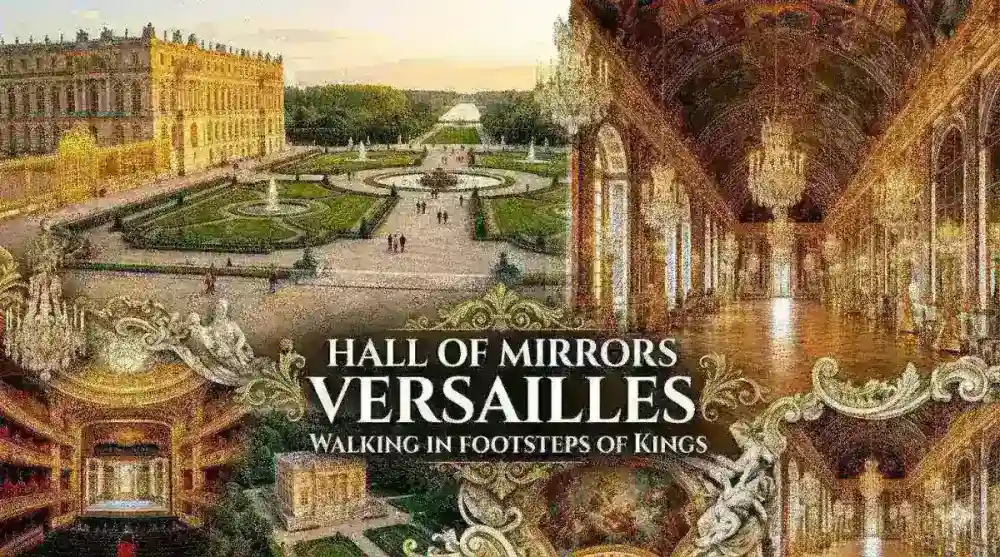
Introduction: The Most Famous Gallery in the World
Step into the Hall of Mirrors at the Palace of Versailles, and you enter a space where history was made, treaties were signed, empires were proclaimed, and the very nature of power was displayed in its most dazzling form. This 73-meter-long gallery, with its 357 mirrors reflecting the light from seventeen arched windows overlooking the gardens, represents not just the pinnacle of French Baroque architecture but one of the most significant spaces in European history.
When Louis XIV's chief architect Jules Hardouin-Mansart completed the Hall of Mirrors in 1684, he created something unprecedented: a gallery that was simultaneously a passageway, a ceremonial space, a work of art, and a political statement. Every element, from Charles Le Brun's ceiling paintings celebrating the Sun King's military victories to the unprecedented use of mirrors (then the most expensive luxury goods in Europe), was designed to overwhelm visitors with the sheer magnitude of French power and royal magnificence.
But the Hall of Mirrors is far more than a beautiful room. It has witnessed events that shaped the modern world: the proclamation of the German Empire in 1871 following France's defeat in the Franco-Prussian War, the signing of the Treaty of Versailles in 1919 that formally ended World War I, and countless royal ceremonies, diplomatic receptions, and court festivities that defined the age of absolute monarchy.
This comprehensive guide explores every aspect of the Hall of Mirrors: its construction and architectural innovation, the artistic program that adorns its walls and ceiling, the historical events that unfolded within its walls, and what visitors can experience today when walking through this extraordinary space. Whether you're planning your first visit to Versailles or seeking deeper understanding of this iconic gallery, you'll discover why the Hall of Mirrors remains one of humanity's greatest artistic and architectural achievements.
The Vision Behind the Gallery: Louis XIV's Masterpiece

To understand the Hall of Mirrors, one must first understand the monarch who commissioned it and the political context that made it necessary. Louis XIV, who reigned from 1643 to 1715, was not content with merely being King of France; he aspired to be the most powerful monarch in Europe, and he understood that power required visible expression.
From Terrace to Gallery
The space occupied by the Hall of Mirrors was originally designed as an open-air terrace, a common feature in Italian Renaissance palaces that allowed residents to enjoy views of the gardens. However, the French climate, with its frequent rain and cool temperatures, made an open terrace impractical for year-round use. More importantly, Louis XIV and his advisors recognized that this central gallery connecting the King's and Queen's apartments represented a missed opportunity for displaying royal power.
In 1678, Louis XIV commissioned Jules Hardouin-Mansart to transform the terrace into an enclosed gallery. The decision was revolutionary: rather than simply creating a covered walkway, Hardouin-Mansart would create a space that celebrated French artistic and technical achievement while simultaneously demonstrating the king's supremacy.
The Mirror Innovation
The most striking feature of the Hall of Mirrors was, and remains, its mirrors. In the 17th century, mirrors were among the most expensive luxury goods in Europe. The Republic of Venice held a near-monopoly on mirror production, and Venetian mirrors were so valuable that the Republic guarded their manufacturing secrets with the threat of death for any artisan who revealed them.
Louis XIV's minister Jean-Baptiste Colbert, determined to break Venice's monopoly and demonstrate French self-sufficiency, recruited Venetian mirror-makers to France in the 1660s. By the time construction began on the Hall of Mirrors, France had established its own mirror manufactory at Saint-Gobain, and French mirrors rivaled Venetian quality.
The decision to use 357 mirrors in the Hall of Mirrors was thus both aesthetic and political. The mirrors reflected light from the windows, making the gallery brighter and more spectacular than any other space in Europe. But they also demonstrated that France could produce luxury goods equal to any in the world, and that Louis XIV's power was so complete that he could command resources that other monarchs could only dream of possessing.
Architectural Innovation
Hardouin-Mansart's design for the Hall of Mirrors represented a synthesis of French classical architecture and baroque spectacle. The gallery measures 73 meters long, 10.5 meters wide, and 12.3 meters high – dimensions that create a sense of grandeur without overwhelming the human scale.
The architectural scheme is deceptively simple: seventeen arched windows on the garden side are mirrored by seventeen arcades containing the mirrors on the opposite wall. The arches are supported by marble pilasters topped with gilt-bronze capitals featuring the royal symbol of the sun and the Gallic rooster. The floor is laid with multicolored marble in geometric patterns, and the ceiling consists of a series of vaults decorated with paintings.
Yet within this seemingly straightforward design, Hardouin-Mansart incorporated numerous innovations. The use of mirrors to reflect the gardens created a visual connection between interior and exterior, making the gallery feel larger and more open. The careful proportioning of the space, based on classical principles, created a sense of harmony and balance. And the integration of architecture, painting, and decorative arts into a unified whole established a new standard for royal interiors.
Charles Le Brun's Artistic Program: Painting the Sun King's Glory

While Hardouin-Mansart designed the architectural framework of the Hall of Mirrors, it was Charles Le Brun who gave the gallery its artistic soul. As Louis XIV's chief painter and director of the Gobelins manufactory, Le Brun was responsible for creating the decorative program that would celebrate the king's achievements and legitimize his absolute power.
The Ceiling Paintings
The ceiling of the Hall of Mirrors features thirty paintings by Charles Le Brun and his workshop, depicting the first eighteen years of Louis XIV's personal reign (1661-1678). The central and largest painting, "The King Governing by Himself," shows Louis XIV personifying the state, surrounded by allegorical figures representing the arts, sciences, and virtues.
The paintings are arranged chronologically, telling the story of Louis XIV's military victories, diplomatic triumphs, and domestic achievements. Scenes include the rebuilding of the Louvre, the establishment of French trading companies, the reform of the judicial system, and numerous military campaigns. Each painting is surrounded by elaborate stucco frames featuring symbols of royal power and allegorical figures.
Le Brun's artistic style perfectly suited the propagandistic purpose of the gallery. His figures are heroic and idealized, his compositions dynamic and dramatic, and his use of color rich and vibrant. The paintings don't merely record events; they interpret them, presenting Louis XIV as a figure of almost divine power whose reign brought glory, prosperity, and order to France.
The Decorative Scheme
Beyond the ceiling paintings, Le Brun designed every aspect of the gallery's decoration. The walls feature pilasters of red marble with gilt-bronze capitals. The arches are decorated with symbols of French military power, including trophies of weapons and armor. The mirror frames are carved and gilded, featuring the royal sun symbol and other emblems of Louis XIV's power.
The overall effect is one of overwhelming splendor. Every surface is decorated, every element is gilded or painted, and every detail contributes to the celebration of royal power. The Hall of Mirrors was designed to be experienced as a total work of art, where architecture, painting, sculpture, and decorative arts combine to create an environment of unprecedented magnificence.
Symbolic Program
Every element of the Hall of Mirrors carries symbolic meaning. The sun motif, appearing throughout the decoration, references Louis XIV's chosen emblem and his identification with Apollo, the sun god. The mirrors themselves symbolize the king's ability to reflect glory and to multiply his presence throughout the palace.
The paintings depicting military victories served a specific political purpose: they reminded visitors that Louis XIV was not merely a ruler but a conqueror, a monarch whose military prowess expanded French territory and established French dominance in Europe. At a time when Versailles was becoming the diplomatic center of Europe, these images served as constant reminders of French power.
Architectural and Technical Marvels

The construction of the Hall of Mirrors represented a triumph of 17th-century engineering and craftsmanship. Creating a gallery of this scale and complexity required innovations in multiple fields, from mirror production to structural engineering to decorative arts.
Mirror Production
The production of the 357 mirrors for the Hall of Mirrors was one of the greatest technical achievements of the project. Each mirror measured approximately 1.5 meters tall – enormous for the period – and required months of skilled labor to produce.
The mirror-making process was complex and dangerous. Artisans created mirrors by coating glass with a mixture of mercury and tin, a process that released toxic fumes and often shortened the lives of the workers. The glass itself had to be perfectly flat and free of bubbles or imperfections, requirements that demanded exceptional skill and quality control.
The Saint-Gobain manufactory, established specifically to produce mirrors for Versailles, employed the finest craftsmen from Venice and France. The mirrors they produced were not only technically superior but also represented French national pride – a demonstration that France could match or exceed the quality of any European luxury good.
Structural Engineering
Building a gallery 73 meters long with large windows on one side and heavy mirrors on the other presented significant structural challenges. Hardouin-Mansart had to ensure that the walls could support the weight of the mirrors while also accommodating the large window openings.
The solution involved careful calculation of load-bearing walls, the use of iron reinforcements (a relatively new technology in the 1670s), and precise engineering of the vaulted ceiling. The gallery had to be stable enough to support not just its own weight but also the crowds of courtiers and visitors who would walk through it daily.
Lighting and Ventilation
The Hall of Mirrors was designed to maximize natural light. The seventeen windows on the garden side allowed daylight to flood the gallery, while the mirrors reflected and multiplied this light, creating a brilliance that was unprecedented in European palace architecture.
However, the gallery also required artificial lighting for evening events. Hundreds of candles in crystal chandeliers and wall sconces provided illumination, though this created challenges with heat, smoke, and fire risk. The gallery's high ceilings and large windows also helped with ventilation, though summer temperatures could still be uncomfortable.
Climate Control
Maintaining the Hall of Mirrors presented ongoing challenges. The mirrors were sensitive to humidity and temperature changes, which could cause the glass to warp or the backing to deteriorate. The marble floors required constant cleaning and polishing. The painted ceiling needed protection from water damage and required periodic restoration.
These maintenance requirements continue to this day, with the Palace of Versailles employing specialized conservators who work constantly to preserve the gallery for future generations.
Ceremonies and Court Life in the Gallery

The Hall of Mirrors was not merely a showcase for royal power; it was a functional space that played a central role in the daily life of the court and in the ceremonial that defined Louis XIV's reign.
Daily Court Life
During Louis XIV's reign, the Hall of Mirrors served as a passageway connecting the King's and Queen's apartments. Courtiers would walk through the gallery as they moved between different parts of the palace, and the gallery thus became a space for social interaction, political maneuvering, and the display of status.
The king himself would walk through the gallery regularly, and courtiers would gather to catch a glimpse of their monarch or to petition him for favors. The gallery thus functioned as a space where the hierarchical nature of court society was constantly reinforced, where proximity to the king was the ultimate measure of status.
Ceremonial Functions
Beyond its role in daily court life, the Hall of Mirrors hosted some of the most important ceremonies of Louis XIV's reign. Royal weddings, diplomatic receptions, and state banquets all took place in the gallery, transforming it from a passageway into a stage for the performance of royal power.
One of the most spectacular uses of the gallery was for evening festivities. The gallery would be illuminated by thousands of candles in crystal chandeliers and wall sconces, creating a magical atmosphere of light and reflection. Musicians would perform, dancers would entertain, and the court would engage in the elaborate social rituals that defined Versailles life.
Diplomatic Receptions
The Hall of Mirrors played a crucial role in French diplomacy. Foreign ambassadors and dignitaries would be received in the gallery, where they would be overwhelmed by its splendor and reminded of French power. The gallery thus functioned as a tool of soft power, using beauty and magnificence to achieve political ends.
Diplomatic ceremonies in the gallery were carefully choreographed to emphasize French supremacy. The route that ambassadors would take through the palace, the timing of their reception, and the exact words exchanged were all calculated to maximize the impact of French royal power.
Historic Events: When History Was Made

While the Hall of Mirrors was designed to celebrate the glory of Louis XIV, it would go on to witness events that the Sun King could never have imagined – events that would shape the course of European and world history.
The Proclamation of the German Empire (1871)
On January 18, 1871, in the aftermath of France's defeat in the Franco-Prussian War, the Hall of Mirrors witnessed a moment of profound national humiliation for France. In this gallery built to celebrate French supremacy, the German princes proclaimed the establishment of the German Empire, with King Wilhelm I of Prussia as Emperor.
The choice of location was deliberate and symbolic. By proclaiming the German Empire in the Hall of Mirrors, the Germans were not just celebrating their victory; they were asserting their dominance over France and reversing the power dynamic that had existed since the time of Louis XIV. For the French, this was a bitter pill to swallow – the space that had celebrated French glory now witnessed French defeat.
The Treaty of Versailles (1919)
On June 28, 1919, the Hall of Mirrors once again became the stage for a historic event, though this time the symbolism was reversed. The Treaty of Versailles, formally ending World War I, was signed in the very gallery where the German Empire had been proclaimed forty-eight years earlier.
For France, this was a moment of vindication. The treaty imposed harsh penalties on Germany, including territorial losses, military restrictions, and massive reparations. By signing the treaty in the Hall of Mirrors, France was asserting its victory and, in a sense, avenging the humiliation of 1871.
The ceremony was carefully staged. The table where the treaty was signed was placed in front of the central window, and the German delegates were required to walk through the gallery, past the assembled representatives of the Allied powers, to sign the document. Every detail was calculated to emphasize German defeat and Allied victory.
Other Historic Moments
Beyond these two defining events, the Hall of Mirrors has witnessed numerous other moments of historical significance. Royal weddings, state funerals, diplomatic negotiations, and political ceremonies have all taken place in the gallery, making it one of the most historically significant spaces in Europe.
In more recent times, the gallery has hosted state visits by foreign leaders, including addresses to the French Parliament by foreign heads of state. Each event adds another layer to the gallery's rich history, ensuring that it remains not just a monument to the past but a living space where history continues to be made.
Preservation and Restoration Challenges

Maintaining the Hall of Mirrors for future generations presents enormous challenges. The gallery is over 340 years old, and the ravages of time, combined with the impact of millions of visitors, require constant attention and care.
Environmental Challenges
The Hall of Mirrors is particularly vulnerable to environmental damage. Fluctuations in temperature and humidity can cause the mirrors to warp or deteriorate, the marble to crack, and the paintings to flake. The gallery's large windows, while beautiful, expose the interior to UV radiation that can fade paintings and damage decorative elements.
Climate control is essential but challenging. The gallery must be kept at a stable temperature and humidity level, but it also receives thousands of visitors daily, whose body heat and breath affect the environment. Modern HVAC systems help maintain stable conditions, but balancing preservation needs with visitor comfort is an ongoing challenge.
Visitor Impact
With over 7 million visitors annually, the Hall of Mirrors faces enormous wear and tear. The marble floors show signs of erosion from foot traffic, the mirrors require regular cleaning to remove fingerprints and condensation, and the decorative elements need constant monitoring for damage.
The Palace of Versailles has implemented various measures to protect the gallery while maintaining public access. These include limiting the number of visitors in the gallery at any one time, installing protective barriers where appropriate, and using advanced monitoring systems to detect early signs of deterioration.
Restoration Projects
Major restoration projects have been undertaken to preserve the Hall of Mirrors for future generations. The most recent major restoration, completed in 2007, involved cleaning the ceiling paintings, restoring the decorative elements, and repairing the mirrors. The project cost over €12 million and took several years to complete.
Restoration work must balance the need to preserve original materials with the need to maintain the gallery's appearance and structural integrity. Conservators use the most advanced techniques available, from laser cleaning of paintings to microscopic analysis of materials, to ensure that restoration work is both effective and reversible.
Ongoing Maintenance
Beyond major restoration projects, the Hall of Mirrors requires daily maintenance. Specialized conservators monitor the condition of the paintings, mirrors, marble, and decorative elements. Cleaning must be done carefully to avoid damage, and any signs of deterioration must be addressed immediately.
The gallery's chandeliers, featuring thousands of crystal drops, require regular cleaning and maintenance. The mirrors must be cleaned using specialized techniques that avoid damaging the delicate backing. The marble floors must be polished and protected from wear.
Visiting the Hall of Mirrors: A Practical Guide

For visitors planning to experience the Hall of Mirrors, proper preparation can greatly enhance the experience. Here's everything you need to know:
Best Time to Visit
Time of Day:
- Early Morning: Arrive when the palace opens (9:00 AM) to see the Hall of Mirrors before crowds arrive. The morning light streaming through the windows creates spectacular reflections.
- Late Afternoon: Visit after 4:00 PM when crowds begin to thin. The afternoon light creates different reflections and a warmer atmosphere.
- Avoid: Midday (11:00 AM - 3:00 PM) when crowds are heaviest and it's most difficult to appreciate the space or take photographs.
- 👉 Brno 2026: Europe's Top Destination - Architecture, Food, Fewer Crowds
- 👉 Switzerland ETIAS 2026: New Entry Rules for USA and UK Citizens
- 👉 ETIAS Hungary 2026: Mandatory for US & UK Travelers
Time of Year:
- Spring (April-June): Pleasant weather, gardens in bloom, moderate crowds
- Fall (September-October): Beautiful light, fewer crowds, comfortable temperatures
- Winter (November-March): Fewest crowds, but shorter days and less natural light
- Summer (July-August): Peak crowds, longest days, but expect significant crowds
- 👉 Brno 2026: Europe's Top Destination - Architecture, Food, Fewer Crowds
- 👉 Switzerland ETIAS 2026: New Entry Rules for USA and UK Citizens
- 👉 ETIAS Hungary 2026: Mandatory for US & UK Travelers
Ticket Information
Admission:
- Palace Ticket: €21 (includes Hall of Mirrors, State Apartments, and temporary exhibitions)
- Passport Ticket: €29 (includes entire estate: palace, Trianon estates, and gardens on fountain show days)
- Free Admission: Under 18, EU residents under 26, disabled visitors and one companion
- First Sunday: Free palace admission (November-March only), but expect massive crowds
- 👉 Brno 2026: Europe's Top Destination - Architecture, Food, Fewer Crowds
- 👉 Switzerland ETIAS 2026: New Entry Rules for USA and UK Citizens
- 👉 ETIAS Hungary 2026: Mandatory for US & UK Travelers
Booking:
- Online Booking: Strongly recommended to skip ticket office lines
- Timed Entry: Choose a specific entry time to avoid waiting
- Audio Guide: Included with palace ticket; highly recommended for context
- 👉 Brno 2026: Europe's Top Destination - Architecture, Food, Fewer Crowds
- 👉 Switzerland ETIAS 2026: New Entry Rules for USA and UK Citizens
- 👉 ETIAS Hungary 2026: Mandatory for US & UK Travelers
Photography Tips
Photographing the Hall of Mirrors is challenging but rewarding:
- No Flash: Flash photography is prohibited to protect the paintings and mirrors
- Wide-Angle Lens: Essential for capturing the full length of the gallery
- Early or Late: Best light and fewest people for photography
- Reflections: Use the mirrors creatively to capture unique perspectives
- Ceiling Details: Bring a lens that can capture ceiling painting details
- Patience: Wait for crowds to clear for clean shots
- 👉 Brno 2026: Europe's Top Destination - Architecture, Food, Fewer Crowds
- 👉 Switzerland ETIAS 2026: New Entry Rules for USA and UK Citizens
- 👉 ETIAS Hungary 2026: Mandatory for US & UK Travelers
What to Expect
Crowds: The Hall of Mirrors is the most visited space in Versailles. Expect crowds, especially during peak season and midday. Be patient and move slowly through the gallery.
Time to Spend: Plan to spend 20-30 minutes in the Hall of Mirrors to appreciate the architecture, paintings, and decorative elements. Rushing through diminishes the experience.
Accessibility: The Hall of Mirrors is accessible to visitors with reduced mobility. Elevators are available, and the marble floor is smooth and level.
Facilities: Restrooms are located near the entrance to the palace. There are no facilities within the Hall of Mirrors itself.
The Hall of Mirrors in Popular Culture

The Hall of Mirrors has transcended its historical significance to become an icon of French culture and a symbol of royal opulence recognized worldwide.
Film and Television
The Hall of Mirrors has appeared in numerous films and television productions, from historical dramas to fantasy films. Its spectacular appearance makes it a favorite location for filmmakers seeking to convey luxury, power, and historical grandeur.
Notable appearances include films about Marie Antoinette, Louis XIV, and various historical dramas. The gallery's visual impact is so powerful that it often becomes a character in its own right, representing the excess and glory of the French monarchy.
Literature and Art
Writers and artists have been inspired by the Hall of Mirrors for centuries. The gallery appears in historical novels, poetry, and paintings, often serving as a symbol of absolute power, artistic achievement, or the transience of glory.
The mirrors themselves have become a metaphor for reflection, self-examination, and the multiplication of images – themes that resonate in our modern age of social media and digital reproduction.
Modern Symbolism
Today, the Hall of Mirrors serves multiple symbolic functions. For France, it represents national heritage and artistic achievement. For the world, it represents the pinnacle of baroque architecture and the height of royal absolutism. For visitors, it offers a tangible connection to history and a reminder of both human creativity and human folly.
Conclusion: A Timeless Testament to Power and Beauty

The Hall of Mirrors at Versailles is far more than a beautiful gallery. It is a space where art, architecture, politics, and history converge to create something truly extraordinary. From its construction under Louis XIV to its role in shaping modern European history, from its artistic splendor to its ongoing preservation challenges, the Hall of Mirrors continues to captivate and inspire.
Walking through the Hall of Mirrors today, surrounded by the reflections of mirrors and the paintings of Charles Le Brun, one can almost hear the echoes of history: the footsteps of courtiers in their silk slippers, the music of court festivities, the solemn words of treaty signings, and the whispers of countless visitors who have marveled at this space over the centuries.
The Hall of Mirrors reminds us of the heights human creativity can reach when backed by unlimited resources and absolute power. It also reminds us of the transience of that power – Louis XIV's absolute monarchy is long gone, but his gallery remains, continuing to inspire awe and wonder.
For visitors, the Hall of Mirrors offers more than just a photo opportunity or a historical lesson. It offers a moment of transcendence, a chance to stand in a space where history was made and to contemplate the complex interplay of beauty, power, and human ambition. Whether you're a history enthusiast, an architecture lover, an art aficionado, or simply a curious traveler, the Hall of Mirrors deserves a place on your list of must-see destinations.
As you walk through this extraordinary gallery, take time to look beyond the surface splendor. Contemplate the skill of the craftsmen who created it, the political ambitions that drove its construction, the historical events it witnessed, and the ongoing efforts to preserve it for future generations. In doing so, you'll gain a deeper appreciation for why the Hall of Mirrors remains, after more than three centuries, one of the world's most magnificent spaces – a true testament to the zenith of French royal opulence.
0 Comments