.webp)
.webp)
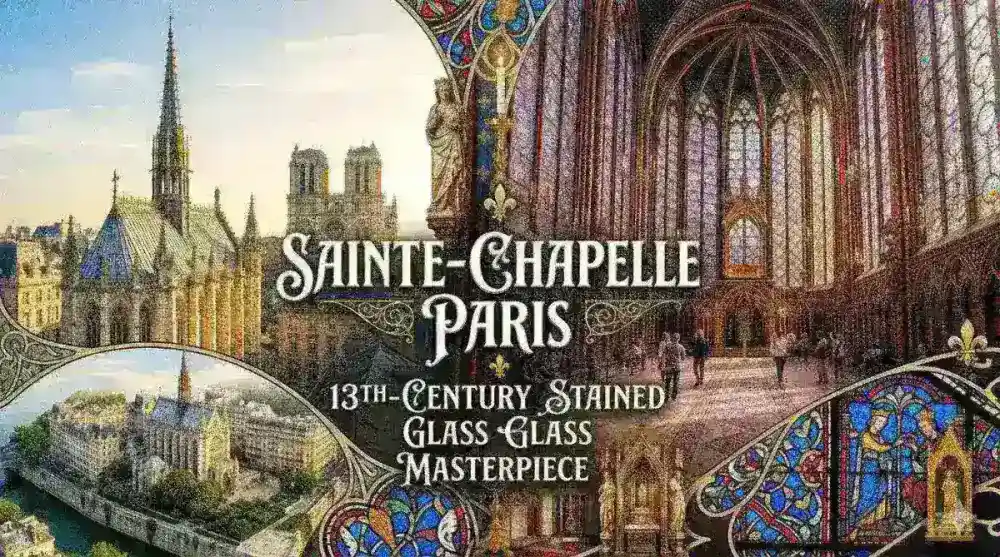
Introduction: A Jewel Box of Light and Faith
Tucked within the confines of the former royal palace on Paris's Île de la Cité, Sainte-Chapelle stands as one of the most extraordinary achievements of Gothic architecture and one of the world's most breathtaking displays of stained glass. Built in the mid-13th century by King Louis IX (later Saint Louis) to house precious Christian relics, including the Crown of Thorns, this intimate royal chapel was designed not merely as a place of worship but as a reliquary on a monumental scale – a stone and glass container for sacred treasures that would elevate the French monarchy and affirm Paris as a new Jerusalem.
Step inside the Upper Chapel, and you enter a space unlike any other: walls that seem to dissolve into 15-meter-high sheets of colored light, where 1,113 individual scenes from the Bible unfold across 6,458 square feet of stained glass, where slender stone columns rise like palm trees to support a vaulted ceiling painted with stars, and where sunlight transforms the interior into a kaleidoscope of blues, reds, and golds that has moved visitors to tears for nearly eight centuries.
Sainte-Chapelle represents the zenith of the Rayonnant Gothic style, an architectural movement that emphasized light, verticality, and the dematerialization of stone in favor of glass. Every element of the chapel's design – from the slender columns that minimize structural intrusion to the intricate tracery that holds the glass in place to the carefully orchestrated narrative program of the windows – serves a single purpose: to create an earthly vision of the Heavenly Jerusalem, a space where the divine could be experienced through the transcendent beauty of light and color.
This comprehensive guide explores every aspect of Sainte-Chapelle: the historical context that led to its construction, the extraordinary stained glass windows that define its character, the architectural innovations that made such a vision possible, the relics that inspired its creation, and practical information for experiencing this Gothic masterpiece today. Whether you're a lover of medieval art, a student of Gothic architecture, a person of faith, or simply someone who appreciates beauty in any form, you'll discover why Sainte-Chapelle remains one of Paris's most magical and essential destinations.
The Vision of Saint Louis: Why Sainte-Chapelle Was Built

To understand Sainte-Chapelle, one must first understand the king who commissioned it and the religious and political ambitions that drove its creation. Louis IX, who reigned from 1226 to 1270, was one of medieval Europe's most pious and capable monarchs. His deep personal faith, commitment to justice, and military leadership (including two crusades) would eventually lead to his canonization in 1297, just 27 years after his death.
The Relics That Inspired a Masterpiece
In 1238, Louis IX acquired what he believed to be the Crown of Thorns placed on Christ's head during the Passion, purchasing it from Baldwin II, the Latin Emperor of Constantinople, who needed funds to defend his crumbling empire. This acquisition was followed by other precious relics, including fragments of the True Cross and the Holy Lance. For Louis, these were not mere curiosities but sacred treasures that connected France directly to the life of Christ and affirmed the French monarchy's divine favor.
But relics required an appropriate setting. The existing royal chapel on the Île de la Cité was inadequate for housing such precious objects and for the elaborate liturgical ceremonies Louis envisioned. In 1241, the king commissioned the construction of a new chapel that would serve as both a sanctuary for the relics and a statement of royal piety and power.
Political and Spiritual Ambitions
Sainte-Chapelle served multiple purposes beyond housing relics. Politically, it affirmed Paris as a new center of Christian devotion, rivaling Constantinople and Rome. By bringing the most sacred relics of Christendom to France, Louis positioned himself as the most Christian king and Paris as a new Jerusalem. The chapel became a symbol of Capetian legitimacy and divine favor, reinforcing the monarchy's authority in an age when religious and political power were inseparable.
Spiritually, Sainte-Chapelle was designed to facilitate a direct encounter with the divine. The extensive stained glass program, depicting the entire biblical narrative from Genesis to the resurrection of Christ, was intended to educate and inspire the royal family and court, many of whom were illiterate. The windows served as a "Bible in glass," making sacred history visible and immediate.
Construction and Consecration
Construction began around 1242 and was completed with remarkable speed – the chapel was consecrated on April 26, 1248. This rapid construction (just six years for such a complex building) reflects both the urgency of Louis's vision and the extraordinary resources devoted to the project. The master mason and designer remain unknown, though scholars attribute the work to a team of highly skilled craftsmen working under royal patronage.
The cost was enormous: contemporary accounts suggest the chapel cost approximately 40,000 livres, roughly equivalent to one-third of Louis IX's annual revenue. This investment underscores the chapel's importance to the king's vision of sacred monarchy.
Architectural Innovation: The Rayonnant Gothic Masterpiece

Sainte-Chapelle represents the purest expression of Rayonnant Gothic architecture, a style that emerged in France in the mid-13th century and emphasized light, verticality, and the dissolution of solid walls in favor of glass. Understanding the chapel's architectural innovations helps explain how such an extraordinary vision of light and color was made possible.
Two-Level Design
Sainte-Chapelle consists of two chapels stacked vertically, each serving a distinct function:
The Lower Chapel (Chapelle Basse): Dedicated to the Virgin Mary, this more intimate space served the palace staff and lower-ranking members of the royal household. Though smaller and less elaborate than the Upper Chapel, it features beautiful vaulted ceilings painted with stars, delicate columns, and stained glass windows depicting scenes from the life of the Virgin and apocalyptic visions. The Lower Chapel demonstrates that even the "secondary" space in Sainte-Chapelle was executed with extraordinary artistry.
The Upper Chapel (Chapelle Haute): This is the chapel's crowning achievement, the space designed to house the sacred relics and accommodate the royal family and high court. Measuring 36 meters long, 17 meters wide, and 20.5 meters high, the Upper Chapel creates an overwhelming sense of verticality and light. The walls are almost entirely composed of stained glass, with stone reduced to slender columns and delicate tracery.
The Dematerialization of Stone
What makes Sainte-Chapelle architecturally revolutionary is the extent to which stone has been minimized in favor of glass. The walls of the Upper Chapel are approximately 75% stained glass – an unprecedented proportion for the 13th century. This was achieved through several innovations:
- Slender Columns: The chapel's structural support comes from slender, clustered columns that rise from the floor to the vaulted ceiling, minimizing visual obstruction and creating a sense of weightlessness
- Iron Armature: An innovative iron framework supports the stained glass panels, allowing for larger windows and more delicate tracery than stone alone could support
- Pointed Arches and Ribbed Vaults: These Gothic innovations distribute weight efficiently, allowing walls to be opened up for glass
- Tracery: The intricate stone patterns that divide the windows are not merely decorative but structural, holding the glass in place while creating elegant geometric designs
- 👉 Oulu European Capital of Culture 2026: Complete guide to events, art trails, and festivals.
- 👉 First-Time Travelers Guide to Navigating Tallinn Helsinki Ferry Lines
- 👉 Tara National Park Coolcation: Serbia's 2026 Summer Escape
The Stained Glass Program
The Upper Chapel's 15 stained glass windows, each approximately 15 meters high, contain 1,113 individual scenes depicting the biblical narrative from Genesis to the resurrection of Christ. The windows are organized thematically and chronologically:
- North Wall: Scenes from Genesis, Exodus, and the early history of Israel
- South Wall: The life of Christ, from the Annunciation to the Resurrection
- East Wall (Apse): The Passion of Christ and the Apocalypse, culminating in the great rose window depicting the End Times
- 👉 Oulu European Capital of Culture 2026: Complete guide to events, art trails, and festivals.
- 👉 First-Time Travelers Guide to Navigating Tallinn Helsinki Ferry Lines
- 👉 Tara National Park Coolcation: Serbia's 2026 Summer Escape
The windows were designed to be "read" sequentially, guiding viewers through sacred history and culminating in the relics housed in the chapel's elaborate reliquary shrine (now lost, but reconstructed in modern times). This narrative program transformed the chapel into a three-dimensional Bible, where architecture, glass, and liturgy combined to create an immersive spiritual experience.
Color and Light
The stained glass of Sainte-Chapelle is renowned for its extraordinary color, particularly its deep, luminous blues – often called "Sainte-Chapelle blue." This color was achieved using cobalt oxide, a rare and expensive pigment that produced an intense, jewel-like hue. The glassmakers also employed a technique called "silver stain," applying silver compounds to the glass before firing to create yellow and gold tones.
The chapel's orientation was carefully calculated to maximize the impact of natural light. The large windows on the south and east sides catch the morning and midday sun, flooding the interior with colored light that changes throughout the day. On a sunny morning, the Upper Chapel becomes a space of almost supernatural beauty, where stone seems to dissolve and visitors are surrounded by a luminous vision of sacred history.
The Stained Glass: A Biblical Narrative in Color and Light

The stained glass windows of Sainte-Chapelle are not merely decorative; they are a sophisticated theological program that tells the story of salvation history and affirms the divine legitimacy of the French monarchy. Understanding the windows' content and symbolism deepens appreciation of this extraordinary artistic achievement.
Technical Mastery
Creating the stained glass of Sainte-Chapelle required extraordinary skill and resources. Each window consists of hundreds of individual pieces of colored glass, cut to precise shapes and held together by lead cames (strips). The glass was colored by adding metallic oxides during production: cobalt for blue, copper for red and green, manganese for purple, and antimony for yellow.
Painters then added details – faces, hands, inscriptions – using a mixture of iron oxide and ground glass, which was fired onto the surface. This technique allowed for remarkable detail and expression within the constraints of the medium. The result is a visual language that is both decorative and narrative, capable of conveying complex theological ideas through image and color.
Key Windows and Scenes
While every window rewards close attention, several stand out for their artistic quality and theological significance:
The Genesis Window: Located on the north wall, this window depicts the creation of the world, the fall of Adam and Eve, and the early history of humanity. The vibrant blues and greens create a vision of paradise lost, while the sequential panels guide viewers through the foundational stories of the Judeo-Christian tradition.
The Life of Christ Window: On the south wall, this window presents the Gospel narrative from the Annunciation to the Resurrection. The central panels depicting Christ's ministry and Passion are particularly powerful, using rich reds and golds to convey the drama and significance of these events.
The Passion and Apocalypse Windows: Located in the apse, these windows culminate the chapel's narrative program. The Passion scenes depict Christ's suffering and death with extraordinary emotional intensity, while the Apocalypse window presents a vision of the End Times and the triumph of Christ. The great rose window above, added in the 15th century, depicts the Apocalypse in radiant detail.
The Relic Window: One window specifically depicts the translation of the relics to Sainte-Chapelle, showing Louis IX and his brother Robert of Artois carrying the Crown of Thorns in procession. This window affirms the chapel's purpose and the king's role as protector of sacred treasures.
Symbolism and Royal Ideology
The stained glass program serves not only to educate and inspire but also to affirm the divine legitimacy of the French monarchy. Several windows draw parallels between biblical kings and the Capetian dynasty, presenting Louis IX as a new Solomon or David, a ruler chosen by God to protect sacred relics and govern with justice.
The fleur-de-lis, the symbol of the French monarchy, appears throughout the windows, subtly reinforcing the connection between sacred history and royal authority. The overall effect is to position Sainte-Chapelle – and by extension, the French monarchy – at the center of God's plan for human salvation.
Preservation and Restoration: Keeping the Light Alive

The extraordinary stained glass of Sainte-Chapelle has survived nearly 800 years, but not without significant challenges. Understanding the chapel's preservation history helps explain both the remarkable condition of the windows and the ongoing efforts to protect them for future generations.
Historical Threats
Sainte-Chapelle faced numerous threats over the centuries:
- The French Revolution: In the 1790s, the chapel was repurposed as a grain store and government office. The relics were dispersed, and the elaborate reliquary shrine was melted down for its gold. Fortunately, the stained glass was largely spared, though some panels were damaged or removed.
- Environmental Damage: Centuries of exposure to weather, pollution, and temperature fluctuations took a toll on the glass and its supporting structures.
- World War II: The chapel was damaged during the war, and some windows were removed for protection, though most survived intact.
- 👉 Oulu European Capital of Culture 2026: Complete guide to events, art trails, and festivals.
- 👉 First-Time Travelers Guide to Navigating Tallinn Helsinki Ferry Lines
- 👉 Tara National Park Coolcation: Serbia's 2026 Summer Escape
Major Restoration Projects
Several major restoration campaigns have ensured the chapel's survival:
19th-Century Restoration: Under the direction of Eugène Viollet-le-Duc, the chapel underwent extensive restoration in the 1840s-1850s. While Viollet-le-Duc's approach was sometimes heavy-handed by modern standards, his work saved the chapel from further deterioration and restored many damaged elements.
20th-Century Conservation: More recent restoration efforts have focused on careful conservation rather than reconstruction. Advanced techniques, including laser cleaning and microscopic analysis, allow conservators to remove grime and repair damage without compromising the original glass.
Recent Work (2008-2014): A comprehensive restoration campaign cleaned the stained glass, repaired structural elements, and improved climate control to protect the windows from environmental damage. This project revealed colors and details that had been obscured by centuries of grime, allowing visitors to experience the windows closer to their original splendor.
Ongoing Challenges
Preserving Sainte-Chapelle's stained glass remains an ongoing challenge:
- Light Exposure: While natural light is essential to the chapel's effect, prolonged exposure can fade colors and weaken glass. Careful monitoring and climate control help mitigate this risk.
- Pollution: Urban pollution can deposit grime on the glass, requiring regular cleaning. Modern air filtration systems help reduce this problem.
- Structural Integrity: The iron armature that supports the glass requires regular inspection and maintenance to prevent corrosion and ensure stability.
- Visitor Impact: With over 1 million visitors annually, managing foot traffic and environmental conditions within the chapel is essential to preserving this fragile masterpiece.
- 👉 Oulu European Capital of Culture 2026: Complete guide to events, art trails, and festivals.
- 👉 First-Time Travelers Guide to Navigating Tallinn Helsinki Ferry Lines
- 👉 Tara National Park Coolcation: Serbia's 2026 Summer Escape
Visiting Sainte-Chapelle: Practical Information

Experiencing Sainte-Chapelle requires some planning to make the most of this extraordinary space. Here's everything you need to know:
Location and Access
Address: 8 Boulevard du Palais, 75001 Paris (within the Conciergerie complex on the Île de la Cité)
Metro: Lines 1, 4, 7, 11, 14 to Châtelet; Line 4 to Cité; Line 10 to Cluny-La Sorbonne
RER: Lines B, C to Saint-Michel-Notre-Dame
Walking: The chapel is a short walk from Notre-Dame Cathedral and easily accessible from the Left or Right Bank
Opening Hours
- April-September: 9:00 AM - 7:00 PM daily
- October-March: 9:00 AM - 5:00 PM daily
- Closed: January 1, May 1, and December 25
- Last entry: 45 minutes before closing
- 👉 Oulu European Capital of Culture 2026: Complete guide to events, art trails, and festivals.
- 👉 First-Time Travelers Guide to Navigating Tallinn Helsinki Ferry Lines
- 👉 Tara National Park Coolcation: Serbia's 2026 Summer Escape
Admission Prices (2026)
- Full Price: €12.50 (includes access to both Upper and Lower Chapels)
- Reduced Price: €10 (for EU residents under 26, teachers, large families)
- Free Admission: Under 18, EU residents under 26, disabled visitors and one companion, first Sunday of January, February, March, November, and December
- Combined Ticket: €18.50 for Sainte-Chapelle + Conciergerie
- Paris Museum Pass: Accepted; allows skip-the-line entry
- 👉 Oulu European Capital of Culture 2026: Complete guide to events, art trails, and festivals.
- 👉 First-Time Travelers Guide to Navigating Tallinn Helsinki Ferry Lines
- 👉 Tara National Park Coolcation: Serbia's 2026 Summer Escape
Tickets and Skip-the-Line Strategies
Sainte-Chapelle is one of Paris's most popular attractions, and lines can be long. Strategies to avoid waiting:
- Book Online: Purchase timed-entry tickets in advance at the official website. This is the most reliable way to skip the ticket line.
- Visit Early or Late: Arrive at opening (9:00 AM) or late afternoon to avoid peak crowds. Morning light is particularly spectacular in the Upper Chapel.
- Weekday Visits: Tuesday-Thursday are typically less crowded than weekends.
- Use the Museum Pass: The Paris Museum Pass includes entry and allows use of the pass-holder entrance.
- Avoid Free Days: Free admission days draw massive crowds; visit on a paid day if possible.
- 👉 Oulu European Capital of Culture 2026: Complete guide to events, art trails, and festivals.
- 👉 First-Time Travelers Guide to Navigating Tallinn Helsinki Ferry Lines
- 👉 Tara National Park Coolcation: Serbia's 2026 Summer Escape
Best Time to Experience the Stained Glass
The impact of Sainte-Chapelle's stained glass depends dramatically on natural light:
- Sunny Mornings (9:00-11:00 AM): The east-facing windows catch the morning sun, creating the most spectacular display of colored light. This is the ideal time for photography and for experiencing the chapel's full effect.
- Midday: Light is brightest but can create harsh contrasts; the chapel is also most crowded.
- Late Afternoon: Softer light and fewer crowds create a more contemplative atmosphere, though the windows may appear less vibrant.
- Overcast Days: While the windows will appear less brilliant, the diffused light can reveal details and colors that bright sun obscures.
- 👉 Oulu European Capital of Culture 2026: Complete guide to events, art trails, and festivals.
- 👉 First-Time Travelers Guide to Navigating Tallinn Helsinki Ferry Lines
- 👉 Tara National Park Coolcation: Serbia's 2026 Summer Escape
Photography Rules
- Personal Photography: Allowed without flash or tripods
- Flash: Prohibited to protect the stained glass
- Tripods: Not permitted due to space constraints and crowd management
- Commercial Use: Requires advance permission
- Tips: Visit on a sunny morning for the best light; use a polarizing filter to reduce glare; be mindful of other visitors
- 👉 Oulu European Capital of Culture 2026: Complete guide to events, art trails, and festivals.
- 👉 First-Time Travelers Guide to Navigating Tallinn Helsinki Ferry Lines
- 👉 Tara National Park Coolcation: Serbia's 2026 Summer Escape
What to Expect During Your Visit
- Security: All visitors pass through airport-style security; allow extra time
- Audio Guide: Available for €5; provides valuable context for understanding the stained glass and history
- Duration: Allow 45-60 minutes to fully appreciate both chapels
- Accessibility: The Lower Chapel is wheelchair accessible; the Upper Chapel requires climbing a narrow spiral staircase (not accessible)
- Facilities: Restrooms available; no food or drink permitted inside the chapel
- 👉 Oulu European Capital of Culture 2026: Complete guide to events, art trails, and festivals.
- 👉 First-Time Travelers Guide to Navigating Tallinn Helsinki Ferry Lines
- 👉 Tara National Park Coolcation: Serbia's 2026 Summer Escape
Enhancing Your Visit: Tips for Appreciating Sainte-Chapelle

To deepen your appreciation of Sainte-Chapelle's extraordinary stained glass, consider these strategies:
Start with the Lower Chapel
Begin your visit in the Lower Chapel. Though smaller and less elaborate than the Upper Chapel, it provides important context: you'll see how Gothic architecture works on a more intimate scale, and you'll appreciate the contrast when you ascend to the luminous splendor above.
Take Time to "Read" the Windows
The stained glass tells a story. Rather than rushing through, take time to follow the narrative panels, identifying key scenes and noticing how color and composition convey meaning. The audio guide can help you understand the theological program and historical context.
Look Up
Don't miss the vaulted ceiling of the Upper Chapel, painted deep blue with golden stars. This celestial canopy completes the chapel's vision of the Heavenly Jerusalem, where earth and heaven meet in a space of transcendent beauty.
Visit on a Sunny Day If Possible
While Sainte-Chapelle is beautiful in any light, a sunny morning transforms the Upper Chapel into an experience of almost supernatural beauty. If your schedule allows, plan your visit for a clear morning to experience the stained glass at its most spectacular.
Combine with Nearby Sites
Sainte-Chapelle is located within the former royal palace complex on the Île de la Cité. Consider combining your visit with:
- The Conciergerie: The former palace's medieval halls and the prison where Marie Antoinette was held
- Notre-Dame Cathedral: A short walk away; currently under restoration but exterior views are spectacular
- The Île de la Cité: Explore the historic heart of Paris, including the Square du Vert-Galant and nearby bridges
- 👉 Oulu European Capital of Culture 2026: Complete guide to events, art trails, and festivals.
- 👉 First-Time Travelers Guide to Navigating Tallinn Helsinki Ferry Lines
- 👉 Tara National Park Coolcation: Serbia's 2026 Summer Escape
Conclusion: A Timeless Vision of Light and Faith

Sainte-Chapelle represents one of humanity's most extraordinary achievements in art, architecture, and spiritual expression. Built nearly 800 years ago to house sacred relics and affirm the divine legitimacy of the French monarchy, this intimate Gothic chapel continues to move visitors with its transcendent beauty and profound vision.
The stained glass windows of Sainte-Chapelle are more than decorative elements; they are a theological program, a narrative of salvation history, and a demonstration of the transformative power of light and color. When sunlight streams through these 13th-century panels, the stone walls seem to dissolve, and visitors are surrounded by a luminous vision that bridges the earthly and the divine. In an age of digital screens and artificial light, the experience of Sainte-Chapelle reminds us of the unique power of natural light filtered through human artistry to create moments of wonder and transcendence.
But Sainte-Chapelle is not merely a relic of the past. It remains a living space of worship, culture, and contemplation. Regular concerts of sacred and classical music take advantage of the chapel's extraordinary acoustics, creating experiences that combine visual and auditory beauty. The chapel continues to inspire artists, architects, and visitors who seek to understand how beauty can elevate the human spirit.
For those who visit, Sainte-Chapelle offers more than a tourist attraction; it offers an encounter with the sublime. Whether you approach the chapel as a person of faith, a lover of art and architecture, a student of history, or simply someone who appreciates beauty, the experience of standing within those walls of colored light is transformative. The stained glass tells stories that have shaped Western culture; the architecture demonstrates the heights of human creativity; and the overall effect – a space where light, color, and stone combine to create something greater than the sum of its parts – reminds us of art's power to express the inexpressible.
As you plan your visit to Paris, make Sainte-Chapelle a priority. Arrive on a sunny morning, take time to contemplate the windows, and allow yourself to be moved by a vision of beauty that has inspired awe for nearly eight centuries. In the luminous sanctuary of Sainte-Chapelle, you'll discover why this Gothic jewel remains one of the world's most magical and essential cultural treasures – a testament to the enduring power of faith, art, and light to elevate the human spirit.
0 Comments