.webp)
.webp)
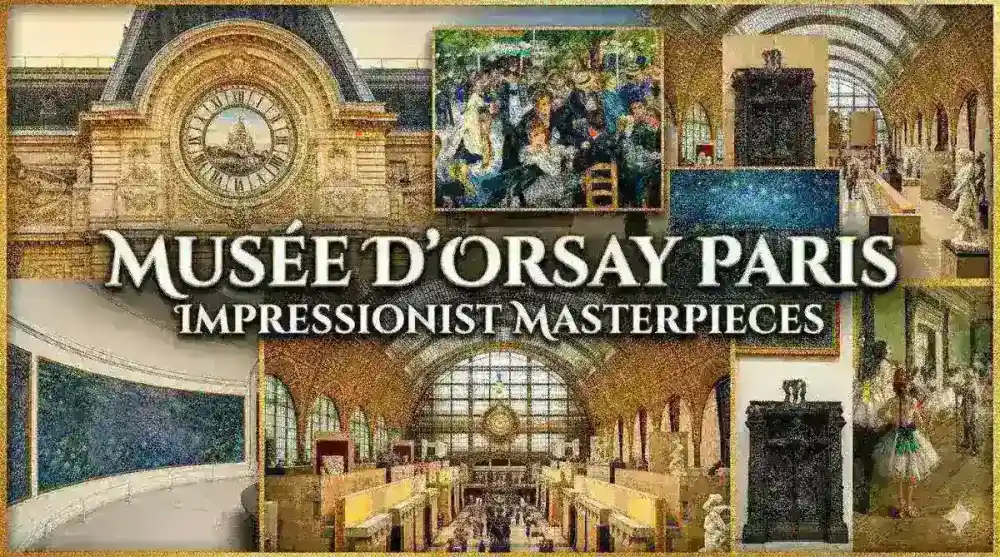
Introduction: Where Art Meets Architecture in the Heart of Paris
Step through the doors of the Musée d'Orsay, and you enter a space where art history and architectural innovation converge in one of the world's most spectacular museum settings. Housed in the magnificent Beaux-Arts shell of the former Gare d'Orsay railway station, this extraordinary museum contains the world's finest collection of Impressionist and Post-Impressionist masterpieces, displayed within a luminous nave that once echoed with the sounds of steam engines and departing travelers.
Opened to the public in 1986 after a remarkable transformation designed by the Italian architect Gae Aulenti, the Musée d'Orsay represents a triumph of adaptive reuse – the conversion of a threatened historic building into a world-class cultural institution. The result is a museum experience unlike any other: Impressionist paintings by Monet, Renoir, Degas, and Van Gogh displayed beneath a soaring glass-vaulted ceiling; sculptures by Rodin and Carpeaux positioned along grand ceremonial staircases; and the famous giant clock face offering one of Paris's most romantic views over the Seine and Montmartre.
For art lovers, the Musée d'Orsay is essential pilgrimage territory. This is where you encounter the revolutionary works that changed the course of art history: Monet's shimmering Water Lilies, Renoir's joyful Bal du moulin de la Galette, Van Gogh's intense self-portraits and Starry Night Over the Rhône, Degas's graceful ballet dancers, and Cézanne's groundbreaking compositions that paved the way for modern art. These are not merely famous paintings; they are works that challenged artistic conventions, captured fleeting moments of light and life, and continue to move viewers more than a century after their creation.
This comprehensive guide explores every aspect of the Musée d'Orsay: the fascinating history of the building itself, the masterpieces that define its collection, the architectural features that make visiting such a unique experience, and practical information for planning an unforgettable visit. Whether you're a first-time visitor to Paris or a seasoned art enthusiast returning to revisit beloved works, you'll discover why the Musée d'Orsay remains one of the world's most beloved and essential museums.
From Railway Station to Art Temple: The Building's Remarkable History

To fully appreciate the Musée d'Orsay, one must understand the extraordinary story of the building that houses it. The museum's setting is not merely a backdrop for art; it is an integral part of the experience, a masterpiece of Beaux-Arts architecture that tells its own story of innovation, decline, and rebirth.
The Gare d'Orsay: A Belle Époque Masterpiece
The building that now houses the Musée d'Orsay was originally constructed as the Gare d'Orsay, a railway station built for the 1900 Exposition Universelle (World's Fair) in Paris. Designed by the architects Victor Laloux, Lucien Magne, and Émile Bénard, the station was a showcase of Belle Époque engineering and aesthetics, combining modern functionality with ornate Beaux-Arts decoration.
The station served the Paris-Orléans railway line, connecting the capital with southwestern France. Its location on the Left Bank, directly across the Seine from the Tuileries Garden and the Louvre, made it a prestigious gateway to the city. The grand nave, with its soaring glass-and-iron vault spanning 40 meters wide and 138 meters long, was one of the largest interior spaces in Paris, designed to accommodate the steam locomotives of the era while impressing arriving passengers with its scale and beauty.
The station's architecture reflected the optimism and technological confidence of the Belle Époque. Ornate sculptural groups adorned the facade, clock faces marked the passage of time for travelers, and the luminous interior, flooded with natural light through the glass roof, created a sense of grandeur and movement. For four decades, the Gare d'Orsay served as a vital transportation hub, welcoming millions of passengers and symbolizing Paris's status as a modern metropolis.
Decline and Threat
By the mid-20th century, the Gare d'Orsay faced obsolescence. The electrification of France's railway system rendered the station's short platforms unsuitable for modern trains. Passenger service ended in 1939, and the building was repurposed for various uses: a mailing center during World War II, a filming location for Orson Welles's The Trial (1962), and even a temporary auction house.
By the 1970s, the building's future was uncertain. Demolition was seriously considered, and the magnificent structure faced the same fate as many other historic buildings sacrificed to urban development. However, a growing appreciation for 19th-century architecture and the building's extraordinary potential sparked efforts to save it.
Transformation into a Museum
In 1977, the French government decided to transform the Gare d'Orsay into a museum dedicated to 19th-century art, filling a crucial gap between the Louvre's ancient and Renaissance collections and the Centre Pompidou's modern and contemporary holdings. The project was ambitious: preserve the building's historic character while creating a functional, world-class museum space.
The Italian architect Gae Aulenti was commissioned to lead the transformation. Her design genius lay in respecting the building's original architecture while creating intimate gallery spaces within the vast nave. She inserted freestanding pavilions and mezzanines that broke the enormous space into human-scale galleries without obscuring the grandeur of the original structure.
The museum opened in December 1986 to critical acclaim. Visitors were captivated by the juxtaposition of Impressionist masterpieces with the Belle Époque architecture that surrounded them. The giant clock face, once a functional element for travelers, became one of the museum's most iconic features, framing views of Paris and creating a uniquely romantic setting for viewing art.
Architectural Highlights
Today, the Musée d'Orsay's architecture is as much a draw as its collection. Key features include:
- The Grand Nave: The vast central hall, with its glass-vaulted ceiling flooding the space with natural light, creates a luminous setting for sculpture and large-scale paintings
- The Giant Clock: The famous clock face on the upper level offers spectacular views of Paris and has become one of the museum's most photographed features
- The Grand Staircase: The ceremonial staircase, adorned with sculptures, provides a dramatic approach to the upper galleries
- Beaux-Arts Details: Ornate moldings, sculptural groups, and decorative elements throughout the building celebrate the artistry of the Belle Époque
- Adaptive Reuse: The integration of modern museum functions within a historic structure demonstrates how preservation and innovation can coexist
- 👉 Bulgaria Digital Nomad Visa 2026: Income and Application Guide
- 👉 2026 Figure Skating World Championship Prague: Tickets & Hotels Guide
- 👉 Albania vs Croatia 2026: Why Budget Travelers Switch Coasts
Understanding this architectural history enriches the museum experience. Every painting you view is framed not just by a wall but by a building that is itself a work of art, a testament to the creativity and ambition of the era that produced the Impressionist movement.
The Collection: Impressionism and Beyond

The Musée d'Orsay houses the world's most comprehensive collection of Impressionist and Post-Impressionist art, spanning the revolutionary period from approximately 1848 to 1914. This collection tells the story of one of art history's most transformative movements, when artists broke with academic tradition to capture light, movement, and modern life in radically new ways.
The Impressionist Revolution
Impressionism emerged in the 1860s and 1870s as a group of artists rejected the rigid conventions of the French Academy. Rather than painting historical or mythological subjects in polished studio techniques, the Impressionists sought to capture fleeting moments of light and atmosphere, often painting outdoors (en plein air) to observe nature directly.
The movement's name derives from Claude Monet's 1872 painting Impression, Sunrise, which a critic used mockingly to describe the artists' loose, sketch-like technique. The Impressionists embraced the label, and their revolutionary approach – visible brushstrokes, bright colors, emphasis on light over line – changed the course of art history.
Must-See Impressionist Masterpieces
The Musée d'Orsay's Impressionist collection is unparalleled. Essential works include:
Claude Monet: The father of Impressionism is represented by numerous masterpieces. Don't miss the series of Water Lilies paintings, which show Monet's late-career exploration of color and light; his Cathedral of Rouen series, demonstrating his fascination with changing light conditions; and early works like Women in the Garden that established his revolutionary technique.
Pierre-Auguste Renoir: Renoir's joyful celebration of life is captured in Bal du moulin de la Galette, one of the museum's most beloved paintings. This vibrant scene of Parisians dancing in Montmartre captures the spirit of Impressionism: light filtering through trees, figures captured in motion, and a sense of spontaneous joy.
Edgar Degas: Though he rejected the Impressionist label, Degas exhibited with the group and shared their interest in modern life. His ballet dancers – painted, sculpted, and drawn – capture movement and grace with unmatched sensitivity. Don't miss The Dance Class and Little Dancer Aged Fourteen, his controversial sculpture of a young ballet student.
Édouard Manet: A pivotal figure who bridged Realism and Impressionism, Manet challenged artistic conventions with works like Olympia and Le Déjeuner sur l'herbe. His bold compositions and modern subjects paved the way for the Impressionist revolution.
Camille Pissarro and Alfred Sisley: These dedicated Impressionists captured the French countryside and urban scenes with sensitivity to light and atmosphere. Their landscapes demonstrate the movement's commitment to painting directly from nature.
Post-Impressionism: Beyond Impressionism
The museum's collection extends beyond Impressionism to encompass the diverse movements that followed, collectively known as Post-Impressionism. These artists built on Impressionist innovations while pursuing more personal, expressive, or structural approaches to art.
Vincent van Gogh: The Musée d'Orsay holds the world's largest collection of Van Gogh paintings. Essential works include his intense Self-Portrait, the swirling Starry Night Over the Rhône, the vibrant Bedroom at Arles, and the poignant Church at Auvers-sur-Oise. Van Gogh's expressive brushwork and emotional intensity represent a radical departure from Impressionist objectivity.
Paul Cézanne: Cézanne's methodical exploration of form and structure influenced the development of Cubism and modern art. His landscapes of Mont Sainte-Victoire, still lifes, and card players demonstrate his revolutionary approach to representing three-dimensional space on a two-dimensional surface.
Paul Gauguin: Gauguin's search for primal authenticity led him from Brittany to Tahiti, where he created some of his most famous works. His bold colors, flattened forms, and symbolic subjects represent a move toward abstraction and symbolism.
Georges Seurat and Pointillism: Seurat's scientific approach to color and light resulted in Pointillism, a technique using tiny dots of pure color that blend in the viewer's eye. A Sunday Afternoon on the Island of La Grande Jatte (a study for the famous Chicago painting) demonstrates this meticulous technique.
Henri de Toulouse-Lautrec: Toulouse-Lautrec's posters and paintings of Parisian nightlife capture the energy and decadence of fin-de-siècle Paris. His portraits of dancers, singers, and prostitutes are both documentary and deeply empathetic.
Sculpture: The Three-Dimensional Revolution
The Musée d'Orsay's sculpture collection is equally impressive, featuring works that paralleled the innovations of Impressionist painting. Auguste Rodin, the father of modern sculpture, is represented by major works including The Thinker, The Gates of Hell, and The Burghers of Calais. His expressive, unfinished surfaces challenged academic ideals of polished perfection.
Other notable sculptors include Jean-Baptiste Carpeaux, whose dynamic Ugolino and His Sons demonstrates Romantic energy; Camille Claudel, Rodin's student and collaborator, whose powerful works like The Waltz deserve greater recognition; and Aristide Maillol, whose serene female nudes represent a return to classical ideals.
The museum's sculpture galleries, positioned along the grand nave and ceremonial staircases, create a dialogue between three-dimensional art and the building's architecture, enhancing both.
Navigating the Museum: Layout and Highlights

The Musée d'Orsay's layout can seem daunting at first glance, but understanding its organization helps you make the most of your visit. The museum is arranged chronologically and thematically across three main levels.
Level 0: Ground Floor
The ground floor features art from 1848 to 1870, including Academic painting, Realism, and the early works that led to Impressionism. Key highlights include:
- Realist Masterpieces: Courbet's The Artist's Studio and Burial at Ornans, monumental works that challenged academic conventions
- Barbizon School: Landscapes by Corot, Rousseau, and Millet that influenced the Impressionists
- Early Manet: Works that bridge Realism and Impressionism
- Sculpture Gallery: Major 19th-century sculptures displayed in the grand nave
- 👉 Bulgaria Digital Nomad Visa 2026: Income and Application Guide
- 👉 2026 Figure Skating World Championship Prague: Tickets & Hotels Guide
- 👉 Albania vs Croatia 2026: Why Budget Travelers Switch Coasts
Level 2: Middle Level
The middle level is dedicated to Impressionism, the museum's crown jewel. This is where you'll find the most famous paintings:
- Monet Gallery: Multiple rooms showcasing Monet's evolution from early works to the Water Lilies series
- Renoir Room: Featuring Bal du moulin de la Galette and other joyful masterpieces
- Degas Collection: Ballet dancers, racecourses, and intimate domestic scenes
- Manet and the Impressionists: Works by Morisot, Pissarro, Sisley, and others who defined the movement
- 👉 Bulgaria Digital Nomad Visa 2026: Income and Application Guide
- 👉 2026 Figure Skating World Championship Prague: Tickets & Hotels Guide
- 👉 Albania vs Croatia 2026: Why Budget Travelers Switch Coasts
Level 5: Top Level
The top level features Post-Impressionist art and the famous clock terrace:
- Van Gogh Gallery: An extraordinary collection of the artist's most famous works
- Cézanne Rooms: Landscapes, still lifes, and portraits that influenced modern art
- Gauguin and Symbolism: Works exploring color, symbolism, and non-Western influences
- The Clock Terrace: The iconic clock face offering spectacular views of Paris – a must-visit photo opportunity
- Decorative Arts: Art Nouveau furniture, jewelry, and design objects from the period
- 👉 Bulgaria Digital Nomad Visa 2026: Income and Application Guide
- 👉 2026 Figure Skating World Championship Prague: Tickets & Hotels Guide
- 👉 Albania vs Croatia 2026: Why Budget Travelers Switch Coasts
Strategic Visiting Tips
To maximize your experience:
- Start at the Top: Begin on Level 5 with Post-Impressionism, then work your way down. This avoids crowds and lets you see the most famous works when you're freshest.
- Don't Miss the Clock: Visit the clock terrace early or late to avoid crowds and capture the best light for photos.
- Allow Time for Sculpture: The ground floor sculpture gallery is often overlooked but contains masterpieces in a stunning setting.
- Use the Audio Guide: The museum's audio guide provides valuable context for understanding the art and its historical significance.
- Take Breaks: The museum café on Level 5 offers refreshments with a view, perfect for recharging during a long visit.
- 👉 Bulgaria Digital Nomad Visa 2026: Income and Application Guide
- 👉 2026 Figure Skating World Championship Prague: Tickets & Hotels Guide
- 👉 Albania vs Croatia 2026: Why Budget Travelers Switch Coasts
Practical Visitor Information

Planning your visit to the Musée d'Orsay requires attention to practical details. Here's everything you need to know:
Location and Transportation
Address: 1 Rue de la Légion d'Honneur, 75007 Paris
Metro: Line 12 to Solférino; RER C to Musée d'Orsay
Bus: Lines 24, 63, 68, 83, 84, 94
Walking: The museum is a pleasant 10-minute walk from the Louvre across the Pont Royal bridge
Opening Hours
- Tuesday-Sunday: 9:30 AM - 6:00 PM
- Thursday: Open until 9:45 PM (ideal for evening visits with fewer crowds)
- Monday: Closed
- May 1 and December 25: Closed
- 👉 Bulgaria Digital Nomad Visa 2026: Income and Application Guide
- 👉 2026 Figure Skating World Championship Prague: Tickets & Hotels Guide
- 👉 Albania vs Croatia 2026: Why Budget Travelers Switch Coasts
Admission Prices (2026)
- Full Price: €16
- Reduced Price: €13 (for EU residents under 26, teachers, large families)
- Free Admission: Under 18, EU residents under 26, disabled visitors and one companion, first Sunday of each month (expect large crowds)
- Paris Museum Pass: Accepted; allows skip-the-line entry
- 👉 Bulgaria Digital Nomad Visa 2026: Income and Application Guide
- 👉 2026 Figure Skating World Championship Prague: Tickets & Hotels Guide
- 👉 Albania vs Croatia 2026: Why Budget Travelers Switch Coasts
Tickets and Skip-the-Line Strategies
The Musée d'Orsay is one of Paris's most popular museums, and lines can be long. Strategies to avoid waiting:
- Book Online: Purchase timed-entry tickets in advance at the official website. This is the most reliable way to skip the ticket line.
- Visit Thursday Evening: The museum is open late on Thursdays, and evening hours are typically less crowded.
- Arrive Early or Late: Arrive at opening (9:30 AM) or after 4:00 PM to avoid peak crowds.
- Use the Museum Pass: The Paris Museum Pass includes entry and allows use of the pass-holder entrance.
- Avoid First Sundays: Free admission on the first Sunday of the month draws massive crowds; visit on a paid day if possible.
- 👉 Bulgaria Digital Nomad Visa 2026: Income and Application Guide
- 👉 2026 Figure Skating World Championship Prague: Tickets & Hotels Guide
- 👉 Albania vs Croatia 2026: Why Budget Travelers Switch Coasts
Photography Rules
- Personal Photography: Allowed in permanent collection galleries without flash or tripods
- Temporary Exhibitions: Photography often prohibited; check signage
- Commercial Use: Requires advance permission
- Selfies: Permitted but be mindful of other visitors
- 👉 Bulgaria Digital Nomad Visa 2026: Income and Application Guide
- 👉 2026 Figure Skating World Championship Prague: Tickets & Hotels Guide
- 👉 Albania vs Croatia 2026: Why Budget Travelers Switch Coasts
Facilities and Amenities
- Café: The museum café on Level 5 offers meals and refreshments with views of the galleries
- Restaurant: The elegant Restaurant du Musée d'Orsay, designed by Bruno Gaudin, serves lunch in a stunning Belle Époque setting
- Bookshop: Extensive selection of art books, catalogs, and souvenirs
- Cloakroom: Free coat and bag check required for large bags
- Accessibility: Wheelchair accessible; elevators serve all levels; wheelchairs available for loan
- 👉 Bulgaria Digital Nomad Visa 2026: Income and Application Guide
- 👉 2026 Figure Skating World Championship Prague: Tickets & Hotels Guide
- 👉 Albania vs Croatia 2026: Why Budget Travelers Switch Coasts
Enhancing Your Visit: Tips for Art Lovers

To deepen your appreciation of the Musée d'Orsay's collection, consider these strategies:
Focus on Themes
Rather than trying to see everything, choose a theme for your visit:
- Light and Color: Follow the evolution of Impressionist technique from Monet's early works to his late Water Lilies
- Modern Life: Explore how artists captured Parisian society, from Degas's ballet to Toulouse-Lautrec's cabarets
- Nature and Landscape: Compare Barbizon School landscapes with Impressionist and Post-Impressionist interpretations
- Portraiture: Observe how approaches to portraiture evolved from Academic realism to Van Gogh's expressive intensity
- 👉 Bulgaria Digital Nomad Visa 2026: Income and Application Guide
- 👉 2026 Figure Skating World Championship Prague: Tickets & Hotels Guide
- 👉 Albania vs Croatia 2026: Why Budget Travelers Switch Coasts
Use the Audio Guide
The museum's audio guide (€5) provides valuable context for understanding the art, artists, and historical period. It's particularly helpful for understanding the revolutionary techniques and subjects that defined Impressionism.
Take a Guided Tour
Guided tours (available in multiple languages) offer expert insights and help you navigate the collection efficiently. Themes include Impressionist highlights, architecture and art, and women artists of the period.
Don't Rush
The Musée d'Orsay rewards contemplation. Rather than rushing to check off famous paintings, spend time with works that speak to you. Notice brushstrokes, color choices, and compositional decisions. Consider what the artist was trying to capture and how they achieved it.
Visit the Clock Terrace
The famous clock face on Level 5 offers one of Paris's most romantic views. Frame the Seine, Sacré-Cœur, and Montmartre through the clock's numerals for an unforgettable photo. Visit early or late to avoid crowds.
Conclusion: A Timeless Encounter with Artistic Revolution

The Musée d'Orsay offers more than a collection of famous paintings; it offers an immersive journey into one of art history's most revolutionary periods. Within the luminous nave of a former railway station, you encounter the works that changed how we see the world: Impressionist masterpieces that capture fleeting moments of light and life, Post-Impressionist innovations that paved the way for modern art, and sculptures that challenged traditional notions of form and beauty.
But the museum's magic lies not just in its collection but in its setting. The Beaux-Arts architecture of the former Gare d'Orsay creates a dialogue between past and present, between the Belle Époque optimism that produced both the station and the Impressionist movement, and our contemporary appreciation for their achievements. Walking through these galleries, you're not just viewing art; you're experiencing a carefully choreographed encounter with history, beauty, and human creativity.
For first-time visitors to Paris, the Musée d'Orsay is essential – a manageable alternative to the overwhelming scale of the Louvre, with a focused collection that tells a coherent and compelling story. For returning visitors, it offers the pleasure of revisiting beloved works and discovering new favorites in a setting that never ceases to inspire.
As you plan your visit, remember that the Musée d'Orsay is not just a place to see famous paintings; it's a place to understand how art evolves, how artists challenge conventions, and how moments of creative revolution continue to resonate across time. Whether you're captivated by Monet's shimmering water lilies, moved by Van Gogh's intense self-portraits, or inspired by the architectural beauty of the building itself, the Musée d'Orsay offers an unforgettable encounter with artistic genius.
So step through the doors, climb the grand staircase, and let the masterpieces of Impressionism and Post-Impressionism transport you to a world where light, color, and life itself became the subjects of art. In the luminous galleries of the Musée d'Orsay, you'll discover why these paintings continue to move viewers more than a century after their creation – and why this extraordinary museum remains one of Paris's most treasured cultural institutions.
0 Comments