.webp)
.webp)
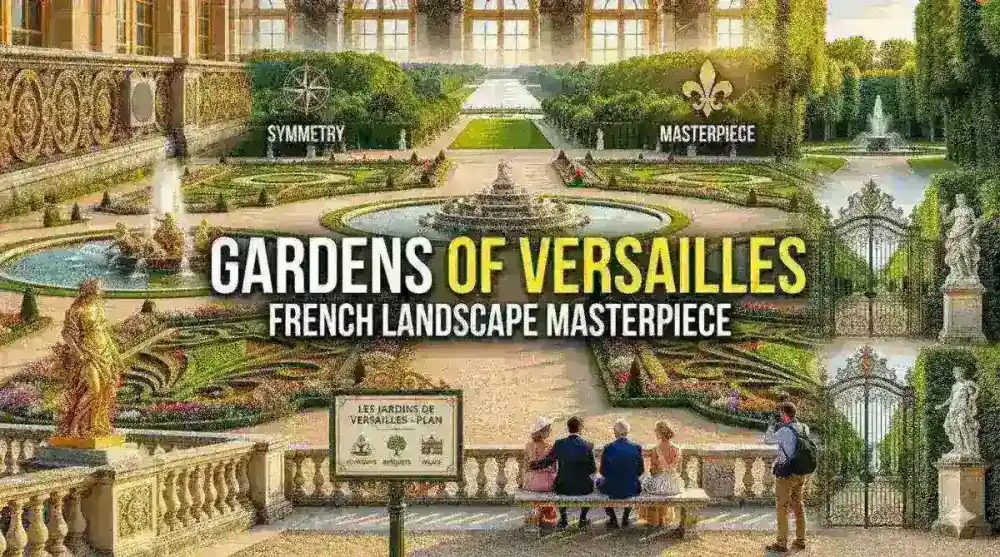
Introduction: Nature Perfected by Human Genius
The Gardens of Versailles represent one of humanity's most ambitious attempts to impose order on nature, transforming marshy, uneven land into the most spectacular formal gardens the world had ever seen. Spanning over 800 hectares (nearly 2,000 acres), these gardens are not merely a complement to the Palace of Versailles but a masterpiece in their own right – a living work of art that demonstrates the absolute mastery of landscape architecture, hydraulic engineering, and symbolic design.
Created primarily by André Le Nôtre between 1661 and 1700 for Louis XIV, the Gardens of Versailles became the model for formal garden design across Europe. From Schönbrunn in Vienna to Peterhof in Russia, from Hampton Court in England to Caserta in Italy, monarchs and nobles sought to emulate Le Nôtre's vision, making the French formal garden style the international standard for aristocratic landscapes.
But the Gardens of Versailles are far more than beautiful scenery. They represent a sophisticated political statement, a demonstration of the Sun King's power to reshape nature itself, and a complex symbolic program that celebrates Louis XIV's glory through every tree, fountain, and pathway. The gardens contain 200,000 trees, 210,000 flowers planted annually, 50 fountains, 600 water jets, and countless sculptures – all arranged according to precise geometric principles that create vistas of breathtaking scale and beauty.
This comprehensive guide explores every aspect of the Gardens of Versailles: the genius of André Le Nôtre's design, the engineering marvels that made it possible, the symbolic meaning embedded in every element, the seasonal transformations that keep the gardens perpetually fresh, and practical information for visitors seeking to experience this extraordinary landscape. Whether you're a garden enthusiast, a history buff, or simply someone who appreciates natural beauty shaped by human artistry, you'll discover why the Gardens of Versailles remain the ultimate expression of French landscape design.
André Le Nôtre: The Master Behind the Masterpiece

To understand the Gardens of Versailles, one must first understand the man who created them. André Le Nôtre (1613-1700) was not merely a gardener but a visionary artist, engineer, and mathematician who revolutionized landscape architecture and established the principles of French formal garden design.
A Family Legacy
Le Nôtre came from a distinguished family of gardeners. His grandfather Pierre Le Nôtre had worked on the Tuileries Gardens in Paris, and his father Jean Le Nôtre succeeded him as head gardener of the Tuileries. This family background gave André an intimate understanding of plants, horticulture, and garden design from an early age.
But Le Nôtre's education extended far beyond practical gardening. He studied painting under Charles Le Brun (who would later decorate the Hall of Mirrors), architecture under François Mansart, and mathematics and perspective – knowledge that would prove crucial to his revolutionary approach to landscape design.
The Visionary Approach
What set Le Nôtre apart from his predecessors was his ability to think on a monumental scale while maintaining perfect proportion and harmony. He understood that gardens should not merely decorate a palace but extend its power and symmetry into the landscape itself. His designs were based on several key principles:
Perspective and Optics: Le Nôtre was a master of forced perspective, using optical illusions to make distances appear greater or lesser than they actually were. He understood how the human eye perceives space and used this knowledge to create vistas that seemed to stretch to infinity.
Geometry and Order: Every element in a Le Nôtre garden was placed according to precise geometric principles. Straight lines, perfect circles, and symmetrical patterns dominated the design, reflecting the 17th-century belief that human reason could and should impose order on nature.
Integration with Architecture: Le Nôtre's gardens were never standalone creations but extensions of the architecture they surrounded. The central axis of the garden aligned perfectly with the palace facade, creating a unified composition where building and landscape became one.
Theatricality: Le Nôtre designed his gardens to be experienced as a sequence of revelations. As visitors moved through the space, new vistas would open up, fountains would surprise them, and carefully framed views would create moments of drama and wonder.
Working at Versailles
When Louis XIV commissioned Le Nôtre to transform the gardens at Versailles in 1661, the site presented enormous challenges. The land was marshy, uneven, and lacked natural water sources. The soil was poor, and the area was prone to flooding. Most gardeners would have been daunted, but Le Nôtre saw opportunity.
He began with massive earth-moving operations, reshaping the land to create the gentle slopes and terraces that characterize the gardens today. He designed an elaborate hydraulic system to bring water from the Seine River and local ponds, constructing reservoirs, aqueducts, and pumps that represented the most advanced hydraulic engineering of the era.
The project employed thousands of workers – at its peak, up to 36,000 men were working on the gardens. Soldiers, peasants, and even convicts labored to move earth, plant trees, and construct fountains. The scale of the operation was unprecedented, reflecting Louis XIV's determination to create gardens that would surpass anything that had come before.
The Grand Design: Layout and Organization

The Gardens of Versailles are organized according to a precise hierarchical system that reflects both aesthetic principles and political ideology. Understanding this layout is essential to appreciating the gardens' full impact.
The Central Axis
Everything at Versailles revolves around the central east-west axis that extends from the palace facade through the gardens to the horizon. This axis is not merely a design element but a statement of royal power – the king at the center, with everything organized around his presence.
From the palace, the axis passes through:
- The Parterre d'Eau: Two large reflecting pools decorated with bronze statues representing the rivers of France
- The Parterre du Midi: Ornamental flower beds with intricate boxwood patterns
- The Latona Fountain: Depicting the goddess Latona protecting her children Apollo and Diana
- The Royal Allée (Tapis Vert): A vast green carpet of lawn stretching 330 meters
- The Apollo Fountain: Showing the sun god rising from the sea in his chariot
- The Grand Canal: A 1.6-kilometer cross-shaped waterway
- 👉 Patras Carnival 2026: Complete Guide to Greece's Biggest Festival
- 👉 First-Time Travelers Guide to Navigating Tallinn Helsinki Ferry Lines
- 👉 ETIAS Czechia 2026: Mandatory Rules for US & UK Citizens
This sequence is not random but tells a story: from Latona (representing Louis XIV's mother Anne of Austria protecting the young king during the Fronde rebellions) to Apollo (representing Louis XIV himself as the Sun King). The entire garden becomes a narrative of royal glory.
The Parterres
Closest to the palace are the parterres – ornamental gardens featuring intricate patterns created with low boxwood hedges, colored gravel, and flowers. These required constant maintenance and were changed seasonally to provide year-round beauty.
The Parterre d'Eau, created in 1674, features two large rectangular pools decorated with bronze statues representing the major rivers of France. These pools reflect the palace facade, creating a stunning visual effect and symbolically bringing the rivers of France to pay homage to the king.
The Parterre du Midi and Parterre du Nord flank the central axis, featuring elaborate broderie (embroidery-like) patterns that could only be fully appreciated from the palace windows above. This design choice emphasized that the gardens were created for the king's pleasure and viewing.
The Bosquets (Garden Groves)
Beyond the formal parterres, Le Nôtre created numerous bosquets – enclosed garden rooms that provided variety and surprise within the overall formal design. Each bosquet had its own theme, character, and hidden pleasures:
The Ballroom Grove (Bosquet de la Salle de Bal): Features a cascading waterfall that created a natural amphitheater for outdoor concerts and dancing. The tiered design allowed spectators to enjoy performances while surrounded by nature.
The Colonnade Grove: A circular peristyle of marble columns surrounding a sculpture of Pluto abducting Proserpina. This elegant space provided a setting for intimate concerts and represented the height of garden architecture.
The Enceladus Grove: Depicts the giant Enceladus buried under rocks, with water jets erupting from beneath – a dramatic representation of the mythological figure's struggle.
The Apollo Baths: A grotto decorated with sculptures and fountains, providing a cool retreat during hot summer days.
The Star Grove (Bosquet de l'Étoile): Features paths radiating from a central point like a star, creating interesting perspectives and hiding places for romantic encounters.
These bosquets demonstrated that French formal gardening could accommodate variety, surprise, and even elements of the picturesque within its overall geometric order. They also provided private spaces where courtiers could escape, however briefly, the constant surveillance of court life.
The Fountains: Engineering Marvels and Artistic Triumphs

The fountains of Versailles represent some of the most elaborate hydraulic engineering and sculptural artistry of the 17th century. They were not merely decorative but served as demonstrations of royal power and technical prowess.
The Hydraulic System
Creating the fountains at Versailles presented enormous technical challenges. The site lacked natural water sources, and the elevation differences made water pressure a constant problem. Le Nôtre worked with hydraulic engineers to create one of the most complex water systems of the era.
The Machine de Marly, built between 1681 and 1684, was designed to pump water from the Seine River to Versailles. This massive installation featured fourteen giant water wheels driving over 250 pumps that lifted water 162 meters up the hill to reservoirs. It was considered one of the wonders of the world, though it was plagued by constant mechanical problems and required a staff of 600 to maintain.
Despite these efforts, water pressure remained insufficient to run all the fountains simultaneously. Louis XIV could only enjoy the full spectacle of all fountains operating for brief periods during special occasions. For most of the time, fountains were turned on only as the king approached, then turned off behind him – a practice that required teams of boys stationed throughout the gardens to signal when the king was approaching.
Major Fountains
The Latona Fountain (Bassin de Latone): Created between 1668 and 1670, this fountain depicts the goddess Latona protecting her children Apollo and Diana from the mocking peasants of Lycia. The sculptural group, by Gaspard Marsy, shows the peasants being transformed into frogs as punishment for their insolence. This was an allegory for the Fronde rebellions, with Louis XIV as Apollo who would one day avenge his mother (Anne of Austria, represented by Latona).
The fountain features multiple tiers with water jets creating dramatic effects. The lower tiers feature frogs and turtles spouting water, while the upper tier shows Latona and her children.
The Royal Allée and Apollo Fountain: The Tapis Vert (Green Carpet) is a vast lawn stretching 330 meters from the Latona Fountain to the Apollo Fountain. This perspective creates a dramatic vista that draws the eye toward the sun god.
The Apollo Fountain (Bassin d'Apollon), created between 1668 and 1671, shows the sun god rising from the sea in his chariot, drawn by four horses. The sculpture, by Jean-Baptiste Tuby, perfectly captures the dynamic movement of the horses and the radiant power of Apollo. This fountain directly references Louis XIV's identification with the sun god and his role as the center of the French universe.
The Grand Canal: Beyond the Apollo Fountain lies the Grand Canal, a massive waterway 1.6 kilometers long and 62 meters wide, shaped like a cross. Created between 1667 and 1679, the canal served multiple functions: it provided a dramatic visual terminus for the garden's central axis, it helped drain the marshy ground, and it served as a venue for naval reviews and festive boating parties.
During Louis XIV's reign, the canal was used for elaborate water spectacles, including mock naval battles and gondola rides (Louis XIV received gondolas as a gift from the Venetian Republic). The canal also helped regulate the garden's water supply, serving as a reservoir for the fountains.
Symbolism and Political Meaning

The Gardens of Versailles were never merely decorative; they were a sophisticated political statement, a visual representation of Louis XIV's absolute power and his vision of France.
The Sun King's Iconography
Louis XIV chose the sun as his personal emblem, and this symbol permeates every aspect of the gardens. Apollo, the Greek sun god, appears repeatedly in sculptures and fountains. The entire garden is oriented on an east-west axis, following the sun's path across the sky.
This solar symbolism served multiple purposes. It identified Louis XIV with divine power (Apollo was not just the sun god but also the god of order, reason, and the arts). It suggested that just as the sun is the center of the universe, Louis XIV was the center of France. And it implied that the king's power, like the sun's light, reached everywhere and gave life to all.
Mythological Programs
The gardens' sculptures and fountains tell a complex mythological narrative that celebrates Louis XIV's reign. The progression from Latona to Apollo tells the story of the king's childhood (protected by his mother during the Fronde) to his glorious adulthood as the Sun King.
Other mythological references reinforce themes of power, victory, and divine right. Hercules appears as a symbol of strength and heroic virtue. Mars represents military prowess. Diana represents the hunt, one of Louis XIV's favorite pastimes. Each sculpture and fountain contributes to an overall program that presents the king as a figure of almost divine power.
Control of Nature
The very design of the gardens – with their perfect geometry, straight lines, and symmetrical patterns – represents the triumph of human reason over wild nature. In the 17th century, this was not just an aesthetic choice but a political statement. Just as Louis XIV imposed order on the French nobility (bringing them to Versailles and subjecting them to elaborate court ritual), he imposed order on nature itself.
The gardens thus become a metaphor for the king's absolute power. The trees are pruned into perfect shapes, the water is forced to dance in precise patterns, and the land itself is reshaped according to human will. This domination of nature mirrored Louis XIV's domination of France and his attempts to dominate Europe.
Seasonal Changes and Maintenance

The Gardens of Versailles are not static monuments but living, changing landscapes that require constant care and attention. The appearance of the gardens changes dramatically with the seasons, and maintaining them is a year-round endeavor.
Spring
Spring is when the gardens truly come alive. The 210,000 flowers planted annually begin to bloom, creating spectacular displays of color in the parterres. The trees leaf out, creating green canopies in the bosquets. The fountains, which are turned off during winter to prevent freeze damage, are turned back on, usually in late March or early April.
Spring is also when the most intensive planting occurs. Teams of gardeners work to plant the annual flowers that will provide color throughout the growing season. The boxwood hedges are trimmed and shaped, and the lawns are repaired and reseeded as needed.
Summer
Summer is peak season for the gardens, with everything in full bloom and the fountains operating daily. This is when the gardens receive the most visitors, and maintenance crews work constantly to keep everything in perfect condition.
The heat and sun require intensive watering – the gardens consume enormous amounts of water during summer months. The lawns must be watered daily, and the flower beds require constant attention to remove spent blooms and encourage continued flowering.
Summer is also when the Musical Fountains Shows (Grandes Eaux Musicales) take place, with the fountains dancing to baroque music on weekends. These spectacular displays require additional maintenance and preparation.
Fall
Fall brings dramatic changes to the gardens. The trees display spectacular autumn colors, particularly in the bosquets where mature specimens create a canopy of gold, red, and orange. The flower beds are gradually cleared as annuals complete their life cycle.
Fall is when the gardens begin to prepare for winter. Tender plants are removed or protected, the fountains are drained to prevent freeze damage (usually in late October), and the gardeners begin planning for the next year's plantings.
Winter
Winter transforms the gardens into a more austere landscape. Without leaves on the trees and flowers in the beds, the underlying structure of the design becomes more visible. The geometric patterns of the parterres, the straight lines of the pathways, and the architectural forms of the sculptures become more prominent.
Winter is when major maintenance and renovation work occurs. Trees are pruned, pathways are repaired, sculptures are cleaned and restored, and planning occurs for the next season. The gardeners also use this time to propagate new plants and prepare the soil for spring planting.
Ongoing Maintenance
Maintaining the Gardens of Versailles is a massive undertaking that requires a staff of over 80 full-time gardeners and numerous seasonal workers. The work includes:
- Tree care: The 200,000 trees require regular pruning, disease monitoring, and eventual replacement. Some trees date back to Louis XIV's era, while others are relatively recent plantings.
- Lawn maintenance: The extensive lawns require regular mowing, watering, fertilizing, and repair. The famous Tapis Vert requires particularly careful maintenance to maintain its perfect green carpet appearance.
- Flower production: The gardens maintain their own nurseries where many of the annual flowers are grown. This ensures a steady supply of healthy plants and allows for precise control over colors and varieties.
- Water system maintenance: The complex hydraulic system requires constant monitoring and repair. Pumps, pipes, and fountains must be maintained to ensure reliable operation.
- Sculpture conservation: The hundreds of sculptures throughout the gardens require regular cleaning, conservation, and occasional restoration to protect them from weathering and pollution.
- 👉 Patras Carnival 2026: Complete Guide to Greece's Biggest Festival
- 👉 First-Time Travelers Guide to Navigating Tallinn Helsinki Ferry Lines
- 👉 ETIAS Czechia 2026: Mandatory Rules for US & UK Citizens
The Gardens' Influence on Landscape Architecture

The Gardens of Versailles did not merely set a standard for French garden design; they influenced landscape architecture across Europe and beyond. For over a century, Le Nôtre's style dominated aristocratic garden design, making the French formal garden the international standard.
European Imitations
Monarchs and nobles throughout Europe sought to emulate Versailles, commissioning gardens designed according to Le Nôtre's principles:
- Schönbrunn Palace, Vienna: The Habsburg emperors created gardens directly inspired by Versailles, complete with parterres, fountains, and a grand axis.
- Peterhof, Russia: Peter the Great, determined to create a "Russian Versailles," built spectacular gardens featuring elaborate fountains and a grand canal overlooking the Gulf of Finland.
- Caserta, Italy: The Bourbon kings of Naples created one of the largest palace complexes in Europe, with gardens stretching over 120 hectares featuring fountains, sculptures, and a grand canal.
- Hampton Court, England: William and Mary commissioned gardens in the French style, though on a more modest scale than Versailles.
- Herrenhausen, Germany: The Electors of Hanover created formal gardens that remain among the finest examples of French-style design in Germany.
- 👉 Patras Carnival 2026: Complete Guide to Greece's Biggest Festival
- 👉 First-Time Travelers Guide to Navigating Tallinn Helsinki Ferry Lines
- 👉 ETIAS Czechia 2026: Mandatory Rules for US & UK Citizens
The Shift to English Landscape Gardens
By the mid-18th century, the French formal style began to fall out of favor, replaced by the English landscape garden movement that emphasized naturalistic, picturesque designs. Critics like Horace Walpole mocked the artificiality of French gardens, and designers like Capability Brown created landscapes that appeared more "natural."
However, even as tastes changed, the influence of Versailles persisted. The English landscape garden movement was, in part, a reaction against French formality, which demonstrates how dominant that style had become. And in the 19th and 20th centuries, there were periodic revivals of formal garden design, with Versailles continuing to serve as the ultimate reference point.
Modern Legacy
Today, the Gardens of Versailles continue to influence landscape architecture and garden design. They remain the ultimate example of formal garden design, studied by students of landscape architecture around the world. The principles of symmetry, perspective, and integration with architecture that Le Nôtre perfected continue to inform contemporary garden design.
The gardens also serve as a reminder of the power of landscape to express political and cultural values. Just as Versailles expressed the absolute power of Louis XIV, modern landscapes express the values and priorities of their creators – whether that's environmental sustainability, social equity, or aesthetic pleasure.
Visiting the Gardens: Practical Information

For visitors planning to experience the Gardens of Versailles, proper preparation can greatly enhance the experience. Here's everything you need to know:
Admission and Tickets
Garden Access:
- Free Days: The gardens are free to visit on days when the Musical Fountains Shows are not running (typically weekdays outside of peak season)
- Musical Gardens: €9.50 on days when the gardens feature music but not fountain shows (typically Tuesdays, Fridays, Sundays, and holidays during high season)
- Musical Fountains Shows: €10.50 on days when the fountains dance to music (typically Saturdays and Sundays during high season, plus some holidays)
- Passport Ticket: €29 includes palace, Trianon estates, and gardens on fountain show days – best value for visitors wanting to see everything
- 👉 Patras Carnival 2026: Complete Guide to Greece's Biggest Festival
- 👉 First-Time Travelers Guide to Navigating Tallinn Helsinki Ferry Lines
- 👉 ETIAS Czechia 2026: Mandatory Rules for US & UK Citizens
Opening Hours
- High Season (April-October): 8:00 AM - 8:30 PM
- Low Season (November-March): 8:00 AM - 6:00 PM
- Gardens open daily year-round, unlike the palace which is closed Mondays
- 👉 Patras Carnival 2026: Complete Guide to Greece's Biggest Festival
- 👉 First-Time Travelers Guide to Navigating Tallinn Helsinki Ferry Lines
- 👉 ETIAS Czechia 2026: Mandatory Rules for US & UK Citizens
Best Time to Visit
Time of Year:
- Spring (April-June): Ideal time with flowers in bloom, fountains operating, and moderate crowds. The gardens are at their most colorful.
- Summer (July-August): Warm weather and daily fountain shows, but expect large crowds. The Musical Fountains Shows on weekends are spectacular but draw big crowds.
- Fall (September-October): Beautiful autumn colors, fewer crowds, pleasant weather. The gardens take on a different but equally beautiful character.
- Winter (November-March): Fewest crowds and free admission on most days, but fountains are off and the gardens are more austere. Good for photography and peaceful walks.
- 👉 Patras Carnival 2026: Complete Guide to Greece's Biggest Festival
- 👉 First-Time Travelers Guide to Navigating Tallinn Helsinki Ferry Lines
- 👉 ETIAS Czechia 2026: Mandatory Rules for US & UK Citizens
Time of Day:
- Early Morning: Arrive at opening (8:00 AM) for the best light, fewest crowds, and most peaceful experience. The morning light creates beautiful reflections in the water features.
- Late Afternoon: Visit after 4:00 PM when crowds begin to thin. The afternoon light creates warm tones and long shadows.
- Avoid: Midday (11:00 AM - 3:00 PM) when crowds are heaviest and the sun is harshest.
- 👉 Patras Carnival 2026: Complete Guide to Greece's Biggest Festival
- 👉 First-Time Travelers Guide to Navigating Tallinn Helsinki Ferry Lines
- 👉 ETIAS Czechia 2026: Mandatory Rules for US & UK Citizens
Getting Around
The gardens are vast – over 800 hectares – and walking from one end to the other can take several hours. Several options make exploration easier:
Walking: Free and allows you to explore at your own pace. Wear comfortable shoes as you'll be walking on gravel, grass, and paved surfaces. Allow at least 3-4 hours to see the main features.
Golf Cart Rental: €18/hour or €30 for 2 hours. Electric carts seat 2-4 people and allow you to cover more ground, especially useful for reaching the Trianon estates. Reservations recommended during peak season.
Little Train: €8.50 for a guided tour of the main garden features. Good for first-time visitors who want an overview, but less flexible than renting a cart.
Bicycle Rental: Available seasonally for those who prefer to pedal. Good exercise but can be challenging on gravel paths.
What to Bring
- Comfortable walking shoes: Essential for navigating gravel paths and grass
- Water and snacks: While there are cafés and vendors, having your own supplies allows you to explore without worrying about finding food
- Sun protection: Hat, sunglasses, and sunscreen – much of the garden is exposed
- Camera: The gardens are spectacular for photography, especially during golden hour
- Map or guidebook: The gardens are complex and easy to get lost in; a map helps you navigate
- Picnic blanket: Picnicking is allowed in designated areas (not on the formal parterres)
- 👉 Patras Carnival 2026: Complete Guide to Greece's Biggest Festival
- 👉 First-Time Travelers Guide to Navigating Tallinn Helsinki Ferry Lines
- 👉 ETIAS Czechia 2026: Mandatory Rules for US & UK Citizens
Must-See Features
If you have limited time, prioritize these features:
- The Parterre d'Eau: The ornamental pools closest to the palace
- The Latona Fountain: One of the most spectacular fountain groups
- The Royal Allée (Tapis Vert): The vast green lawn with views to the Apollo Fountain
- The Apollo Fountain: The dramatic sun god sculpture
- The Grand Canal: The massive waterway that terminates the central axis
- At least 2-3 Bosquets: The Colonnade and Ballroom Grove are particularly impressive
Conclusion: A Living Masterpiece

The Gardens of Versailles represent far more than a beautiful landscape; they are a testament to human creativity, engineering prowess, and the power of vision. André Le Nôtre's masterpiece continues to inspire awe over three centuries after its creation, demonstrating that great art transcends its time.
Walking through these gardens today, one can appreciate not just their beauty but their complexity – the sophisticated hydraulic systems that make the fountains dance, the precise geometry that creates perfect perspectives, the symbolic program that celebrates royal power, and the constant labor required to maintain this living work of art.
The Gardens of Versailles also remind us of the complex relationship between beauty and power, between art and politics. These gardens were created with unlimited resources and forced labor, designed to glorify an absolute monarch and demonstrate his dominance over nature itself. Yet they have outlasted the monarchy that created them, becoming not a symbol of royal power but a universal treasure belonging to all humanity.
For visitors, the Gardens of Versailles offer something for everyone: breathtaking beauty for the casual visitor, horticultural excellence for the gardening enthusiast, engineering marvels for the technically minded, symbolic depth for the historian, and endless inspiration for the artist. Whether you have an hour or a full day, whether you come in spring when the flowers bloom or winter when the structure is revealed, the gardens reward exploration and contemplation.
As you walk through these extraordinary grounds, take time to appreciate not just what you see but what it represents: the pinnacle of French landscape design, a masterpiece of human creativity, and a living monument that continues to evolve while preserving its essential character. The Gardens of Versailles are not frozen in time but are a living, breathing work of art that continues to inspire, educate, and delight visitors from around the world.
In the end, the Gardens of Versailles teach us that true mastery lies not just in creating beauty but in sustaining it, not just in imposing order but in harmonizing with nature, and not just in serving the powerful but in creating something that transcends its origins to become a gift to all humanity. This is the enduring legacy of André Le Nôtre's masterpiece – a legacy that continues to grow, bloom, and inspire more than three centuries after its creation.
0 Comments