.webp)
.webp)
Afghanistan Drone Laws 2026 and Archaeological Filming Permits Guide
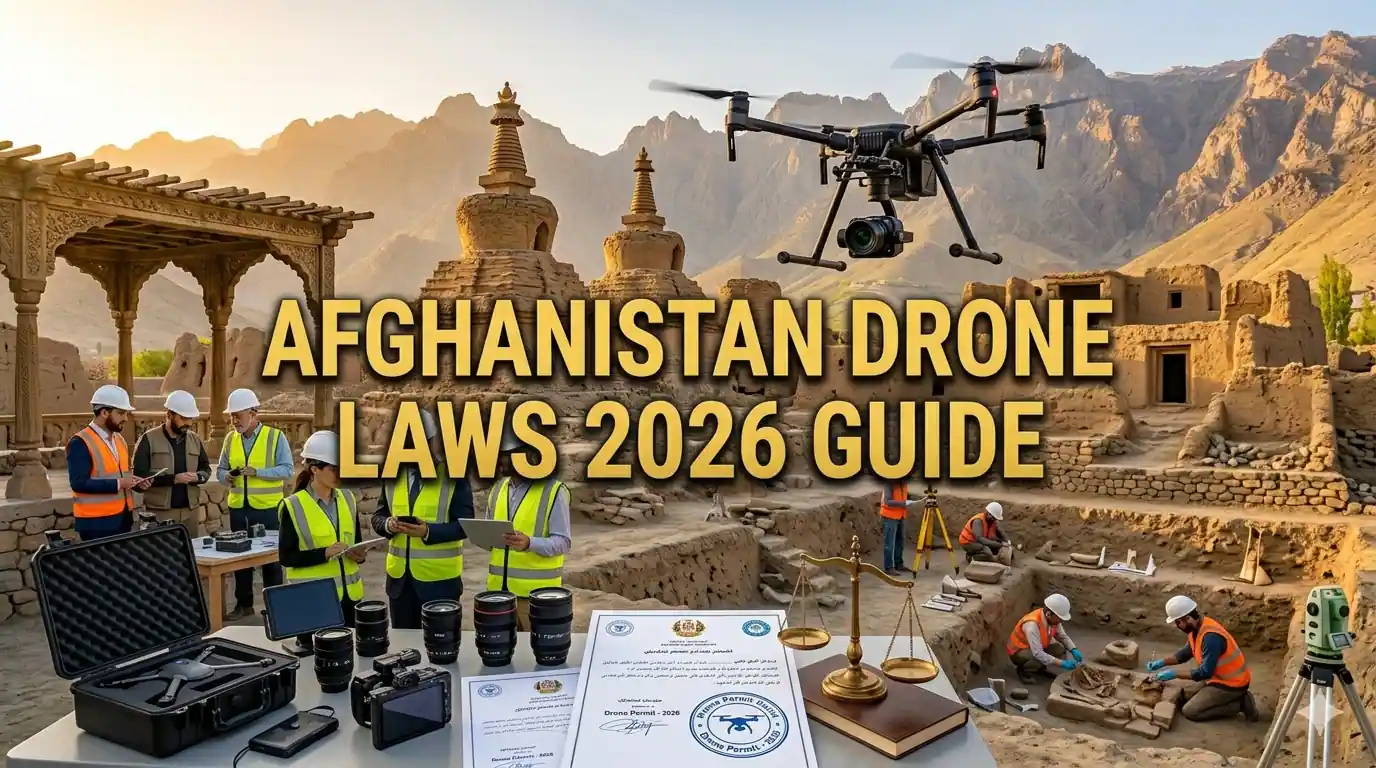
Introduction to Afghanistan Drone Regulations
Afghanistan's drone laws have undergone significant changes following the political transition in 2021.
Archaeological filming with drones now requires navigating complex regulatory frameworks and security considerations.
Understanding current permit requirements is essential for researchers, documentarians, and heritage preservation teams.
This guide provides comprehensive information on legal requirements, application processes, and practical considerations.
Compliance with Afghan regulations protects both operators and the country's invaluable cultural heritage sites.
Current Legal Framework for Drone Operations

Drone operations in Afghanistan are currently governed by the de facto authorities and Civil Aviation regulations.
All unmanned aerial vehicle activities require explicit authorization from multiple government entities.
Archaeological and documentary filming faces additional scrutiny due to cultural heritage protection concerns.
Foreign nationals encounter stricter requirements compared to Afghan citizens and local organizations.
Violations of drone regulations can result in equipment confiscation, detention, and legal prosecution.
Who Controls Drone Regulation in Afghanistan
The Afghanistan Civil Aviation Authority maintains technical oversight of airspace management and drone registration.
The Ministry of Information and Culture reviews and approves archaeological and heritage filming requests.
Security agencies including the Ministry of Interior assess applications for national security implications.
Provincial governors hold authority to grant or deny access to sites within their jurisdictions.
Local community leaders and elders may need to provide consent for operations in their areas.
Types of Drone Operations Requiring Permits
Archaeological survey and documentation projects require comprehensive permits from cultural authorities.
Documentary filmmaking for commercial or educational purposes needs media ministry approval.
Academic research involving aerial photography must demonstrate scholarly credentials and institutional affiliation.
Heritage preservation and conservation projects require coordination with international organizations.
Commercial photography and videography face the most stringent review and highest fees.
Permit Application Process

Securing drone filming permits in Afghanistan involves multiple sequential steps and considerable lead time.
Applications must be submitted well in advance with complete documentation and clear project justification.
Each government entity reviews applications independently creating potential for delays or contradictory decisions.
Local sponsors or fixers significantly improve approval chances and facilitate bureaucratic navigation.
Patience and persistence are essential qualities for successfully completing the permit acquisition process.
Required Documentation
Valid passport copies and visa documentation for all foreign team members must be included.
Detailed project proposal outlining objectives, methodology, and expected outcomes is mandatory.
Equipment specifications including drone make, model, serial numbers, and technical capabilities required.
Letters of support from Afghan academic institutions or cultural organizations strengthen applications.
Proof of professional liability insurance covering drone operations and third party damages needed.
Application Timeline and Fees
Submit applications at least three to six months before intended filming dates.
Standard processing times range from four to twelve weeks depending on project complexity.
Expedited processing may be available for additional fees though not guaranteed.
Permit fees vary from five hundred to five thousand US dollars based on project scope.
Additional charges apply for security escorts, government minders, and site access fees.
Archaeological Filming Specific Requirements

Archaeological drone filming faces heightened scrutiny due to sensitivities around cultural heritage.
Projects must demonstrate clear benefit to Afghan cultural preservation and historical understanding.
International collaborations with recognized universities or heritage organizations receive priority consideration.
Data sharing agreements ensuring Afghan institutions receive copies of all footage are mandatory.
Restrictions may apply to filming at religious sites or locations with contemporary cultural significance.
Protected Heritage Sites
Bamiyan Valley UNESCO World Heritage Site requires special permits from both national and provincial authorities.
Ancient Buddhist monasteries and cave complexes face strict filming limitations to protect fragile remains.
Islamic architectural monuments including mosques and madrasas may restrict drone operations during prayer times.
Archaeological sites in active excavation zones require coordination with field directors and Ministry oversight.
Military sensitive areas near borders or strategic locations are completely off limits to drone operations.
Data Management and Sharing Obligations
All raw footage and processed data must be shared with the Ministry of Information and Culture.
Afghan National Institute of Archaeology receives copies of all archaeological documentation materials.
Publication and distribution rights must be clearly defined in permit agreements before filming begins.
Digital archives should be deposited with Afghan institutions for long term preservation and access.
Commercial exploitation of archaeological footage requires separate licensing agreements and revenue sharing.
Security Considerations and Restrictions

Security concerns represent the primary barrier to drone operations throughout Afghanistan.
Certain provinces and districts are completely closed to foreign filming teams and drone operations.
Security escorts may be mandatory depending on location and current threat assessments.
Flight altitude and distance restrictions protect against surveillance concerns and airspace violations.
Real time coordination with security forces may be required during all drone operations.
No Fly Zones
Airports and aviation facilities maintain strict no fly zones extending several kilometers in all directions.
Government buildings, military installations, and intelligence facilities are completely prohibited areas.
Border regions within twenty kilometers of international boundaries face severe restrictions.
Urban centers including Kabul, Kandahar, and Herat may have additional local flight limitations.
Religious sites during major ceremonies and gatherings temporarily restrict all aerial operations.
Security Escort Requirements
High risk areas require armed security escorts increasing project costs substantially.
Government appointed minders may accompany filming teams at no direct cost but limit independence.
Security briefings before and after each filming day are mandatory in sensitive locations.
Emergency evacuation plans must be filed with local authorities before commencing operations.
Communication equipment including satellite phones ensures contact in areas without cellular coverage.
Technical Specifications and Equipment Requirements

Drone equipment must meet specific technical standards and registration requirements before operation.
Certain drone models and capabilities face restrictions based on security concerns.
Equipment inspection and verification occurs at entry points and before field deployment.
Battery transport and storage must comply with international aviation dangerous goods regulations.
Backup equipment and repair capabilities are essential given limited local technical support.
Approved Drone Categories
Small drones under two hundred and fifty grams face fewer restrictions but limited capabilities.
Commercial drones between two hundred and fifty grams and twenty five kilograms require full permits.
Large drones exceeding twenty five kilograms face severe restrictions and may be prohibited.
Drones with thermal imaging, night vision, or extended range capabilities require special authorization.
Consumer models from DJI, Autel, and similar manufacturers generally acceptable for approved projects.
Registration and Marking Requirements
All drones must be registered with Afghanistan Civil Aviation Authority before importation.
Registration numbers must be visibly marked on drone fuselage in permanent legible characters.
Import documentation including commercial invoices and technical specifications required at customs.
Temporary import permits allow equipment re export after project completion without duties.
Equipment lists must match exactly what enters and leaves the country to avoid complications.
Insurance and Liability Coverage

Comprehensive insurance coverage is mandatory for all drone operations in Afghanistan.
Standard travel insurance does not cover drone related incidents requiring specialized policies.
Third party liability coverage protects against damage to property or injury to persons.
Equipment insurance covers loss, theft, or damage to expensive drone systems and accessories.
Cultural heritage damage coverage addresses potential harm to archaeological sites and monuments.
Required Coverage Levels
Third party liability minimum of one million US dollars typically required for commercial operations.
Archaeological filming may require higher coverage up to five million dollars for heritage damage.
Equipment coverage should reflect full replacement value including lenses, batteries, and accessories.
Medical evacuation insurance essential given limited healthcare infrastructure in remote areas.
Kidnap and ransom coverage may be recommended for high risk locations and extended projects.
Insurance Documentation
Certificates of insurance must name Afghan government entities as additional insured parties.
Policy documents must be translated into Dari or Pashto for official submission.
Proof of premium payment and active coverage status required before permit issuance.
Insurance company contact information for claims must be provided in permit applications.
Policy exclusions should be reviewed carefully to ensure archaeological operations are covered.
Local Partnerships and Fixer Services

Working with local Afghan partners significantly improves permit approval chances and field operations.
Experienced fixers navigate bureaucratic complexities and facilitate relationships with authorities.
Local academic institutions provide credibility and demonstrate commitment to Afghan scholarship.
Cultural organizations offer context and ensure respectful engagement with heritage sites.
Community leaders grant social license to operate and help resolve local concerns or conflicts.
Finding Reputable Local Partners
Kabul University archaeology and history departments maintain expertise and institutional connections.
Afghan Institute of Archaeology employs professionals experienced in heritage documentation projects.
Local fixer companies specializing in media production understand permit processes and logistics.
International organizations like UNESCO maintain Afghan staff who can provide guidance and introductions.
Professional references and verification of credentials essential before engaging local partners.
Roles and Responsibilities
Local partners assist with permit applications, translations, and government liaison activities.
Fixers arrange transportation, accommodation, and local logistics for filming teams.
Cultural advisors ensure respectful engagement with sites and communities preventing inadvertent offense.
Local camera operators and drone pilots may be required or preferred by authorities.
Clear contracts defining scope, compensation, and expectations prevent misunderstandings.
Cultural Sensitivity and Community Engagement

Respectful engagement with local communities is essential for successful archaeological filming.
Afghanistan's diverse ethnic and religious landscape requires cultural awareness and adaptation.
Community concerns about drone operations must be addressed through dialogue and transparency.
Benefits to local communities including employment and capacity building improve project acceptance.
Cultural protocols around gender, dress, and behavior must be observed by all team members.
Community Consultation Process
Meet with village elders and community leaders before commencing any filming activities.
Explain project goals, methods, and benefits in accessible language through local translators.
Address concerns about privacy, religious sensitivities, and potential impacts on daily life.
Obtain verbal or written consent from community representatives before beginning operations.
Establish grievance mechanisms allowing communities to raise concerns during project implementation.
Gender Considerations
Female team members may face restrictions on movement and interaction in conservative areas.
Mixed gender teams require careful planning to ensure cultural appropriateness and safety.
Female archaeologists and researchers may need female escorts or minders in some locations.
Respect local norms regarding dress, behavior, and gender segregation in public spaces.
Engage female community members through appropriate channels to ensure inclusive consultation.
Post Production and Distribution Requirements

Permit agreements typically include obligations regarding how footage may be used and distributed.
Content review and approval processes may apply before public release of archaeological materials.
Credit and acknowledgment requirements ensure Afghan institutions receive proper recognition.
Revenue sharing arrangements may apply to commercial productions using Afghan cultural heritage.
Archival obligations preserve materials for future research and educational purposes.
Content Review and Approval
Ministry of Information and Culture may require preview of finished products before distribution.
Review periods of thirty to sixty days should be factored into release schedules.
Requested changes must be addressed though appeal processes exist for unreasonable demands.
Educational and academic projects typically face less restrictive review than commercial productions.
Failure to submit materials for review can result in permit violations and future restrictions.
Archival and Access Obligations
High resolution copies of all footage must be deposited with Afghan cultural institutions.
Metadata and documentation describing materials facilitates future research and discovery.
Digital preservation formats ensure long term accessibility as technology evolves.
Access arrangements balance preservation needs with intellectual property and commercial considerations.
Capacity building components may include training Afghan staff in archival management and preservation.
Alternative Approaches and Contingency Planning

Given the challenges of obtaining drone permits, alternative documentation methods should be considered.
Ground based photography and videography can capture many archaeological features effectively.
Existing satellite imagery and aerial photography may suffice for some research objectives.
Collaboration with Afghan institutions already holding permits can provide access opportunities.
Flexible project designs accommodate permit denials or operational restrictions.
Ground Based Documentation
High resolution cameras with telephoto lenses capture details from ground level perspectives.
Photogrammetry from multiple ground angles creates three dimensional models without aerial access.
Terrestrial laser scanning provides precise documentation of architectural features and stratigraphy.
Ground based methods avoid many regulatory hurdles while producing valuable research data.
Combining ground and limited aerial data maximizes documentation quality within constraints.
Remote Sensing Alternatives
Commercial satellite imagery from providers like Maxar offers high resolution aerial views.
Historical aerial photography archives document site conditions before recent conflicts.
LIDAR data may be available from previous surveys though access can be restricted.
Remote sensing analysis can be conducted without entering Afghanistan reducing security risks.
Collaboration with Afghan colleagues enables ground truthing of remotely sensed data.
Current Challenges and Practical Realities

The current political situation in Afghanistan creates significant obstacles for drone filming permits.
International recognition issues complicate visa procurement and legal status for foreign researchers.
Banking restrictions and sanctions affect payment of fees, insurance, and local services.
Security conditions remain volatile in many regions limiting safe access to archaeological sites.
Reduced international presence means fewer resources and support for heritage documentation projects.
Navigating Political Complexities
Engage with current authorities while maintaining ethical standards regarding recognition and legitimacy.
Coordinate with international heritage organizations monitoring Afghan cultural property protection.
Document all permits and approvals carefully to protect against future legal or political challenges.
Maintain professional relationships across political divides to preserve access and collaboration.
Prioritize heritage protection and documentation over political considerations in all decisions.
Financial and Logistical Constraints
International banking sanctions require creative solutions for transferring funds into Afghanistan.
Cash based economy necessitates carrying significant funds creating security risks.
Limited flight options and high costs affect travel budgets and scheduling flexibility.
Accommodation and services may not meet international standards requiring adaptation and preparation.
Contingency funds of thirty to fifty percent accommodate unexpected expenses and delays.
Resources and Support Organizations

Several international organizations provide guidance and support for archaeological work in Afghanistan.
Professional networks facilitate information sharing and collaboration among researchers.
Training programs build local capacity for heritage documentation and preservation.
Funding opportunities exist though competition is intense and requirements stringent.
Staying connected with the Afghan archaeology community ensures access to current information.
International Heritage Organizations
UNESCO maintains programs supporting Afghan cultural heritage protection and documentation.
ICOMOS provides technical expertise and advocacy for archaeological site preservation.
The World Monuments Fund includes Afghan sites on watch lists attracting preservation resources.
International Council of Museums supports Afghan museums and collections management.
Archaeological Institute of America offers resources and networking for Afghanistan researchers.
Professional Networks and Information Sources
Afghanistan Archaeology mailing list shares news, opportunities, and safety information.
Society for American Archaeology and European Association of Archaeologists include Afghanistan specialists.
Academic conferences provide venues for sharing research and building collaborations.
Online forums and social media groups offer real time updates on conditions and regulations.
Embassy cultural affairs sections may provide guidance though capacities are currently limited.
Conclusion and Recommendations

Obtaining drone permits for archaeological filming in Afghanistan requires patience, preparation, and persistence.
Current political and security conditions create substantial challenges that must be carefully assessed.
Local partnerships and cultural sensitivity are essential for successful and ethical operations.
Alternative documentation methods may achieve research objectives with fewer regulatory obstacles.
Prioritizing Afghan heritage protection and capacity building ensures lasting positive impacts.
0 Comments