.webp)
.webp)
Introduction: A Radical Vision for Art and Architecture
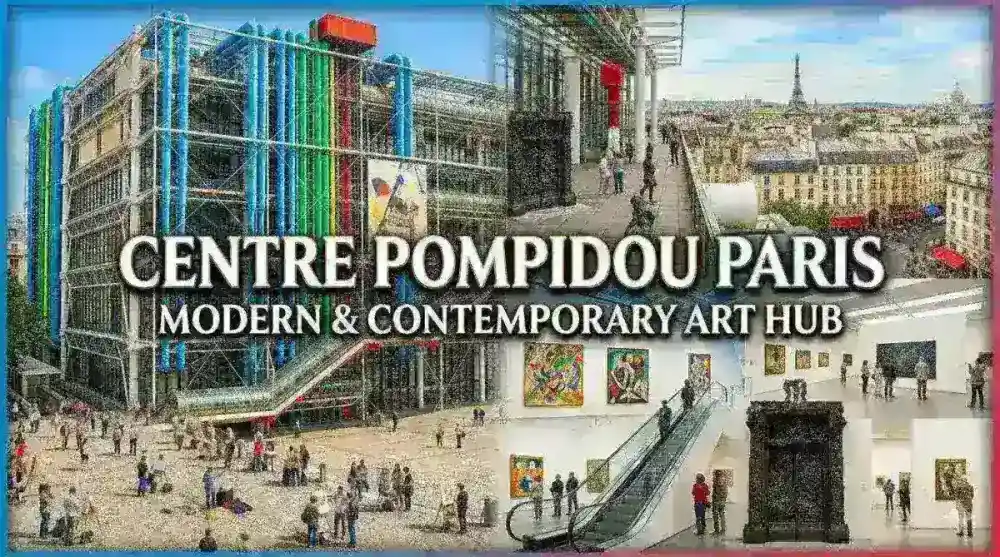
When the Centre Pompidou opened its doors in 1977, it stunned Paris and the art world with a vision so radical, so unconventional, that it divided critics and captivated the public in equal measure. This extraordinary building, with its colorful external pipes, exposed structural elements, and escalators snaking up the facade like a mechanical caterpillar, represented a complete break from traditional museum architecture. More than just a container for art, the Centre Pompidou was conceived as a "cultural factory" – a dynamic, accessible, interdisciplinary space where modern and contemporary art, literature, music, cinema, and research could converge.
Nearly five decades later, the Centre Pompidou remains one of the world's most important institutions for modern and contemporary art. Its collection, the Musée National d'Art Moderne, is the largest in Europe for 20th and 21st-century art, featuring masterpieces by Picasso, Matisse, Kandinsky, Duchamp, Warhol, and countless other artists who defined and redefined artistic expression. But the Centre Pompidou is far more than a repository of famous works; it is a living laboratory for contemporary culture, constantly evolving through groundbreaking exhibitions, innovative programming, and a commitment to making art accessible to all.
Located in the vibrant Beaubourg neighborhood of Paris's 4th arrondissement, the Centre Pompidou occupies a unique position both geographically and culturally. It bridges the historic Marais district with the contemporary energy of Paris's cultural scene, serving as a meeting point for locals and visitors, artists and audiences, tradition and innovation. The building itself – designed by the then-little-known architects Renzo Piano and Richard Rogers – remains as provocative and relevant today as it was at its opening, a testament to the power of visionary architecture to shape cultural experience.
This comprehensive guide explores every aspect of the Centre Pompidou: the revolutionary architecture that redefined museum design, the extraordinary collection that tells the story of modern and contemporary art, the dynamic exhibitions and programs that keep the institution at the forefront of contemporary culture, and practical information for planning an unforgettable visit. Whether you're a modern art enthusiast, an architecture lover, or simply someone curious about one of Paris's most distinctive cultural landmarks, you'll discover why the Centre Pompidou remains an essential destination for anyone interested in the art and ideas that shape our world.
Architecture as Statement: The Inside-Out Building

To understand the Centre Pompidou, one must first understand the radical architectural vision that created it. The building is not merely a setting for art; it is itself a work of art, a bold statement about accessibility, transparency, and the role of culture in contemporary society.
The Competition and Vision
In 1971, French President Georges Pompidou launched an international competition to create a new cultural center in the heart of Paris. The brief was ambitious: a multidisciplinary institution that would house a museum of modern art, a public library, a center for music and acoustic research, and spaces for exhibitions, cinema, and performance. More than 680 architectural firms submitted proposals, making it one of the most competitive architectural competitions in history.
The winning design, by the relatively unknown team of Renzo Piano (Italian) and Richard Rogers (British), along with Gianfranco Franchini, was revolutionary. Rather than creating a traditional museum with art displayed in neutral, inward-facing galleries, Piano and Rogers proposed turning the building inside out. All the functional elements typically hidden within walls – heating and cooling ducts, water pipes, electrical conduits, elevators, and escalators – would be placed on the exterior, color-coded for clarity and creating a vibrant, industrial aesthetic.
The Color-Coded Exterior
The Centre Pompidou's distinctive facade is organized according to a precise color code that reveals the building's inner workings:
- Blue: Air conditioning and climate control systems
- Green: Water circuits and plumbing
- Yellow: Electrical systems and lighting
- Red: Circulation elements – elevators, escalators, emergency exits, and safety features
- 👉 Bansko 2026: Europe's Cheapest Best Value Ski Resort
- 👉 Vatican City Summer Travel Survival Tips 2026
- 👉 Madrid’s Green Lung: A 2026 Guide to Retiro Park and the Shimmering Crystal Palace
This "inside-out" design served multiple purposes. Aesthetically, it created a playful, almost cartoon-like appearance that challenged conventional notions of architectural beauty. Functionally, it freed up interior space for flexible, column-free galleries that could be reconfigured for different exhibitions. Symbolically, it represented transparency and accessibility – the idea that culture should not be hidden behind imposing facades but should be open, visible, and inviting to all.
The Exterior Escalator
One of the building's most iconic features is the transparent exterior escalator that snakes up the western facade. Encased in a glass tube, this escalator offers visitors a unique experience: a slowly ascending panorama of Paris, with views of Sacré-Cœur, Notre-Dame, and the city's rooftops unfolding as you rise. The escalator is not merely functional; it is theatrical, turning the act of entering the museum into a performance and offering a preview of the cultural journey ahead.
Flexible Interior Spaces
Inside, the Centre Pompidou's design prioritizes flexibility. The vast floor plates, free of load-bearing walls, can be reconfigured to accommodate exhibitions of any scale or format. This adaptability has proven crucial for a museum dedicated to contemporary art, where installation requirements vary dramatically from traditional paintings to immersive multimedia installations.
The building's modular design also reflects the interdisciplinary mission of the Centre Pompidou. The Musée National d'Art Moderne occupies the 4th and 5th floors, the Bibliothèque Publique d'Information (Public Information Library) spans floors 1-3, the IRCAM music research center is located underground, and exhibition spaces, cinemas, and performance areas are distributed throughout. This vertical integration encourages visitors to move between different forms of cultural engagement, fostering unexpected connections between art, literature, music, and ideas.
Controversy and Acceptance
When the Centre Pompidou opened in 1977, it was deeply controversial. Many Parisians viewed the building as an industrial eyesore that clashed with the city's historic architecture. Critics mocked it as a "refinery," a "cultural gas station," or worse. Yet the public responded with enthusiasm: in its first year, the Centre Pompidou welcomed over 6 million visitors, far exceeding expectations.
Over time, the building has become beloved, even iconic. Its once-shocking design is now recognized as a masterpiece of High-Tech architecture, and the Centre Pompidou has influenced museum design worldwide. The building's ability to provoke, engage, and ultimately win over skeptics is a testament to the power of bold architectural vision.
The Collection: Musée National d'Art Moderne

At the heart of the Centre Pompidou lies the Musée National d'Art Moderne, which holds the largest collection of modern and contemporary art in Europe. Spanning from 1905 to the present day, the collection tells the story of artistic innovation across more than a century of radical change.
Scope and Significance
The museum's collection includes over 120,000 works by more than 7,000 artists, encompassing painting, sculpture, drawing, printmaking, photography, architecture, design, and new media. This extraordinary breadth allows the museum to present a comprehensive narrative of modern and contemporary art, from the Fauvism and Cubism of the early 20th century to the conceptual art, installation, and digital practices of today.
What sets the Centre Pompidou apart is not just the size of its collection but its curatorial approach. Rather than presenting art chronologically or by movement, the museum emphasizes connections, dialogues, and tensions between different artists, periods, and media. This approach encourages visitors to think critically about art history and to discover unexpected relationships between works.
Essential Artists and Masterpieces
While the collection is vast, certain artists and works are essential viewing for any visitor:
Henri Matisse: The Centre Pompidou holds one of the world's finest collections of Matisse's work, including paintings, sculptures, drawings, and cut-outs. Don't miss The Red Studio, a masterpiece that revolutionized the representation of interior space, and the late cut-outs that demonstrate Matisse's continued innovation into old age.
Pablo Picasso: With over 300 works, the museum's Picasso collection is extraordinary. Key works include Portrait of Gertrude Stein, which bridges his early and Cubist periods; The Accordionist, a major Cubist composition; and numerous works from his Blue and Rose periods.
Wassily Kandinsky: As a pioneer of abstract art, Kandinsky is central to the museum's narrative. His Composition VIII and Improvisations demonstrate his revolutionary belief that color and form could express spiritual and emotional truths independent of representational content.
Marcel Duchamp: The father of conceptual art is represented by key works including Bicycle Wheel and Fountain (a replica of the famous readymade), which challenged fundamental assumptions about what constitutes art.
Francis Picabia and the Dada Movement: The Centre Pompidou's Dada collection is unparalleled, featuring works that embraced absurdity, chance, and anti-art as responses to the trauma of World War I.
Surrealism: Works by André Breton, Max Ernst, Joan Miró, and René Magritte explore the unconscious, dreams, and the irrational, expanding the boundaries of artistic expression.
Abstract Expressionism and Post-War Art: The collection includes major works by Jackson Pollock, Mark Rothko, and European artists like Jean Fautrier and Wols, demonstrating the global spread of abstract art after World War II.
Pop Art and Nouveau Réalisme: Works by Andy Warhol, Roy Lichtenstein, Yves Klein, and Niki de Saint Phalle reflect the engagement with mass culture, consumerism, and the body that characterized art in the 1960s.
Contemporary Practices: The museum actively collects contemporary art, with works by artists like Anselm Kiefer, Sophie Calle, Pierre Huyghe, and many others who continue to push the boundaries of artistic practice.
Beyond Painting: Design, Photography, and New Media
The Centre Pompidou's collection extends far beyond traditional fine art. The museum holds significant holdings in:
- Design: Furniture, industrial design, and graphic design that reflect the evolution of everyday objects and visual culture
- Photography: A comprehensive collection documenting the medium's evolution from documentary to conceptual practices
- Architecture: Models, drawings, and photographs that explore the built environment as artistic practice
- New Media: Video art, digital art, and interactive installations that engage with contemporary technology
- 👉 Bansko 2026: Europe's Cheapest Best Value Ski Resort
- 👉 Vatican City Summer Travel Survival Tips 2026
- 👉 Madrid’s Green Lung: A 2026 Guide to Retiro Park and the Shimmering Crystal Palace
This interdisciplinary approach reflects the Centre Pompidou's founding vision: that art does not exist in isolation but is part of a broader cultural ecosystem that includes design, technology, and everyday life.
Exhibitions and Programming: A Dynamic Cultural Hub

Beyond its permanent collection, the Centre Pompidou distinguishes itself through an ambitious program of temporary exhibitions, performances, screenings, and public events that keep the institution at the forefront of contemporary culture.
Major Temporary Exhibitions
The Centre Pompidou mounts approximately 10-15 major temporary exhibitions each year, ranging from retrospectives of individual artists to thematic surveys of artistic movements or cultural phenomena. Recent exhibitions have included:
- Artist Retrospectives: Comprehensive surveys of figures like Frida Kahlo, Jackson Pollock, or contemporary artists pushing new boundaries
- Thematic Exhibitions: Shows exploring topics like surrealism and politics, art and technology, or the relationship between art and social movements
- Contemporary Focus: Exhibitions dedicated to emerging artists and new artistic practices, ensuring the museum remains engaged with the present moment
- 👉 Bansko 2026: Europe's Cheapest Best Value Ski Resort
- 👉 Vatican City Summer Travel Survival Tips 2026
- 👉 Madrid’s Green Lung: A 2026 Guide to Retiro Park and the Shimmering Crystal Palace
These exhibitions are characterized by rigorous scholarship, innovative installation design, and a commitment to making complex ideas accessible to diverse audiences.
Interdisciplinary Programming
True to its founding mission, the Centre Pompidou offers programming that crosses disciplinary boundaries:
- Cinema: The museum's cinema screens classic and contemporary films, often in dialogue with current exhibitions or thematic programs
- Performance: Dance, theater, and performance art events take place in dedicated spaces, bringing live art into conversation with the visual arts
- Music: The IRCAM (Institut de Recherche et Coordination Acoustique/Musique), located beneath the museum, conducts cutting-edge research in music and sound, with concerts and events open to the public
- Literature and Ideas: Lectures, debates, and readings engage with the intellectual currents that shape contemporary art and culture
- 👉 Bansko 2026: Europe's Cheapest Best Value Ski Resort
- 👉 Vatican City Summer Travel Survival Tips 2026
- 👉 Madrid’s Green Lung: A 2026 Guide to Retiro Park and the Shimmering Crystal Palace
This interdisciplinary approach encourages visitors to make connections between different forms of cultural expression and to see art as part of a broader conversation about society, technology, and human experience.
Public Engagement and Education
The Centre Pompidou is committed to making art accessible to all audiences. Educational programs include:
- Guided Tours: Available in multiple languages, covering highlights of the collection or specific exhibitions
- Workshops: Hands-on activities for children, families, and adults that explore artistic techniques and concepts
- Digital Resources: Online collections, virtual tours, and educational materials that extend the museum's reach beyond its physical walls
- Community Programs: Initiatives designed to engage diverse communities and make the museum a welcoming space for all
- 👉 Bansko 2026: Europe's Cheapest Best Value Ski Resort
- 👉 Vatican City Summer Travel Survival Tips 2026
- 👉 Madrid’s Green Lung: A 2026 Guide to Retiro Park and the Shimmering Crystal Palace
The Surrounding Ecosystem: Library, IRCAM, and Beaubourg

The Centre Pompidou is more than a museum; it is a multidisciplinary cultural complex that integrates multiple institutions and functions.
Bibliothèque Publique d'Information (BPI)
Located on floors 1-3 of the building, the Public Information Library is one of Europe's largest public libraries, with over 2 million documents including books, periodicals, films, and digital resources. The library is free and open to all, embodying the Centre Pompidou's commitment to democratizing access to knowledge.
The BPI's open-stack design allows visitors to browse freely, and its multimedia resources support research across disciplines. For visitors to the museum, the library offers a quiet space for reflection and a resource for deepening understanding of art and culture.
IRCAM: Music and Acoustic Research
Beneath the museum lies IRCAM (Institut de Recherche et Coordination Acoustique/Musique), founded by composer Pierre Boulez in 1977. IRCAM is a world-leading center for research in music, sound, and technology, bringing together composers, scientists, and engineers to explore the frontiers of musical creation.
IRCAM's concerts and events are open to the public, offering a unique opportunity to experience cutting-edge musical practices. The institute's work exemplifies the Centre Pompidou's vision of culture as an interdisciplinary enterprise where art, science, and technology converge.
The Beaubourg Neighborhood
The Centre Pompidou's location in the Beaubourg area of the Marais district enhances its cultural significance. The surrounding neighborhood is one of Paris's most vibrant, with:
- Street Performance: The plaza in front of the Centre Pompidou is a gathering place for street artists, musicians, and performers, creating a lively, democratic cultural space
- Cafés and Restaurants: Numerous dining options range from casual cafés to upscale restaurants, many with terraces overlooking the museum
- Shopping: The Marais is known for its boutiques, vintage shops, and design stores, complementing the Centre Pompidou's focus on creativity and innovation
- Historic Architecture: The contrast between the Centre Pompidou's radical modernism and the Marais's historic buildings creates a dynamic urban dialogue
- 👉 Bansko 2026: Europe's Cheapest Best Value Ski Resort
- 👉 Vatican City Summer Travel Survival Tips 2026
- 👉 Madrid’s Green Lung: A 2026 Guide to Retiro Park and the Shimmering Crystal Palace
Visitors are encouraged to explore the neighborhood before or after their museum visit, experiencing the Centre Pompidou as part of a broader cultural landscape.
Practical Visitor Information

Planning your visit to the Centre Pompidou requires attention to practical details. Here's everything you need to know:
Location and Transportation
Address: Place Georges-Pompidou, 75004 Paris
Metro: Lines 1, 4, 7, 11, 14 to Châtelet; Line 11 to Rambuteau; Line 1 to Hôtel de Ville
RER: Lines A, B, D to Châtelet-Les Halles
Bus: Lines 21, 29, 38, 47, 58, 69, 70, 72, 74, 75, 81, 85, 96
Opening Hours
- Museum (Musée National d'Art Moderne): Wednesday-Monday, 11:00 AM - 9:00 PM; closed Tuesdays
- Exhibitions: Same hours as museum; some exhibitions may have extended hours
- Library (BPI): Wednesday-Monday, 12:00 PM - 10:00 PM; closed Tuesdays and public holidays
- IRCAM: Varies by event; check schedule for concerts and performances
- 👉 Bansko 2026: Europe's Cheapest Best Value Ski Resort
- 👉 Vatican City Summer Travel Survival Tips 2026
- 👉 Madrid’s Green Lung: A 2026 Guide to Retiro Park and the Shimmering Crystal Palace
Admission Prices (2026)
Museum Collection (Permanent Collection):
- Full Price: €15
- Reduced Price: €12 (for EU residents under 26, teachers, large families)
- Free Admission: Under 18, EU residents under 26, disabled visitors and one companion, first Sunday of each month
- 👉 Bansko 2026: Europe's Cheapest Best Value Ski Resort
- 👉 Vatican City Summer Travel Survival Tips 2026
- 👉 Madrid’s Green Lung: A 2026 Guide to Retiro Park and the Shimmering Crystal Palace
Temporary Exhibitions:
- Full Price: €14-16 depending on exhibition
- Combined Ticket: €18-20 for collection + exhibition
- Paris Museum Pass: Accepted for both collection and exhibitions
- 👉 Bansko 2026: Europe's Cheapest Best Value Ski Resort
- 👉 Vatican City Summer Travel Survival Tips 2026
- 👉 Madrid’s Green Lung: A 2026 Guide to Retiro Park and the Shimmering Crystal Palace
Tickets and Skip-the-Line Strategies
The Centre Pompidou is one of Paris's most popular museums, and lines can be long. Strategies to avoid waiting:
- Book Online: Purchase timed-entry tickets in advance at the official website. This is the most reliable way to skip the ticket line.
- Visit Wednesday or Thursday Evening: The museum is open until 9:00 PM, and evening hours are typically less crowded.
- Arrive Early or Late: Arrive at opening (11:00 AM) or after 6:00 PM to avoid peak crowds.
- Use the Museum Pass: The Paris Museum Pass includes entry and allows use of the pass-holder entrance.
- Avoid First Sundays: Free admission on the first Sunday of the month draws massive crowds; visit on a paid day if possible.
- 👉 Bansko 2026: Europe's Cheapest Best Value Ski Resort
- 👉 Vatican City Summer Travel Survival Tips 2026
- 👉 Madrid’s Green Lung: A 2026 Guide to Retiro Park and the Shimmering Crystal Palace
Photography Rules
- Permanent Collection: Photography allowed without flash or tripods
- Temporary Exhibitions: Photography often prohibited; check signage at entrance
- Commercial Use: Requires advance permission
- Selfies: Permitted but be mindful of other visitors
- 👉 Bansko 2026: Europe's Cheapest Best Value Ski Resort
- 👉 Vatican City Summer Travel Survival Tips 2026
- 👉 Madrid’s Green Lung: A 2026 Guide to Retiro Park and the Shimmering Crystal Palace
Facilities and Amenities
- Restaurant: Georges Restaurant on the 6th floor offers dining with panoramic views of Paris; reservations recommended
- Café: Casual café options on lower levels for quick refreshments
- Bookshop: Extensive selection of art books, catalogs, and design objects
- Cloakroom: Free coat and bag check required for large bags
- Accessibility: Wheelchair accessible; elevators serve all levels; wheelchairs available for loan
- Rooftop Terrace: Free access to the top floor for panoramic views of Paris (separate from museum admission)
- 👉 Bansko 2026: Europe's Cheapest Best Value Ski Resort
- 👉 Vatican City Summer Travel Survival Tips 2026
- 👉 Madrid’s Green Lung: A 2026 Guide to Retiro Park and the Shimmering Crystal Palace
Enhancing Your Visit: Tips for Art Enthusiasts

To deepen your appreciation of the Centre Pompidou's collection and programs, consider these strategies:
Start with the Permanent Collection
Begin your visit with the Musée National d'Art Moderne's permanent collection on floors 4 and 5. This allows you to understand the historical trajectory of modern and contemporary art before engaging with temporary exhibitions that may assume this knowledge.
Don't Miss the View
Take time to ride the exterior escalator and visit the rooftop terrace. The panoramic views of Paris provide context for the museum's urban location and offer a memorable conclusion to your visit.
Use the Audio Guide
The museum's audio guide (€5) provides valuable context for understanding the collection, artists, and historical movements. It's particularly helpful for understanding the revolutionary techniques and ideas that defined modern art.
Explore Beyond the Museum
Allow time to explore the library, browse the bookshop, or attend a performance or screening. The Centre Pompidou's interdisciplinary mission rewards visitors who engage with multiple aspects of its programming.
Take Your Time
The Centre Pompidou's collection is vast, and attempting to see everything in one visit can be overwhelming. Focus on artists or movements that interest you most, and allow time for contemplation rather than rushing through galleries.
Conclusion: A Living Laboratory for Contemporary Culture

The Centre Pompidou represents far more than a museum of modern and contemporary art; it is a bold experiment in cultural democratization, interdisciplinary collaboration, and architectural innovation. From its radical "inside-out" design to its comprehensive collection spanning over a century of artistic revolution, from its dynamic exhibition program to its commitment to accessibility and public engagement, the Centre Pompidou continues to challenge, inspire, and provoke.
For visitors, the Centre Pompidou offers an unparalleled opportunity to engage with the art and ideas that have shaped the modern world. Within its flexible galleries, you encounter masterpieces by Picasso, Matisse, Kandinsky, and Duchamp alongside contemporary works that push the boundaries of artistic practice. On its exterior escalator, you ascend above Paris, gaining perspective on the city and the cultural journey ahead. In its surrounding plaza, you witness the democratic energy of street performance and public gathering that embodies the institution's founding vision.
But the Centre Pompidou's greatest achievement may be its enduring relevance. Nearly five decades after its opening, the building remains as provocative and engaging as ever, a testament to the power of visionary architecture to shape cultural experience. Its collection continues to grow and evolve, ensuring that the story of modern and contemporary art remains a living, unfolding narrative. Its programming continues to engage with the pressing questions of our time, from technology and identity to ecology and social justice.
As you plan your visit, remember that the Centre Pompidou is not just a place to see famous paintings; it is a place to encounter the ideas, innovations, and provocations that continue to shape our understanding of art and culture. Whether you're captivated by a Fauvist explosion of color, challenged by a conceptual installation, or inspired by the building's radical architecture, the Centre Pompidou offers an unforgettable encounter with the creative spirit of the modern and contemporary world.
So step into the colorful, mechanical wonder of the Centre Pompidou, ride the escalator up through the heart of Paris, and let the art and ideas within transport you to the frontiers of human creativity. In this extraordinary cultural hub, you'll discover why modern and contemporary art remain vital, provocative, and essential to understanding who we are and who we might become.
0 Comments