.webp)
.webp)
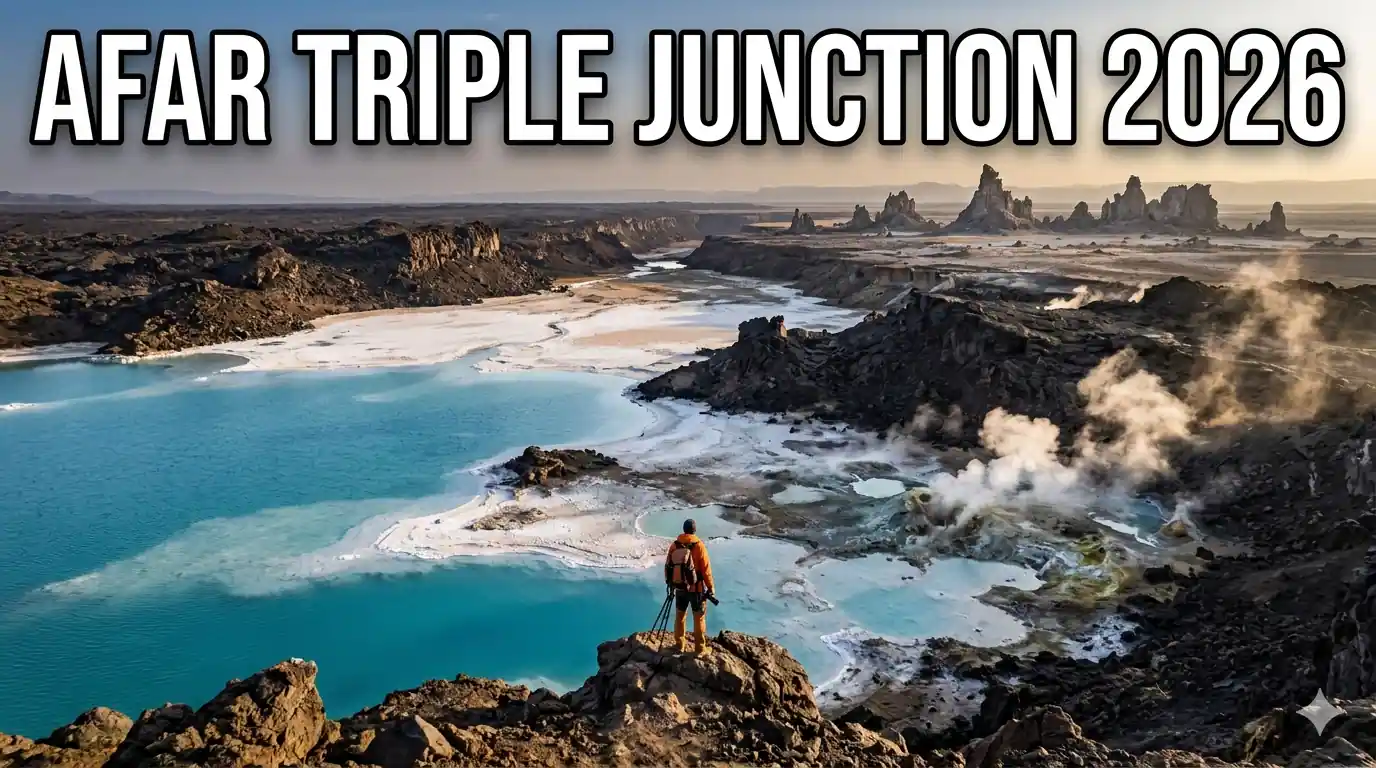
Why 2026 is the Year of Geological Tourism in Djibouti: Exploring the Afar Triple Junction
In the Horn of Africa, where the Earth is literally tearing itself apart, lies one of the planet's most extraordinary geological spectacles. Djibouti sits at the crossroads of three massive tectonic plates—the African, Arabian, and Somali plates—creating the Afar Triple Junction, a rare geological phenomenon visible nowhere else on Earth. In 2026, this unique positioning has catalyzed a new form of travel: geological tourism, where adventurers, scientists, and curious explorers converge to witness the raw forces that shape our planet.
From the turquoise waters of Lake Assal, one of the saltiest bodies of water on Earth sitting 155 meters below sea level, to the otherworldly limestone chimneys of Lake Abbe steaming against the backdrop of the Danakil Desert, Djibouti offers an unparalleled window into Earth's geological processes. The country's dramatic landscapes—volcanic formations, active geothermal features, vast salt flats, and the deepest point in Africa—make it the ultimate destination for understanding plate tectonics, continental rifting, and volcanic activity.
As global interest in geotourism surges and travelers seek meaningful, educational experiences that connect them to Earth's natural processes, 2026 marks a pivotal year for Djibouti. Improved infrastructure, enhanced safety protocols, and growing international recognition position the country as the premier destination for witnessing geological phenomena that typically occur over millions of years—but here, you can see them happening now.
Understanding the Afar Triple Junction: Where Three Plates Collide

The Geological Phenomenon Explained
The Afar Triple Junction represents one of Earth's most dynamic geological settings. Here, three tectonic plates are pulling apart from each other in what geologists call a "triple junction"—the African Plate to the west, the Arabian Plate to the east, and the Somali Plate to the south. This divergent boundary creates a Y-shaped rift system where the Earth's crust is thinning, stretching, and eventually will split entirely, potentially forming a new ocean in millions of years.
The phenomenon occurs because of mantle upwelling—hot material from deep within the Earth rising toward the surface, creating pressure that pushes the plates apart. This process, called continental rifting, is the same mechanism that originally separated Africa from South America millions of years ago. In the Afar region, you're witnessing the birth of a new ocean basin in real-time, making it one of the most significant geological sites on the planet.
Why This Matters for Understanding Earth
The Afar Triple Junction isn't just a geological curiosity—it's a living laboratory that helps scientists understand:
- Continental breakup: How continents split and new oceans form
- Volcanic processes: The relationship between rifting and volcanic activity
- Earthquake mechanics: How stress builds and releases along plate boundaries
- Climate history: How geological changes affect regional and global climate
- Early human evolution: The Afar region is where "Lucy," the famous 3.2-million-year-old hominin fossil, was discovered
- 👉 Kribi Thalassotherapy Centre 2026: Cameroon's Wellness Hub
- 👉 Mount Afadja Peak Hiking Guide for Volta Region Adventures
- 👉 Angola eVisa 2026: 98+ Nationalities Digital Entry
For visitors, this means every landscape tells a story millions of years in the making. The cracked earth, steaming fumaroles, salt-encrusted lakes, and volcanic peaks aren't just scenic—they're evidence of planetary-scale forces at work.
Djibouti's Geological Wonders: A Comprehensive Guide

Lake Assal: Africa's Lowest Point and Saltiest Lake
Lake Assal is the crown jewel of Djibouti's geological attractions and a must-visit destination for any geological tourist. Situated 155 meters (509 feet) below sea level, it holds the distinction of being the lowest point on the African continent and one of the lowest points on Earth's land surface.
Geological significance:
- Salinity: With a salinity level of 34.8% (ten times saltier than seawater), Lake Assal is one of the saltiest bodies of water on Earth, exceeded only by Antarctica's Don Juan Pond
- Formation: The lake formed through volcanic activity and tectonic rifting, creating a closed basin where water evaporates faster than it's replenished, concentrating salts
- Economic importance: The lake contains an estimated 2 billion tons of salt, harvested traditionally by Afar people and exported regionally
- Extreme environment: Temperatures regularly exceed 50°C (122°F), making it one of the hottest places on Earth
- 👉 Kribi Thalassotherapy Centre 2026: Cameroon's Wellness Hub
- 👉 Mount Afadja Peak Hiking Guide for Volta Region Adventures
- 👉 Angola eVisa 2026: 98+ Nationalities Digital Entry
What to see:
- Crystalline salt formations creating surreal white landscapes
- Turquoise-blue waters contrasting dramatically with white salt flats
- Black volcanic rock surrounding the lake
- Traditional salt caravans with camels transporting salt blocks
- Geothermal springs feeding into the lake
- 👉 Kribi Thalassotherapy Centre 2026: Cameroon's Wellness Hub
- 👉 Mount Afadja Peak Hiking Guide for Volta Region Adventures
- 👉 Angola eVisa 2026: 98+ Nationalities Digital Entry
Visitor experience: You can walk on the salt crust (it's solid enough to support your weight), swim in the hypersaline water (you'll float effortlessly), and witness the traditional salt harvesting methods that have continued for centuries. The stark beauty of the landscape—white salt, blue water, black volcanic rock, and golden desert—creates photographic opportunities unlike anywhere else on Earth.
Lake Abbe: The Otherworldly Limestone Chimneys
If Lake Assal showcases the power of evaporation and salinity, Lake Abbe demonstrates the dramatic interplay between geothermal activity and mineral deposition. Located on the Djibouti-Ethiopia border, this alkaline lake features one of the most alien landscapes on the planet.
Geological features:
- Limestone chimneys: Towering formations up to 50 meters (164 feet) tall, created by geothermal springs depositing calcium carbonate and silica over thousands of years
- Steaming fumaroles: Geothermal vents releasing steam and gases, creating an eerie, prehistoric atmosphere
- Alkaline waters: High pH levels and mineral content create vivid colors and support extremophile organisms
- Volcanic backdrop: The lake sits in a volcanic depression surrounded by active and dormant volcanoes
- 👉 Kribi Thalassotherapy Centre 2026: Cameroon's Wellness Hub
- 👉 Mount Afadja Peak Hiking Guide for Volta Region Adventures
- 👉 Angola eVisa 2026: 98+ Nationalities Digital Entry
Why it looks like another planet: The combination of steaming chimneys, barren landscape, alkaline pools, and volcanic terrain makes Lake Abbe resemble scenes from science fiction films. In fact, it's been used as a filming location for movies depicting alien worlds.
Best viewing times: Sunrise and sunset create dramatic lighting as steam rises from the chimneys, casting long shadows and creating an ethereal atmosphere. The temperature extremes—scorching days and surprisingly cool nights—add to the dramatic experience.
The Danakil Depression: Earth's Hottest Inhabited Place
While primarily in Ethiopia, the Danakil Depression extends into Djibouti and represents one of the most geologically active and extreme environments on Earth. This vast desert basin sits below sea level and experiences some of the highest temperatures ever recorded.
Key features accessible from Djibouti:
- Active volcanoes: Including Erta Ale, one of the few lava lakes on Earth
- Salt flats: Vast expanses of salt created by evaporated ancient seas
- Geothermal features: Hot springs, fumaroles, and sulfur deposits
- Colorful mineral deposits: Yellow sulfur, white salt, green copper, and red iron oxides create a painter's palette of colors
- 👉 Kribi Thalassotherapy Centre 2026: Cameroon's Wellness Hub
- 👉 Mount Afadja Peak Hiking Guide for Volta Region Adventures
- 👉 Angola eVisa 2026: 98+ Nationalities Digital Entry
Volcanic Formations and Geothermal Activity
Djibouti's volcanic landscape includes several significant formations that showcase different stages of volcanic activity:
Ardoukoba Volcano: This volcano last erupted in 1978, creating a dramatic fissure that split the Earth and formed new land. The eruption was directly related to rifting activity, providing scientists with valuable data about the relationship between volcanic eruptions and plate tectonics.
Geothermal fields: Throughout Djibouti, you'll find areas where the Earth's heat escapes to the surface through hot springs, steam vents, and fumaroles. These features demonstrate the thin crust and high heat flow characteristic of rift zones.
Why 2026 is the Perfect Year for Geological Tourism in Djibouti

Infrastructure Improvements
After years of development, 2026 marks a turning point for geological tourism in Djibouti:
- Road improvements: Major routes to Lake Assal and Lake Abbe have been upgraded, reducing travel time and improving safety
- Visitor facilities: New interpretation centers, viewing platforms, and basic amenities enhance the visitor experience while protecting fragile geological features
- Accommodation expansion: Eco-lodges and campsites near geological sites provide comfortable bases for exploration
- Communication networks: Improved cellular coverage and emergency services increase safety for independent travelers
- 👉 Kribi Thalassotherapy Centre 2026: Cameroon's Wellness Hub
- 👉 Mount Afadja Peak Hiking Guide for Volta Region Adventures
- 👉 Angola eVisa 2026: 98+ Nationalities Digital Entry
Growing International Recognition
Djibouti's geological significance is gaining global attention:
- UNESCO considerations: Discussions about World Heritage status for the Afar Triple Junction region
- Scientific conferences: International geological symposia held in Djibouti City attract researchers worldwide
- Documentary features: Major nature documentaries highlighting the region's geological importance
- Educational partnerships: Universities establishing field schools for geology and earth sciences students
- 👉 Kribi Thalassotherapy Centre 2026: Cameroon's Wellness Hub
- 👉 Mount Afadja Peak Hiking Guide for Volta Region Adventures
- 👉 Angola eVisa 2026: 98+ Nationalities Digital Entry
Sustainability Initiatives
2026 sees the implementation of comprehensive geotourism management plans:
- Visitor limits: Controlled access to sensitive areas prevents degradation
- Local guide training: Afar and Issa community members trained as geological guides, combining traditional knowledge with scientific understanding
- Conservation funding: Tourism revenue directly supports geological site preservation
- Educational programs: Schools and visitor centers teach about geological processes and conservation
- 👉 Kribi Thalassotherapy Centre 2026: Cameroon's Wellness Hub
- 👉 Mount Afadja Peak Hiking Guide for Volta Region Adventures
- 👉 Angola eVisa 2026: 98+ Nationalities Digital Entry
Planning Your Geological Tourism Adventure

Best Time to Visit
Djibouti's extreme climate requires careful timing for geological tourism:
Optimal season (November-March):
- Temperatures more manageable (25-35°C / 77-95°F)
- Lower humidity
- Clear skies for photography
- Comfortable for extended outdoor exploration
- 👉 Kribi Thalassotherapy Centre 2026: Cameroon's Wellness Hub
- 👉 Mount Afadja Peak Hiking Guide for Volta Region Adventures
- 👉 Angola eVisa 2026: 98+ Nationalities Digital Entry
Shoulder season (April-May, October):
- Hotter but still visitable
- Fewer tourists
- Lower prices
- 👉 Kribi Thalassotherapy Centre 2026: Cameroon's Wellness Hub
- 👉 Mount Afadja Peak Hiking Guide for Volta Region Adventures
- 👉 Angola eVisa 2026: 98+ Nationalities Digital Entry
Avoid (June-September):
- Extreme heat (regularly exceeds 45°C / 113°F)
- High humidity
- Dangerous conditions for outdoor activities
- 👉 Kribi Thalassotherapy Centre 2026: Cameroon's Wellness Hub
- 👉 Mount Afadja Peak Hiking Guide for Volta Region Adventures
- 👉 Angola eVisa 2026: 98+ Nationalities Digital Entry
How to Reach Geological Sites
Getting to Djibouti
- By air: Djibouti-Ambouli International Airport (JIB) receives flights from Addis Ababa, Dubai, Paris, and other major hubs
- By sea: Ferry services from Yemen (though currently limited due to regional conflicts)
- By land: Overland routes from Ethiopia via the Ethio-Djibouti Railway or road
- 👉 Kribi Thalassotherapy Centre 2026: Cameroon's Wellness Hub
- 👉 Mount Afadja Peak Hiking Guide for Volta Region Adventures
- 👉 Angola eVisa 2026: 98+ Nationalities Digital Entry
Reaching Lake Assal
- Distance: 120 kilometers (75 miles) from Djibouti City
- Travel time: 2-3 hours by vehicle
- Road conditions: Paved highway in good condition
- Transportation options:
- Private 4WD vehicle rental
- Guided tour with transportation
- Public bus (limited schedule, basic comfort)
- 👉 Kribi Thalassotherapy Centre 2026: Cameroon's Wellness Hub
- 👉 Mount Afadja Peak Hiking Guide for Volta Region Adventures
- 👉 Angola eVisa 2026: 98+ Nationalities Digital Entry
- 👉 Kribi Thalassotherapy Centre 2026: Cameroon's Wellness Hub
- 👉 Mount Afadja Peak Hiking Guide for Volta Region Adventures
- 👉 Angola eVisa 2026: 98+ Nationalities Digital Entry
Reaching Lake Abbe
- Distance: 250 kilometers (155 miles) from Djibouti City
- Travel time: 5-6 hours by vehicle
- Road conditions: Mix of paved and dirt roads; 4WD essential
- Transportation options:
- Guided tour (recommended for first-time visitors)
- Private 4WD with experienced driver
- Multi-day expedition with camping equipment
- 👉 Kribi Thalassotherapy Centre 2026: Cameroon's Wellness Hub
- 👉 Mount Afadja Peak Hiking Guide for Volta Region Adventures
- 👉 Angola eVisa 2026: 98+ Nationalities Digital Entry
- 👉 Kribi Thalassotherapy Centre 2026: Cameroon's Wellness Hub
- 👉 Mount Afadja Peak Hiking Guide for Volta Region Adventures
- 👉 Angola eVisa 2026: 98+ Nationalities Digital Entry
Sample Geological Tourism Itinerary (7 Days)
Day 1: Arrival and Acclimatization
- Arrive at Djibouti-Ambouli International Airport
- Transfer to hotel in Djibouti City
- Visit the National Museum to understand geological and cultural context
- Rest and acclimatize to climate
- Accommodation: Hotel in Djibouti City
- 👉 Kribi Thalassotherapy Centre 2026: Cameroon's Wellness Hub
- 👉 Mount Afadja Peak Hiking Guide for Volta Region Adventures
- 👉 Angola eVisa 2026: 98+ Nationalities Digital Entry
Day 2: Lake Assal Exploration
- Early departure to avoid midday heat
- Stop at viewpoints along the rift valley
- Arrive at Lake Assal; visit salt harvesting areas
- Walk on salt crust and swim in hypersaline water
- Photograph dramatic landscapes
- Return to Djibouti City or stay at lakeside camp
- Accommodation: Djibouti City or Lake Assal camp
- 👉 Kribi Thalassotherapy Centre 2026: Cameroon's Wellness Hub
- 👉 Mount Afadja Peak Hiking Guide for Volta Region Adventures
- 👉 Angola eVisa 2026: 98+ Nationalities Digital Entry
Day 3: Journey to Lake Abbe
- Early morning departure with 4WD vehicle
- Travel through volcanic landscapes and desert
- Stop at geological points of interest en route
- Arrive at Lake Abbe by afternoon
- First exploration of limestone chimneys
- Sunset photography session
- Accommodation: Camp at Lake Abbe
- 👉 Kribi Thalassotherapy Centre 2026: Cameroon's Wellness Hub
- 👉 Mount Afadja Peak Hiking Guide for Volta Region Adventures
- 👉 Angola eVisa 2026: 98+ Nationalities Digital Entry
Day 4: Lake Abbe Deep Exploration
- Sunrise at the chimneys
- Guided geological tour with expert
- Visit geothermal features and fumaroles
- Understand formation processes
- Afternoon rest during peak heat
- Evening exploration and stargazing
- Accommodation: Camp at Lake Abbe
- 👉 Kribi Thalassotherapy Centre 2026: Cameroon's Wellness Hub
- 👉 Mount Afadja Peak Hiking Guide for Volta Region Adventures
- 👉 Angola eVisa 2026: 98+ Nationalities Digital Entry
Day 5: Return Journey with Stops
- Morning departure from Lake Abbe
- Visit additional volcanic formations
- Stop at traditional Afar villages
- Learn about human adaptation to extreme environments
- Return to Djibouti City
- Accommodation: Hotel in Djibouti City
- 👉 Kribi Thalassotherapy Centre 2026: Cameroon's Wellness Hub
- 👉 Mount Afadja Peak Hiking Guide for Volta Region Adventures
- 👉 Angola eVisa 2026: 98+ Nationalities Digital Entry
Day 6: Ardoukoba Volcano and Geothermal Sites
- Day trip to Ardoukoba volcano
- Explore 1978 eruption site
- Visit geothermal fields
- Understand ongoing rifting processes
- Return to Djibouti City
- Accommodation: Hotel in Djibouti City
- 👉 Kribi Thalassotherapy Centre 2026: Cameroon's Wellness Hub
- 👉 Mount Afadja Peak Hiking Guide for Volta Region Adventures
- 👉 Angola eVisa 2026: 98+ Nationalities Digital Entry
Day 7: Departure or Extension
- Visit local markets for geological souvenirs (salt crystals, minerals)
- Final photography in Djibouti City
- Departure or extend for additional exploration
- 👉 Kribi Thalassotherapy Centre 2026: Cameroon's Wellness Hub
- 👉 Mount Afadja Peak Hiking Guide for Volta Region Adventures
- 👉 Angola eVisa 2026: 98+ Nationalities Digital Entry
Essential Preparation for Geological Tourism

Physical Requirements
Geological tourism in Djibouti demands reasonable fitness:
- Walking: Ability to walk 3-5 kilometers on uneven terrain
- Heat tolerance: Comfort with temperatures exceeding 40°C (104°F)
- Altitude: Most sites are below sea level, but some volcanic areas reach 500-1000 meters
- Endurance: Long days with 6-8 hours of activity
- 👉 Kribi Thalassotherapy Centre 2026: Cameroon's Wellness Hub
- 👉 Mount Afadja Peak Hiking Guide for Volta Region Adventures
- 👉 Angola eVisa 2026: 98+ Nationalities Digital Entry
Packing List for Geological Exploration
Clothing
- Lightweight, breathable fabrics: Linen or moisture-wicking synthetics
- Long sleeves and pants: Sun protection while staying cool
- Wide-brimmed hat: Essential for sun protection
- Sunglasses: UV protection critical in bright, reflective environments
- Sturdy hiking boots: Ankle support for rocky, uneven terrain
- Sandals: For camp and water activities
- 👉 Kribi Thalassotherapy Centre 2026: Cameroon's Wellness Hub
- 👉 Mount Afadja Peak Hiking Guide for Volta Region Adventures
- 👉 Angola eVisa 2026: 98+ Nationalities Digital Entry
Equipment
- High-SPF sunscreen: SPF 50+ recommended
- Reusable water bottles: Minimum 3-liter capacity per person per day
- Camera: With extra batteries (heat drains batteries quickly)
- Binoculars: For viewing distant geological features
- Headlamp: Essential for early morning and evening exploration
- Backpack: Day pack for carrying water and essentials
- 👉 Kribi Thalassotherapy Centre 2026: Cameroon's Wellness Hub
- 👉 Mount Afadja Peak Hiking Guide for Volta Region Adventures
- 👉 Angola eVisa 2026: 98+ Nationalities Digital Entry
Health and Safety
- First aid kit: Including blister treatment, antiseptic, bandages
- Medications: Personal prescriptions plus anti-diarrheal, pain relievers
- Electrolyte supplements: Critical for preventing dehydration
- Insect repellent: DEET-based for malaria prevention
- Travel insurance: Must cover emergency evacuation
- 👉 Kribi Thalassotherapy Centre 2026: Cameroon's Wellness Hub
- 👉 Mount Afadja Peak Hiking Guide for Volta Region Adventures
- 👉 Angola eVisa 2026: 98+ Nationalities Digital Entry
Safety Considerations
Extreme Heat Management
- Hydration: Drink 4-5 liters of water daily minimum
- Timing: Explore early morning and late afternoon; rest during midday heat
- Recognition of heat illness: Know symptoms of heat exhaustion and heat stroke
- Shade: Always carry sun shelter or seek natural shade
- 👉 Kribi Thalassotherapy Centre 2026: Cameroon's Wellness Hub
- 👉 Mount Afadja Peak Hiking Guide for Volta Region Adventures
- 👉 Angola eVisa 2026: 98+ Nationalities Digital Entry
Geological Hazards
- Unstable ground: Salt crust can be thin in places; test before walking
- Geothermal features: Maintain safe distance from hot springs and fumaroles
- Volcanic activity: Monitor alerts; follow guide instructions
- Earthquakes: Region experiences seismic activity; know safety procedures
- 👉 Kribi Thalassotherapy Centre 2026: Cameroon's Wellness Hub
- 👉 Mount Afadja Peak Hiking Guide for Volta Region Adventures
- 👉 Angola eVisa 2026: 98+ Nationalities Digital Entry
Remote Location Preparedness
- Communication: Satellite phone recommended for Lake Abbe expeditions
- Navigation: GPS device and physical maps
- Emergency supplies: Extra food, water, and first aid
- Local guides: Always use experienced guides for remote areas
- 👉 Kribi Thalassotherapy Centre 2026: Cameroon's Wellness Hub
- 👉 Mount Afadja Peak Hiking Guide for Volta Region Adventures
- 👉 Angola eVisa 2026: 98+ Nationalities Digital Entry
Cost Considerations for Geological Tourism

Budget Breakdown (Per Person)
Visa and Entry
- Djibouti eVisa: $50-100 USD depending on nationality and duration
- Park fees: $20-50 USD for protected areas
- 👉 Kribi Thalassotherapy Centre 2026: Cameroon's Wellness Hub
- 👉 Mount Afadja Peak Hiking Guide for Volta Region Adventures
- 👉 Angola eVisa 2026: 98+ Nationalities Digital Entry
Accommodation
- Budget: $30-60 USD per night (basic hotels, campsites)
- Mid-range: $80-150 USD per night (comfortable hotels, eco-lodges)
- High-end: $200+ USD per night (luxury lodges, private camps)
- 👉 Kribi Thalassotherapy Centre 2026: Cameroon's Wellness Hub
- 👉 Mount Afadja Peak Hiking Guide for Volta Region Adventures
- 👉 Angola eVisa 2026: 98+ Nationalities Digital Entry
Transportation
- 4WD rental: $100-200 USD per day (including driver)
- Fuel: $50-100 USD for week-long itinerary
- Guided tours: $150-400 USD per day (including transport, guide, meals)
- 👉 Kribi Thalassotherapy Centre 2026: Cameroon's Wellness Hub
- 👉 Mount Afadja Peak Hiking Guide for Volta Region Adventures
- 👉 Angola eVisa 2026: 98+ Nationalities Digital Entry
Food and Water
- Restaurants: $15-40 USD per day
- Camping meals: $10-20 USD per day
- Bottled water: $5-10 USD per day (essential)
- 👉 Kribi Thalassotherapy Centre 2026: Cameroon's Wellness Hub
- 👉 Mount Afadja Peak Hiking Guide for Volta Region Adventures
- 👉 Angola eVisa 2026: 98+ Nationalities Digital Entry
Guides and Activities
- Geological guide: $100-200 USD per day
- Specialized tours: $200-500 USD for multi-day expeditions
- 👉 Kribi Thalassotherapy Centre 2026: Cameroon's Wellness Hub
- 👉 Mount Afadja Peak Hiking Guide for Volta Region Adventures
- 👉 Angola eVisa 2026: 98+ Nationalities Digital Entry
Total estimated budget (7 days, mid-range): $1,200-2,500 USD per person
Money-Saving Tips
- Travel in groups: Split guide and vehicle costs
- Camping: Reduces accommodation costs significantly
- Local transportation: Use public buses where feasible
- Self-catering: Prepare your own meals when possible
- Shoulder season: Visit April-May or October for lower prices
- 👉 Kribi Thalassotherapy Centre 2026: Cameroon's Wellness Hub
- 👉 Mount Afadja Peak Hiking Guide for Volta Region Adventures
- 👉 Angola eVisa 2026: 98+ Nationalities Digital Entry
The Science Behind the Spectacle: Understanding What You're Seeing

Plate Tectonics in Action
When you stand at the Afar Triple Junction, you're witnessing processes that shaped—and continue to shape—our planet:
Rifting process: As the three plates pull apart at rates of 1-2 centimeters per year, the Earth's crust thins and fractures. This creates the characteristic rift valley topography you see throughout Djibouti. Eventually, in perhaps 10 million years, the Red Sea and Gulf of Aden will merge, flooding the Afar Depression and creating a new ocean that separates the Horn of Africa from the rest of the continent.
Volcanic activity: The thinning crust allows magma to rise more easily to the surface, creating the volcanic features throughout the region. This is why Djibouti has numerous volcanoes, hot springs, and geothermal features.
Salt Formation Processes
Lake Assal's extreme salinity results from a perfect storm of geological conditions:
- Closed basin: No outlet means water can only leave through evaporation
- High evaporation rate: Extreme heat causes rapid water loss
- Seawater intrusion: Underground connections to the Gulf of Tadjoura bring in salt water
- Concentration: As water evaporates, salts become increasingly concentrated
- Crystallization: Eventually, salts precipitate out, forming the spectacular salt formations
- 👉 Kribi Thalassotherapy Centre 2026: Cameroon's Wellness Hub
- 👉 Mount Afadja Peak Hiking Guide for Volta Region Adventures
- 👉 Angola eVisa 2026: 98+ Nationalities Digital Entry
Limestone Chimney Formation
Lake Abbe's iconic chimneys form through a fascinating process:
- Geothermal springs: Hot, mineral-rich water emerges from underground
- Mineral deposition: As water reaches the surface and cools, it deposits calcium carbonate and silica
- Layer by layer: Over thousands of years, these deposits build upward
- Vent closure: Eventually, the spring vent becomes blocked, stopping growth
- Erosion: Wind and water sculpt the chimneys into their current dramatic forms
- 👉 Kribi Thalassotherapy Centre 2026: Cameroon's Wellness Hub
- 👉 Mount Afadja Peak Hiking Guide for Volta Region Adventures
- 👉 Angola eVisa 2026: 98+ Nationalities Digital Entry
Sustainable Geological Tourism: Protecting These Wonders

Leave No Trace Principles
Geological sites are fragile and irreplaceable. Follow these guidelines:
- Stay on designated paths: Prevents erosion and protects delicate formations
- Don't remove rocks or minerals: Every piece tells a geological story
- Pack out all trash: Nothing biodegrades quickly in arid environments
- Respect wildlife: Even extreme environments support life
- Minimize campfire impacts: Use camp stoves instead of wood fires
- 👉 Kribi Thalassotherapy Centre 2026: Cameroon's Wellness Hub
- 👉 Mount Afadja Peak Hiking Guide for Volta Region Adventures
- 👉 Angola eVisa 2026: 98+ Nationalities Digital Entry
Supporting Local Communities
Geological tourism should benefit local populations:
- Hire local guides: Afar and Issa guides possess invaluable traditional knowledge
- Buy local products: Support salt harvesters, craftspeople, and farmers
- Respect cultural sites: Many geological features have cultural significance
- Learn local languages: Basic greetings in Afar or Somali go a long way
- 👉 Kribi Thalassotherapy Centre 2026: Cameroon's Wellness Hub
- 👉 Mount Afadja Peak Hiking Guide for Volta Region Adventures
- 👉 Angola eVisa 2026: 98+ Nationalities Digital Entry
Contributing to Conservation
Your visit can directly support preservation:
- Pay park fees: These fund conservation efforts
- Donate to geological research: Support ongoing scientific studies
- Participate in citizen science: Some programs allow tourists to contribute data
- Educate others: Share what you learn about geological conservation
- 👉 Kribi Thalassotherapy Centre 2026: Cameroon's Wellness Hub
- 👉 Mount Afadja Peak Hiking Guide for Volta Region Adventures
- 👉 Angola eVisa 2026: 98+ Nationalities Digital Entry
Conclusion: Witnessing Earth's Creation Story
Djibouti in 2026 offers something increasingly rare in our modern world: the opportunity to witness planetary-scale processes with your own eyes. The Afar Triple Junction isn't just a destination—it's a classroom, a laboratory, and a testament to the dynamic nature of our planet.
As you stand on the salt crust of Lake Assal, 155 meters below sea level, surrounded by volcanic peaks and feeling the Earth's heat beneath your feet, you'll understand something profound: we live on a living, breathing, constantly changing planet. The landscapes of Djibouti remind us that continents move, oceans form, and the Earth reshapes itself over time.
Geological tourism in Djibouti offers more than stunning photographs and unique experiences. It provides perspective—on Earth's history, on human timescales, and on our place in the natural world. In 2026, with improved infrastructure, growing awareness, and commitment to sustainability, there has never been a better time to explore these extraordinary landscapes.
The Afar Triple Junction waits, patient as the geological processes that formed it. Come witness the birth of an ocean. Come walk where continents divide. Come understand, in the most visceral way possible, that Earth is not static—it's alive, dynamic, and endlessly fascinating.
Your geological adventure in Djibouti awaits.
0 Comments